

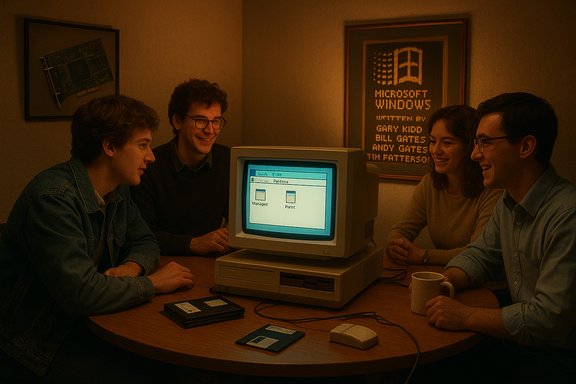
Forty years after a set of 5.25‑inch floppy disks left a factory, the tiny, tiled‑window experiment known as Windows 1.0 has not only inspired decades of computing design but also — thanks to a decades‑old hidden credit buried in its binaries — reunited the people who built it for a long, surprising evening of stories, pranks, technical improvisation, and management rituals that shaped the modern PC era.
Windows 1.0 arrived as an operating environment rather than a full operating system: a graphical shell that ran on top of MS‑DOS and introduced a mouse‑driven interface, tiled windows, and a handful of bundled apps — Notepad, Paint (Paintbrush), Calculator, the MS‑DOS Executive, and a few utilities. The release-to‑manufacturing date widely recorded in archival timelines is November 20, 1985, and the minimum hardware expectations at the time required an Intel 8088‑class CPU, support for CGA/HGC/EGA graphics, two floppy drives (or a hard disk), and 256 KB of RAM for the earliest retail RTM version. Those technical anchors are consistent across contemporary records and encyclopedic summaries. The product that shipped in late 1985 was small by later standards and often criticized for sluggishness and limited third‑party software. Yet it codified a set of metaphors — windows, menus, icons — that persisted and provided Microsoft with a place to iterate, extend, and preserve compatibility for decades. Over time those metaphors matured into platform features that powered mass adoption (Windows 3.x, Windows 95) and enterprise consolidation (Windows NT → XP), culminating in the modern, service‑and‑AI oriented Windows 11 era. The forty‑year retrospective is therefore less about nostalgia and more about tracing design and business choices that still resonate: compatibility, ecosystem scale, and the tradeoffs that come when an OS becomes a global substrate.
Today, Microsoft is again at an inflection — this time around system‑level AI, Copilot integration, and hardware co‑design — and the lessons from the Windows 1.0 era are instructive. They remind us that strategic decisions about compatibility, cadence, and partner economics can accelerate adoption but also create long‑running obligations and governance questions. The reunion’s stories are therefore not just quaint recollections; they are source material for thinking about how to manage platform transitions responsibly at planetary scale.
Source: LinkedIn Windows 1.0, 40 years later: The untold origin story
 Background / Overview
Windows 1.0 arrived as an operating environment rather than a full operating system: a graphical shell that ran on top of MS‑DOS and introduced a mouse‑driven interface, tiled windows, and a handful of bundled apps — Notepad, Paint (Paintbrush), Calculator, the MS‑DOS Executive, and a few utilities. The release-to‑manufacturing date widely recorded in archival timelines is November 20, 1985, and the minimum hardware expectations at the time required an Intel 8088‑class CPU, support for CGA/HGC/EGA graphics, two floppy drives (or a hard disk), and 256 KB of RAM for the earliest retail RTM version. Those technical anchors are consistent across contemporary records and encyclopedic summaries. The product that shipped in late 1985 was small by later standards and often criticized for sluggishness and limited third‑party software. Yet it codified a set of metaphors — windows, menus, icons — that persisted and provided Microsoft with a place to iterate, extend, and preserve compatibility for decades. Over time those metaphors matured into platform features that powered mass adoption (Windows 3.x, Windows 95) and enterprise consolidation (Windows NT → XP), culminating in the modern, service‑and‑AI oriented Windows 11 era. The forty‑year retrospective is therefore less about nostalgia and more about tracing design and business choices that still resonate: compatibility, ecosystem scale, and the tradeoffs that come when an OS becomes a global substrate.Inside the reunion: how an Easter egg became a guest list
The discovery that made the reunion possible
A credit list hidden inside an innocuous bitmap file in Windows 1.0 resurfaced in 2022 when a digital archaeologist reverse‑engineered early Windows binaries and extracted encrypted data that contained developer names, a “congratulations” message, and a roster the team had never expected to be found. That find — widely reported in 2022 and again revisited during the reunion coverage — served as the roster that helped track down original contributors for a 40th‑anniversary dinner hosted in Bellevue. The story of the Easter egg is now corroborated by multiple independent outlets and the archival binary analysis that revealed the data’s intentional obfuscation. Why it mattered beyond nostalgia: the embedded credits were effectively a time capsule that allowed a disparate group of engineers, documenters, and managers to reconnect, correct early impressions, and collectively weigh how small, often improvisational engineering decisions can ripple into decades of platform behavior. The reunion’s attendees included many who went on to notable careers in software, hardware, and adjacent industries — and the moment underscored a rare opportunity to hear candid accounts about the early product under conditions of memory, myth, and selective recollection.Anecdotes, pranks, and the “snicker test”
Reunions with original engineers almost always produce stories that blend technical explanation with personality. The dinner produced several memorable vignettes: a prank that turned off bits on a colleague’s display; Bill Gates’ detail‑level involvement in polishing perceived speed by fiddling with a game timer; and a management ritual Steve Ballmer later called the “snicker test” — a formative technique of repeating an assertion and watching the room’s reaction to see whether the team actually believed it. Such recollections capture a mix of culture and constraints: a scrappy team in their 20s making design choices under severe resource bounds and tight deadlines. These recollections were reported in a contemporary account of the reunion and are presented as first‑hand recollections, not objective secondary evidence.Technical context: what engineers actually had to work with
Memory models, segment limits, and real constraints
It is important to be precise about what “memory limits” meant in the mid‑1980s. The Intel 8086/8088 family used a segmented memory model that effectively constrained contiguous addressable regions to 64 KB per segment. Engineers building an environment like Windows had to marshal code and data across such segments, and that segmentation behavior shaped both APIs and on‑screen memory management strategies. Separately, the earliest retail RTM of Windows 1.0 listed a minimum of 256 KB of RAM in its published system requirements, with later minor releases increasing that baseline. The practical implications were severe: the UI was designed for determinism and predictability (tiled windows rather than arbitrary overlapping windows), conservative graphics algorithms, and drivers that minimized working set sizes. Both the segment architecture and the RAM requirements are well documented in historical technical records. Those constraints explain many of Windows 1.0’s visible design choices. For example, tiled windows reduced the need to copy and redraw arbitrary overlapping regions; banding techniques for printing limited memory pressure when imaging pages; and small, single‑purpose bundled utilities served as usable demos while keeping storage and run‑time footprints minimal. When reunion participants joked about building a functioning environment “under the 64K segment limits,” they were referencing a real, low‑level engineering boundary that shaped algorithms and APIs.Hardware and packaging
Windows 1.0 shipped on multiple 5.25‑inch floppies and expected either two double‑sided floppy drives or a hard disk for practical installation. Graphics modes included CGA, HGC, and EGA depending on the installed adapter, and the product required MS‑DOS 2.0 as the underlying environment. These hardware and storage realities influenced the distribution model, user manuals, and early adoption patterns; shipping on floppy meant real copy‑protection and distribution tradeoffs that later eras of Windows — CD‑ROM and then network distribution — would ultimately remove.The forgotten engineering practices that shaped long‑term outcomes
Pragmatism over perfection
A recurring theme at the reunion, and in technical histories, is that Microsoft prioritized shipping enough of the right stuff, at the right time rather than waiting for a perfect product. That tactical calculus — shipping incremental improvements, preserving compatibility, and accepting a degree of imperfection — became the operating model for Windows for decades. The reunion’s oral recollections confirmed this posture: teams made deliberate tradeoffs to meet schedules and to preserve downstream compatibility with MS‑DOS and third‑party DOS applications. Those choices produced two outcomes: a vast, stable developer ecosystem and a large legacy surface area that would complicate future security and usability decisions.Hidden engineering fingerprints: Easter eggs and artifacts
The existence of embedded, hard‑to‑discover credits highlights an engineer’s desire to leave a human signature inside code. That fingerprint wasn’t meant to be a marketing artifact; it was an insider’s joke and a protective time capsule. That hidden data required reverse‑engineering tools and techniques not widely available at the original release, which explains how it remained undiscovered for decades. The inclusion of such artifacts shows the dual nature of early software development — intensely practical, yet irreversibly human. Contemporary reports of the Easter egg’s discovery in 2022 explain both the discovery mechanics and why it stayed hidden until modern examination.The managerial and cultural story
Young teams, intense schedules, and emergent culture
The Windows 1.0 team was unusually young — many in their 20s and some younger — and the culture of long nights, mashed social and work lives, and playful experiments was central to how work got done. Reunion attendees described an atmosphere closer to a college lab than a formalized engineering organization: improvised driver stacks, long nights debugging, and a strong sense of mission. That culture accelerated iteration but left gaps in formal process, long‑term planning, and documentation — all familiar tradeoffs for high‑velocity product teams. The reunion recollections are consistent with multiple historical accounts of startup‑style engineering at early Microsoft.Leadership rituals that stuck
Steve Ballmer’s “snicker test” — the practice of repeating schedule or status claims back to a group and observing involuntary reactions to detect disbelief or skepticism — was recounted as a management habit formed during that era. As recounted at the reunion, the “snicker test” is less about public shaming and more about a pragmatic truth‑checking technique in fast‑moving projects. It is one of several memorable management practices with long legs; such rituals are part of how early leadership philosophies translate into long‑term organizational culture.Strengths and outcomes: what Windows 1.0 actually delivered
- It established the desktop metaphors — windows, menus, dialogs — that made graphical computing accessible to mainstream PC users.
- It introduced the PC world to a bundled, mouse‑driven workflow and small utilities that illustrated new ways of interacting with software.
- It created a stable API surface and a compatibility ethic that later releases exploited to produce a vast ecosystem of applications and hardware vendors.
- It produced a cohort of engineers and product leaders who shaped future Microsoft efforts and the wider industry.
Risks and tradeoffs exposed by the reunion
Legacy surface area and long tails
The backward‑compatibility posture that served Windows well is now one of its most consequential constraints. Maintaining decades‑old APIs, drivers, and compatibility layers increases the attack surface and complicates security improvements. The reunion's oral history makes clear that many early choices were intentional tradeoffs: shipping with an MS‑DOS compatibility layer preserved software investment, but it also lengthened the chain of implicit dependencies that hardware, enterprise tooling, and applications now assume. Those tradeoffs are visible in modern concerns — from driver model complexity to exploit mitigations that must preserve older behaviors.The cost of incrementalism at scale
Incrementally adding features while preserving old behaviors has economic and engineering costs. The more a platform promises continuity, the greater the burden on engineering to test, validate, and mitigate interactions between old and new components. The reunion underscored how early shortcuts — sensible under resource constraints — can calcify into long‑term maintenance obligations. As Microsoft pivots toward system‑level AI features and Copilot integration, those obligations increase: new agentic behaviors must coexist with legacy assumptions across millions of devices.Mythmaking vs. verifiable history
Reunion stories are valuable but also shaped by selective memory. Many colorful anecdotes — who exactly found the hidden credits by slamming the keyboard, or whether a particular demo was “real code” or smoke‑and‑mirrors — are presented as recollections and should be treated as human testimony rather than archival fact. Contemporary reporting of the reunion balances anecdote and archival verification, but readers should understand the boundary between oral history and independently documented claims. The Easter egg itself is verifiable in binary analysis; the interpretation of certain managerial events or motives is inherently subjective.A short, verifiable timeline (key load‑bearing facts)
- Windows 1.0 announced (project initially called Interface Manager): 1983 (public announcement) and development thereafter.
- Windows 1.0 release to manufacturing (first retail release Windows 1.01): November 20, 1985.
- Hidden credits (Easter egg) discovered in Windows 1.0 binaries: reported publicly in 2022 after reverse‑engineering work revealed an encrypted credit list in a bundled bitmap.
- Reunion and GeekWire coverage: December 2025 reporting of a 40‑year reunion that used the hidden credits as a starting point to locate attendees and record recollections.
Practical takeaways for modern readers, engineers, and IT leaders
- Preserve artifacts: small embedded artifacts can become powerful historical anchors. Engineers and organizations should consider archival practices for code, binaries, and documentation; these are invaluable for future verification, teaching, and cultural memory.
- Understand tradeoffs: shipping early with compatibility in mind can accelerate adoption, but it adds maintenance cost. Teams should balance short‑term shipping goals with long‑term maintenance budgets and explicit technical debt repayment plans.
- Treat oral histories with critical context: first‑hand recollections are rich and instructive but not a substitute for archival verification; combine interviews with preserved artifacts whenever possible.
- For product managers: the “snicker test” is an operational heuristic worth formalizing — capture team reactions to key commitments and document follow‑up actions to resolve skepticism into actionable risk mitigation.
Why this anniversary matters beyond nostalgia
The Windows 1.0 reunion is compelling precisely because it reveals how small engineering decisions, cultural practices, and management heuristics can echo across product lines and decades. The original team’s work created not only a set of UI metaphors but also a playbook for how Microsoft built platform advantage: pragmatic shipping, aggressive compatibility, and close relationships with hardware partners and third‑party developers.Today, Microsoft is again at an inflection — this time around system‑level AI, Copilot integration, and hardware co‑design — and the lessons from the Windows 1.0 era are instructive. They remind us that strategic decisions about compatibility, cadence, and partner economics can accelerate adoption but also create long‑running obligations and governance questions. The reunion’s stories are therefore not just quaint recollections; they are source material for thinking about how to manage platform transitions responsibly at planetary scale.
Conclusion
The hidden credits in Windows 1.0 were more than an amusing historical footnote; they were the spark that brought together a group of engineers and leaders whose choices — made under 64K segment limits, tight RAM constraints, and intense schedules — spelled out the early DNA of a platform that would shape computing for generations. Their reunion, documented in contemporary reporting, illuminates a pragmatic, improvisational era of software development while offering a set of clear lessons about tradeoffs, cultural rituals, and the long tails of technical debt. As the industry faces new platform transitions, those lessons are more useful than ever: a reminder that shipping the right thing at the right time matters, but so does preserving history, verifying claims, and preparing for the maintenance obligations that success inevitably creates.Source: LinkedIn Windows 1.0, 40 years later: The untold origin story
