

Microsoft has quietly admitted what many Windows users have been saying out loud for more than a year: Windows 11 needs repair before it gets any more ambition. In a series of internal shifts and public remarks that surfaced in late 2025 and January 2026, Microsoft’s Windows leadership acknowledged persistent regressions, pledged a year-long focus on performance, reliability and everyday polish, and signaled a tactical change — including device‑gated releases and “swarming” teams — to get there. ps://www.theverge.com/report/787796/microsoft-windows-reorg-single-engineering-team-changes)
Windows 11 shipped with a modernized UI and deep AI integration goals, but that dual pursuit of aesthetics and agentic features coincided with an uptick in user-visible problems: File Explorer sluggishness, inconsistent dark‑mode behavior, update-induced failures, and a perception that AI experiments and promotional nudges were being prioritized over the OS’s fundamentals. The resulting user frustration — especially among Insiders, developers, gamers and enterprise IT —ocal backlash through late 2024, 2025 and into 2026.
Microsoft’s response has three public strands: an acknowledgement from Windows leadership that the feedback is valid, an operational reallocation of engineering resources toward triage and fixes (the internal term “swarming”), and a more cautious release posture that splits platform work across device‑gated branches in 2026. These are strategic moves aimed at restoring trust with a user base that still numbers in the hundreds of mis alternately cited Windows reaching roughly one billion devices and confusion in public metrics, underscoring the scale and importance of any reliability shortfall.
The biggest wildcard is partner coordination. Gaming regressions and driver compatibility are primarily an ecosystem problem; Microsoft can drive incentives and testing requirements, but GPU vendors, OEMs and anti‑cheat middleware must deliver in step. Without tight partner alignment, some fixes will remain partial.
Finally, optics matter. The public tone must shift from boastful AI marketing to transparent, accountable engineering updates. The moment Microsoft pairs the public pledge with verifiable data and fewer emergency fixes, sentiment will shen, users and admins have reason to be cautiously optimistic — hopeful that 2026 can be a year of repair rather than reinvention.
The community will be watching closely; success will be judged not by slogans but by snappy File Explorer windows, fewer update nightmares, and a Windows experience that respects user defaults more than it sells features. If Microsoft manages that, the platform’s scale will once again be an advantage rather than a liability.
Source: filmogaz.com Microsoft Vows Windows 11 Improvements by 2026, Tackling OS Pain Points
 Background / Overview
Windows 11 shipped with a modernized UI and deep AI integration goals, but that dual pursuit of aesthetics and agentic features coincided with an uptick in user-visible problems: File Explorer sluggishness, inconsistent dark‑mode behavior, update-induced failures, and a perception that AI experiments and promotional nudges were being prioritized over the OS’s fundamentals. The resulting user frustration — especially among Insiders, developers, gamers and enterprise IT —ocal backlash through late 2024, 2025 and into 2026. Microsoft’s response has three public strands: an acknowledgement from Windows leadership that the feedback is valid, an operational reallocation of engineering resources toward triage and fixes (the internal term “swarming”), and a more cautious release posture that splits platform work across device‑gated branches in 2026. These are strategic moves aimed at restoring trust with a user base that still numbers in the hundreds of mis alternately cited Windows reaching roughly one billion devices and confusion in public metrics, underscoring the scale and importance of any reliability shortfall.
What broke: the visible pain points that pushed Microsoft to act
File Explorer, micro‑latency and “snappiness” complaints
Small UI hitches add up. Users have reported longer “first paint” times for File Explorer, perceptible delays when switching windows or opening Start, and context‑menu clutter caused by third‑party shell extenser integrations. Those micro‑latencies erode the sense of a snappy, responsive OS and are among the highest‑visibility complaints because they affect every user interaction. Microsoft has already experimented with preloading and caching in Insider builds to attack these issues.Regressions from updates and emergency patches
Several cumulative updates in late 2025 and early 2026 produced high‑impact regressions requiring out‑of‑band remediation. Reporting and community timelines point to a January 13, 2026 cumulative update thated in update notes) and at least one subsequent emergency package intended to address authentication and shutdown problems. These incidents crystallized a fear among admins and power users: applying updates had become a riskier prospect than it used to be.UX polish and small but consequential irritants
e, visual flickers, mixed native/web surfaces in shell components, and intrusive upsells for OneDrive, Edge and Copilot features created a cumulative perception problem. These issues are often low‑risk to fix individually, yet they carry outsized influence on overall sentiment. Microsoft’s public roadmap for 2026 explicitly lists usability polish as a priority area.AI framing and community backlash
Microsoft’s push to make Windows more “agentic” with Copilot integrations and on‑device AI features drew skepticism and, in some cases, outright backlash. Senior messaging about an “agentic OS” and promotional tweets extolling AI benefits were met with sarcasm and criticism from developers and enthusiasts; at least one high‑profile post by Pavan Davuluri saw replies disabled as the tone‑deafness of the messaging compounded existing trust problems. Reporters and local outlets documented the reaction and noted the connection between AI‑first messaging and user frustration around reliability.Microsoft’s public commitment and what it actually entails
The pledge in a sentence
Pavan Davuluri, President of Windows and Devices, summarized the shift succinctly: Microsoft has “heard the feedback” and will prioritize fixes that are meaningful for people — specifically improving system performance, boosting reliability, and enhancing the everyday Windows experience throughout 2026. That language represents a public recommitment, not simply a call for nicer marketing copy.“Swarmingpline triage teams
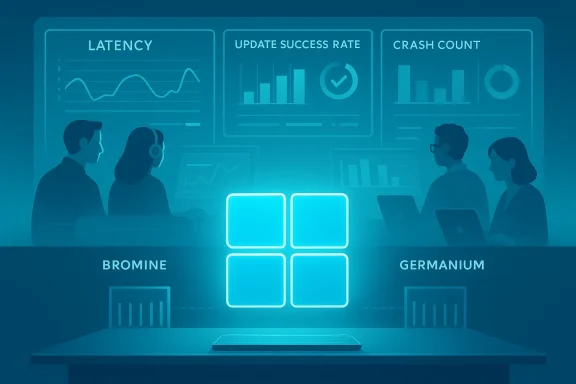
Microsoft plans to use an incident‑response style approach — swarming — where cross‑functional experts (kernel, update servicing, drivers, QA, telemetry) are temporarily concentrated on high‑impact regressions until root causes are fixed. This model accelerates fixes but can deprioritize long‑term validation work unless governance ensures regression controls remain in place. Early Insider experiments, such as targeted performance logging and Explorer preloads, are examples of swarming in practice.Device gating: Bromine (26H1) vs limit risk, Microsoft will split platform work into at least two branches in 2026: a platform‑first spring release (commonly reported as Bromine, or 26H1) aimed at next‑gen Arm and Copilot+ devices, and a broader consumer release (reported as Germanium, 26H2) later in the year for the wider installed base. Device gating reduces the blast radius for low‑level kernel and scheduler changes but introduces lifecycle complexity for enterprises and power users who must manage mixed update surfaces. Reported codenames and timing reflect internal planning and community reconstruction rather than a hard, immutable schedule.
What Microsoft says it will fix in 2026 — and how credible those promises are
Microsoft’s stated priority areas are straightforward and sensible: performaate reliability, day‑to‑day UX polish, gaming stability, and clearer controls for AI/telemetry. The credibility of achieving those goals will depend on three operational realities:- Telemetry and metrics: Microsoft must publish auditable metrics (Explorer latency SLOs, update‑failure rates, mean time‑to‑fix regnon‑essential telemetry noise while preserving the diagnostic fidelity engineers need. Without measurable targets and external validation, promises mean little.
- Partner coordination: Gaming and driver fixes require GPU vendors, anti‑cheat providers and OEMs to cooperate closely on testing and driver certification. These ecosystems are fragmented, and progress hinges on aligned incentives and timelines.
- Release discipline: Swarming works when paired with stricter release controls. Microsoft must slow some feature velocity to maintain test coverage and prevent repeat regressions; otherwise, fixes may be temporary. Early signals — device gating and smaller, targeted rollouts — are promising but not conclusive.
and examples: January 2026 as a micro‑case
January 2026 illustrates both the problem and what Microsoft is trying to fix. Community timelines and reporting document a January 13 cumulative update that introduced several regression symptoms (shutdown failures, Remote Desktop authentication issues, cloud‑storage hangs) and prompte‑band emergency update days later. Those incidents not only caused technical disruption; they eroded confidence in the servicing pipeline — the precise defect the 2026 strategy intends to fix. The expectation now is fewer emergency OOB patches and faster root‑cause remediation when regressions happen.Strengths of Microsoft’s plan — why this could work
- Focused resources: Concentrating senior engineering talent on a prioritizedproblems is the right operational play when trust is eroding. Swarming accelerates fixes and can reduce mean time‑to‑repair for critical regressions.
- Risk containment via device gating: Bromine/Germanium — if executed well — lets Microsoft enable new silicon optimizations without delivering risky low‑level changes to older, vulnerable devices. That reduces the chance of mass regressions affecting the broader install base.
- Clear, user‑centric targets: By explicitly naming system performance, reliability and everyday UX as the year’s priorities, Microsoft sets expectations for a different operational mindset inside Windows engineering. Public accountability — if accompanied by transparent metrics — can rebuild trust.
Risks, trade‑offs and what could go wrong
Fragmentation and lifecycle cing creates a two‑track world in which some users — especially those on new Copilot+ hardware — receive platform changes earlier, while the majority waits. That helps engineering risk but complicates enterprise management, patch orchestration and third‑party compatibility testing. IT teams hate multiple lifecycles; fragmentation can generate its own support costs.
Swarming's short‑termism
Swarming is excellent for quick wins, but it can deprioritize systematic improvements to test automation, long‑running validation suites, and upstream architectural debt. Unless Microsoft simultaneously invests in improved validation tooling and release engineering, fixes may not stick.The optics of AI vs reliability
Microsoft’s AI investments are strategic and lucrative, but continuing to foreground agentic mesliability problems persist will keep trust low. The company must show concrete, measurable reliability improvements before resuming aggressive AI feature pushes at scale. Social backlash to some AI promotional posts — and the disabling of replies on at least one leadership post — shows how sensitive public sentiment is.The measurement problem
Promises mean little without transparent, repeatable metrics. Microsoft will need to publish release‑health data — not just anecdotal fixes — and make it auditable for IT and t If metrics remain opaque, skepticism will persist even if quality improves.What users and admins should do now — practical, tactical advice
- For home users and power users:
- Defer non‑security feature updates for a short period after Microsoft’s broad rotem snapshots or a restore point before major updates.
- Prune unnecessary context‑menu extensions and third‑party shell hooks to reduce Explorer friction.
- Opt into Insider builds only if you want to help test early fixes; otherwise, remain on Release Preview or stable channels.
- For IT administrators:
- Keep a staged ring strategy: pilot → broad pilot → general deployment; validate critical apps and drivers during each stage.
- Use Enhanced telemetry in a controlled pilot to capture reproducible traces (with user consent) that can help Microsoft or OEMs triage issues faster.
- recovery plans; consider Extended Security Updates (ESU) as a bridge while fleets are validated.
- For gamers and creative professionals:
- Prioritize official OEM GPU drivers and validated anti‑cheat stacks before applying feature updates.
- Test new Windows builds in a secondary partition or external drive if you rely on peak performance or compatibility.
How we’ll judge success — measurable items Microsoft should publish
- Explorer median cold‑start latency (ms) and a target SLO (e.g., sub‑100ms for common shell actions).
- Update failure rate (percentage of devices experiencing failed cumulative updates) and time‑to‑repair for high‑impact regressions.
- Number of emergency out‑of‑band patches per quarter (a declining trend would indicate better release discipline).
- Published partner‑certification timetables for driver and an.
- Clear enterprise GPOs for AI/telemetry opt‑outs and a public telemetry governance statement.
Critical assessment: will Microsoft pull this off?
Microsoft has done this kind of operational pivot before. The company is large enough to redireering resources, and device gating is a sensible risk‑management tool. Yet the hard parts are procedural and cultural: rebuilding test coverage, changing release discipline, and earning back trust among power users and enterprises.The biggest wildcard is partner coordination. Gaming regressions and driver compatibility are primarily an ecosystem problem; Microsoft can drive incentives and testing requirements, but GPU vendors, OEMs and anti‑cheat middleware must deliver in step. Without tight partner alignment, some fixes will remain partial.
Finally, optics matter. The public tone must shift from boastful AI marketing to transparent, accountable engineering updates. The moment Microsoft pairs the public pledge with verifiable data and fewer emergency fixes, sentiment will shen, users and admins have reason to be cautiously optimistic — hopeful that 2026 can be a year of repair rather than reinvention.
Bottom line
Microsoft’s public vow to prioritize Windows 11’s fundamentals in 2026 is a necessary and sensible response to a measurable decline in user trust. Early signals — swarming teams, device‑gated Broes, targeted Insider experiments — are promising operational changes. But the work is hard, not glamorous: it requires disciplined release engineering, better telemetry governance, and sustained partner coordination. Watch for published release‑health metrics, a declining cadence of emergency patches, and visible UX fixes in Shell components. If Microsoft accomplishes those things, 2026 will be remembered as the year Windows stopped breaking the basics — and regained a measure of the confidence its size makes every regression so consequential.The community will be watching closely; success will be judged not by slogans but by snappy File Explorer windows, fewer update nightmares, and a Windows experience that respects user defaults more than it sells features. If Microsoft manages that, the platform’s scale will once again be an advantage rather than a liability.
Source: filmogaz.com Microsoft Vows Windows 11 Improvements by 2026, Tackling OS Pain Points
