Microsoft has quietly pushed a Canary-channel build that relabels Windows 11 as version 26H1 — but the company says this is not the next mainstream feature update; it’s a targeted, platform-only branch intended to enable next‑generation Arm and AI‑centric silicon such as Qualcomm’s Snapdragon X2 family and potentially Nvidia’s N1X-class chips, and it will not be forced onto today’s Intel/AMD machines.
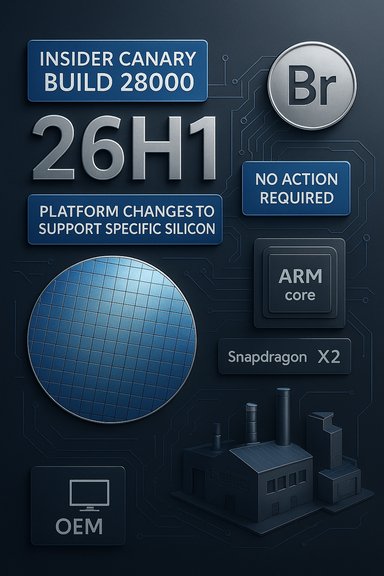
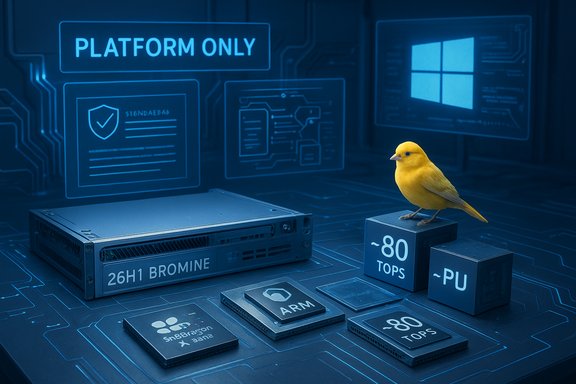
Microsoft released Windows 11 Insider Preview Build 28000 to the Canary Channel and updated the visible version string to Windows 11, version 26H1. The Windows Insider announcement explicitly states that “26H1 is not a feature update for version 25H2 and only includes platform changes to support specific silicon,” and that there is no action required from customers. This is a deliberate engineering move: Canary is being used as a testbed for platform plumbing rather than consumer-facing experiences. Why this matters: Microsoft is effectively creating a short‑lived or device‑gated platform baseline (sometimes referred to in reporting as the “Bromine” branch) so OEMs and silicon partners can ship devices whose firmware, drivers, and kernel-level integrations need OS-level adjustments that the mainstream 25H2 branch does not provide. That lets hardware launch on a validated OS image while Microsoft preserves its annual, consumer-focused feature cadence (the broader user-facing update remains scheduled as 26H2 in H2 2026).
Microsoft’s Canary drop makes one strategic point crystal clear: Windows development is now inseparable from silicon roadmaps. The practical consequence for users is modest — most will see no change — but for OEMs, silicon vendors, and enterprise teams, 26H1 represents a necessary engineering accommodation as Windows prepares to host a new generation of Arm‑native, NPU‑centric PCs. Conclusion: treat 26H1 as a targeted, technical bridge between today’s Windows baseline and the next wave of Arm and AI‑accelerated hardware — an engineering workaround that, if managed well, can deliver better day‑one experiences for new devices without fragmenting the Windows experience for the billions who will remain on the mainstream cadence.
Source: Windows Latest Windows 11 26H1 confirmed, but it's not for all. Only Nvidia Arm-based N1X, Snapdragon X2 will get it
 Background: what happened and why it matters
Microsoft released Windows 11 Insider Preview Build 28000 to the Canary Channel and updated the visible version string to Windows 11, version 26H1. The Windows Insider announcement explicitly states that “26H1 is not a feature update for version 25H2 and only includes platform changes to support specific silicon,” and that there is no action required from customers. This is a deliberate engineering move: Canary is being used as a testbed for platform plumbing rather than consumer-facing experiences. Why this matters: Microsoft is effectively creating a short‑lived or device‑gated platform baseline (sometimes referred to in reporting as the “Bromine” branch) so OEMs and silicon partners can ship devices whose firmware, drivers, and kernel-level integrations need OS-level adjustments that the mainstream 25H2 branch does not provide. That lets hardware launch on a validated OS image while Microsoft preserves its annual, consumer-focused feature cadence (the broader user-facing update remains scheduled as 26H2 in H2 2026).Overview: what Windows 11 26H1 is — and what it isn’t
- 26H1 is a platform-only update in Canary (Build 28000), intended for co‑engineered devices that require low‑level OS and driver changes.
- It is not a general consumer feature update for the installed base running 25H2; mainstream features will continue to arrive on the H2 cadence.
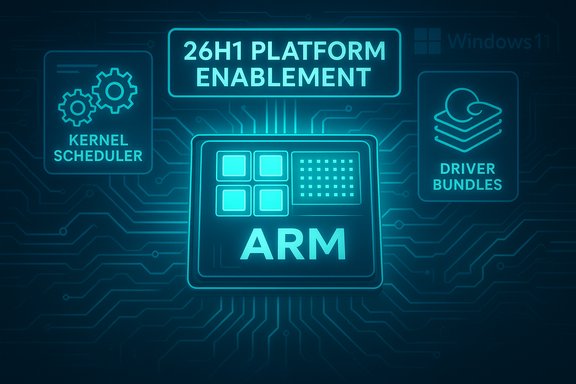
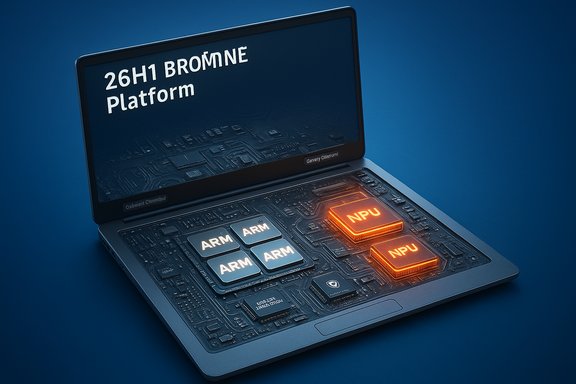
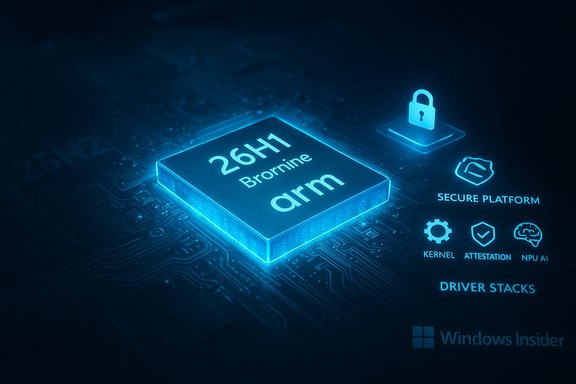
- The practical purpose is to enable device‑specific capabilities (NPUs, firmware attestation, tuned power/scheduler behavior) required by new Arm SoCs and other specialized chips before those devices ship.
The technical case for a platform branch
Modern SoCs — especially those targeting on‑device AI — introduce components and behaviors that touch deep OS layers:- NPUs and model runtimes that require signed manifests, attestation, and privileged runtime drivers.
- Heterogeneous core topologies (big/little or mixed microarchitectures) that benefit from scheduler and governor changes.
- New GPU/DSP driver stacks and media pipelines tuned to vendor silicon and power envelopes.
- Firmware and secure‑enclave integrations for model privacy, attestation, or key‑protection flows.
What Build 28000 actually contains
In public notes, Build 28000 lists only a handful of fixes (for example, Live Captions stability and an Outlook credentials dialog bug) and some Canary‑specific known issues. The visible change — the version bump to 26H1 — is the signal; the under‑the‑hood plumbing is the reason. Microsoft’s message intentionally avoids promising consumer features in this flight.Snapdragon X2: why Qualcomm’s new silicon is the leading trigger
Qualcomm’s Snapdragon X2 family (marketed as X2 Elite and X2 Elite Extreme) was announced at the Snapdragon Summit and is being positioned as a generational leap for Windows on Arm laptops. Independent reporting and vendor materials highlight these attributes:- New Oryon CPU cores on a 3nm process, with top-bin boost clocks reported up to 5.0 GHz on high-end SKUs.
- A dramatically larger Hexagon NPU — industry reporting places peak NPU throughput around ~80 TOPS on certain X2 SKUs.
- Substantially increased GPU performance and system memory bandwidth, plus modern connectivity stacks (Wi‑Fi 7, advanced 5G).
Nvidia N1X / N1: promising, powerful, but still speculative
The idea that Nvidia’s N1X (and N1) Arm SoCs could be beneficiaries of 26H1 shows why Microsoft is thinking in terms broader than a single silicon vendor. Reporting suggests Nvidia and MediaTek have been collaborating on Arm SoCs designed for Windows, and multiple outlets have surfaced leaks and timeline updates for the N1X family:- Industry coverage has linked N1X/N1 to MediaTek co‑development, Blackwell-based GPU elements, and aggressive TOPS figures in leaked data, with Near‑term timelines slipping into early 2026 for some SKUs.
- Several outlets have reported delays and revisions to N1X schedules, and some supply‑chain writeups attribute those delays in part to the need for Microsoft to finalize Windows WoA behavior for next‑gen features. That underscores the bi‑directional dependency: silicon needs OS support, and OS teams need hardware inputs to validate platform changes.
What devices will (and won’t) get 26H1
- Devices shipping with Snapdragon X2 (Copilot+/X2 Elite) and possibly initial Nvidia/MediaTek N1X‑based systems are the primary candidates to ship with the 26H1 platform image preinstalled. OEMs prefer shipping with a validated, signed OS image that includes tuned drivers and firmware.
- Existing Intel and AMD devices will not be forced to migrate to 26H1; most users will remain on 25H2 and later receive the consumer‑facing 26H2 update during Microsoft’s annual H2 cadence.
- For Arm devices that ship with 26H1, Microsoft expects them to later upgrade to 26H2 as part of the unified consumer roll‑out in the second half of the year. OEM timing and servicing mechanics (e.g., Known Issue Rollback tokens, enablement packages) will determine precisely when and how features are exposed.
OEMs, enterprises, and update management: practical implications
For OEMs- This approach makes launching new SoCs smoother. OEMs can preintegrate signed firmwares, drivers, and vendor binaries into Bromine/26H1 images and ship devices that “just work” out of the box.
- Co‑engineering windows will be tight: Microsoft and vendors often require device images and driver bundles months ahead of retail availability to pass certification and image signing processes.
- Expect a short period of mixed baselines: some devices in your fleet may be running a Bromine‑based image while others remain on standard 25H2/26H2 flows. That increases the need to validate imaging, provisioning, and management tooling (SCCM/Intune scripts, driver packs, WSUS behaviors).
- Don’t deploy Canary images in production. Use the Dev/Beta channels for feature validation and keep Canary strictly for isolated engineering testing. Microsoft’s own guidance emphasizes that Canary builds can require a clean reinstall to switch channels.
- Most people don’t need to act. If you own an Intel or AMD laptop, you won’t be getting 26H1 as part of normal Windows Update, and the consumer features will arrive under the usual H2 feature update cadence.
New AI features and minimum hardware requirements
Microsoft and the industry have increasingly tied certain on‑device AI experiences to minimum NPU performance thresholds (for example, the 40 TOPS floor that many vendor programs cite for local model acceleration). Reporting around Snapdragon X2 highlights NPUs in the ~45–80 TOPS band for X2 SKUs, which explains why OS‑level scheduling, runtime manifests, and attestation plumbing must be validated in a device‑gated branch prior to launch. If Microsoft keeps AI features gated by NPU capability, expect feature availability to be conditional on the device’s NPU performance, firmware, and vendor driver stack. Caveat: the precise TOPS thresholds Microsoft enforces are subject to change, and some user experiences can be implemented via cloud fallbacks or hybrid inference if local NPUs fall below the threshold. Any numbers quoted from leaks should be treated as indicative, not contractual.Risks and trade‑offs: fragmentation, support burden, and messaging
- Fragmentation risk: A short‑term divergence in platform baselines — devices shipping with 26H1 vs. those on 25H2 — can create confusion for users, and extra work for ISVs and driver teams that must ensure compatibility across baseline variants. The risk is mitigated if Microsoft folds Bromine platform changes into the later H2 release, but that outcome remains unconfirmed.
- Driver and security surface: Platform branches often include low‑level changes that can expose new compatibility issues with legacy kernel components or third‑party drivers. Microsoft’s targeted approach minimizes broad exposure but increases the importance of OEM driver certification and testing.
- Communication and perception: Labeling a Canary platform flight as “26H1” risks being misread by end users as a general mid‑cycle consumer feature update. Microsoft’s explicit messaging that it is platform‑only is critical to avoid large waves of confusion and help‑desk calls.
Insider guidance: how to test and what to expect in Canary
- Canary is for platform-level validation: expect instability, power/sleep regressions, and other low-level issues. Report bugs through Feedback Hub with reproducible steps.
- If you’re an engineer or OEM partner, work with Microsoft and vendor channels to validate driver bundles, NPU runtimes, and firmware interactions against the Bromine candidate. Prepare to reimage devices if Canary builds are used for prolonged testing, since channel crosswalks can require clean installs.
- Consumers who are curious should avoid Canary on primary machines. Back up data and use secondary test hardware if you want early access.
Timeline: what to watch and when
- November 2025: Canary build 28000 appears publicly; Microsoft may seed RTM/bundled images to OEMs once co‑engineering stabilizes.
- Early 2026 (H1): Qualcomm has indicated X2‑based devices should begin shipping in the first half of 2026; OEM announcements (CES and OEM press events) will be the clearest signals that 26H1 images are being used for retail SKUs.
- 2026 H2: Microsoft’s planned consumer feature update (26H2) should be the vehicle that brings broad feature parity to the wider Windows ecosystem — whether that update is built on top of Bromine or merges selected changes remains an open question. Microsoft’s public messaging keeps the H2 cadence intact.
- Official Microsoft Flight Hub and Windows Insider Blog notes for channel transitions, RTM announcements, and servicing guidance.
- OEM SKU declarations specifying whether devices ship with 26H1 images or remain on a 25H2 baseline.
- Qualcomm, Nvidia, and MediaTek announcements regarding SKUs, NPU specs, and shipping timelines — leaks will continue, but vendor confirmations are the definitive source.
What this means for the Windows ecosystem
Microsoft’s targeted platform branch strategy is pragmatic engineering for a world in which silicon innovation moves faster and in more heterogenous directions than ever. The pros are clear:- Faster, less risky device launches because OEMs receive an OS image that’s already been validated against the device’s firmware and drivers.
- Better day‑one experience for buyers of Copilot+ or NPU‑centric devices.
- Preservation of the consumer feature cadence so the installed base isn’t forced into risky migrations.
- Short‑term platform divergence and an extra layer of complexity for IT and ISV compatibility testing.
- Potential for confusion if messaging isn’t clear about who gets what and when.
- A reliance on OEMs and vendors to produce high‑quality drivers and manifests that conform to Microsoft’s platform expectations.
Final analysis and recommendations
Microsoft’s Build 28000 Canary drop is a clear, intentional signal that Windows engineering is preparing for a substantive wave of Arm and AI‑centric PCs. For readers and organizations:- Home users on Intel/AMD: no immediate action required. Continue normal update practices and expect the next consumer feature wave during the H2 2026 release.
- Early adopters and Insiders: If you test Canary, do so on non‑critical hardware and file detailed feedback about power, driver, and sleep/shutdown behaviors. Be prepared for a clean reinstall if you later move channels.
- IT and device managers: Treat 26H1‑based SKUs as separate images to validate. Coordinate with OEMs on driver packs, servicing policies, and recovery workflows. Plan for short-term mixed‑fleet complexity.
- OEMs and silicon partners: Use the Bromine/26H1 window to finalize driver signing, firmware integration, and attestation stacks so devices ship with a known‑good baseline.
Microsoft’s Canary drop makes one strategic point crystal clear: Windows development is now inseparable from silicon roadmaps. The practical consequence for users is modest — most will see no change — but for OEMs, silicon vendors, and enterprise teams, 26H1 represents a necessary engineering accommodation as Windows prepares to host a new generation of Arm‑native, NPU‑centric PCs. Conclusion: treat 26H1 as a targeted, technical bridge between today’s Windows baseline and the next wave of Arm and AI‑accelerated hardware — an engineering workaround that, if managed well, can deliver better day‑one experiences for new devices without fragmenting the Windows experience for the billions who will remain on the mainstream cadence.
Source: Windows Latest Windows 11 26H1 confirmed, but it's not for all. Only Nvidia Arm-based N1X, Snapdragon X2 will get it