

Microsoft’s quietly released Canary build that surfaces as Windows 11, version 26H1 marks a deliberate, engineering-first pivot: the update is being issued as a device-targeted platform baseline and — for now — will arrive preinstalled on Snapdragon X2-equipped PCs rather than be pushed broadly to Intel and AMD machines.
Microsoft updated the Canary channel to Build 28000 and explicitly described the visible version string as Windows 11, version 26H1, adding that “26H1 is not a feature update for version 25H2 and only includes platform changes to support specific silicon.” That public wording is crucial: Microsoft frames 26H1 as platform plumbing rather than a consumer-facing feature wave, and it instructs that there is no action required for current users on the 25H2 branch. Independent reporting and OEM briefings tie this platform branch to Qualcomm’s new Snapdragon X2 family. Several OEMs — notably ASUS — confirmed that ZenBook models built on Snapdragon X2 will ship factory-imaged with the 26H1 baseline, whereas similar SKUs using Intel or AMD silicon will ship with the 25H2 lineage. That combination of Microsoft’s Canary note and vendor timing creates a consistent narrative: 26H1 exists to enable next‑generation Arm silicon at launch, not to split the general Windows feature roadmap.
Key technical elements expected in 26H1 include:
However, the model increases complexity for buyers, IT teams, and developers. The industry will be watching both OEM messaging and independent benchmarks closely: the technical promise of Snapdragon X2-class NPUs and the real-world experience of Copilot+ tasks on day one determine whether this device‑first release balances risk and reward successfully. Until real-world reviews and benchmarks are available, treat vendor TOPS and clock claims as aspirational targets subject to verification.
Windows’ future is becoming more co‑designed with silicon: an OS that adapts its platform baseline to hardware capability can unlock better on‑device AI and battery life, but it requires precise communication and disciplined servicing. 26H1/Bromine is the clearest evidence yet that Microsoft is willing to ship platform-level changes in a targeted way — a strategy that can accelerate hardware adoption when executed transparently, or create fragmentation headaches if messaging and update mechanics lag behind. The next months — OEM launch notes, independent benchmarks, and Microsoft’s servicing guidance — will determine whether 26H1 is a short-lived engineering convenience or a model Microsoft repeats more broadly as on‑device AI proliferates.
Source: XDA Windows 11's 26H1 update will only arrive on Snapdragon X2 PCs, but for good reason
 Background
Microsoft updated the Canary channel to Build 28000 and explicitly described the visible version string as Windows 11, version 26H1, adding that “26H1 is not a feature update for version 25H2 and only includes platform changes to support specific silicon.” That public wording is crucial: Microsoft frames 26H1 as platform plumbing rather than a consumer-facing feature wave, and it instructs that there is no action required for current users on the 25H2 branch. Independent reporting and OEM briefings tie this platform branch to Qualcomm’s new Snapdragon X2 family. Several OEMs — notably ASUS — confirmed that ZenBook models built on Snapdragon X2 will ship factory-imaged with the 26H1 baseline, whereas similar SKUs using Intel or AMD silicon will ship with the 25H2 lineage. That combination of Microsoft’s Canary note and vendor timing creates a consistent narrative: 26H1 exists to enable next‑generation Arm silicon at launch, not to split the general Windows feature roadmap. What 26H1 actually is — a technical summary
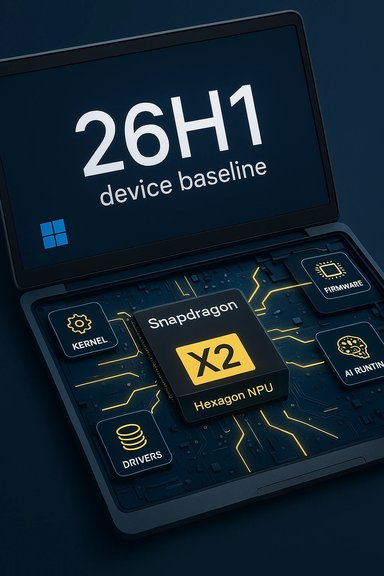
26H1, as surfaced in Canary Build 28000, is best understood as a device-specific OS baseline that packages low-level kernel, driver, firmware, and runtime changes targeted at hardware that cannot be reliably supported by the shared 25H2 servicing baseline.Key technical elements expected in 26H1 include:
- Kernel and scheduler updates to better handle heterogeneous core topologies and the new Oryon-based CPU behaviors in Snapdragon X2-class chips.
- Bundled DCH driver stacks and vendor-signed firmware for GPU, ISP, connectivity and storage tuned to X2 power and thermal envelopes.
- NPU runtimes (Hexagon runtime updates or equivalents), secure model manifests, and attestation hooks required for reliable, privacy-conscious on‑device AI.
- Servicing metadata and device catalog entries enabling Microsoft and OEMs to target enabling or rollback behaviors to qualifying hardware without touching the broad servicing branch.
Why only Snapdragon X2 devices — engineering, cadence, and risk management
The decision to gate 26H1 to certain Arm systems reflects three interlocking engineering realities:- Modern Arm SoCs are increasingly heterogeneous and include very large NPUs and new power/firmware interfaces that touch deep OS surfaces. These changes are not always safely backportable into a widely distributed servicing branch without risking regressions.
- OEMs need an RTM-like, factory‑flashable image that includes validated drivers and signed firmware so day‑one experience and supportability are predictable. Delivering that image as a targeted platform baseline reduces the likelihood of messy post‑ship fixes.
- Qualcomm and other silicon partners operate on engineering and launch cadences that don’t always align with Microsoft’s annual H2 feature cycle. Providing a device‑scoped platform image lets Microsoft match the silicon and OEM timelines without derailing the mainstream servicing track.
Snapdragon X2: what the silicon brings — and what should be treated cautiously
Qualcomm’s Snapdragon X2 family (Elite, Elite Extreme, and recent X2 Plus variants) has been marketed as a step change for Windows‑on‑Arm, with vendor claims including:- New Oryon CPU cores with high single-core boost clocks on top-bin SKUs.
- Larger Hexagon NPUs advertised in the tens of TOPS (headline figures around 80 TOPS for some X2 SKUs).
- Improvements to the GPU, memory bandwidth (LPDDR5X), and modern I/O features such as PCIe Gen 5 and Wi‑Fi 7 to support heavier local AI and media workloads.
Precedent: Microsoft’s earlier hardware-gated rollouts
Microsoft has used hardware-gated release patterns before. When Copilot+ PCs first rolled out, certain on‑device AI experiences were initially restricted to qualifying hardware with NPUs and attestation capabilities; the broader install base received parity later via mainstream servicing or staged flips. The 26H1/Bromine approach is consistent with that prior behavior and reflects a continuing trend: Microsoft will sometimes ship platform-level binaries with device‑specific validation gates to protect the broader ecosystem.What this means for buyers, IT admins and developers
Consumers and buyers
- If you plan to buy an early Snapdragon X2 Copilot+ laptop (for example, the Asus ZenBook A14/A16 announced at CES), expect the device to ship with a factory-imaged 26H1 image that contains validated drivers and on‑device AI plumbing. That can mean better day‑one stability for AI features on qualifying hardware.
- For owners of existing Intel/AMD laptops: there’s no forced migration to 26H1. Daily users will remain on the mainstream 25H2 branch and should expect visibility of broad user‑facing features in the normal H2 cycle (26H2).
IT administrators and enterprise teams
- Treat 26H1 devices as vendor-provided images rather than a standard Windows servicing branch. Pilot any X2 devices in a controlled ring to validate MDM/endpoint agents, VPNs, antimalware agents, and kernel-mode components.
- Confirm upgrade and servicing policies with OEM partners: how will driver/firmware updates be delivered post‑ship? Will device catalog entries be tracked in your inventory system? These are practical questions for mixed‑fleet management.
Developers and ISVs
- Prioritize native Arm64 builds where practical and ensure graceful fallbacks for NPU-accelerated features. Expect a bifurcated testing matrix: one path optimized for X2-class NPUs and another fallback for CPU/GPU-only devices.
- Use Microsoft’s Windows ML / ONNX and the Copilot+ guidance to detect execution providers and route inference appropriately. Windows ML’s EP discovery and ONNX ecosystem are the recommended patterns for NPU access on Copilot+ PCs.
The risks and downsides — fragmentation, messaging, and support complexity
Microsoft’s approach is sensible from an engineering standpoint, but it introduces practical risks:- Fragmentation risk: multiple platform baselines active simultaneously (25H2 mainstream + device-limited 26H1 images) complicate inventory, update reporting, and support scripts. IT teams managing mixed fleets will need clear telemetry and SKU mappings to avoid confusion.
- Communication friction: consumers may misinterpret “26H1” as a mass-market update offering new visible features and feel unfairly excluded if their Intel/AMD device remains on 25H2 until H2. Clear OEM messaging at point-of-sale is essential.
- Operational burden: faster silicon cadence plus device-specific images can increase the frequency of vendor-signed driver updates and firmware refreshes in the early months after launch. That’s good for quality but bad for high-scale managed environments that prefer fewer, predictable update windows.
- Verification gap: vendor-promised TOPS and boost clocks are marketing targets. Real applications and battery-limited scenarios often reveal very different conclusions; independent benchmarking and field telemetry will be the ultimate arbiter. Microsoft’s device‑first baseline helps protect users from immature behavior, but it does not remove the need for third‑party validation.
Timeline and what to watch next
Based on Microsoft’s Canary activity and OEM timing signals, the practical timeline looks like this:- Late 2025 — Microsoft finalizes Canary snapshots and the Bromine branch; Build 28000 appears in Canary.
- Q1 2026 — First Snapdragon X2 laptops (ZenBook A14/A16 and others) expected to land in retail channels with factory‑flashed 26H1 images. OEM press materials for the ZenBook family show Snapdragon X2 models planned for early 2026.
- H2 2026 — Microsoft’s normal annual feature release (26H2) is expected to deliver broad, user-facing features to the general Windows install base, consolidating any platform work that Bromine enabled.
- Look for OEM support documentation that explicitly states whether a device ships with 26H1 and how updates will be delivered.
- Watch independent hardware reviews and benchmarks for sustained NPU and CPU performance on shipping X2 laptops; vendor claims should be validated against real workloads before procurement decisions.
How to prepare: practical recommendations
For consumers considering a purchase:- If on‑device AI and day‑one NPU-backed experiences are important, prioritize Copilot+ devices that ship with validated images (Snapdragon X2 models will be the earliest candidates). Confirm with the retailer/OEM which Windows image ships on the SKU.
- Pilot at scale: acquire a small number of X2-based units and validate enterprise tooling and security agents before wide rollout.
- Vendor SLAs: insist on clear support and update cadences from OEMs: how and when will driver/firmware updates be delivered and signed?
- Inventory tagging: ensure your asset inventory flags platform baseline (25H2 vs 26H1) so patching and reporting rules can be applied correctly.
- Add Arm64 CI/CD targets and validate fallback paths; use Windows ML/ONNX and test NPU execution providers. Document the behavior your app expects when local NPU acceleration is unavailable.
A measured verdict
Windows 11 version 26H1 is not a dramatic consumer-facing release; it is a pragmatic engineering maneuver to enable the next wave of on‑device AI hardware with as little day‑one friction as possible. That choice gives OEMs and Microsoft a safer path to ship complex Arm silicon and NPU-enabled experiences, while preserving the mainstream annual H2 consumer cadence for the wider Windows population.However, the model increases complexity for buyers, IT teams, and developers. The industry will be watching both OEM messaging and independent benchmarks closely: the technical promise of Snapdragon X2-class NPUs and the real-world experience of Copilot+ tasks on day one determine whether this device‑first release balances risk and reward successfully. Until real-world reviews and benchmarks are available, treat vendor TOPS and clock claims as aspirational targets subject to verification.
Windows’ future is becoming more co‑designed with silicon: an OS that adapts its platform baseline to hardware capability can unlock better on‑device AI and battery life, but it requires precise communication and disciplined servicing. 26H1/Bromine is the clearest evidence yet that Microsoft is willing to ship platform-level changes in a targeted way — a strategy that can accelerate hardware adoption when executed transparently, or create fragmentation headaches if messaging and update mechanics lag behind. The next months — OEM launch notes, independent benchmarks, and Microsoft’s servicing guidance — will determine whether 26H1 is a short-lived engineering convenience or a model Microsoft repeats more broadly as on‑device AI proliferates.
Source: XDA Windows 11's 26H1 update will only arrive on Snapdragon X2 PCs, but for good reason
