

Microsoft’s Canary surprise this week — Windows 11 now reports a visible version of 26H1 in Settings — is not the consumer-facing feature wave many expected; it’s a platform-only, device-gated baseline intended to enable next‑generation silicon, and its arrival coincided with a string of operational headaches (notably a BitLocker/WinRE update regression) and a shock to the gaming community: a high‑profile title moving into maintenance mode. The moves together underline a recurring theme: Microsoft is optimizing Windows around new silicon and on‑device AI, but the trade‑offs include more complex servicing matrices, fractured messaging, and acute operational risk for IT and players alike.
Microsoft pushed Windows 11 Insider Preview Build 28000 to the Canary Channel and — importantly — updated the visible version string to Windows 11, version 26H1. The Windows Insider announcement is explicit: “26H1 is not a feature update for version 25H2 and only includes platform changes to support specific silicon. There is no action required from customers.” That phrasing matters; this is a baseline for OEM and silicon enablement, not the next broad consumer release. The broader context is twofold. First, PC silicon has moved from CPU+GPU to heterogeneous systems integrating large NPUs, new power models, and firmware contracts that demand lower‑level OS plumbing. Second, Microsoft’s release model has shifted toward an annual H2 feature cadence while using targeted or device‑gated images to enable day‑one compatibility for new Copilot+ hardware. The 26H1 Canary drop (often linked in reporting to an internal codename such as Bromine) appears to be exactly that: a device‑specific platform baseline to support new Arm PC SoCs (most notably Qualcomm’s Snapdragon X2 family and, possibly, emerging NVIDIA/MediaTek client designs). At the same time, the gaming world saw heavy churn: one long‑running title moved from active development to maintenance, and the Steam Hardware & Software Survey shows gaming PCs moving rapidly to Windows 11 — a transition with practical consequences for developers, anti‑cheat, and driver teams.
Other gaming notes this week:
The October BitLocker/WinRE incident is a timely reminder: changes that touch pre‑boot and recovery components can cause immediate and irreversible pain for end users. Escrowing recovery keys, piloting updates on representative hardware, and insisting on transparent OEM servicing guarantees are not optional steps — they are essential risk mitigations as Windows and PC silicon continue to evolve in lockstep.
Taken together, the week’s headlines are a microcosm of the platform tradeoff Microsoft is managing: accelerate hardware‑first innovation, but accept the cost of more complex support matrices and the need for clearer, bolder communication to avoid needless friction for users and enterprises.
Conclusion
The industry is shifting away from “one‑size‑fits‑all” OS servicing toward device‑aware platform baselines. That’s good for delivering on the promise of on‑device AI and better day‑one experiences on new silicon, but it also demands stronger operational discipline from Microsoft, OEMs, and IT teams. The immediate task for administrators is conservative: inventory, escrow, pilot, and demand clarity — because when platform plumbing changes the boot chain, the cost of complacency is very high.
Source: Neowin Microsoft Weekly: Windows 11 26H1 is official and not-so-infinite Halo
 Background / Overview
Microsoft pushed Windows 11 Insider Preview Build 28000 to the Canary Channel and — importantly — updated the visible version string to Windows 11, version 26H1. The Windows Insider announcement is explicit: “26H1 is not a feature update for version 25H2 and only includes platform changes to support specific silicon. There is no action required from customers.” That phrasing matters; this is a baseline for OEM and silicon enablement, not the next broad consumer release. The broader context is twofold. First, PC silicon has moved from CPU+GPU to heterogeneous systems integrating large NPUs, new power models, and firmware contracts that demand lower‑level OS plumbing. Second, Microsoft’s release model has shifted toward an annual H2 feature cadence while using targeted or device‑gated images to enable day‑one compatibility for new Copilot+ hardware. The 26H1 Canary drop (often linked in reporting to an internal codename such as Bromine) appears to be exactly that: a device‑specific platform baseline to support new Arm PC SoCs (most notably Qualcomm’s Snapdragon X2 family and, possibly, emerging NVIDIA/MediaTek client designs). At the same time, the gaming world saw heavy churn: one long‑running title moved from active development to maintenance, and the Steam Hardware & Software Survey shows gaming PCs moving rapidly to Windows 11 — a transition with practical consequences for developers, anti‑cheat, and driver teams. What Windows 11 version 26H1 actually is
A platform baseline, not a consumer upgrade
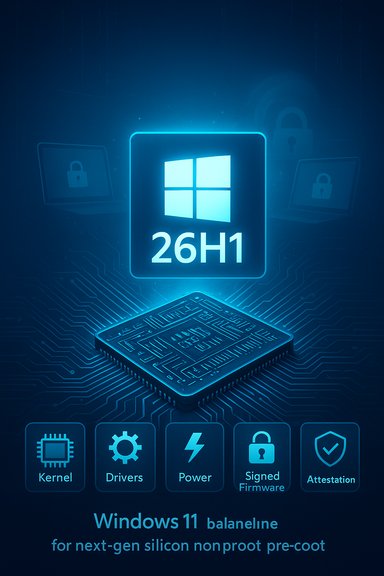
- Intent: Provide a validated OS image with the necessary kernel, driver, firmware hooks, and runtime plumbing for specific next‑gen silicon so OEMs can ship devices with a known‑good configuration.
- Scope: Low‑level compatibility work — driver model updates, NPU runtime integration, power/scheduler tuning, and signed firmware/attestation frameworks — not broad UI or consumer features.
- Rollout: Appears initially in the Canary Channel (Build 28000) for Insiders and OEM partners; Microsoft states this is not the feature update for users on 25H2.
Why Microsoft is doing this
New SoCs are complex and sometimes require OS API and driver changes that are risky to push to the entire Windows population. A device‑gated baseline lets Microsoft and OEMs:- Ship tuned, signed images for factory flashing.
- Co‑validate drivers and firmware in the field without exposing billions of devices.
- Preserve a predictable annual consumer feature cadence while enabling early hardware features in a controlled way.
Likely hardware targets
Industry reporting and community traces link 26H1 to Qualcomm’s Snapdragon X2 family (marketed as X2 Elite/X2 Elite Extreme) and to emerging NVIDIA/MediaTek Arm client designs. The Snapdragon X2 lineup is positioned to deliver much larger NPUs (measured in tens of TOPS), new Oryon CPU cores, and higher memory bandwidth — all reasons Microsoft would want a platform image that’s pre‑tuned and factory‑validated. Early devices are expected in early 2026, which aligns with a 26H1 device enablement timeline.Technical anatomy: Bromine, NPUs, and the plumbing work
What’s changing under the hood
- Kernel and scheduler updates to better support heterogeneous CPU clusters and NPU offload.
- New HAL/driver contracts for Hexagon‑class NPUs and vendor‑specific runtime libraries.
- Secure runtime and attestation hooks for on‑device AI model protection and privacy (a prerequisite for many Copilot+ experiences).
- Changes to ACPI/power policies and display/IO interconnect tuning to match novel SoC thermal and memory topologies.
Why these are not easy to backport
- A single low‑level change can ripple across drivers, WinRE/Safe OS, boot measurements (affecting BitLocker), and OEM firmware. That coupling is why Microsoft treats these as platform‑specific engineering tasks rather than a mass servicing toggle.
- The pre‑boot and recovery environment is particularly fragile; small packaging or driver regressions in WinRE can create severe lockout scenarios for encrypted devices. The October servicing wave exposed precisely this fragility.
Practical implications — guidance for different audiences
Consumers and mainstream users
- Remain on 25H2/24H2 unless you buy a new Copilot+ device that ships with a 26H1 image.
- Don’t enroll production devices in Canary: treat Canary/Bromine installations as experimental pilots only.
OEMs, system integrators, and partners
- Expect to work with Microsoft on signed images, certified drivers, and factory‑flashing processes tied to specific SKUs.
- Validate sysprep, driver bundles, and hardware attestation flows with Bromine/26H1 images before mass imaging.
Enterprise and IT admins
- Inventory hardware now and identify machines that may be targeted for Bromine images; insist on clear servicing and SLAs from OEMs.
- Escrow BitLocker recovery keys and rehearse recovery procedures: the recent BitLocker/WinRE regression showed that updates touching pre‑boot components can cause immediate business impact.
The October update, BitLocker, and the cost of fragile pre‑boot plumbing
October’s cumulative update wave (mid‑October servicing) triggered two high‑impact problems on a subset of devices: unexpected BitLocker recovery prompts and a WinRE USB input regression that prevented entry of recovery keys. Microsoft acknowledged the problem in its Release Health and issued an out‑of‑band cumulative update (KB5070773) plus enterprise Known Issue Rollback options to remediate the USB regression. A separate May 2025 incident (KB5058379) similarly required an out‑of‑band fix (KB5061768) on affected Intel vPro devices. This pattern underscores the operational danger when servicing touches Safe OS/WinRE or other pre‑boot artifacts. Key operational lessons:- Always escrow recovery keys centrally; if a device prompts for BitLocker recovery and WinRE won’t accept USB input, local recovery may be impossible without the key.
- Pilot updates across representative hardware before wide deployment — pre‑boot regressions have outsized consequence.
- Know your KIR options for managed estates; Microsoft’s Known Issue Rollback and OOB packages are often the fastest remediation channel for enterprise fleets.
Windows 10 EOL, ESU, and the Steam snapshot
Microsoft’s consumer Windows 10 support window closed in mid‑October 2025, and the company offered a limited Extended Security Updates (ESU) pathway for devices that must remain on Windows 10. In parallel, Valve’s Steam Hardware & Software Survey (October 2025 snapshot) shows Windows 11 at 63.57% and Windows 10 at 31.14% among Steam users — a rapid gaming‑oriented migration but one that still leaves a sizeable Windows 10 minority that matters for publishers and anti‑cheat tooling. The Steam data is critical for game developers and driver vendors because it represents the active gaming population, not general desktop share. What that means practically:- Game studios and driver vendors must continue to test against Windows 10 in the near term, but time‑boxed ESU lifecycles and OEM driver policies will accelerate the switch to Windows 11 as the default testing baseline.
- For gamers, moving to Windows 11 now is less a luxury and more a compatibility/long‑term support requirement for new titles and day‑one drivers.
Windows Insider: where the previews landed this week
Microsoft’s Insider activity this week reflects the split strategy:- Canary Channel — Build 27982 / 28000: Introduced UI customizations, lock screen and widget changes, and is the first preview surface that shows the 26H1 version string in Build 28000. Microsoft emphasizes these Canary flights are platform‑focused.
- Dev Channel — Build 26220.7070: Windows Recovery improvements, redesigned Widgets UI, and bug fixes.
- Beta & Release Preview: Quieter this week; the main feature development remains in 25H2 for broad previewing.
Microsoft Edge, passkeys, and the broader security story
Microsoft Edge’s password manager gained passkey saving and syncing across Windows devices — a practical security upgrade that makes passkeys viable for everyday users; Edge now stores encrypted passkeys in Microsoft Password Manager on Windows and can sync them across devices tied to a Microsoft Account. This is a tangible step toward passwordless authentication on Windows desktops and aligns with Microsoft’s broader push to make on‑device and cloud‑backed authentication practical for consumers. The feature is rolling out in Edge and initially available on Windows. Why this matters in the context of 26H1:- The platform baseline is explicitly about enabling secure, local AI and runtime stacks on certain silicon. Passkeys and secure key escrow are complementary: they reduce phishing risk while enabling on‑device cryptographic authentication tied to the hardware and Trusted Platform Module (TPM) or equivalent secure enclave.
Gaming fallout: Halo Infinite and other shifts
Reports this week summarized by Neowin indicate that Halo Infinite received its final update and has moved out of active development at Halo Studios, with the studio reallocating resources to future projects. The reporting framed this as a strategic studio pivot rather than an immediate removal of playability — the game remains playable but will no longer be actively updated. That claim appears in coverage aggregated by community outlets, but independent, direct studio or publisher confirmation was not immediately surfaced in public official channels at the time of writing; treat the claim as supported by journalistic reporting but flagged for verification against Halo Studios / Halo Waypoint official posts for authoritative confirmation.Other gaming notes this week:
- Battlefield Studios added a Relaxed Mode for players who prefer lighter, bot‑filled sessions.
- Game Pass and GeForce NOW refreshed their lineups with new additions and removals. These catalog shifts matter for subscription users and for emulator/driver compatibility testing.
Strengths, risks, and the tradeoff calculus
Strengths
- Better day‑one experiences for new hardware: By co‑shipping tuned images with OEMs, Microsoft can reduce device launch regressions and deliver the full promise of local inference for Copilot+ hardware.
- Faster silicon enablement: OEMs and silicon partners get a validated OS baseline for factory flashing and certification.
- Targeted risk containment: Device‑gated branches avoid exposing the entire Windows base to low‑level changes that could break older hardware unexpectedly.
Risks and costs
- Servicing fragmentation: Different device baselines complicate patching matrices for enterprises and third‑party vendors. Procurement and helpdesk workflows become more complex.
- Communication friction: Version labels like 26H1 can be misread as broad feature releases; Microsoft’s messaging must be crystal clear to avoid unnecessary upgrades or enrollment.
- Operational fragility: Pre‑boot and recovery environment changes can trigger BitLocker lockouts with catastrophic data‑loss risk if recovery keys aren’t accessible — a real operational hazard demonstrated in October.
- Gaming ecosystem churn: When major live‑service titles move into maintenance mode, community-hosted ecosystems, modding, and competitive circuits must adapt quickly; this has downstream effects on player retention and esports planning.
Recommended actions for IT and power users
- Inventory and segment devices by SKU, firmware, and Copilot+ eligibility now.
- Escrow BitLocker recovery keys centrally and test recovery procedures.
- Use lab rings to pilot Canary/Bromine images for device‑specific testing only; do not enroll production.
- Vet OEM servicing roadmaps and insist on signed factory images and explicit update policies for 26H1 devices.
- For gamers, hold off on risky GPU driver upgrades until community confirmation for legacy titles; track vendor driver notes for known regressions.
Where claims remain speculative — cautionary notes
- The assertion that Microsoft “flagged Windows 10 ESU devices as unsupported” and then reversed the decision appears in aggregated reporting; independent official confirmation of that specific misflagging incident was not findable in the public Microsoft documentation at the time of this piece. Treat such claims as reported by community and trade outlets and verify against Microsoft support notices or official statements before acting on them in production environments.
- The precise OEM/device SKUs that will ship 26H1 at RTM and the long‑term servicing guarantees for those devices remain to be published by Microsoft and its OEM partners. Procurement decisions should wait for vendor documentation.
- The report that Halo Infinite has been fully “discontinued” draws from journalistic coverage summarized in the weekly roundups; check Halo Waypoint/Xbox Wire for studio posts to confirm the scope and timeline of maintenance mode or server changes.
Final assessment
Windows 11 version 26H1 is real and visible in Canary builds, but it is not the next universal feature update — it’s a pragmatic engineering construct to accelerate the arrival of next‑gen Copilot+ hardware without destabilizing the broader Windows population. Microsoft’s approach is technically sensible and offers clear benefits for OEM partners and users of the newest devices. At the same time, it introduces operational complexity that enterprises, imaging shops, and helpdesks must plan for now.The October BitLocker/WinRE incident is a timely reminder: changes that touch pre‑boot and recovery components can cause immediate and irreversible pain for end users. Escrowing recovery keys, piloting updates on representative hardware, and insisting on transparent OEM servicing guarantees are not optional steps — they are essential risk mitigations as Windows and PC silicon continue to evolve in lockstep.
Taken together, the week’s headlines are a microcosm of the platform tradeoff Microsoft is managing: accelerate hardware‑first innovation, but accept the cost of more complex support matrices and the need for clearer, bolder communication to avoid needless friction for users and enterprises.
Conclusion
The industry is shifting away from “one‑size‑fits‑all” OS servicing toward device‑aware platform baselines. That’s good for delivering on the promise of on‑device AI and better day‑one experiences on new silicon, but it also demands stronger operational discipline from Microsoft, OEMs, and IT teams. The immediate task for administrators is conservative: inventory, escrow, pilot, and demand clarity — because when platform plumbing changes the boot chain, the cost of complacency is very high.
Source: Neowin Microsoft Weekly: Windows 11 26H1 is official and not-so-infinite Halo
