

Microsoft has quietly shipped Windows 11 Insider Preview Build 28000.1199 to the Canary Channel — a low-key release that changes the visible OS version to 26H1 but contains no consumer-facing features, only a small set of targeted fixes and platform plumbing intended to enable specific next‑generation silicon.
Microsoft’s Insider rings serve distinct engineering purposes: Canary is the earliest testbed for low‑level platform changes, Dev and Beta host new experiences and feature previews, and Release Preview mirrors near‑shipping updates. The Build 28000 series — now visible as Windows 11, version 26H1 in Settings and winver — is being promoted by Microsoft as a platform-only flight rather than the next broad feature update for the 25H2 stream. That messaging is explicit in the Canary release notes: “26H1 is not a feature update for version 25H2 and only includes platform changes to support specific silicon.” Why does that matter? Labeling a Canary build 26H1 while simultaneously saying it’s platform‑only changes expectations. A version bump can easily be read by the public as a full feature release; Microsoft deliberately framed this flight as an engineering baseline to enable OEMs and silicon partners — not as a mass feature rollout. Independent reporting and community analysis point to this branch (often discussed under the internal name “Bromine”) as the foundation OEMs will use to ship devices that require new kernel, driver, scheduler and NPU plumbing.
Source: Neowin Windows 11 26H1 gets a bunch of fixes in new build 28000.1199
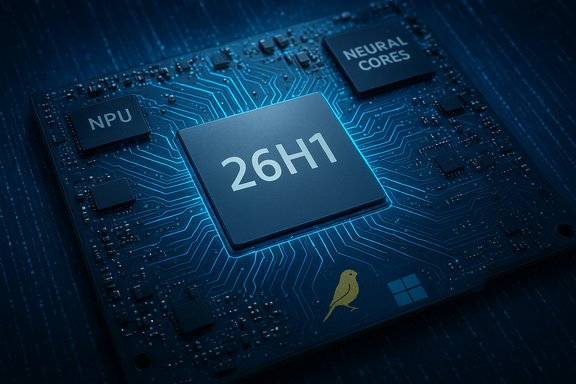 Background / Overview
Microsoft’s Insider rings serve distinct engineering purposes: Canary is the earliest testbed for low‑level platform changes, Dev and Beta host new experiences and feature previews, and Release Preview mirrors near‑shipping updates. The Build 28000 series — now visible as Windows 11, version 26H1 in Settings and winver — is being promoted by Microsoft as a platform-only flight rather than the next broad feature update for the 25H2 stream. That messaging is explicit in the Canary release notes: “26H1 is not a feature update for version 25H2 and only includes platform changes to support specific silicon.” Why does that matter? Labeling a Canary build 26H1 while simultaneously saying it’s platform‑only changes expectations. A version bump can easily be read by the public as a full feature release; Microsoft deliberately framed this flight as an engineering baseline to enable OEMs and silicon partners — not as a mass feature rollout. Independent reporting and community analysis point to this branch (often discussed under the internal name “Bromine”) as the foundation OEMs will use to ship devices that require new kernel, driver, scheduler and NPU plumbing. What Build 28000.1199 actually contains
Microsoft’s public changelog for Build 28000.1199 is intentionally brief: it indicates a small set of general improvements and fixes rather than new features. The most visible, user‑facing notes called out in the Canary blog post and mirrored by community captures are:- Fix for Live Captions crashes seen in earlier Canary flights.
- Fix for an issue that could make the Outlook credentials/login window inaccessible in recent flights.
- Known issues still being tracked, including Reports of the redesigned Start menu unexpectedly scrolling to the top and investigations into sleep/shutdown anomalies on some devices.
The silicon story: why a platform branch now?
Modern laptop SoCs are no longer simple CPU+GPU packages. The newest Arm PC parts integrate large NPUs (neural processing units), heterogeneous CPU topologies, and revised power/firmware semantics that require deeper OS-level hooks. Qualcomm’s recently announced Snapdragon X2 Elite and X2 Elite Extreme families are prime examples: vendor materials and industry coverage describe Oryon cores on advanced process nodes, substantially larger Hexagon NPUs with very high TOPS claims, and higher memory/GPU bandwidth targets — characteristics that commonly necessitate kernel, scheduler, driver and attestation changes in Windows. Devices using those chips are expected in the first half of 2026, which aligns with Microsoft creating a separate platform baseline now so OEMs have a known‑good OS image for factory flashing. Multiple independent outlets and community telemetry therefore tie 26H1 (Build 28000) to enabling next‑generation Arm silicon — most notably Qualcomm’s Snapdragon X2 family — though Microsoft’s official Canary announcement doesn’t name any vendor. That distinction is important: the vendor linkage is a well‑supported inference based on timing and technical fit, not an explicit Microsoft confirmation. Treat vendor exclusivity claims as probable but not definitively stated by Microsoft.Technical implications — what’s likely changed under the hood
Although the Canary notes list only a few fixes, the engineering work validated in a platform branch like Bromine commonly includes:- Kernel and scheduler updates to handle heterogeneous CPU clusters and high core counts, ensuring workload placement is correct across mixed microarchitectures.
- Power and thermal policy adjustments for novel SoC envelopes where NPUs and sustained AI workloads change typical power profiles.
- New DCH driver packages for GPU/ISP/media stacks and wireless controllers tailored to vendor implementations, including packaging and signing for OEM factory images.
- Integration points and attestation hooks for NPU runtimes so on‑device AI models can run securely and efficiently, plus runtime telemetry and secure execution flows.
Who this affects — and who it doesn’t
- Consumers and typical Intel/AMD PCs: no immediate action required. Microsoft explicitly states this is not a feature update for 25H2; most existing PCs should remain on the mainstream servicing stream.
- Early adopters and Copilot+ device buyers: first‑wave Arm devices that require the new platform baseline may ship with 26H1 preinstalled so NPU‑accelerated experiences work on day one. Expect OEM images to be the main distribution route for qualifying devices.
- Enterprises and IT admins: treat 26H1 as a vendor/device‑specific factory image rather than a broad servicing channel. Pilot any new Arm hardware in controlled rings, validate endpoint agents, drivers, VPNs and antimalware on the Bromine baseline, and prepare for device-specific servicing rules.
- Developers and ISVs: prioritize Arm64 native builds, test fallbacks for missing NPU acceleration, and validate third‑party kernel components, anticheat, DRM, and low‑level drivers on any 26H1 hardware you plan to support.
Risks, trade-offs and things to watch
- Fragmentation and servicing complexity
Adding a device‑targeted platform branch increases the number of distinct Windows images and servicing paths that OEMs and IT teams must manage. This adds operational complexity and raises the need for clear communication from Microsoft and OEMs about which devices get which updates. - Perceived feature gating
If OEMs or Microsoft restrict certain AI features to qualifying hardware for extended periods, the strategy could be perceived as gating — even if the intent is stability and day‑one functionality. Historically Microsoft has staged device‑gated experiences to protect quality; prolonged exclusivity would be contentious. Note that current reporting treats any hardware linkage as probable rather than declarative. - Third‑party driver and kernel risks
Kernel/scheduler changes aimed at heterogeneous cores can expose fragile third‑party drivers, anticheat modules, and enterprise kernel‑mode components to regressions. Vendors will need to validate their modules early on the Bromine baseline. - Reversion friction for Insiders
Canary builds that exercise platform branches can be difficult to revert from, often requiring wipe-and‑reinstall to return to Beta/Dev or production servicing if the branch diverges meaningfully. That risk is an operational hassle for testers. - Unverifiable vendor exclusivity claims
While reporting strongly points to Snapdragon X2 as a major driver for 26H1, Microsoft’s official release does not name Qualcomm or any OEM. Treat vendor-specific claims as well‑supported inferences — useful for preparation — but not as firm, Microsoft‑stated guarantees. - Runtime compatibility gaps (real‑world example)
Community reports on Canary threads and Reddit mention breakage or behavioral changes for older runtimes (for example, .NET Framework 3.5 interactions discussed in community captures). These are the kinds of regressions that can surface when low‑level plumbing changes; they merit attention if your workloads depend on legacy runtimes.
Timeline and what to expect next
- Build 28000.1199 (Canary) is a Canary‑level release intended for partner co‑validation and early Insiders. Microsoft’s messaging emphasizes no action required for general customers.
- Industry reporting and vendor roadmaps place first‑wave Snapdragon X2 devices and other potential Arm platforms in the first half of 2026. That timing matches a device‑targeted 26H1 RTM being finalized now and OEMs preparing factory images.
- The broader, consumer‑facing feature update that most users receive is expected as 26H2 in the second half of 2026; that H2 release will be the place where Microsoft delivers mass feature updates across the installed base. Until then, 25H2 remains the primary feature branch for most customers.
Practical guidance — what Insiders, IT and OEMs should do now
- For Insiders who want to test 28000.1199:
- Use non‑primary hardware or VMs to avoid disruption. Canary builds can require clean reinstalls to leave the ring.
- Focus testing on the specific scenarios you care about (Live Captions, Outlook sign‑in, power states), and record telemetry that might help Microsoft and OEMs reproduce issues.
- For OEMs and silicon partners:
- Validate imaging and factory‑flash workflows with the Bromine/26H1 baseline early. Test DCH driver bundles, firmware attestation pathways, and NPU runtime delivery (model signing, secure execution).
- Coordinate with Microsoft on driver signing and servicing metadata to ensure targeted enablement is controllable and reversible where needed.
- For enterprises planning pilot programs:
- Run X2 or other qualifying Arm devices in tightly controlled rings. Validate management tooling, antimalware, VPN clients, SSO and device attestation workflows. Expect some additional variance in endpoint behavior during the early shipments.
- For developers and ISVs:
- Prioritize Arm64 native builds and ensure graceful fallbacks for missing NPU acceleration. Validate anticheat/DRM kernel components early. If your app depends on legacy runtimes (for example, .NET 3.5), check community reports and test thoroughly on Canary images.
- If you must downgrade:
- Understand the cost: leaving Canary when platform baselines diverge can require a full reinstall. Plan for rollback images and automated provisioning to minimize downtime.
Critical analysis — strengths and potential risks
Strengths- Pragmatic engineering: By separating platform enablement from consumer features, Microsoft can co‑validate deep OS changes with partners and reduce day‑one regressions on devices that require new kernel and NPU integrations. This improves the likelihood that new Arm devices ship stable.
- Clear, conservative messaging: Microsoft’s public note explicitly disclaims that 26H1 is not a feature update for 25H2, which helps prevent misinterpretation of the version bump as a mass feature release.
- Faster hardware enablement: OEMs get a signed, validated platform baseline to image devices, enabling vendor‑specific features (on‑device AI, attestation) to work at launch.
- Fragmented servicing matrix: Multiple platform baselines increase complexity for IT and consumers, and miscommunication could lead to support confusion.
- Perception of gating: Device-centric enablement of AI features risks negative PR if consumers or enterprises perceive that capabilities are locked behind hardware. Microsoft and partners will need to be explicit about timelines and parity plans.
- Compatibility and regression exposure: Kernel and scheduler changes can reveal fragile third‑party code; anticheat and enterprise kernel‑mode components are particular risk vectors. Robust partner outreach is essential.
- Vendor exclusivity: Multiple outlets and community trackers link 26H1 to Snapdragon X2 and other Arm candidates. However, Microsoft’s announcement names no vendor. Treat the Snapdragon linkage as a strong working hypothesis supported by timing and technical fit, not a direct Microsoft statement.
Bottom line
Build 28000.1199 is a focused, Canary‑channel release whose public-facing notes list only a few small fixes, but whose strategic intent is to create a validated platform baseline for the next generation of Arm and AI‑centric PC silicon. Microsoft’s explicit message that 26H1 is not a consumer feature update for 25H2 matters: this is about hardware enablement and shipping reliable factory images for devices that require deeper OS changes. For most users on x86/x64 today, nothing changes; for OEMs, ISVs and enterprises preparing for early‑2026 Arm hardware, this is the cue to begin intensive compatibility testing and deployment planning. The pragmatic engineering approach — isolating risky kernel and driver work in a device‑gated branch — has clear advantages for day‑one device quality. But it also introduces operational complexity and the potential for perceived feature gating. Clear vendor and Microsoft communication, proactive partner validation, and careful pilot planning will determine whether this split‑track model smooths future device launches or becomes a source of fragmentation.Source: Neowin Windows 11 26H1 gets a bunch of fixes in new build 28000.1199
