• Thread Author
Microsoft has quietly pushed a Canary-channel build that relabels Windows 11 as version 26H1 — but the company says this is not the next mainstream feature update; it’s a targeted, platform-only branch intended to enable next‑generation Arm and AI‑centric silicon such as Qualcomm’s Snapdragon X2 family and potentially Nvidia’s N1X-class chips, and it will not be forced onto today’s Intel/AMD machines.

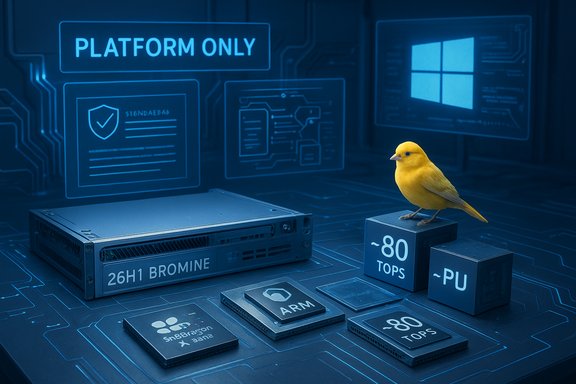
A yellow canary perched on AI processor blocks in a blue, futuristic tech lab.Background: what happened and why it matters​

Microsoft released Windows 11 Insider Preview Build 28000 to the Canary Channel and updated the visible version string to Windows 11, version 26H1. The Windows Insider announcement explicitly states that “26H1 is not a feature update for version 25H2 and only includes platform changes to support specific silicon,” and that there is no action required from customers. This is a deliberate engineering move: Canary is being used as a testbed for platform plumbing rather than consumer-facing experiences. Why this matters: Microsoft is effectively creating a short‑lived or device‑gated platform baseline (sometimes referred to in reporting as the “Bromine” branch) so OEMs and silicon partners can ship devices whose firmware, drivers, and kernel-level integrations need OS-level adjustments that the mainstream 25H2 branch does not provide. That lets hardware launch on a validated OS image while Microsoft preserves its annual, consumer-focused feature cadence (the broader user-facing update remains scheduled as 26H2 in H2 2026).

Overview: what Windows 11 26H1 is — and what it isn’t​

  • 26H1 is a platform-only update in Canary (Build 28000), intended for co‑engineered devices that require low‑level OS and driver changes.
  • It is not a general consumer feature update for the installed base running 25H2; mainstream features will continue to arrive on the H2 cadence.
  • The practical purpose is to enable device‑specific capabilities (NPUs, firmware attestation, tuned power/scheduler behavior) required by new Arm SoCs and other specialized chips before those devices ship.
This separation protects the broad Windows ecosystem from destabilizing changes while letting OEMs ship new silicon with an OS image that’s been validated against vendor drivers, secure runtime stacks, and firmware hooks.

The technical case for a platform branch​

Modern SoCs — especially those targeting on‑device AI — introduce components and behaviors that touch deep OS layers:
  • NPUs and model runtimes that require signed manifests, attestation, and privileged runtime drivers.
  • Heterogeneous core topologies (big/little or mixed microarchitectures) that benefit from scheduler and governor changes.
  • New GPU/DSP driver stacks and media pipelines tuned to vendor silicon and power envelopes.
  • Firmware and secure‑enclave integrations for model privacy, attestation, or key‑protection flows.
A narrow platform branch lets Microsoft, silicon vendors, and OEMs test and validate these pieces together without exposing the broader Windows population to potential regressions. It’s an engineering pattern Microsoft has used before when device launches demanded tight co‑validation.

What Build 28000 actually contains​

In public notes, Build 28000 lists only a handful of fixes (for example, Live Captions stability and an Outlook credentials dialog bug) and some Canary‑specific known issues. The visible change — the version bump to 26H1 — is the signal; the under‑the‑hood plumbing is the reason. Microsoft’s message intentionally avoids promising consumer features in this flight.

Snapdragon X2: why Qualcomm’s new silicon is the leading trigger​

Qualcomm’s Snapdragon X2 family (marketed as X2 Elite and X2 Elite Extreme) was announced at the Snapdragon Summit and is being positioned as a generational leap for Windows on Arm laptops. Independent reporting and vendor materials highlight these attributes:
  • New Oryon CPU cores on a 3nm process, with top-bin boost clocks reported up to 5.0 GHz on high-end SKUs.
  • A dramatically larger Hexagon NPU — industry reporting places peak NPU throughput around ~80 TOPS on certain X2 SKUs.
  • Substantially increased GPU performance and system memory bandwidth, plus modern connectivity stacks (Wi‑Fi 7, advanced 5G).
Those capabilities are precisely the kind of hardware that benefits from OS‑level scheduling, DCH driver signoffs, and validated NPU runtimes so features like low‑latency local AI, model offload, and privacy‑sensitive Copilot+ experiences behave predictably at day one. Qualcomm has signaled that X2‑based systems should begin appearing in early 2026, which aligns with a device‑targeted platform release appearing months earlier for co‑engineering and RTM image packaging.

Nvidia N1X / N1: promising, powerful, but still speculative​

The idea that Nvidia’s N1X (and N1) Arm SoCs could be beneficiaries of 26H1 shows why Microsoft is thinking in terms broader than a single silicon vendor. Reporting suggests Nvidia and MediaTek have been collaborating on Arm SoCs designed for Windows, and multiple outlets have surfaced leaks and timeline updates for the N1X family:
  • Industry coverage has linked N1X/N1 to MediaTek co‑development, Blackwell-based GPU elements, and aggressive TOPS figures in leaked data, with Near‑term timelines slipping into early 2026 for some SKUs.
  • Several outlets have reported delays and revisions to N1X schedules, and some supply‑chain writeups attribute those delays in part to the need for Microsoft to finalize Windows WoA behavior for next‑gen features. That underscores the bi‑directional dependency: silicon needs OS support, and OS teams need hardware inputs to validate platform changes.
Caveat and verification: technical leak data for N1X varies significantly between reports (TOPS figures, core counts, and power envelopes differ), and multiple outlets caution that early engineering samples and leaked benchmarks do not always reflect final silicon or shipping configurations. Treat the Nvidia/N1X linkage to 26H1 as plausible but not yet definitive; Microsoft’s official announcement does not name NVIDIA explicitly.

What devices will (and won’t) get 26H1​

  • Devices shipping with Snapdragon X2 (Copilot+/X2 Elite) and possibly initial Nvidia/MediaTek N1X‑based systems are the primary candidates to ship with the 26H1 platform image preinstalled. OEMs prefer shipping with a validated, signed OS image that includes tuned drivers and firmware.
  • Existing Intel and AMD devices will not be forced to migrate to 26H1; most users will remain on 25H2 and later receive the consumer‑facing 26H2 update during Microsoft’s annual H2 cadence.
  • For Arm devices that ship with 26H1, Microsoft expects them to later upgrade to 26H2 as part of the unified consumer roll‑out in the second half of the year. OEM timing and servicing mechanics (e.g., Known Issue Rollback tokens, enablement packages) will determine precisely when and how features are exposed.

OEMs, enterprises, and update management: practical implications​

For OEMs
  • This approach makes launching new SoCs smoother. OEMs can preintegrate signed firmwares, drivers, and vendor binaries into Bromine/26H1 images and ship devices that “just work” out of the box.
  • Co‑engineering windows will be tight: Microsoft and vendors often require device images and driver bundles months ahead of retail availability to pass certification and image signing processes.
For enterprises and IT teams
  • Expect a short period of mixed baselines: some devices in your fleet may be running a Bromine‑based image while others remain on standard 25H2/26H2 flows. That increases the need to validate imaging, provisioning, and management tooling (SCCM/Intune scripts, driver packs, WSUS behaviors).
  • Don’t deploy Canary images in production. Use the Dev/Beta channels for feature validation and keep Canary strictly for isolated engineering testing. Microsoft’s own guidance emphasizes that Canary builds can require a clean reinstall to switch channels.
For consumers
  • Most people don’t need to act. If you own an Intel or AMD laptop, you won’t be getting 26H1 as part of normal Windows Update, and the consumer features will arrive under the usual H2 feature update cadence.

New AI features and minimum hardware requirements​

Microsoft and the industry have increasingly tied certain on‑device AI experiences to minimum NPU performance thresholds (for example, the 40 TOPS floor that many vendor programs cite for local model acceleration). Reporting around Snapdragon X2 highlights NPUs in the ~45–80 TOPS band for X2 SKUs, which explains why OS‑level scheduling, runtime manifests, and attestation plumbing must be validated in a device‑gated branch prior to launch. If Microsoft keeps AI features gated by NPU capability, expect feature availability to be conditional on the device’s NPU performance, firmware, and vendor driver stack. Caveat: the precise TOPS thresholds Microsoft enforces are subject to change, and some user experiences can be implemented via cloud fallbacks or hybrid inference if local NPUs fall below the threshold. Any numbers quoted from leaks should be treated as indicative, not contractual.

Risks and trade‑offs: fragmentation, support burden, and messaging​

  • Fragmentation risk: A short‑term divergence in platform baselines — devices shipping with 26H1 vs. those on 25H2 — can create confusion for users, and extra work for ISVs and driver teams that must ensure compatibility across baseline variants. The risk is mitigated if Microsoft folds Bromine platform changes into the later H2 release, but that outcome remains unconfirmed.
  • Driver and security surface: Platform branches often include low‑level changes that can expose new compatibility issues with legacy kernel components or third‑party drivers. Microsoft’s targeted approach minimizes broad exposure but increases the importance of OEM driver certification and testing.
  • Communication and perception: Labeling a Canary platform flight as “26H1” risks being misread by end users as a general mid‑cycle consumer feature update. Microsoft’s explicit messaging that it is platform‑only is critical to avoid large waves of confusion and help‑desk calls.

Insider guidance: how to test and what to expect in Canary​

  • Canary is for platform-level validation: expect instability, power/sleep regressions, and other low-level issues. Report bugs through Feedback Hub with reproducible steps.
  • If you’re an engineer or OEM partner, work with Microsoft and vendor channels to validate driver bundles, NPU runtimes, and firmware interactions against the Bromine candidate. Prepare to reimage devices if Canary builds are used for prolonged testing, since channel crosswalks can require clean installs.
  • Consumers who are curious should avoid Canary on primary machines. Back up data and use secondary test hardware if you want early access.

Timeline: what to watch and when​

  • November 2025: Canary build 28000 appears publicly; Microsoft may seed RTM/bundled images to OEMs once co‑engineering stabilizes.
  • Early 2026 (H1): Qualcomm has indicated X2‑based devices should begin shipping in the first half of 2026; OEM announcements (CES and OEM press events) will be the clearest signals that 26H1 images are being used for retail SKUs.
  • 2026 H2: Microsoft’s planned consumer feature update (26H2) should be the vehicle that brings broad feature parity to the wider Windows ecosystem — whether that update is built on top of Bromine or merges selected changes remains an open question. Microsoft’s public messaging keeps the H2 cadence intact.
Key things to monitor:
  • Official Microsoft Flight Hub and Windows Insider Blog notes for channel transitions, RTM announcements, and servicing guidance.
  • OEM SKU declarations specifying whether devices ship with 26H1 images or remain on a 25H2 baseline.
  • Qualcomm, Nvidia, and MediaTek announcements regarding SKUs, NPU specs, and shipping timelines — leaks will continue, but vendor confirmations are the definitive source.

What this means for the Windows ecosystem​

Microsoft’s targeted platform branch strategy is pragmatic engineering for a world in which silicon innovation moves faster and in more heterogenous directions than ever. The pros are clear:
  • Faster, less risky device launches because OEMs receive an OS image that’s already been validated against the device’s firmware and drivers.
  • Better day‑one experience for buyers of Copilot+ or NPU‑centric devices.
  • Preservation of the consumer feature cadence so the installed base isn’t forced into risky migrations.
The cons are equally real:
  • Short‑term platform divergence and an extra layer of complexity for IT and ISV compatibility testing.
  • Potential for confusion if messaging isn’t clear about who gets what and when.
  • A reliance on OEMs and vendors to produce high‑quality drivers and manifests that conform to Microsoft’s platform expectations.
Taken together, this is less a marketing-driven fork and more an engineering safety valve: it helps ensure that radical hardware advances land on Windows without destabilizing the ecosystem that supports billions of PCs.

Final analysis and recommendations​

Microsoft’s Build 28000 Canary drop is a clear, intentional signal that Windows engineering is preparing for a substantive wave of Arm and AI‑centric PCs. For readers and organizations:
  • Home users on Intel/AMD: no immediate action required. Continue normal update practices and expect the next consumer feature wave during the H2 2026 release.
  • Early adopters and Insiders: If you test Canary, do so on non‑critical hardware and file detailed feedback about power, driver, and sleep/shutdown behaviors. Be prepared for a clean reinstall if you later move channels.
  • IT and device managers: Treat 26H1‑based SKUs as separate images to validate. Coordinate with OEMs on driver packs, servicing policies, and recovery workflows. Plan for short-term mixed‑fleet complexity.
  • OEMs and silicon partners: Use the Bromine/26H1 window to finalize driver signing, firmware integration, and attestation stacks so devices ship with a known‑good baseline.
Strong engineering partnerships between Microsoft, Qualcomm, Nvidia, MediaTek, and OEMs will determine whether this approach is a one‑time, device‑targeted tactic or the start of a repeatable pattern for major hardware transitions. The immediate technical need is evident: NPUs, secure model runtimes, and heterogeneous SoC behaviors demand OS changes, and Microsoft’s platform branch is the conservative, supportable way to deliver them without destabilizing the broader Windows population.
Microsoft’s Canary drop makes one strategic point crystal clear: Windows development is now inseparable from silicon roadmaps. The practical consequence for users is modest — most will see no change — but for OEMs, silicon vendors, and enterprise teams, 26H1 represents a necessary engineering accommodation as Windows prepares to host a new generation of Arm‑native, NPU‑centric PCs. Conclusion: treat 26H1 as a targeted, technical bridge between today’s Windows baseline and the next wave of Arm and AI‑accelerated hardware — an engineering workaround that, if managed well, can deliver better day‑one experiences for new devices without fragmenting the Windows experience for the billions who will remain on the mainstream cadence.

Source: Windows Latest Windows 11 26H1 confirmed, but it's not for all. Only Nvidia Arm-based N1X, Snapdragon X2 will get it
 

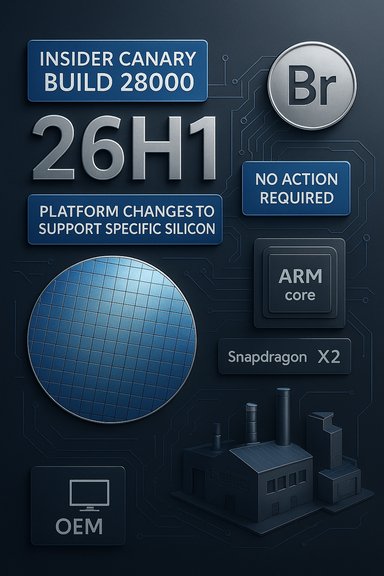
Tech infographic detailing Insider Canary build and silicon chips (ARM core, Snapdragon).
Microsoft has pushed a surprising but tightly scoped change into the Windows Insider Canary channel: a new Canary build that updates the visible version string to Windows 11, version 26H1, but — crucially — Microsoft says this is not the next general feature update for the installed base; it’s a platform-only branch aimed at enabling support for specific, next‑generation silicon.

Background / Overview​

Microsoft released Windows 11 Insider Preview Build 28000 to the Canary channel and updated the version shown in Settings → System → About (and winver) to 26H1. The Windows Insider blog describes the flight as containing “a small set of general improvements and fixes” and explicitly states that “26H1 is not a feature update for version 25H2 and only includes platform changes to support specific silicon.” There is no action required from customers. This short announcement has two simple but important implications. First, the visible version bump is primarily a signal to OEMs and silicon partners that Microsoft has created a new platform baseline — reported in industry coverage as Bromine — that will be used to validate low‑level kernel, driver and firmware integrations for hardware that departs from today’s platform expectations. Second, mainstream feature work remains on the 25H2 branch, and Microsoft continues to assert an annual feature cadence (with the next broad update expected in H2), leaving 26H1 as a device-targeted engineering branch rather than a mass-market rollout.

What Microsoft actually said — the official position​

  • Microsoft published the Canary notes for Build 28000 and changed the versioning to 26H1 in the UI. The blog post pairs that visible change with a short, direct clarification: “26H1 is not a feature update for version 25H2 and only includes platform changes to support specific silicon. There is no action required from customers.”
  • Microsoft also reiterated that 25H2 remains the primary branch for feature development and that Windows 11 will continue with an annual H2 feature update cadence. Insiders — and partners — should treat Canary as the earliest testbed for platform plumbing, while Dev/Beta receive feature-first experiences.
Those short, unequivocal sentences are the operative guidance: for enterprise administrators and everyday users, this Canary bump is a heads‑up, not a migration order.

The build, the codename and the engineering pattern​

Build 28000 and “Bromine”​

Build 28000 in Canary is being reported widely as the first public snapshot of the new platform branch sometimes identified in reporting as Bromine. That codename and build-range behavior are typical of Microsoft’s engineering workflow: Canary is used to surface platform-level changes early in the cycle, even when those changes will only be applied to a narrow set of devices. The visible version number (26H1) is therefore best read as a platform tag rather than a promise of new consumer features.

Why Microsoft uses platform branches​

Modern SoCs, particularly high-end Arm PC designs, integrate large NPUs, revised memory subsystems, new GPU and ISP designs, and firmware models that change how the OS interacts with the silicon. Those changes often require kernel, scheduler, driver and power‑management work that is deeper than a typical feature enablement package can safely provide to the entire installed base.
By carving a narrow platform branch:
  • Microsoft can co‑validate drivers and firmware with OEMs before devices ship.
  • OEMs receive a known‑good, signed image to flash at factory time.
  • Microsoft can avoid introducing risky low‑level changes into the universal servicing stream for all devices.
This engineering pattern reduces launch-day regressions while preserving a predictable feature cadence for the broad Windows ecosystem.

Is this about Qualcomm’s Snapdragon X2 (and Nvidia N1X)?​

Microsoft’s Canary announcement does not name specific silicon. However, multiple independent outlets and community research point to Qualcomm’s Snapdragon X2 family (marketed as Snapdragon X2 Elite and X2 Elite Extreme) as the leading candidate that precipitated this platform branch. Reporting also mentions NVIDIA‑class Arm efforts (sometimes referenced as N1/N1X) as potential additional drivers for platform work. Treat these vendor attributions as well‑supported industry inferences rather than direct Microsoft confirmations. Qualcomm announced the Snapdragon X2 family at its Snapdragon Summit, describing a generational jump that includes:
  • Third‑generation Oryon CPU cores built on a 3nm process, with top boost clocks reported up to 5.0 GHz on flagship X2 Elite Extreme parts.
  • Up to 18 CPU cores on some SKUs (12 Prime + 6 Performance on top‑bin parts).
  • An upgraded Hexagon NPU with quoted performance around 80 TOPS (INT8) for certain X2 SKUs.
  • Larger caches, higher memory bandwidth (reported tables show up to 228 GB/s for the Extreme SKU), improved Adreno GPU clocks and modern connectivity (Wi‑Fi 7, modem family support).
Those attributes are exactly the sort of platform‑level changes that can require OS‑level plumbing beyond what a servicing package can safely apply to every PC.

Cross‑checking the major claims​

  1. Microsoft changed the visible version to 26H1 and called the build out in Canary: verified directly via the Windows Insider blog post announcing Build 28000.
  2. Microsoft’s message that 26H1 is not a feature update for 25H2 and only includes platform changes: present verbatim in the Canary release notes and confirmed by multiple independent outlets reporting on the blog post.
  3. Snapdragon X2 is the most likely silicon target for Bromine: Qualcomm’s Snapdragon X2 announcement, plus multiple hardware outlets, describe X2’s new NPU/GPU/CPU characteristics and early‑2026 hardware windows — the timing and scope match the need for a platform branch. This vendor‑linkage is a credible industry inference supported by technical fit and timeline, though Microsoft did not explicitly name Qualcomm in the Canary post. Flagging: vendor attribution remains an informed hypothesis until Microsoft or the OEMs explicitly confirm the device–OS pairing.

Practical implications — consumers, OEMs, and IT​

For consumers and general users​

  • No action required: Microsoft’s Canary announcement explicitly says there is no action required from customers. Home users who keep Windows Update on its default consumer track won’t be forced onto 26H1.
  • New devices: expect some upcoming Windows on Arm laptops (reported to ship in early 2026) to ship with Bromine/26H1 images preinstalled if the vendors require the new platform plumbing to expose on‑device AI features and tuned power characteristics.

For OEMs and silicon partners​

  • A coordinated factory image: Bromine allows OEMs to ship devices with a validated OS image that includes the necessary drivers and firmware hooks for NPUs, ISP pipelines and heterogeneous core scheduling.
  • Certification and day‑one support: OEMs can reduce day‑one patch risk by integrating platform‑specific fixes into the device image rather than relying on post‑ship servicing.

For IT administrators and enterprise​

  • No immediate mass migration: Windows 11 version 25H2 remains the primary feature branch for broad deployment; IT fleets won’t be coerced onto 26H1 simply because fresh devices use a different platform image.
  • Validation posture: enterprises buying new Arm‑based Copilot+ devices should consider device validation cycles that include driver and firmware testing on the vendor‑shipped image. If the new devices ship with Bromine/26H1, expect a different servicing baseline for those systems.
  • Canary caveats: Insiders who join Canary to test platform builds may find it difficult to revert to Dev/Beta/Release Preview without a clean install because platform branches can introduce setup and image differences incompatible with other channels. That’s the standard Canary tradeoff.

Developer and ISV guidance​

Independent software vendors and driver teams should treat Bromine as a device‑targeted engineering snapshot that could expose new kernel APIs, runtime ABIs or driver expectations. Key focus areas:
  • Verify kernel‑mode and user‑mode drivers for compatibility with the new platform ABI and scheduler behavior.
  • Test NPU runtime bindings and model manifests (Hexagon or other vendor NPUs) to ensure correct attestation and secure runtime behaviors.
  • Validate power and thermal policies across heterogeneous core topologies; some SoCs use mixed core strategies that require scheduler hints and governors tailored to the silicon.
  • Plan for targeted imaging and driver delivery mechanisms that let bridges be built between Bromine‑based devices and enterprise toolchains.
The short version: prepare for early collaboration with OEMs and silicon partners, and include Bromine‑based devices in ISV compatibility matrices if the hardware will appear in customer environments.

Benefits of the split‑track approach​

  • Day‑one device compatibility: OEMs and silicon vendors ship systems with an OS image that exposes the hardware’s full capabilities on day one.
  • Reduced risk to the broad install base: deep platform changes remain gated to devices that need them, minimizing accidental regressions on existing Intel/AMD PCs.
  • Faster co‑validation loops: Canary allows Microsoft, OEMs and silicon vendors to iterate early on fixes that touch kernel, driver and firmware layers.
These are pragmatic wins when the hardware landscape changes rapidly — especially for Arm PC designs with large NPUs and new power/thermal envelopes.

Risks and potential downsides​

  • Fragmentation and complexity: a device‑specific platform branch increases complexity for QA, ISV support and enterprise management. Organizations must track two servicing baselines if they operate Bromine‑based devices alongside the mainstream fleet.
  • Communication friction: visible version changes (26H1) can be misread by consumers and administrators as a universal feature release. Microsoft’s explicit clarifications mitigate this, but confusion could still arise if OEM marketing or retailer descriptions fail to explicitly communicate device gating.
  • Support and servicing divergence: Bromine devices may follow different KB and servicing behavior for low‑level fixes, complicating patch policies and troubleshooting playbooks in heterogeneous environments.
  • Testing burden for ISVs: developers that rely on low‑level drivers or high‑performance computing stacks must expand test matrices to include Bromine images and new NPU runtime flows.
Each of these issues is solvable — but they require early planning and a coordinated testing strategy between OEMs, Microsoft and customers.

Timeline and what to expect next​

  • Canary Build 28000 surfaced in November 2025 and updated the visible version to 26H1, with Microsoft stressing it is a platform change only.
  • Qualcomm’s Snapdragon X2 family was announced in late‑2025 with vendors and media projecting first devices in early 2026. That device timing aligns with the engineering need for a platform baseline such as Bromine.
  • Microsoft maintains its annual H2 feature cadence: expect the broad consumer/enterprise feature update 26H2 in the second half of the year (H2 2026) under Microsoft’s stated plan. Features that require the new platform may be gated to Bromine devices first and then delivered to the mass market via the H2 feature update or enablement packages.

How to prepare (checklist for IT teams and power users)​

  1. Inventory: identify any new Arm‑based devices planned for purchase and ask OEMs whether the device will ship with a Bromine/26H1 image.
  2. Validate: plan early validation of device images in a lab environment; prioritize driver, firmware, and model runtime testing.
  3. Segregate: maintain separate servicing channels or update rings for Bromine devices during piloting to avoid cross‑pollination of platform-specific fixes.
  4. Coordinate with OEMs: secure driver bundles and recovery images from OEMs and ensure rollback paths exist.
  5. Communicate: document to end users and stakeholders that a visible version bump does not imply an urgent required upgrade for current machines.
These steps reduce operational surprise and allow organizations to adopt next‑gen silicon without destabilizing their existing fleet.

What remains unconfirmed — and what to watch​

  • Microsoft did not explicitly name Qualcomm (or any other vendor) in the Canary release; the Snapdragon X2 connection is derived from independent reporting, OEM signals and timeline alignment. That vendor attribution is credible but not officially confirmed by Microsoft in the Build 28000 announcement. Exercise caution when planning purchases based on media linkage alone.
  • Whether Bromine will remain a short‑lived, factory‑image baseline for a small set of devices or evolve into a longer‑lived servicing branch is unknown. Microsoft’s messaging suggests a narrow scope for now, but future decisions may change how tightly the company gates and services platform branches.

Bottom line​

Microsoft’s Canary‑channel publication of Windows 11, version 26H1 (Build 28000) is an engineering move: a targeted platform branch intended to enable specific next‑generation silicon rather than a universal Windows 11 feature update. For most users and enterprises, the practical takeaway is simple — no action required and continue to treat 25H2 as the current production feature baseline. For OEMs, silicon partners and ISVs, this is a call to coordinate: Bromine (Build 28000) will be where deep driver, firmware and runtime integration gets validated for new Arm‑class chips. This model reduces day‑one risk for new devices while protecting the broader Windows population — but it raises real testing, servicing and communication challenges that vendors and IT teams must address before the first Bromine‑based PCs hit desks in early 2026.
Source: heise online Windows 11 26H1: Support for specific processors
 

Microsoft has quietly flipped the visible Windows version string to Windows 11, version 26H1 in the Canary Channel — but this is not a conventional consumer feature update; it is a narrowly scoped, platform-only branch intended to enable support for “specific silicon,” and Microsoft says ordinary customers do not need to take any action.

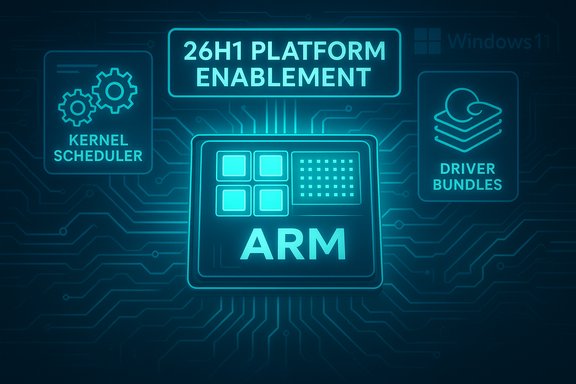
ARM platform enablement with 26H1, kernel scheduler, and driver bundles.Background / Overview​

Microsoft’s recent Canary release (Insider Preview Build 28000) updates winver and Settings to show 26H1, but the company’s public note is explicit: “26H1 is not a feature update for version 25H2 and only includes platform changes to support specific silicon.” That language reframes 26H1 as an engineering branch, not the next broad H2 feature rollout.
This move follows a pattern Microsoft has used in the last several releases: keep major feature development on an annual H2 cadence while using targeted branches and device-specific images to validate deep, low-level platform changes for new hardware families. The Canary Channel is therefore acting as a staging ground for OS plumbing — kernel, scheduler, drivers, NPU runtimes and firmware attestation — that new Arm and AI-centric SoCs require.

What Microsoft actually released (and what it means)​

The public messaging​

Microsoft’s Canary notes for Build 28000 describe only a small number of user-visible fixes (for example, Live Captions stability and an Outlook credential dialog fix) while explicitly saying the build’s purpose is platform enablement for “specific silicon.” The company further reiterates that 25H2 remains the primary place for new features, and Windows will keep an annual feature cadence with the next broad feature update expected as 26H2 in H2.

The technical takeaway​

Labeling a build 26H1 while limiting it to platform work accomplishes two engineering goals:
  • Provides a validated OS baseline OEMs can ship preinstalled on devices that require non‑trivial OS changes at day one.
  • Keeps the consumer-facing feature stream stable and predictable for the broad installed base.
This is pragmatic: new SoCs — particularly those with large NPUs and heterogeneous core topologies — often need kernel/scheduler tweaks, new driver stacks, attestation hooks for on‑device models, and power/thermal policy adjustments that aren’t suitable for a universal push to billions of existing machines.

Why a platform-only branch is likely required now​

Heterogeneous cores, NPUs and complex firmware interactions​

Modern Arm PC-class SoCs are not just “faster processors.” They are heterogeneous systems combining:
  • Multiple CPU core types and high core counts.
  • Large, vendor-specific NPUs and associated runtime stacks.
  • Redesigned GPU/ISP and media pipelines.
  • New firmware semantics for attestation and secure model execution.
Each of these components touches low-level OS interfaces — scheduling, driver signing, attestation, memory management and power governance — and can require coordinated changes across Microsoft, the silicon vendor, and OEM firmware. A narrow platform branch lets this co‑engineering happen in a constrained environment.

Precedent: Copilot+ and gated features​

Microsoft has previously gated AI-heavy features to qualifying Copilot+ devices that had the required NPUs and firmware attestation models. That same playbook — release device-targeted OS images that deliver day‑one compatibility and gated user experiences — appears to be the model behind 26H1.

Which silicon is most likely in scope?​

Microsoft’s note intentionally omits vendor names, but community reporting and industry announcements point to two likely candidates:
  • Qualcomm Snapdragon X2 family (X2 Elite / X2 Elite Extreme) — industry materials and independent reporting describe the X2 family as a generational leap for Windows on Arm with a new Oryon CPU microarchitecture, 3nm-class process nodes for flagship SKUs, and substantially larger Hexagon NPUs marketed in the tens of TOPS (some higher‑end figures cited around ~80 TOPS). Vendors have indicated first-wave devices are expected in early 2026.
  • NVIDIA N1x / N1-class designs (possible) — community chatter and some reporting have floated NVIDIA’s Arm-based plans as another potential target for Bromine/26H1, though that linkage is more speculative and should be treated cautiously until vendors confirm.
Important caveat: Microsoft’s Canary notes do not name Qualcomm or NVIDIA. The Snapdragon X2 hypothesis is strongly supported by timing and vendor announcements, but the vendor linkage remains an informed inference rather than a direct Microsoft confirmation. Treat claims of vendor exclusivity or long-term gating as provisional until Microsoft or an OEM issues a formal roadmap.

Snapdragon X2: technical implications and engineering demands​

What Qualcomm claims (and why it matters)​

Public materials from Qualcomm and reporting by independent outlets (as aggregated by community research) characterize X2-class parts as:
  • New Oryon CPU cores on a 3nm-class process.
  • Larger Hexagon NPUs targeting high TOPS for on‑device inference workloads.
  • Upgraded Adreno GPUs and higher memory bandwidth, plus modern I/O stacks (PCIe Gen5, Wi‑Fi 7 etc..
  • A device availability window in early 2026.
These hardware leaps create the precise class of OS work that justifies a dedicated platform branch: DCH driver bundles, NPU runtimes and secure manifests, attestation hooks for model execution, and scheduler/power tuning for heterogeneous topologies.

Areas of OS work you should expect​

  • Kernel and scheduler updates to make efficient use of mixed-core layouts.
  • New driver packages for GPU, ISP, wireless and storage controllers.
  • Secure NPU runtimes and attestation pathways to enable on-device AI features.
  • Targeted servicing metadata so Microsoft/OEMs can flip features on for qualifying devices.
  • Emulation / compatibility improvements for Arm/x64 or x86/x64 scenarios where needed.

What Build 28000 contains (publicly visible)​

Microsoft’s Canary changelog for Build 28000 is intentionally compact. Publicly called-out items include:
  • Fixes for Live Captions stability.
  • An accessibility fix for the Outlook credentials/login dialog.
  • Canary-scale known issues such as Start menu scrolling oddities and reports of sleep/shutdown problems on some devices.
The visible changelog is deliberately light because the substantive changes — driver/firmware integration, scheduler tweaks, NPU runtime plumbing — occur beneath the public notes and are validated through partner co‑engineering channels.

Who this affects — and who it doesn’t​

Consumers and everyday users​

No immediate action is required. The ordinary Windows 11 update cadence remains unchanged: 25H2 is still the primary feature track, and general feature updates will continue on the H2 cycle (26H2 for broad feature delivery). Typical devices on Intel and AMD will not be forced onto the 26H1 platform branch.

Early adopters and Copilot+ buyers​

Users who purchase the first wave of Snapdragon X2 (or other qualifying) Copilot+ devices should expect vendor images that may ship with the Bromine/26H1 platform baseline preinstalled to ensure day‑one compatibility for NPU-enabled experiences. Those devices may expose new local AI features earlier than the broad install base.

Enterprises and IT admins​

Treat 26H1 as a vendor-specific OEM image — not a general servicing channel. If your organization plans to pilot X2 devices, run them in tightly controlled rings, validate endpoint agents, VPNs, antimalware/DRM and management tooling, and prepare for device‑targeted servicing and image variants. Microsoft’s device catalog/servicing mechanisms will likely be used to manage targeted enabling and rollbacks.

Developers and ISVs​

Priorities for developers shift toward:
  • Optimizing native Arm64 binaries and NPU-accelerated code paths.
  • Validating kernel-mode components, anticheat/DRM modules, and device drivers on Arm hardware early.
  • Designing fallback paths when NPU acceleration isn’t present.
If your app depends heavily on native code or hardware-accelerated AI, early access to X2 hardware and the Bromine platform image will shorten the feedback loop for tuning and compatibility.

Risks, downsides, and areas to watch​

1. Short-term fragmentation and support complexity​

A device-targeted platform branch increases the number of distinct Windows images and servicing paths OEMs and enterprises must manage. That raises the risk of confusion for consumers and IT admins around which devices receive which updates and when. Communication clarity from Microsoft and OEMs will be crucial.

2. Potential for perceived feature gating​

If Microsoft (or OEMs) expose AI features only on X2 or other qualifying devices for extended periods, the strategy could generate negative perceptions of feature gating. Historically, Microsoft has sometimes staged device-gated experiences to ensure quality, but prolonged exclusivity would pressure the broader ecosystem. Statements tying features to Copilot+ hardware in previous rollouts set precedent — but permanence would be contentious. Treat claims of permanent gating as provisional until explicitly documented.

3. Driver and third‑party compatibility risks​

Kernel and scheduler changes aimed at heterogeneous cores can expose fragile drivers and legacy kernel-mode components to regressions. Third-party drivers, anticheat, and specialized enterprise tooling must be validated on the new platform baseline. Proactive vendor coordination will reduce support incidents but cannot eliminate early teething issues.

4. Complexity for Insiders and testers​

Canary builds that exercise new platform branches can be difficult to revert from; Microsoft often requires a clean install to move out of Canary when platform baselines diverge. That increases the friction for testers who later want to return to Beta/Dev or Release Preview.

Recommendations​

For consumers​

  • Do not chase Canary builds unless you are comfortable with early, platform-level testing and potential reinstallation.
  • If buying a new Copilot+ Arm laptop at launch, verify the OEM’s support and driver policies and whether features will be enabled at purchase.

For enterprise IT​

  • Treat 26H1 devices as vendor-specific images and pilot them in isolated rings.
  • Validate endpoint management, VPN, SSO, and EDR on device images before broad deployment.
  • Coordinate with OEMs for driver/firmware bundles and servicing guidance.

For developers and ISVs​

  • Prioritize Arm64 builds and test NPU-accelerated workflows on qualifying hardware.
  • Validate interaction with kernel-mode components, DRM and anticheat modules on the platform baseline early to avoid late fixes.

What to watch next (timeline and signals)​

  • OEM announcements and prebuilt images for Snapdragon X2 systems will be a direct signal that the Bromine/26H1 platform is moving from Canary to OEM imaging. Watch for device availability windows pegged to early 2026.
  • Microsoft’s further guidance about whether 26H1 remains device-limited or will later be merged into the mainstream 26H2 branch is the single most important policy question for enterprises and ISVs. Until Microsoft clarifies, assume a staged, hardware-first approach.
  • Public details about NPU runtimes, attestation models, and DCH driver bundles will be the technical artifacts developers need to optimize AI workloads on-device. Expect those to appear via OEM SDKs and vendor documentation as devices near launch.

Final analysis: sensible engineering — with trade-offs​

Microsoft’s 26H1 Canary drop is a pragmatic engineering response to a predictable industry problem: when silicon changes meaningfully, the operating system needs a co‑engineered baselining phase to ensure day‑one compatibility. A device‑targeted platform branch reduces launch risk for OEMs and gives early adopters access to hardware-enabled experiences while preserving the mainline feature cadence for the broader user base.
However, this approach has trade-offs. It raises short‑term fragmentation and communication challenges, increases the burden on driver and third‑party software authors, and can create frustration if users perceive lasting feature gating. Those risks can be mitigated with clear vendor and Microsoft communication, robust OEM driver packaging, and early developer engagement — but they will require concerted effort from all ecosystem participants.
Microsoft’s explicit note that “there is no action required from customers” is accurate and important: this is engineering-first work intended to support new silicon, not a consumer-facing feature wave. Treat 26H1 as a targeted step in the platform lifecycle — one that will enable next‑generation Arm PC experiences if the ecosystem coordinates successfully.

Conclusion
Windows 11’s 26H1 Canary debut is a behind-the-scenes maneuver to prepare Windows for a new generation of Arm and AI-focused silicon. It’s a sensible, risk‑aware engineering pattern that prioritizes stability for the broad installed base while letting OEMs ship advanced hardware with a validated software baseline. The payoff — better day‑one compatibility and safer, lower-latency on‑device AI — will be meaningful if Microsoft, silicon vendors and OEMs execute co‑engineering tightly. The cost is short-term complexity: additional servicing paths, testing burden and the potential for perceived feature gating. Monitor OEM roadmaps, vendor SDKs and Microsoft’s servicing guidance closely; those signals will determine how smoothly the ecosystem handles this next wave of Windows-on-Arm devices.

Source: OC3D Microsoft preps Windows 11 26H1 for "specific silicon" - OC3D
 

Microsoft has quietly planted a new flag in the Windows roadmap: a device‑targeted platform baseline labeled Windows 11, version 26H1 — a plumbing‑first release (internally observed as the “Bromine” platform) that Microsoft is using to ready the OS for a new generation of Arm and AI‑centric silicon rather than to ship consumer features to the entire Windows install base.

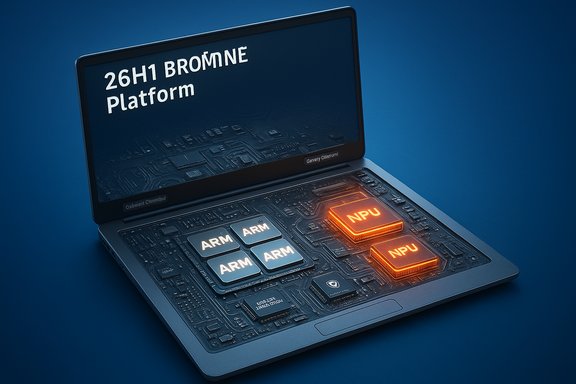
Laptop displays 26H1 Bromne Platform with glowing NPU chips and ARM blocks.Background / Overview​

Microsoft published a Canary‑channel build that surfaces the version string Windows 11, version 26H1 (Build 28000), and the company explicitly stated this flight “is not a feature update for version 25H2 and only includes platform changes to support specific silicon.” That language frames 26H1 as a platform baseline for OEM and silicon partner co‑engineering, not the next broad consumer feature drop. Community telemetry and industry reporting have linked the Bromine/26H1 effort to two headline silicon efforts: Qualcomm’s Snapdragon X2 family (marketed for Copilot+ Windows PCs) and the leaked / rumor‑driven NVIDIA N1X class of Arm SoCs. Those connections are technically plausible given the timing and the substantial low‑level OS work new NPUs, firmware models, and heterogeneous cores demand — but the vendor link is an industry inference rather than a verbatim Microsoft confirmation.

What 26H1 / Bromine actually is — and how it differs from a regular feature update​

Platform baseline versus feature update​

26H1 is platform‑first: it packages kernel adaptations, driver/firmware contracts, NPU runtime plumbing, attestation hooks, and power/scheduler tuning into a validated OEM image. Microsoft has used similar targeted images previously when deep hardware changes risked destabilizing the broader Windows population. The Canary build’s terse public changelog intentionally emphasizes low‑level stability work rather than consumer‑facing features.

Why Microsoft chose a narrow, device‑targeted route​

Modern PC SoCs increasingly integrate large NPUs, reworked memory topologies, and new firmware semantics that touch kernel scheduling, secure attestation, driver signing, and power management. Retrofitting those changes into the mainstream servicing branch risks regressions on millions of existing machines; a constrained platform image lets Microsoft, the silicon vendor, and OEMs validate everything together and ship a known‑good, signed image from the factory.

The technical shape of the problem: what OS changes Silicon like Snapdragon X2 and N1X require​

New-generation Arm laptop SoCs are not merely faster CPUs. They come with multiple architectural shifts that demand OS cooperation:
  • Large NPUs and local model execution — OS needs signed runtime stacks, protected model attestation, and privileged drivers that expose accelerators safely to user‑mode runtimes.
  • Heterogeneous / hybrid core layouts — schedulers and governor policies must be adapted to avoid performance regressions or poor power behavior.
  • Firmware and secure-enclave changes — attestation, keys, and sealed model execution involve firmware/OS contract changes that must be validated end‑to‑end.
  • New DCH driver bundles and media/ISP pipelines — validated driver packaging is essential for day‑one stability and certification.
These are the kinds of changes Microsoft’s Canary notes and community captures indicate Bromine is meant to carry.

Snapdragon X2: the leading practical trigger​

What Qualcomm is shipping (public claims)​

Qualcomm’s Snapdragon X2 family — publicly described as X2 Elite and X2 Elite Extreme — was positioned as a major generational step for Windows on Arm: new Oryon CPU cores built on a 3nm‑class process, up to 18 cores on some SKUs, high peak clocks, much higher memory bandwidth, and dramatically larger Hexagon NPUs marketed into the tens of TOPS (some public figures quote ~80 TOPS for top SKUs). Industry hands‑on and benchmark coverage has amplified these numbers.

Why X2 forces OS work​

The combination of more NPU TOPS, higher memory bandwidth, new GPU/ISP pipelines, and hybrid CPU layouts is exactly the class of hardware that benefits from kernel scheduler changes, tuned power governors, and validated NPU runtimes. Device teams want those pieces in the factory image so features that depend on local AI (Copilot+ experiences, local assistants, on‑device inference) behave predictably from day one. That reality explains why Microsoft would prepare a Bromine baseline timed to the X2 shipping window.

What to treat with caution​

Public TOPS figures, cache sizes, and clock specs reported in early coverage come from vendor materials and early benchmark leaks. While the broad architecture and vendor claims are credible, final retail performance and thermal behavior remain OEM‑dependent and sensitive to firmware/drivers. Treat specific TOPS or clock numbers as vendor claims and early benchmarks rather than immutable final specs.

NVIDIA N1 / N1X: powerful, plausible — but still rumor‑heavy​

Leakage and benchmarks​

NVIDIA’s reported Arm efforts (N1 / N1X) have surfaced repeatedly in leak feeds and benchmark traces, some showing engineering samples running Windows and Linux. Those traces have prompted community speculation about Microsoft needing Bromine to support a second Arm entrant into Windows laptops, especially where very large NPUs or Blackwell‑derived GPU blocks are involved. Independent outlets have published FurMark and Geekbench leak writeups that confirm Windows evaluations of engineering N1X silicon, but the performance data varies widely and should be read as early engineering sample behavior.

Why N1X is still speculative in official terms​

Unlike Qualcomm’s public X2 announcement and vendor specs, NVIDIA has not announced N1X consumer launches and reported timelines have shifted. Some supply‑chain reporting suggests slips into late 2026 for certain SKUs. As with X2, the Bromine connection is logical — but the N1X linkage remains circumstantial pending vendor/OEM confirmations.

Practical implications for stakeholders​

For OEMs and hardware teams​

  • Ship devices with a factory image that includes validated drivers, signed firmware blobs, and NPU runtimes.
  • Reduce day‑one patch risk by co‑engineering the OS image, signing it, and using Microsoft certification/whitelisting workflows.
  • Maintain a clear servicing cadence for Bromine‑based devices (patch channels, rollback pathways, and update tokens).
OEMs get a smoother launch path, but they must coordinate tightly with Microsoft on image signing and servicing cadence. The Bromine approach front‑loads validation but increases logistical complexity during initial deployment.

For consumers and early adopters​

  • New Copilot+ or X2‑class Windows laptops purchased at launch are likely to ship with the Bromine/26H1 image to ensure on‑device AI features work as promised.
  • No immediate action required for ordinary users on existing Intel/AMD devices: Microsoft’s blog emphasizes 25H2 remains the primary feature branch.

For enterprise IT teams​

  • Expect a short period where newly procured Arm devices run a Bromine baseline while the wider fleet remains on 25H2/26H2.
  • Validate images, driver inventories, and management tooling on Bromine devices in isolated test rings before broad deployment.
  • Update and recovery playbooks should be tested for the Bromine image; Insiders switching channels often require clean installs, and platform‑branch recovery can be more complex.

For developers and ISVs​

  • Drivers, kernel‑mode components, and any software that interfaces with NPUs, hypervisors, or firmware must be tested against the Bromine baseline and OEM driver stacks.
  • Developers of AI‑accelerated apps should evaluate whether Bromine devices expose new runtime APIs or attestation flows (and plan conditional logic for feature gating).
  • Encourage native Arm64 builds where feasible; Bromine can reduce friction for Arm‑native binaries and improve local AI performance.

Compatibility, emulation, and the app landscape​

One perennial concern is how older x86 / x64 binaries behave on new Arm platforms. Microsoft ships translation layers, but the real-world experience depends on scheduler behavior, memory topology, and driver correctness.
  • Native Arm64 apps will benefit most from X2/N1‑class NPUs and memory architectures.
  • Translation heuristics and scheduling policy changes in Bromine could meaningfully affect heavy x86 workloads — either improving or regressing performance depending on tuning.
  • Kernel‑mode drivers and legacy platform extensions remain the Achilles’ heel; Bromine’s device‑first image is intended to include tested driver bundles to minimize those failure modes.

Servicing, update model, and fragmentation risk​

Microsoft’s choice to gate platform changes into a device‑specific branch reduces immediate ecosystem risk but introduces short‑term fragmentation:
  • Devices shipping Bromine will likely follow a slightly different servicing baseline than mainstream 25H2/26H2 PCs.
  • Communication clarity will be critical: consumers and IT must know whether features are available only on Copilot+ devices, and which updates apply to Bromine images versus general Windows Update channels.
  • Microsoft has targeted deployment tools (enablement packages, Known Issue Rollbacks, and device‑level tokens) to help manage differential rollouts, but OEMs and enterprises will need to coordinate to avoid patch‑management surprises.

Strengths of Microsoft’s approach​

  • Reduces day‑one regressions: Shipping a validated Bromine image ensures drivers, firmware, and runtime stacks are tested together on hardware that demands special plumbing.
  • Enables secure on‑device AI: A platform that includes attestation hooks and NPU runtime contracts is essential for trustworthy Copilot+ experiences.
  • Keeps mainstream cadence stable: By separating platform plumbing from consumer feature development, Microsoft preserves the annual H2 feature rhythm for the broad install base.

Risks, trade‑offs and open questions​

  • Fragmentation and messaging: Customers and IT teams could be confused by devices shipping on a different baseline. Clear OEM and Microsoft messaging will be essential.
  • Vendor gating and exclusivity concerns: If certain Copilot+ features are only available on Bromine devices initially, that could fuel perceptions of vendor exclusivity; public confirmation is needed to separate rumor from plan.
  • Patch complexity: Different servicing baselines increase testing overhead for enterprises and slow the adoption of security fixes if not handled consistently.
  • Unverified leak data: Some performance and TOPS claims are still early‑benchmark or vendor‑provided numbers; treat them as provisional until final retail hardware is tested.

Timeline, verification, and what to watch next​

  • Microsoft’s Canary blog shows Build 28000 and the 26H1 version string; expect Canary telemetry and OEM engagements in the coming months as Bromine matures.
  • Qualcomm has publicly documented the Snapdragon X2 family and signaled early‑2026 device availability; vendor materials and independent coverage suggest X2 is the practical near‑term trigger for Bromine.
  • NVIDIA N1/N1X remains plausible but more leak‑dependent; treat N1X as a potential secondary catalyst rather than a confirmed target until vendors or OEMs make explicit statements.
Flagged uncertainties: Microsoft’s Canary note does not name Qualcomm or NVIDIA in its public text; linking 26H1 to specific chips is an informed industry inference supported by telemetry and vendor timing but not an explicit Microsoft declaration. That distinction matters for planning and procurement.

Practical checklist for IT, OEMs and early buyers​

  • For OEMs: finalize signed device images with Bromine integrations well ahead of shipping to pass Microsoft validation and to ensure day‑one driver consistency.
  • For enterprises: create isolated test rings for Bromine devices, validate management tooling, and confirm rollback/recovery procedures.
  • For developers: test native Arm64 builds and translation scenarios against Bromine Canary images where possible; coordinate with OEMs for driver/SDK updates.
  • For early buyers: request explicit documentation from the OEM about which Windows version ships on the device, how updates will be delivered, and which Copilot+ features are enabled out of the box.

Final analysis and verdict​

Microsoft’s Canary release of Build 28000 and the 26H1 label is a pragmatic engineering response to a changing silicon landscape: big NPUs, hybrid cores, and novel firmware semantics require coordinated OS, firmware and driver validation to deliver reliable on‑device AI and strong day‑one experiences. Executed transparently and with careful OEM and enterprise coordination, the Bromine/26H1 model can accelerate the arrival of compelling Copilot+ hardware while minimizing user pain. That said, the approach raises short‑term risks: messaging complexity, servicing fragmentation, and the potential for perception of vendor gating if features are initially limited to Bromine devices. Prudence dictates treating vendor performance figures and precise shipping dates as provisional until retail hardware is tested; organizations evaluating early Arm systems should insist on clear documentation about the shipped image, supported features, and the servicing path.
The net effect is clear: Windows is evolving from a passive substrate into an active partner in silicon enablement. For hardware innovation to deliver usable, reliable local AI and long battery life, OS vendors must co‑engineer closely with silicon and OEM partners — and Microsoft’s 26H1/Bromine move is an explicit acknowledgement of that new reality.

Conclusion: 26H1 is not the next mass‑market feature update; it is a platform tool designed to let OEMs ship the next generation of Arm and AI‑first laptops — especially Snapdragon X2 systems — with a validated Windows image. Watch the Canary channel and OEM briefings over the next six months for Bromine maturation, but plan IT validation and procurement with a cautious, test‑first posture to avoid surprise servicing headaches.
Source: HotHardware Microsoft Preps Windows 11 26H1 For A New Breed Of Snapdragon X2 & NVIDIA N1 Silicon
 

Microsoft’s Canary-channel drop of Windows 11, version 26H1 (Build 28000) is real — but it is not a broad consumer feature update and will only be delivered to a narrow set of new devices that require deeper, low‑level platform work. Microsoft made this explicit in the Windows Insider Blog, describing the release as a platform-only update intended to “support specific silicon,” and stressing that 25H2 remains the primary feature track and that ordinary customers do not need to take action.

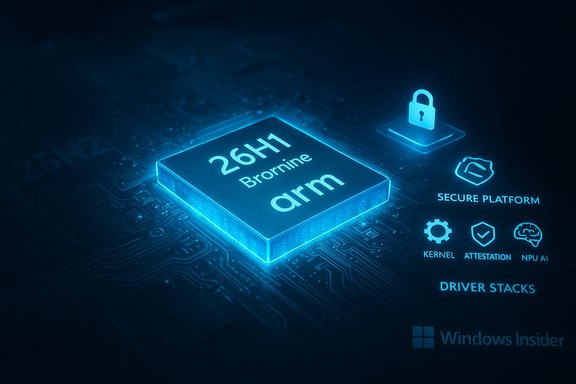
Glowing blue ARM processor chip labeled 26H1 Bromine ARM on a circuit board with security icons.Background / Overview​

Microsoft’s Windows release model since Windows 11 has largely favored a single annual H2 feature cadence supplemented by targeted servicing and staged enablement. The Canary-channel preview that surfaced as Build 28000 changed the visible version string to Windows 11, version 26H1, but the company’s note could not have been clearer: this is a platform enablement branch, not the next general-purpose feature rollout for the billions of existing Windows PCs. Industry reporting and community telemetry have attached an internal platform codename — widely discussed as Bromine — to the 26H1 engineering stream. That codename and the build number (28000) are being treated by analysts and OEM watchers as the baseline Microsoft will hand to hardware partners when they require kernel, scheduler, driver, attestation and runtime changes that can’t be safely grafted into the sweeping 25H2 servicing baseline.

What Microsoft actually released​

  • An Insider Preview — Build 28000 — posted to the Canary channel.
  • A visible version string change to Windows 11, version 26H1 in Settings and winver.
  • A public framing that the build “is not a feature update for version 25H2 and only includes platform changes to support specific silicon.” Microsoft added that there is “no action required from customers.”
The public changelog is intentionally minimal: a handful of small stability fixes and a few known Canary-level issues (for example, Live Captions fixes and reported occasional sleep/shutdown oddities). The visible changelog deliberately understates the significance because the meat of 26H1 is under the hood: kernel plumbing, driver and firmware contracts, NPU runtime hooks, and scheduler/power policies.

Why Microsoft is taking this route​

The engineering problem​

Modern PC-class SoCs — particularly the newest Arm laptop chips — are not just incremental CPU/GPU upgrades. They frequently introduce:
  • Heterogeneous and higher core counts with new scheduling needs.
  • Large on‑die NPUs and new AI runtimes requiring attestation and secure execution.
  • New media/ISP pipelines and driver packaging requirements.
  • Distinct firmware semantics and power/thermal domains.
When these changes are substantial, bending the existing servicing branch (25H2) to accommodate them risks destabilizing the broader Windows base. Creating a constrained platform branch lets Microsoft co‑engineer with OEMs and silicon partners, validate day‑one images, and reduce the blast radius of low‑level regressions.

The market timing problem​

Qualcomm’s next-generation Snapdragon family (commonly referenced as the X2 series) and industry chatter about potential Arm silicon from other vendors (e.g., Nvidia’s N1X rumors) put Microsoft in a position where OEMs want to ship devices early in 2026. Those device launches require an OS baseline that understands new NPUs, firmware attestations, and driver stacks. A device-targeted platform branch enables manufacturers to image and ship hardware confidently without waiting for the usual H2 feature release.

Who will — and won’t — receive 26H1 at launch​

  • Will likely receive 26H1 at launch:
  • First-wave new Arm-based PCs and other systems whose hardware requires the platform plumbing present in Build 28000. OEMs may ship devices with a 26H1-based factory image so drivers, attestation, and on-device AI features work correctly on day one.
  • Will not receive 26H1 at launch:
  • The vast majority of existing Windows 11 PCs — especially Intel and AMD x86 systems — are not expected to be forced onto 26H1. Microsoft reiterates that 25H2 remains the mainline place for new features and that the ordinary annual H2 feature cadence (26H2) will still be used for broad consumer and enterprise distribution.
Microsoft deliberately avoided naming specific silicon vendors in its Canary announcement. Independent reporting and timing alignment point strongly at Snapdragon X2 and other next‑gen Arm chips, but Microsoft’s public wording stops short of naming partners. Treat vendor linkage as probable and well-supported by timelines, not as an explicit Microsoft guarantee.

What 26H1 likely contains (technical breakdown)​

26H1’s public notes show only minor user-facing fixes; the important work is in platform-level changes that typically include:
  • Kernel and scheduler tuning for heterogeneous CPU topologies and new microarchitectures.
  • Power and thermal governance updates aligned to new SoC power envelopes.
  • DCH driver bundles and vendor-specific media/ISP/GPU stacks.
  • NPU runtime integration, secure model attestation and secure‑enclave hooks for on‑device AI.
  • Servicing metadata and device catalog entries enabling targeted rollout/rollback for qualifying hardware.
These are the exact kinds of changes that are hard to backport cleanly to an existing shared servicing baseline, which justifies a parallel platform image.

Benefits of Microsoft’s approach​

  • Reduced day‑one risk for OEMs: shipping a validated image (Bromine/26H1) reduces the chance of driver/firmware incompatibilities when devices first reach consumers.
  • Faster time to market for new silicon: OEMs can announce and ship hardware on schedule because the OS baseline has the required plumbing.
  • Preserved stability for the many existing PCs: by keeping major feature work on the 25H2 branch, Microsoft reduces the odds of large-scale regressions affecting users who don’t need these platform changes.

Risks, tradeoffs and practical downsides​

  • Fragmentation confusion: visible version numbers matter. Moving a subset of devices to 26H1 while the rest remain on 25H2 can confuse consumers, IT teams, and channel partners unless communication is crystal clear.
  • Management and deployment complexity: enterprises will need clear guidance for WSUS, Intune and other management tooling to identify device-targeted servicing and to create appropriate pilot rings.
  • Support and servicing differences: devices on a separate platform branch may have different servicing metadata, rollback tokens, or driver lifecycles, complicating patching and support contracts.
  • Potential gating or feature exclusivity: if on-device AI features rely on specific NPU attestations or hardware capabilities, the first-wave experience may feel exclusive to buyers of qualifying hardware. That creates both marketing differentiation and long-term parity questions.

What this means for key audiences​

Consumers​

If you own a Windows 11 PC today (Intel/AMD or existing Arm devices), you do not need to take any action. Your machine will continue to receive mainstream updates on 25H2 and then 26H2 in the normal H2 cadence. The 26H1 Canary bump is primarily a heads‑up about new hardware arriving in early 2026.

IT administrators and enterprises​

  • Inventory upcoming purchases for early‑2026 Arm hardware and confirm whether vendor images will be Bromine/26H1‑based.
  • Build a pilot ring for any first‑wave devices; validate management tooling, identity flows, security baselines and imaging workflows.
  • Ask OEMs for explicit servicing guidance — how will feature parity be tracked? How will firmware and driver updates be delivered?

OEMs and silicon partners​

  • Use the Bromine/26H1 baseline to finalize driver bundles and factory images. Coordinate on signed firmware blobs, WHQL/driver signing and attestation flows so day‑one features like secure model execution are stable.
  • Communicate clearly at point of sale which on‑device AI or hardware‑gated features require the Bromine platform and how that affects future updates.

ISVs and app developers​

  • Expand Arm64 testing and prepare graceful fallbacks for NPU‑dependent code paths so experiences degrade smoothly when acceleration is absent.
  • Work with OEMs to test on device images before devices ship to customers.

Frequently asked technical questions (short answers)​

  • Will 26H1 come to my Intel/AMD PC automatically? No — Microsoft explicitly stated 26H1 “is not a feature update for version 25H2” and it will not be a broad push to the general install base.
  • Is 26H1 the start of a return to H1/H2 semiannual features? No — Microsoft says it will maintain the annual H2 feature cadence. 26H1 is a targeted platform branch tied to hardware needs, not a reversion to twice-yearly consumer feature releases.
  • Does 26H1 mean Windows is becoming like macOS (hardware-specific OS variants)? Not necessarily. The 26H1 platform branch is a pragmatic engineering move to manage major platform changes while preserving mainstream servicing. Whether Microsoft turns this into a recurring pattern remains to be seen. Treat that outcome as plausible but not yet confirmed.

Short practical checklist (what to do now)​

  • Consumers:
  • Confirm your current version with Settings → System → About or winver; no action required for most users.
  • IT teams:
  • Identify any planned purchases of early‑2026 Arm devices and request OEM servicing/patching documentation.
  • Create a controlled pilot ring for Bromine/26H1 devices.
  • Verify Intune/WSUS visibility for any device-targeted servicing tokens.
  • Developers:
  • Prioritize Arm64 and NPU-absent fallback testing. Coordinate with OEMs for access to preview hardware or Bromine images.
  • OEMs:
  • Test factory imaging workflows on the 26H1 baseline and publish clear customer-facing documentation describing hardware-gated features and future update mechanics.

Longer-term implications and scenarios​

  • Conservative scenario — one-off platform branch:
  • 26H1 functions as a one-time engineering baseline to enable Snapdragon X2 and similar silicon.
  • Feature parity for mainstream users remains achieved on 26H2 in H2 2026.
  • Minimal long-term fragmentation.
  • Repeated device-first approach:
  • Microsoft formalizes a pattern: create device-targeted platform branches whenever new silicon generations require deep OS changes.
  • Benefits: faster launches for OEMs, better day‑one AI experiences.
  • Risks: greater messaging complexity and potential enterprise confusion over servicing differences.
  • Feature gating becomes more common:
  • If on‑device AI or other experiences require NPU attestation, some features may remain effectively gated to devices that ship with Bromine at launch.
  • Microsoft could later fold those features into the mainstream via enablement packages, but perception of exclusivity could persist.

Critical assessment — strengths and concerns​

Notable strengths​

  • Pragmatic engineering: Microsoft recognizes the need for coordinated OS, firmware, and driver work when silicon evolves significantly. A platform branch reduces launch‑day risk and speeds hardware availability.
  • Preserves stability for the majority of users: by avoiding a blanket servicing redesign, Microsoft protects the broader installed base from low-level regressions that can result from large platform changes.

Potential risks and downsides​

  • Communication friction: version labeling (26H1) can create confusion if users interpret it as "the next big update for everyone." Microsoft’s explicit note helps, but retailers, OEM marketing, and press must align messaging.
  • Management complexity: enterprises and ISVs must manage split servicing supportability and ensure tooling properly distinguishes targeted devices.
  • Perception of exclusivity: early on-device AI experiences may be perceived as exclusive to buyers of certain machines, risking customer frustration if feature parity timelines are fuzzy.

Conclusion​

Windows 11 version 26H1 (Build 28000) is a targeted, pragmatic engineering move: a platform-only branch created so Microsoft and OEM partners can validate and ship hardware that depends on substantial kernel, driver and attestation work. For most users, nothing changes — 25H2 remains the mainstream feature baseline, and the normal annual H2 feature update model continues. For OEMs, ISVs and IT teams, 26H1 is a signal to plan test and imaging workflows, expand Arm64 testing, and demand clear servicing commitments from vendors. Whether Microsoft adopts this platform-first model as a recurring practice will be revealed by how it handles future silicon waves and by the communications and servicing mechanics it publishes between now and H2 2026.
Bold terms above highlight the most important technical names and decisions, and the practical checklists provide actionable next steps for consumers, IT teams, OEMs and developers preparing for the first wave of 26H1 devices.

Source: igor´sLAB Windows 11 26H1 is released - but not for all PCs | igor´sLAB
 

Back
Top