

Microsoft’s own documentation now admits a hard truth: turning Windows 11 from an assistant into an agentic operating system — one that can act on your behalf, open apps, click UI elements, and manipulate files — changes the threat model in ways that traditional endpoint defenses were not built to handle. The company bluntly warns that these agents “may hallucinate and produce unexpected outputs” and that they introduce a novel attack class Microsoft calls cross‑prompt injection (XPIA), where content becomes command and can override an agent’s intended instructions.
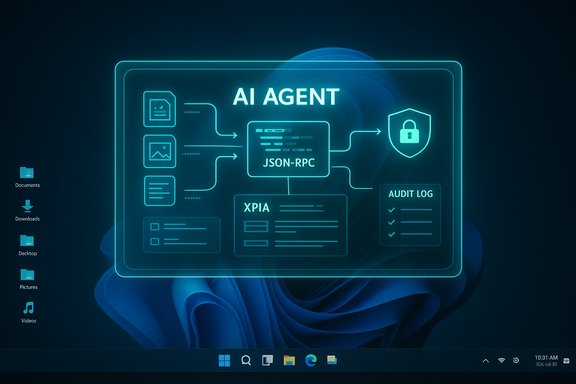
Microsoft has shipped an experimental stack of “agentic” primitives into Windows 11 to let AI models do — not just suggest. The preview includes three core platform pieces: Agent Workspace (an isolated, parallel Windows session where agents run), agent accounts (per‑agent, noninteractive Windows accounts intended for attribution and policy), and the Model Context Protocol (MCP) (a JSON‑RPC–style bridge that lets agents discover app capabilities and call them in a structured, auditable way). The consumer‑facing scenario most visible today is Copilot Actions, which maps natural‑language commands to multi‑step workflows that can cross apps, files, and connectors. From an operational perspective, Microsoft intentionally gated these features: the experimental toggle is off by default and requires an administrator to enable it, applying device‑wide once switched on. During preview, agents can request scoped read/write access to a fixed set of six “known folders” in the user profile — Documents, Downloads, Desktop, Pictures, Music, and Videos — unless additional permissions are explicitly granted. These constraints are meant to limit the immediate attack surface while the feature matures.
But the shift from suggest to do is a fundamental architectural and operational change. It converts previously passive data surfaces into instruction channels, and that requires the broader security ecosystem — endpoint protection vendors, DLP, SIEM, and threat intelligence — to adapt quickly. Microsoft’s candid documentation is a positive step; candidness matters when you’re changing the OS threat model. At the same time, the list of what must be proven in the field is long: containment fidelity, revocation speed, connector trust economics, and user approval UX that actually reduces risk rather than creating approval fatigue.
For IT leaders and careful consumers, the correct posture is cautious curiosity: pilot the features in controlled environments, demand independent containment and XPIA testing, integrate audit trails into existing security pipelines, and treat enablement as a formal risk decision. The productivity gains from agentic computing could be substantial — but only if the ecosystem raises the bar on verification, telemetry, and operational controls as fast as the features are rolled out.
Source: extremetech.com Microsoft Says Windows 11's Agentic AI Can Hallucinate
 Background / Overview
Microsoft has shipped an experimental stack of “agentic” primitives into Windows 11 to let AI models do — not just suggest. The preview includes three core platform pieces: Agent Workspace (an isolated, parallel Windows session where agents run), agent accounts (per‑agent, noninteractive Windows accounts intended for attribution and policy), and the Model Context Protocol (MCP) (a JSON‑RPC–style bridge that lets agents discover app capabilities and call them in a structured, auditable way). The consumer‑facing scenario most visible today is Copilot Actions, which maps natural‑language commands to multi‑step workflows that can cross apps, files, and connectors. From an operational perspective, Microsoft intentionally gated these features: the experimental toggle is off by default and requires an administrator to enable it, applying device‑wide once switched on. During preview, agents can request scoped read/write access to a fixed set of six “known folders” in the user profile — Documents, Downloads, Desktop, Pictures, Music, and Videos — unless additional permissions are explicitly granted. These constraints are meant to limit the immediate attack surface while the feature matures.What Microsoft actually warned — plain English
Microsoft’s public guidance reads more like a security brief than a marketing note. The company calls out three interlocking problems that arise when models are given the ability to act:- Hallucinations: LLMs can produce confident but incorrect outputs. When the model only suggests text, hallucination is an accuracy problem; when an agent translates outputs into actions, hallucination can lead to wrong or harmful operations — e.g., moving or deleting files, sending sensitive documents, or running installers.
- Cross‑Prompt Injection (XPIA): Content that agents ingest — PDFs, rendered HTML previews, images (OCR), metadata, or UI elements — can be weaponized. An attacker who can plant adversarial instructions in those surfaces could cause an agent to obey the malicious directive, turning benign automation into a covert exfiltration or install mechanism. Microsoft named XPIA explicitly in its guidance.
- Novel operational attack surface: Agents that can call connectors or cloud APIs and perform multi‑step plans create legitimate-looking channels for data exfiltration or supply‑chain escalation that traditional EDR/DLP products do not currently detect well. Because these flows use authorized APIs and signed binaries (in principle), detections based on anomalous binaries or network indicators may fail to flag malicious activity.
Technical anatomy: Agent Workspace, agent accounts, and MCP
Agent Workspace: a lightweight containment boundary
Agent Workspace is described as a parallel Windows session with its own desktop and process tree, designed to be more efficient than a full VM for routine UI automation while still offering runtime isolation. The workspace captures visibility (screenshots of agent activity) and aims to produce tamper‑evident logs so actions are auditable and interruptible. Important caveat: Microsoft emphasizes this is not a hypervisor‑backed VM sandbox and that isolation guarantees must be validated by independent testing.Agent accounts and least privilege
When enabled, Windows provisions separate, noninteractive local accounts for agents so that agent actions are attributable to a distinct principal and can be governed by ACLs, Group Policy, Intune, and auditing. This identity separation enables policy controls but does not, by itself, eliminate the risk that an agent can be tricked into performing dangerous actions. Revocation latency, policy propagation, and the robustness of account isolation are real operational details enterprises must stress‑test.Model Context Protocol (MCP): structured tooling, JSON‑RPC style
MCP is Microsoft’s attempt to move agents off brittle UI scraping and into a capability‑based model. Agents discover “tools” and “connectors” via MCP and call them through a JSON‑RPC‑style interface. In theory, MCP provides a central enforcement point for authentication, capability declarations, and logging — a place where Windows can insist on signed connectors, enforce capability scoping, and record intent. In practice, MCP is an evolving protocol and its security depends on ecosystem adoption, signed connector supply chains, and rigorous attestation.Where the promise is real — and where reality diverges
There’s genuine promise in agentic computing. Done correctly, it can:- Remove repetitive, error‑prone clicks and context switching.
- Automate multi‑app workflows (assemble reports from PDFs, batch process media, prepare and send templated emails).
- Expose app capabilities securely through MCP rather than relying on fragile UI automation.
- Early hands‑on reporting finds uneven UX: slow responses, brittle vision/OCR recognition, and occasional mismatch between demo scenarios and messy real‑world inputs. The cognitive overhead of verifying agent actions can erode any productivity gain if agents frequently fail or ask for constant approvals.
- The isolation model is lighter than a VM but not equivalent. That tradeoff is sensible for performance, but security engineers must independently verify containment, kernel‑level isolation, and whether attackers can escalate from an Agent Workspace into the primary user session. Microsoft’s documentation calls these out but does not assert absolute containment.
- Supply‑chain assumptions (signed agents and connectors) reduce risk but create a different dependency: if signing authorities or connector registries are compromised, large‑scale abuse becomes possible, and revocation timelines determine how quickly defenders can respond.
The immediate threat models to worry about
1) XPIA in the wild: content as command
Attackers have proof‑of‑concepts for prompt injection against hosted LLMs; with local agentic systems, the risk materializes on endpoints. Examples of plausible XPIA vectors include:- A PDF with hidden comments or metadata that contains instructions for the agent.
- An image that, when OCR’d by the agent, yields adversarial directives.
- A web preview or email pane containing text that overrides the agent’s context.
- Spreadsheet cells, formulas, or embedded macros replaced by adversarial prompts that the agent consumes when compiling a report.
2) Hallucination turned operational
A hallucinating model that misidentifies a file or misreads an instruction can do the wrong thing: attach an incorrect file to an email, move sensitive documents into an uploaded archive, or follow a bogus URL to fetch a malicious payload. The danger is not theoretical — it’s a change from “wrong suggestion” to “wrong action.” Microsoft frames hallucination as a first‑order security concern for agentic features.3) Connector abuse and stealthy exfiltration
Agents calling cloud connectors can assemble and exfiltrate data using authorized channels (e.g., upload to a legitimate SaaS endpoint). Traditional DLP that flags unusual outbound destinations may not detect exfiltration that looks like normal connector traffic. Logging, tamper‑evident audit trails, and short revocation windows are essential countermeasures but remain aspirational in this preview.Microsoft’s mitigations — solid starting points, incomplete without operational maturity
Microsoft proposes several important mitigations in its documentation and blog posts:- Admin‑gated, device‑wide toggle for experimental agentic features (off by default).
- Scoped folder access limited to six known folders during preview.
- Per‑agent, noninteractive local accounts for attribution.
- Agent Workspace isolation plus visibility and user approval surfaces for sensitive actions.
- Requirement that agent binaries and third‑party connectors be cryptographically signed, with revocation mechanisms.
- Tamper‑evident audit logs and surfaced multi‑step plans for human review.
- The strength of Agent Workspace isolation against kernel or driver escalation needs independent verification.
- The timeliness and operational reliability of signing and revocation mechanisms under attack (compromised publisher keys, supply chain abuse).
- The coverage and usability of user‑facing approvals: frequent, noisy approvals destroy UX; too permissive approvals erode security.
- The integration of audit logs with enterprise SIEM and DLP workflows so detection teams get actionable telemetry.
Practical guidance for IT teams and power users
Treat agentic features as a security decision, not a convenience toggle. Recommended steps:- Do not enable Experimental agentic features on production or user devices until you have tested in an isolated pilot environment. Ensure pilots mirror real‑world user behavior and threat models.
- Require administrative enablement only through MDM (Intune) or Group Policy and document which devices and groups are permitted to use agentic features.
- Integrate agent logs with SIEM: collect tamper‑evident audit trails from Agent Workspace and agent accounts so SOC teams can investigate agent plans and outcomes. Test log integrity and revocation workflows under simulated incidents.
- Harden DLP policies for connector use: assume connectors are a potential exfiltration path and monitor typical connector destinations and volumes. Create alerts for unusual aggregation or packaging of files.
- Establish an “XPIA test suite” as part of your application and content security testing: inject adversarial prompts into PDFs, images, and previews to confirm agents ignore content that should not be treated as instruction. This is a new class of test that existing suites do not cover.
- Limit agent scope in enterprise settings: deny connector use where unnecessary, restrict writable scopes, and require enrollment of signed connectors only from vetted publishers.
- Educate users and build playbooks for when an agent misbehaves: pause, stop, take over, and short revocation. Train IT staff to revoke agent privileges quickly and validate revocation propagation.
Risk vs. reward: a measured take
The productivity potential of agentic Windows is real. For routine, well‑scoped tasks, an agent that can assemble documents, batch process files, and surface relevant information could save hours of manual work. Microsoft’s architectural choices — MCP for capability declarations, agent accounts for attribution, and audit logs for visibility — are aligned with long‑standing security principles.But the shift from suggest to do is a fundamental architectural and operational change. It converts previously passive data surfaces into instruction channels, and that requires the broader security ecosystem — endpoint protection vendors, DLP, SIEM, and threat intelligence — to adapt quickly. Microsoft’s candid documentation is a positive step; candidness matters when you’re changing the OS threat model. At the same time, the list of what must be proven in the field is long: containment fidelity, revocation speed, connector trust economics, and user approval UX that actually reduces risk rather than creating approval fatigue.
Immediate red flags and unknowns to watch
- Containment validation: independent security researchers should be able to test whether Agent Workspace isolation prevents cross‑session attacks and kernel‑level escapes. This is not settled.
- XPIA attack surface mapping: vendors should publish standard test vectors for prompt injection in local environments so defenders can validate whether agents treat content as instruction. There is currently no widely adopted standard test harness for XPIA.
- Supply‑chain resilience: signing and revocation are necessary but not sufficient; the industry needs fast revocation distribution, attestation of connectors, and third‑party audits. Historical precedent shows signing can be abused, so operational controls and monitoring are essential.
- Privacy optics: Microsoft’s earlier Recall feature raised public backlash when third‑party apps attempted to block it or when sensitive data was captured unintentionally. Agentic features reopen privacy questions — especially around what agents are allowed to index, store, or upload. Transparent defaults and user control are vital.
What vendors and the industry must do
- Endpoint security vendors must develop detection heuristics for agentic behavior: automated UI interactions, headless desktops, and multi‑step connector flows should be instrumented and flagged when anomalous.
- DLP vendors must incorporate agent‑aware policies that recognize legitimate connector activity but detect suspicious aggregation or unauthorized data packaging.
- Standards bodies should move quickly to define MCP attestation models, XPIA test suites, and connector signing/revocation best practices.
- Microsoft and partners should fund independent red‑team programs and publish results so customers can understand real‑world risk tradeoffs.
Conclusion
Microsoft’s decision to expose agentic capabilities in Windows 11 is bold, arguably inevitable, and accompanied by unusually candid guidance about the hazards involved. The company is right to highlight hallucination and cross‑prompt injection as first‑order problems — because they are. The engineering foundations (Agent Workspace, agent accounts, MCP, signed binaries, audit logs) are necessary building blocks, but they are not in themselves a guarantee of safety.For IT leaders and careful consumers, the correct posture is cautious curiosity: pilot the features in controlled environments, demand independent containment and XPIA testing, integrate audit trails into existing security pipelines, and treat enablement as a formal risk decision. The productivity gains from agentic computing could be substantial — but only if the ecosystem raises the bar on verification, telemetry, and operational controls as fast as the features are rolled out.
Source: extremetech.com Microsoft Says Windows 11's Agentic AI Can Hallucinate
