Enterprise 5G Laptop Management on Windows 11 with AI eSIM and Intune

  • Thread Author
Microsoft and Ericsson have stitched enterprise-grade 5G control directly into Windows 11, promising IT teams a way to deploy, secure, and optimize always‑connected laptops at scale—complete with automated eSIM switching, Intune integration, and a local AI agent that dynamically steers connections for performance and security.

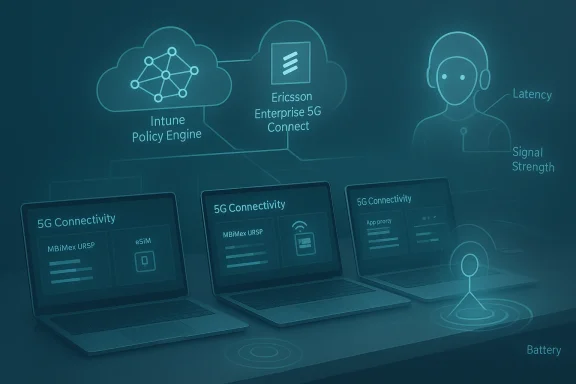
Three laptops show 5G connectivity amid cloud policy engine and latency visuals.Background​

For the last three years vendors have been quietly building the plumbing that turns cellular‑connected laptops from a niche novelty into a manageable enterprise platform. Early trials showed that laptops can do more than passively accept a mobile signal: they can participate in advanced 5G features such as network slicing, remote policy-driven provisioning, and multi‑SIM management. Ericsson, Microsoft, and several carrier partners have repeatedly demonstrated those capabilities in lab and pilot settings, and the announcement on February 17, 2026 marks the first broad, production‑oriented step to bake those controls into Windows itself.
This is not a single‑vendor or single‑feature update. It’s an orchestration layer: Windows 11 (the OS), Microsoft Intune (device and policy management), Ericsson Enterprise 5G Connect (formerly EVCN) and participating communications service providers (CSPs) form a chain that lets IT treat 5G connectivity as another managed resource—like VPN, Wi‑Fi, or anti‑malware. The immediate visible results for IT and users are simpler provisioning, better performance, and fewer help‑desk tickets—but the technical possibilities go deeper.

What Ericsson and Microsoft announced​

The core proposition in plain terms​

  • Managed 5G for laptops: Ericsson’s Enterprise 5G Connect integrates with Windows 11 and Microsoft Intune so enterprises can provision, monitor, and enforce policies for 5G connectivity across laptop fleets.
  • Automatic eSIM switching: Devices can automatically download and switch eSIM profiles based on policy and network quality, reducing the need for users to manually change carriers or swap SIMs.
  • Local AI agent for context‑aware optimization: A runtime component on the device evaluates local conditions and applies rules (latency, signal, application priorities) to choose the best network and settings for the task.
  • Intune policy enforcement: Connectivity can be governed by Intune so network selection, corporate data limits, and security posture are consistent across devices.
These features are being piloted first with Surface Copilot+ PCs and will be offered together with Microsoft 365, Intune, Ericsson Enterprise 5G Connect, and operator bundles. Launch markets in the initial roll‑out include the United States (T‑Mobile), Sweden (Telenor), Singapore (Singtel), and Japan (SoftBank), with additional rollouts planned in the second quarter of 2026.

Why this is more than marketing copy​

At face value, “automatic eSIM switching” and “AI optimization” can sound like buzzwords. But the underlying elements—eSIM management, MBIM/MBIMEx support, URSP/network slice awareness, and Intune orchestration—are real, standards‑based capabilities that Microsoft and device/CPU/modem partners have been working on for years. Windows already supports eSIMs and has been adding MBIM extension support for 5G‑native capabilities; what Ericsson and Microsoft have done is combine those OS capabilities with a carrier‑facing management plane and device‑side intelligence to make them practical at enterprise scale.

Technical underpinnings — how this actually works​

eSIM provisioning and Ericsson Enterprise 5G Connect​

The key operational piece is eSIM orchestration. Ericsson’s Enterprise 5G Connect provides a cloud service that can order, manage and push eSIM profiles to devices at scale. When combined with Windows 11’s eSIM plumbing, IT can preconfigure devices so they connect securely out of the box and switch CSP profiles automatically when policies or connectivity conditions dictate. This enables zero‑touch provisioning for mobile laptops, similar to how corporate phones are managed today.

MBIMEx, URSP, and network slicing support​

Windows has been extending its MBIM (Mobile Broadband Interface Model) host interface to support 5G SA features and network slicing. MBIMEx 4.0 introduces URSP handling and multiple concurrent eMBB slices—mechanisms that allow a device to request different network behaviors for different applications (for example, a low‑latency slice for collaboration and a high‑throughput slice for bulk sync). When the OS and modem support these features, an enterprise can map specific app types to slice preferences and have the network honor them. Microsoft’s MBIMEx docs note these capabilities and the dependencies required at host, device and network levels.

Local AI agent and policy enforcement​

The local agent described in the announcement appears to be a lightweight decision engine that uses telemetry (signal, latency, user activity, battery state, policy) to make per‑connection choices. Because decisions happen on the device, they can be real‑time and context‑aware—crucial for apps like Teams or remote‑access tools that are sensitive to jitter and packet loss. Intune provides the management surface for policies, while Ericsson’s cloud monitors network quality and can feed higher‑level signals back to IT.

What this means for IT, end users, and service providers​

For enterprise IT​

  • Simpler onboarding: Zero‑touch eSIM provisioning can drastically reduce manual setup and physical logistics for distributed workforces.
  • Centralized compliance: IT can enforce connectivity policies in the same way it enforces OS and app policies through Intune.
  • Operational visibility: Ericsson’s cloud telemetry gives visibility into network performance per device and per region, enabling better SLAs for remote work scenarios.

For end users​

  • Fewer interruptions: Automatic carrier switching and device‑level optimization should reduce the number of times users have to choose networks or call support.
  • More predictable collaboration: Apps that need low latency or consistent throughput will benefit from intelligent network pathing and slice awareness where supported.

For carriers and the broader ecosystem​

  • New enterprise bundles: Carriers can deliver preconfigured 5G laptop bundles (device + connectivity + management) and differentiate with managed services rather than just raw Mbps.
  • Private/public network interplay: The same orchestration makes it easier to switch devices between private 5G networks on premises and public networks when users are offsite—useful for manufacturing, healthcare, and retail sectors. Ericsson has shown private/public switching in earlier trials.

Practical benefits and limitations​

Benefits (what enterprises are likely to see quickly)​

  • Reduced time to value for distributed laptop fleets through zero‑touch provisioning.
  • Decreased IT help‑desk load because connectivity choices are automated and policy‑driven.
  • Improved end‑user experience for collaboration, remote desktop, and data‑heavy workflows via slice and policy optimization.

Short‑to‑medium term limitations and caveats​

  • Carrier and regional coverage variability: The experience depends on participating carriers and 5G coverage in each market. The initial rollouts are limited to specific CSPs and countries; global parity will take time.
  • Hardware requirements: Laptops must include compatible 5G modems and eSIM support. Not all enterprise devices have that today; many Windows laptops still rely on Wi‑Fi only.
  • Standards and host support gaps: Some advanced MBIMEx features are optional or pending broader host/device support; Microsoft documentation notes caveats and phased rollouts for full 5G SA phase‑2 features. Administrators should validate modem and driver support before expecting all capabilities.

Security and privacy implications​

Positive security capabilities​

  • Policy enforcement at scale: Using Intune to apply network restrictions and data‑handling rules reduces the chance of insecure connections or data leakage.
  • Centralized lifecycle control for eSIMs: IT can suspend, revoke, or reassign eSIM profiles remotely—an improvement over physical SIM management.

Risks and blind spots​

  • Telemetry privacy: The solution relies on device and network telemetry. Enterprises must evaluate what telemetry is collected, where it’s stored, and whether it aligns with privacy policies and local regulations. The vendor announcements emphasize telemetry for performance and security but stop short of full telemetry schemas; IT teams should demand clear data governance contracts.
  • Dependency on operator cooperation: The depth of control (e.g., slice assignment, QoS adherence) depends on CSPs implementing corresponding network APIs and policies. Not all carriers provide the same level of programmability or willingness to expose such controls.

How organizations should evaluate adoption​

  • Inventory devices for 5G/eSIM readiness. Verify modems, MBIM/driver versions, and firmware support required MBIMEx features.
  • Pilot with a limited user group that covers the full range of mobility scenarios (office, transit, remote). Monitor telemetry and user feedback.
  • Negotiate operator SLAs and API access for the regions that matter most. Ensure carriers agree to the eSIM and slice behaviors you need.
  • Define telemetry and data‑retention policies in the procurement contract with Ericsson/Microsoft and carrier partners. Make privacy and compliance explicit.

Where this fits in the connectivity roadmap​

This announcement is the logical next step after prior demonstrations and pilots. Ericsson, Intel, Microsoft and other partners have shown network slicing and eSIM orchestration on Windows laptops in lab settings for several years; the difference now is a productionized orchestration offering tied to real carrier programs and Intune management. That elevates 5G laptop management from experimental to operational for early adopters.
It also aligns with Microsoft’s broader OS investments: Windows 11 has been progressively expanding its cellular, eSIM, and MBIM capabilities so that the host OS can participate meaningfully in advanced 5G use cases. In parallel, device makers and modem vendors continue to ship more eSIM‑capable devices, and some carriers are packaging laptops and connectivity as a single managed offering.

Business and operational impacts — what CIOs should know​

  • TCO tradeoffs: Enterprises may realize lower operational costs (less on‑site IT, fewer managed Wi‑Fi appliances) but should model data costs and carrier pricing for wide roaming. Carrier bundles and Intune integration could simplify procurement and lifecycle costs, but pricing models vary by operator and region.
  • Digital‑workplace enablement: For roles that require mobility, predictable connectivity with prioritized application routing removes a major friction point. This can enable new hybrid work patterns and field workflows (inspection, on‑site support, healthcare rounds) that previously required complex VPN/Wi‑Fi setups.
  • Vendor lock‑in considerations: While the architecture uses standards (eSIM, MBIM, URSP), the orchestration plane and packaged services are vendor offerings. CIOs should negotiate portability clauses, data access guarantees, and exit strategies when committing to managed 5G bundles.

Realistic timeline and market availability​

Ericsson states broad availability will expand through the second quarter of 2026, with early availability in selected markets during initial pilots and operator programs. Enterprises planning rollouts should map their timelines against carrier availability by country and the device refresh cycles for their laptop fleets.
Meanwhile, Microsoft documentation and vendor driver stacks indicate certain MBIMEx features remain staged and subject to device/driver availability; administrators should expect incremental capability maturation rather than an instantaneous switch‑on of every advanced 5G feature.

Verdict — why this matters, and what to watch​

This development is a meaningful step toward the practical mainstreaming of 5G laptops. By coupling Windows 11’s evolving cellular stack with Ericsson’s orchestration and Intune’s policy fabric, enterprises finally have a vendorized option to treat connectivity as a managed IT asset. For organizations with mobile workforces, regulated data, or use cases that need deterministic network performance, this can reduce friction and enable new productivity models.
However, the real impact will depend on three factors: carrier support and regional availability, device and modem ecosystem readiness, and disciplined enterprise governance around telemetry and cost. If those align, IT teams can expect fewer connectivity headaches and more predictable hybrid work experiences. If they don’t, the technology becomes another partially deployed capability that leaves users and admins confused. Enterprises should therefore pilot conservatively, insist on contractual clarity from vendors, and keep visibility on device and network telemetry.

Quick checklist for IT teams (ready to paste into a rollout plan)​

  • Verify which laptop SKUs in your fleet have eSIM and 5G modem support.
  • Confirm MBIM/driver versions and whether MBIMEx features you need are supported by your hardware vendors.
  • Identify target pilot users and geographies aligned with participating CSPs.
  • Establish telemetry and privacy requirements in your vendor and carrier contracts.
  • Design rollback and cost‑control mechanisms for data and roaming charges.

Final thoughts​

The industry has been building toward this moment for several years. What was once a series of intriguing demos—network slicing on a laptop, eSIM orchestration across borders, AI‑driven QoS choices—has now been packaged into a vendor solution that integrates with the enterprise management tools many organizations already use. For enterprises that prioritize mobile productivity and predictable connectivity, the Microsoft–Ericsson partnership announced on February 17, 2026 represents a practical, standards‑based path forward. But real gains will require careful piloting, device verification, and carrier negotiations—this is a systems integration challenge as much as it is a feature roll‑out.
The transition to managed 5G laptops is no longer a question of “if”; it’s a question of ready, where, and how fast.

Source: Neowin Windows 11 just got a major 5G boost thanks to Ericsson
 

Microsoft and Ericsson have quietly moved 5G from a nice-to-have connectivity option to an enterprise-grade, IT-manageable capability baked into Windows 11 — and the implications for always‑connected, AI‑ready laptops could be profound.

A laptop displays a holographic 5G dashboard with eSIM provisioning and policy controls.Background​

For the past few years, the industry has tested the idea that laptops with built-in cellular — especially 5G — can transform remote work, edge computing, and real‑time AI workflows. Ericsson’s platform, historically referred to as the Enterprise Virtual Cellular Network (EVCN), has been piloted with carriers and device OEMs to automate eSIM provisioning, manage multi‑carrier access, and present a centralized management plane for IT. That engineering trajectory culminates in the newly announced Ericsson Enterprise 5G Connect integration with Windows 11 and Microsoft Intune.
The public announcement made on February 17, 2026, positions the solution as a joint Microsoft‑Ericsson offering where Windows 11’s device stack and Intune management hook into Ericsson’s cloud intelligence to provide policy‑driven connectivity across private and public 5G networks. Early availability is being targeted through partnerships with major CSPs in select markets and piloted first with Microsoft’s new Surface Copilot+ 5G devices.

What Ericsson Enterprise 5G Connect actually is​

A short technical summary​

At its core, Ericsson Enterprise 5G Connect (the successor/renaming of EVCN) is a cloud‑native connectivity management platform that:
  • Automates eSIM profile provisioning and lifecycle (download, activation, switching).
  • Aggregates network intelligence and performs AI‑driven decisions about which network to use in real time.
  • Exposes enterprise policy controls so IT can define which networks and connectivity behaviors are allowed for specific devices or workloads.
  • Integrates with Microsoft Intune so device + connectivity management are handled through a single pane of glass.

Key features called out by the vendors​

  • Automatic eSIM switching between carriers based on signal, cost, SLA, or policy.
  • Local AI agent running on the device that evaluates context (app priority, signal quality, latency) and instructs the cloud management platform or performs autonomous switching locally when needed.
  • Policy enforcement via Intune, enabling corporate control over roaming, data usage, and secure access to corporate applications.
  • Carrier‑agnostic interoperability, with early carrier partners including T‑Mobile (US), Telenor (Sweden), Singtel (Singapore) and SoftBank (Japan), and plans for broader rollouts.
These capabilities are pitched as removing the “user‑visible” friction — auto‑connecting to the best network and keeping diagnostic and switching logic invisible to the end user. That’s the selling point: IT manages the connectivity experience at scale, users get consistent connectivity without troubleshooting.

Why Microsoft validated this for Surface — and what “validated” means​

Microsoft has validated the solution specifically on Surface Copilot+ 5G laptops in a private preview. In practice, validation here means Microsoft has confirmed the integration works with Windows 11’s connectivity stack and that Intune can manage the eSIM lifecycle and apply policies with Ericsson’s backend. Microsoft executives are quoted endorsing Windows 11 as a platform for deploying and managing 5G‑connected PCs at scale, with pilots starting on Surface hardware.
It’s important to be precise about the scope of validation:
  • This is a platform and management validation rather than a consumer product release. The initial preview is enterprise‑focused and vendor controlled.
  • Validation demonstrates functional interoperability and management flows — it does not always imply carrier billing, SLA guarantees, or full global coverage on day one.
  • Broader device support (“will eventually work on PCs too”) is explicitly called out by Ericsson; that extension depends on OEM support, certification, and carrier program availability.

How this integrates with Windows 11 and Intune​

Windows 11 already supports cellular connectivity and eSIM functionality at the OS level. Microsoft’s Settings and Intune MDM allow administrators to configure eSIM download servers (SM‑DP+) and to provision eSIM profiles to devices. Intune has supported eSIM profile deployment and download‑server configuration for Windows devices for some time, enabling enterprises to import activation codes or configure download servers for managed rollout.
Ericsson’s platform adds the cloud‑level orchestration and AI monitoring layer that feeds decisions into Windows/Intune:
  • IT can use Intune to deploy device‑level policies and the eSIM configuration.
  • Ericsson Enterprise 5G Connect monitors network quality and suggests or implements changes according to policy.
  • A local agent on the Surface device can make context‑aware switches without user intervention for speed, latency, or security reasons.
This end‑to‑end approach — device, OS, MDM, carrier orchestration — is what vendors mean when they talk about “enterprise‑grade” connectivity for laptops.

Real benefits for enterprise IT and end users​

The vendors highlight several measurable benefits for IT and employees:
  • Reduced onboarding time: automated eSIM provisioning and zero‑touch setup reduce manual SIM logistics and onboarding steps.
  • Consistent security posture: corporate connectivity policies enforce secure access, preferred networks, and data routing rules across devices.
  • Lower operational overhead: fewer helpdesk tickets and remote issues related to cellular connectivity because switching and diagnostics are centralized.
  • Better app performance and predictable SLAs: AI‑driven routing to networks that meet latency and throughput requirements for priority apps (e.g., conferencing, remote desktop, cloud AI inference).
From the user perspective, the promise is simple: always‑connected productivity without having to manage mobile plans or fiddle with settings.

Caveats, limitations, and what the press release does not (yet) prove​

No vendor announcement can answer every operational question. Below are the important caveats and open items enterprises must treat as unknowns until real‑world testing.

Coverage, roaming costs and operational cost model​

5G availability and quality still depend on carrier coverage maps and spectrum conditions. Automatic switching can reduce dead zones, but it does not create radio coverage where there is none. Enterprises must model roaming, data plan, and multi‑SIM costs when allowing automatic carrier switching. The announcement lists initial carrier partners and markets, but broader global availability is staged over 2026.

Security and control boundaries​

Centralized eSIM provisioning sounds secure, but adding a cloud orchestration layer increases the attack surface. Enterprises will want clarity on:
  • Who controls SM‑DP+ servers and keys?
  • How are eSIM activation flows authenticated and audited?
  • What are the incident response and key‑revocation procedures?
Those operational details are not fully spelled out in vendor marketing materials and will need contractual SLAs.

Battery, thermal and performance tradeoffs​

Continuous network monitoring, frequent switching, and AI agents consume power and CPU cycles. The press release does not quantify battery life impact on Surface 5G devices when using local AI agents or continuous telemetry. These are real engineering tradeoffs that require lab validation and vendor benchmarks — not marketing claims. Treat battery impact as an empirical issue to test.

Management and troubleshooting complexity​

While the objective is to remove user troubleshooting, the backend becomes more complex. IT needs skilled networking and carrier‑management expertise to diagnose cross‑layer issues. Expect a steep learning curve on multi‑carrier policy definitions, eSIM lifecycle events, and billing reconciliation. Community reports and forum threads already show that eSIM provisioning via Intune can be nontrivial in practice and sometimes requires troubleshooting specific to carriers or firmware.

Vendor lock‑in and interoperability​

Ericsson’s platform will be interoperable with partner CSPs, but enterprises should ask about exit strategies: how easy is it to migrate device fleets off Ericsson’s orchestration if business needs change? What open standards and APIs are available to avoid proprietary lock‑in? The announcement emphasizes partner ecosystems but does not fully detail portability guarantees.

What the rollout and timeline look like​

Ericsson’s announcement and accompanying syndications indicate:
  • Private preview: validated on Surface Copilot+ PCs and beginning with controlled enterprise pilots.
  • Initial markets and carriers: United States (T‑Mobile), Sweden (Telenor), Singapore (Singtel), Japan (SoftBank). Additional launches planned in Spain, Germany, and Finland during 2026.
  • Broader availability: Ericsson states broad availability is planned from Q2 2026 with seven CSPs committed to early launch programs.
Enterprises should expect phased availability and plan pilots around the announced markets and carrier partners rather than assume immediate global coverage.

How to evaluate this technology as an enterprise IT leader​

If you run endpoints, networking, or mobile programs, treat this as a strategic capability and evaluate it using disciplined pilots:
  • Run a controlled pilot
  • Select representative job roles with high mobile demands (sales, field service, road warriors).
  • Test across geographies and carrier partners relevant to your operations.
  • Validate performance and battery
  • Measure throughput, latency, session continuity and battery life with and without the Ericsson agent active.
  • Model costs
  • Simulate typical usage patterns and estimate data costs, multi‑carrier surcharges and roaming.
  • Assess security and compliance
  • Review SM‑DP+/SM‑DS key management, telemetry retention, and data residency rules.
  • Establish support SLAs
  • Define helpdesk escalation paths with Ericsson, Microsoft, and carrier partners.

Deployment checklist — practical steps for IT admins​

  • Inventory devices and confirm eSIM hardware support and firmware levels.
  • Update Intune to the latest management templates and ensure eSIM download-server configuration is possible in your tenant. Microsoft’s Intune settings catalog supports configuring eSIM download servers and deploying activation codes.
  • Negotiate carrier agreements that include multi‑carrier provisioning and clear billing/reporting.
  • Define corporate connectivity policies: allowed carriers, roaming rules, app prioritization, and data caps.
  • Create testing plans for app performance (VoIP, RDP, browser & cloud AI inference) under switching conditions.
  • Train support teams on new telemetry and diagnostic flows coming from Ericsson’s platform.
  • Prepare compliance reviews to ensure telemetry collection, eSIM keys and device identity handling meet legal and regulatory requirements.

The AI PC narrative: marketing vs technical reality​

Microsoft and Ericsson are both framing this as part of the broader “AI PC” story: low‑latency, always‑connected devices will better support cloud and on‑device AI usage. There is merit to that claim: consistent connectivity and policy‑driven routing can help guarantee the network characteristics AI workloads need (throughput, latency). However:
  • Connectivity is necessary but not sufficient for AI acceleration. Workloads still depend on cloud backend availability, model partitioning, local hardware (NPU/GPU), and data privacy constraints.
  • Local AI agents that manage connectivity are helpful, but the real gains come when network orchestration ties into workload scheduling, caching, and edge inference placement — items that require cooperation across OS, apps, and cloud services.
  • Enterprises should evaluate those AI use cases concretely (e.g., real‑time transcription, video analytics, large model access) to determine whether the connectivity platform materially changes user or business outcomes.

Risks and legal/regulatory considerations​

  • Data residency and sovereignty: eSIM profiles and network telemetry may cross jurisdictions. Enterprises in regulated industries must validate where connectivity control planes store and process data.
  • Carrier and roaming regulation: multi‑carrier provisioning must comply with local telecom rules; automatic switching might trigger unplanned roaming billing in some regions.
  • Supply chain and vendor concentration: relying on a small set of CSPs or a single orchestration vendor increases strategic risk; plan for redundancy.
  • Security incident exposure: investigate breach scenarios involving eSIM provisioning servers and the mitigation/notification process.

Independent corroboration and community signals​

This joint announcement is broadly corroborated by multiple syndications and financial news outlets covering the Ericsson press release and its collaboration with Microsoft. Independent reporting confirms the same high‑level claims about Intune integration, carrier partners, and staged market availability. Industry analysts note that the move builds on Ericsson’s multi‑market EVCN pilots and Singtel’s earlier 5G+ work that used Ericsson’s EVCN for managed enterprise connectivity.
Community forums and admin communities have been tracking Windows eSIM and Intune eSIM provisioning for some time; operational posts show administrators often encounter configuration or carrier‑specific behaviors that need troubleshooting — a practical reminder that integration at scale is nontrivial and that pilot testing remains essential.

Final analysis — what this really means for enterprise computing​

This announcement is meaningful but measured:
  • It moves the industry a step closer to fully managed, always‑connected enterprise laptops where device, OS, MDM and carrier orchestration are a single administrable pipeline. That capability is powerful for distributed workforces and certain AI workflows that are sensitive to latency and session continuity.
  • However, the practical value will depend on regional carrier coverage, pricing models, and operational maturity. The technology simplifies many operational hurdles (SIM logistics, manual onboarding) but introduces new ones (cloud orchestration dependencies, cross‑layer debugging).
  • For early adopters, the correct playbook is conservative: run targeted pilots with clear KPIs (connectivity SLAs, app performance, battery impact, cost per user), validate Intune and eSIM flows end‑to‑end, and negotiate contractual SLAs with Ericsson and carrier partners.

Recommendations for IT leaders (quick checklist)​

  • Start small: pick two or three user groups that will benefit most from consistent 5G connectivity (e.g., field sales, mobile engineers).
  • Validate the full stack: device firmware, Windows 11 network stack, Intune eSIM settings, Ericsson orchestration, and carrier provisioning.
  • Build cost guardrails: implement policy limits and monitoring for data usage and roaming.
  • Secure the lifecycle: insist on clear key management, incident response, and audit capabilities from vendors.
  • Track metrics: session continuity, mean time to connect, battery delta, and ticket volume to justify scale‑up.

Ericsson and Microsoft’s move signals that the industry is consolidating around managed, policy‑driven 5G for laptops — a capability enterprises have been asking for. The promise is compelling: simpler onboarding, smarter connectivity, and fewer user disruptions. But the real test will be in the deployments: global carrier coverage, real‑world battery and performance tradeoffs, and how well IT teams can absorb the new operational model. Treat the technology as strategic and pilot it with disciplined, measurable objectives before you commit to large‑scale rollouts.

Source: Neowin Windows 11 just got a major 5G boost thanks to Ericsson
 

Microsoft and Ericsson have taken the “always‑connected PC” promise out of pilots and put it squarely into the operating system: Windows 11 will now surface enterprise‑grade 5G management capabilities that tie Microsoft Intune device controls to Ericsson’s cloud‑native Enterprise 5G Connect platform, letting IT teams provision eSIMs, enforce network and application policies, and use AI‑driven analytics to steer connectivity for performance and security across managed laptop fleets.

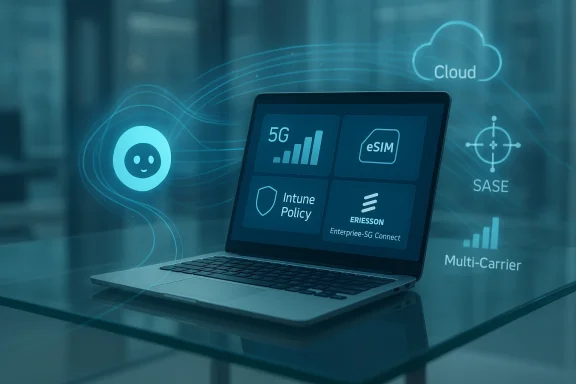
Laptop displays 5G, eSIM, and Intune Policy tiles amid cloud networking visuals.Background​

For years enterprises have treated cellular‑connected laptops as a niche option — useful for road warriors but cumbersome to manage at scale. The technical barriers were predictable: varied carrier provisioning systems, clunky eSIM flows for bulk provisioning, inconsistent drivers and firmware across OEMs, and the absence of centralized tools that combine device policy and network controls.
Ericsson’s enterprise offering — previously called Enterprise Virtual Cellular Network (EVCN) and now marketed as Enterprise 5G Connect — began addressing those operational gaps with zero‑touch provisioning, automated eSIM lifecycle controls, and analytics tied to network quality. The platform positions 5G not only as a transport but as a managed resource that IT can allocate, monitor, and secure. Ericsson’s product pages and prior operator pilots (for example with Singtel and other CSPs) outline those capabilities and the transition from trials to productization.
Separately, Microsoft has been steadily improving Windows’ eSIM capabilities, Intune’s device management surface, and the Surfact‑in 5G modems. That constellation makes Windows an obvious integration point for centrally managed connectivity: the OS can expose modem state, Intune can deliver policies, and OEM firmware can implement policy‑driven behavior.
Community and enterprise IT discussions have followed this development closely on Windows‑focused forums and internal briefings, where IT pros have been tracking the evolution from pilot projects to the packaged joint solution now announced by Ericsson and Microsoft.

What the announcement actually says​

Ericsson’s February 17, 2026 press release — the principal public vehicle for this story — explains the joint solution in practical terms:
  • What’s being integrated: Microsoft Intune device management will be able to orchestrate Ericsson Enterprise 5G Connect controls within Windows 11, enabling centralized policy application to cellular connectivity the same way it applies OS and app policies.
  • Key capabilities called out: AI‑driven connectivity analytics that monitor network quality and dynamically adjust connections; remote eSIM provisioning and automatic eSIM switching between CSPs; per‑device and per‑app network policy enforcement; and a small, local AI agent on Surface 5G laptops that makes real‑time, context‑aware connectivity choices.
  • Commercial footprint at launch: Ericsson and Microsoft said the integrated offering is available in select markets now (United States with T‑Mobile; Sweden with Telenor; Singapore with Singtel; Japan with SoftBank) with additional launches planned in 2026. The companies named several CSPs as early launch partners.
  • Roadmap and bundling: The announcement links the feature to Surface Copilot+ PCs, Microsoft 365, Intune and Ericsson Enterprise 5G Connect bundles and indicated demonstrations scheduled for MWC Barcelona 2026.
Industry wires and trade outlets amplified the release within hours, which confirms that the authoritative source is Ericsson’s press materials and related product pages. Some published writeups repeat the same facts and quotes (for example, the Telecompaper summary and Investing.com repackage), which is what you’d expect for a vendor‑led announcement.
Caveat: a few partner names in distributed coverage appear garbled (for instance some outlets render Spanish operator names oddly). It’s prudent for procurement teams to verify the precise carrier partner list for their market directly with Ericsson or Microsoft before contractual commitments. The press release lists launch CSPs explicitly; still, check local operator agreements when validating coverage and service SLAs.

How it works — technical overview​

The components and the control plane​

At its core this is an integration between three logical components:
  • Windows 11 (client OS): Exposes modem controls, exposes APIs for Intune + local agent, and hosts a local decision agent that can make context‑aware connectivity decisions (e.g., prefer private APN / private 5G slice for finance apps when available). Microsoft framed Windows 11 as the enterprise platform in this integration.
  • Microsoft Intune (device management): Continues to be the policy and provisioning plane for devices. With this integration Intune can deliver not just device configuration but also connectivity‑related policies (which network(s) to prefer, which apps must route over SASE, when to restrict roaming, etc.).
  • Ericsson Enterprise 5G Connect (connectivity platform): The cloud service that provisions eSIM profiles (via GSMA‑compliant mechanisms), maintains analytics about network quality, enables orchestration across multiple CSPs, and offers a single pane for lifecycle management of SIM subscriptions and network settings. It also provides the tunnel/SASE integration Ericsson describes for secure, enterprise‑grade connectivity.

eSIM provisioning and standards context​

eSIM provisioning at scale is powered by GSMA‑defined flows: the Subscription Manager (SM‑DP+) infrastructure packages operator profiles securely and delivers them to eUICCs over an authenticated channel. Enterprise platforms that manage thousands of devices typically work through certified SM‑DP+ providers and leverage GSMA eSIM Discovery to match device eIDs to operator profiles. Ericsson’s Enterprise 5G Connect explicitly offers zero‑touch eSIM provisioning and lifecycle controls for enterprise fleets, which implies it is leveraging the standard remote SIM provisioning ecosystem rather than inventing a proprietary workaround.
Ericsson’s product literature also highlights analytics and an end‑to‑end encrypted path from the laptop to enterprise SASE services — in other words, 5G is treated as a managed WAN and a policyable resource rather than a best‑effort consumer link. That includes mechanisms to pause/terminate subscriptions remotely and to adjust per‑device data packages.

The “AI” parts — what’s local and what’s cloud​

The announcement uses two distinct AI claims:
  • Cloud analytics in Enterprise 5G Connect — cross‑correlating device telemetry and network KPIs to predict issues, recommend policies, and report site‑level performance. This is the classical analytics layer for operational visibility.
  • A small local AI agent on devices — described in the announcement as running on Surface 5G laptops to make real‑time, context‑aware decisions (for example, switching eSIMs or prioritizing app traffic based on detected latency or an SLA requirement). This agent is presented as a local decision point that enforces Intune policies while reacting faster than a cloud roundtrip would allow. That local agent model reduces round trips for short‑term decisions but introduces a new endpoint to secure and monitor.

What this delivers to enterprises — benefits and use cases​

Enterprises should expect a practical shift in how they think about mobile PCs and hybrid work:
  • Zero‑touch onboarding at scale: New laptops can come pre‑provisioned with enterprise eSIM profiles and be ready to authenticate to corporate services right out of the box, cutting onboarding time dramatically. Ericsson quotes potential time‑savings for IT in prior trials.
  • Policy‑driven network selection: IT can set which networks or slices are used for specific apps or groups (for example, prefer private 5G or corporate APN for finance, public 5G for general browsing). This lets organizations treat 5G like a managed WAN.
  • Automatic eSIM switching and roaming control: The platform can automatically swap operator profiles when coverage/price/performance conditions change — valuable for global mobile teams and multinational deployments.
  • SASE and secure tunnels by default: Ericsson explicitly highlights support for tunneling device traffic to cloud SASE stacks and for eSIM‑authenticated VPNs, potentially removing manual VPN setup and delivering consistent security posture.
  • Operational visibility and cost control: Analytics let IT spot poor coverage areas, over‑consumption, or anomalous behavior, enabling more efficient data‑plan management and SLA enforcement.
Relevant example scenarios include field engineers with high‑bandwidth telemetry apps, finance teams needing low‑latency access to private cloud resources, and sales teams that must have predictable, secure connectivity wherever they are.

Risks, challenges, and open questions​

This is a practical, powerful step — but it is not risk‑free. IT leaders should weigh the following carefully.

1) Security and attack surface​

  • Local AI agent risk: A device‑resident agent that can switch network profiles or change routing decisions increases the security surface. If that agent is compromised, it could be used to exfiltrate data by switching to a malicious APN or disabling tunnels. Enterprises must demand transparent security attestations, signed updates, hardened agent code, and monitoring hooks in Intune for any local agent.
  • eSIM lifecycle and trust model: Remote profile management uses PKI and GSMA standards, but attackers targeting subscription management servers or a misconfigured SM‑DP+ could create havoc. GSMA compliance frameworks exist to mitigate this, and vendors will need audited deployments.

2) Regulatory, lawful intercept and cross‑border issues​

  • Regulatory variants: National telecom and lawful intercept regulations differ by country. Automatically switching eSIMs between CSPs or between public and private networks raises regulatory questions around lawful interception, emergency services routing, and data residency. Procurement teams must confirm compliance with both operator and national rules.

3) Carrier commercial models and lock‑in​

  • Who controls the subscriber relationships? Enterprise eSIM management may centralize subscription procurement, but commercial models vary: CSPs, MVNOs, and enterprise brokers may offer competing models. Large enterprises should negotiate not only coverage and price but clear SLAs for provisioning, switching, and fault resolution to avoid operational lock‑in or surprise costs. Ericsson’s documentation suggests flexibility but check local terms.

4) Device OEM and modem support fragmentation​

  • Driver and firmware maturity: Not all laptop modems and eUICCs behave the same. Enterprises will be limited to tested OEM/modem/eUICC combinations that support the full feature set. Microsoft and Ericsson name‑checked Surface devices for the pilot; expect OEM partner lists to expand more slowly than some teams hope.

5) Data collection and privacy​

  • Telemetry footprint: Continuous network and device telemetry is useful for operations but sensitive. Enterprises must define what telemetry is collected, where it is stored, who can access it, and how long it is retained. Data subject rules in the EU and other jurisdictions require care. Ericsson’s product literature touts analytics; the governance model must be specified in contracts.

6) Cost predictability​

  • Roaming and data plan exposure: Automatic switching to higher‑cost networks or slices could increase charges unless policies are tight. Intune‑delivered policy templates will need to be very specific on roaming, cost thresholds, and fallback behaviors to prevent bill shock.
Practical mitigation: insist on secure, auditable agent code and firmware; use GSMA‑accredited SM‑DP+/SM‑SR providers; include lawful‑intercept compliance clauses in CSP contracts; define telemetry and retention rules; test in constrained pilot programs and validate SLA/roaming economics.

A practical deployment checklist for IT teams​

If you’re an IT leader evaluating this offering, follow this pragmatic sequence:
  • Inventory existing hardware for eSIM/eUICC and 5G modem support (models, firmware levels).
  • Run a 3‑month pilot with a representative group of users (field engineers, core remote staff) on Surface Copilot+ or similarly certified devices.
  • Validate eSIM provisioning flows with local CSP(s) and test cross‑border switching in your operational geographies.
  • Define and test Intune policies for:
  • Network selection and priority
  • Roaming restrictions and cost thresholds
  • App‑level routing to SASE/private APN
  • Telemetry collection and alert thresholds
  • Demand signed, verifiable attestations of the local agent’s integrity, and ensure Intune can report agent health and policy conformance.
  • Integrate Enterprise 5G Connect analytics pipelines into existing NOC dashboards and SIEM solutions; define alerting and escalation paths.
  • Run security red team tests focused on eSIM and local agent abuse cases (profile manipulation, profile theft, profile replay attacks).
  • Negotiate CSP contracts that include provisioning SLAs, support windows, and explicit lawful‑intercept compliance clauses.
  • Prepare a user communications plan: explain what changes, what doesn’t, and how support will handle connectivity incidents.
  • Reassess and expand: after successful pilot, define a staged rollout that includes training, device refresh, and procurement cycles.
This sequence keeps deployment controlled and measurable while surfacing governance and commercial issues early.

Market context and competitive landscape​

Ericsson and Microsoft are not inventing the idea of managed 5G laptops, but by embedding connectivity controls into Windows 11 and attaching them to Intune they reduce friction dramatically. Similar operator‑led offerings (for example, the Singtel 5G+ Mobile Workspace powered by Ericsson’s earlier EVCN offerings) showed feasibility in single‑market pilots; this announcement is notable because it stitches Intune — a dominant enterprise MDM — directly into the chain.
Other players in the space will be watching: CSPs that want to own enterprise device relationships, OEMs that need to certify modems, and independent SM‑DP+/SM‑SR providers that supply the underlying PKI and provisioning services. Microsoft’s decision to route this through Windows 11 strengthens the OS vendor’s hand for enterprise connectivity, but carriers and enterprise integrators will still play vital roles.
Worth noting: Microsoft has been deprecating some consumer‑facing “Mobile Plans” functionality and moving toward carrier‑centric or settings‑driven eSIM activations — an indicator that Microsoft wants the OS to be the policy and telemetry surface while leaving plan commerce to carriers. That shift helps explain why Intune + Ericsson is a saner enterprise construct than trying to use consumer apps for large fleets.

Security and compliance recommendations (technical)​

  • Require GSMA‑compliant SM‑DP+/SM‑SR and supplier SAS/SAS‑SM attestations for any provisioning partner. GSMA compliance is the baseline for secure eSIM operations.
  • Harden the local agent: require code signing, secure update channels, and an attestation mechanism (TPM‑backed) to validate agent integrity before it executes any network changes.
  • Integrate with SASE and DLP stacks: ensure that sensitive apps are explicitly routed into enterprise SASE tunnels and monitor for transport policy violations. Ericsson’s product descriptions emphasize encrypted tunnels and SASE integration as part of the solution.
  • Define telemetry contracts: specify which metrics Ericsson retains, which are retained by Microsoft, retention windows, and who can access cross‑correlated analytics. Place data protection clauses in SLAs accordingly.

Conclusion — practical takeaways​

This collaboration between Microsoft and Ericsson is significant because it removes a great deal of the manual friction that has held enterprise 5G laptop deployments back. By combining Intune’s policy plane with Ericsson’s connectivity control plane and the Windows 11 endpoint, IT teams get a coherent toolchain for provisioning, enforcing and measuring secure connectivity at scale. That’s a genuine operational improvement for any organization that needs predictable connectivity for remote or mobile workers.
However, the move also creates new governance and security responsibilities. The local AI agent, the eSIM lifecycle controls, and the cross‑border switching capabilities are powerful, but they also amplify the need for rigorous security attestation, careful contractual controls with CSPs and provisioning providers, and a measured pilot strategy. Enterprises should treat the offering as a platform — one that reduces operational headaches but requires explicit policy, audit and test cycles before wide deployment.
If you manage device fleets, start with an inventory of 5G‑enabled hardware, demand technical attestation for the local agent and SM‑DP+ suppliers, and run a disciplined pilot focused on both operations and security. The upside — consistent, secure, policy‑driven connectivity for the AI era — is real. The right governance and testing will determine whether it becomes a lasting efficiency or another complex, unmanaged service on your tablets and laptops.

Source: Telecompaper Microsoft and Ericsson integrate enterprise 5G management into Windows 11
 

Microsoft and Ericsson have moved the “always‑connected PC” from pilot projects into the OS layer: Windows 11 now includes enterprise-grade 5G management that ties Microsoft Intune to Ericsson’s cloud-native Enterprise 5G Connect, enabling remote eSIM provisioning, policy-driven network selection, and a local AI agent that actively steers connectivity for performance and security.

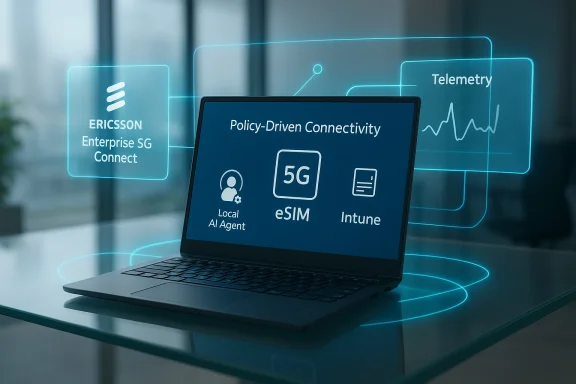
Laptop shows policy-driven connectivity with 5G, eSIM, and AI/Intune icons, surrounded by holographic telemetry.Background​

For years enterprise IT treated cellular on laptops as an afterthought—useful for road warriors, but hard to standardize at scale. That changed as eSIM technology matured and device OEMs began shipping Windows devices with integrated 5G modems and hardware attestation. Ericsson has been building the enterprise orchestration layer for several years—originally branded Enterprise Virtual Cellular Network (EVCN) and now surfaced as Ericsson Enterprise 5G Connect—while Microsoft incrementally expanded Windows 11 and Intune to support richer cellular-management hooks. The joint announcement formalizes those threads into a productized stack intended for real-world IT operations.
The partners say the integration addresses three recurring enterprise pain points:
  • Fragmented carrier management and manual eSIM workflows.
  • Lack of centralized policy enforcement across heterogeneous networks.
  • Unpredictable user experience for latency- or bandwidth-sensitive AI/remote‑work scenarios.
Their public messaging frames the work as an AI‑ready, always‑connected enterprise device strategy—one that bundles Windows 11, Microsoft Intune, Surface Copilot+ devices and Ericsson Enterprise 5G Connect into a managed offering.

What was announced — the headline capabilities​

Here’s what Microsoft and Ericsson say the integration will deliver out of the box:
  • Policy-driven connectivity: IT admins can define in Intune how devices choose networks and prioritize traffic—e.g., force 5G for collaboration apps, keep telemetry on corporate APN, or block unknown networks.
  • Zero‑touch eSIM provisioning: Enterprises can remotely provision, switch, pause or revoke eSIM profiles at fleet scale without user intervention. That includes cross-carrier switching to improve coverage or cost efficiency.
  • Local AI agent: A small, on-device agent evaluates connection telemetry (latency, throughput, error rates, power) and executes context-aware decisions—like switching eSIMs or throttling nonessential traffic—to maintain service levels for critical apps.
  • Observability and orchestration: Ericsson Enterprise 5G Connect gives central IT a single pane to monitor network quality, SLA deviations and per-device connectivity state; it works in close coordination with Intune to enforce security profiles.
  • Carrier partnership rollouts: The solution is already in pilots and early commercial availability in selective markets and with major carriers—U.S. (T‑Mobile), Sweden (Telenor), Singapore (Singtel) and Japan (SoftBank). Broader availability is planned starting in Q2 2026 with additional carrier launches across Europe and other regions.
These claims come directly from the Ericsson announcement and subsequent press distribution, and they have been picked up across trade press—indicating both technical continuity with earlier Ericsson EVCN work and rapid commercialization.

How the solution fits together — a technical tour​

Stack and integration points​

At a high level the solution stitches together four layers:
  • Device OS layer (Windows 11) — exposes APIs to manage eSIM profiles, telemetry and network selection policies, and to host the local AI agent that makes on-device decisions. Windows 11 changes enable Intune and OEM firmware to exercise more control over cellular modems.
  • Device management plane (Microsoft Intune) — acts as the policy authoring and provisioning channel for devices, pushing connectivity profiles, conditional access rules, and device compliance states. Intune becomes the single control point for both workload and connectivity policy.
  • Connectivity orchestration (Ericsson Enterprise 5G Connect) — the cloud service that manages eSIM provisioning, carrier profile catalogs, network performance monitoring, and orchestration across CSPs. It provides the analytics that inform policy decisions and central reporting for IT.
  • Carrier networks (CSPs) — the public 5G networks and carrier APIs that supply operator services and eSIM profiles. Ericsson’s platform integrates with CSP OSS/BSS systems to automate profile lifecycle and to pull network KPIs used for real‑time decisions.
This model places Windows 11 at the heart of the device experience but delegates operator‑specific provisioning and network intelligence to Ericsson, while Intune remains the enterprise control plane for policy and compliance.

On‑device AI: what it likely is (and isn’t)​

Ericsson and Microsoft describe a “local AI agent” that makes context-aware connectivity choices. Based on the technical signals they discuss, that agent will almost certainly be a policy- and telemetry‑driven decision engine rather than a large generative model. Expect:
  • Lightweight inference about connection quality thresholds and user/application context.
  • Rules + ML hybrid models that map telemetry to actions (switch carrier, prioritize flow, reduce syncs).
  • Tight governance to ensure decisions are auditable and reversible under IT control.
Put simply: this is agentic orchestration, not an emergent AI supervisor—useful but bounded by enterprise policy.

Enterprise benefits — what IT teams stand to gain​

For IT leaders evaluating always‑connected PCs, the claimed benefits are tangible and operational:
  • Reduced onboarding time — Zero‑touch eSIM and profile provisioning promises to cut the manual effort of shipping devices that need carrier setup. Ericsson has previously claimed dramatic onboarding savings from EVCN projects, and those economics are central to the pitch.
  • Consistent policy enforcement — Using Intune to carry connectivity policy means network and device posture converge: compliance checks can consider both device state and connection properties. This simplifies remote access security and conditional access rules.
  • Improved end-user experience for latency-sensitive workflows — With on-device optimisation and automated switching, high‑value use cases (videoconferencing, AR/VR collaboration, edge inference) can be prioritized when needed.
  • Operational portability — Enterprises can, in principle, switch CSP relationships at the orchestration layer and push new profiles to devices, reducing the friction of multi‑supplier environments. This could be meaningful for global firms that need multi-country coverage.
  • Bundled procurement path — The early commercial offering bundles Surface Copilot+ devices, Microsoft 365, Intune and Ericsson’s orchestration. For customers already invested in Microsoft device and cloud stacks, that integrated procurement model simplifies vendor management.

Practical deployment considerations​

If you manage Windows fleets today, here’s how to think about a pilot-to-production path.
  • Hardware readiness: Not every laptop supports the required 5G modem features or eSIM remote provisioning interfaces. Prioritize Surface Copilot+ or other validated Copilot+ devices that carry OEM support for the required modem APIs and local AI acceleration.
  • Intune policy design: Define connectivity SLAs, prioritize application flows, and codify fallback rules before flipping on automation. Plan conditional access so that network switching doesn’t inadvertently violate zero‑trust rules.
  • Carrier & regulatory mapping: Make sure Ericsson’s orchestration integrates with CSPs in your target markets, and understand local eSIM regulatory constraints (some countries still limit remote eSIM activation or require in‑person verification). The announced rollouts are phased by market and carrier.
  • Security & telemetry hygiene: Decide what telemetry is allowable for the local AI agent to send back to the cloud for analytics. Balance observability against privacy and data protection obligations.
  • Operational playbooks: Update incident runbooks to include network‑level actions (e.g., force carrier switch, remotely pause profile) and integrate those actions into ticketing/ITSM workflows.

Security, privacy and regulatory risks — what to watch​

The promise is compelling, but the implementation carries material risk vectors that demand sober analysis.
  • eSIM lifecycle control = new attack surface: Centralized remote provisioning simplifies operations but concentrates privilege. If an attacker obtained orchestration credentials, they could reorder profiles or enable covert network access. Mitigation: enforce strong MFA, role separation, logging and just-in-time administrative access.
  • Carrier and data jurisdiction: Orchestrating profiles across multiple CSPs distributes network telemetry across national boundaries. Enterprises with regulated data may need strict data residency controls and contractual assurances from both Ericsson and the CSPs.
  • Vendor lock‑in and operational coupling: The bundled Surface‑Intune‑Ericsson offering simplifies procurement but risks deep coupling of device, OS and connectivity stacks. Bigger enterprises should evaluate multi‑vendor interoperability and insist on portability clauses.
  • Privacy considerations: The local AI agent will process device and network signals that can be sensitive (location inferred from cellular behavior, app usage patterns). Enterprises must document consent models and ensure telemetry minimization.
  • Regulatory scrutiny on eSIM and lawful intercept: Lawful intercept regimes differ by country. Centralized eSIM orchestration must preserve CSP compliance obligations and provide verifiable audit trails for lawful access when necessary. Confirm these controls before wide rollouts.
Where claims are ambiguous—like the exact list of early carrier partners beyond the major names announced—IT teams should validate contractual and technical details directly with their CSPs and with Ericsson or Microsoft before committing to large-scale deployments. Some press distributions repeat carrier names verbatim from the release; confirm market-by-market availability rather than relying on syndication.

Market context and competitive landscape​

Ericsson and Microsoft are not the only players addressing enterprise cellular for endpoints. A few adjacent developments to consider:
  • Ericsson’s prior EVCN / E5G Connect work has already been adopted by CSPs (for example, Singtel’s 5G+ Mobile Workspace) to deliver packaged enterprise offerings—so this announcement accelerates an already visible trajectory toward operator‑facing enterprise orchestration.
  • Network appliance vendors and SD‑WAN players (Cradlepoint, VMware, Fortinet) have long pushed cellular-enabled edge devices and policy orchestration. Ericsson’s approach is distinct because it ties cellular orchestration directly into the device OS and MDM plane rather than focusing solely on branch appliances.
  • Device OEMs will matter. Microsoft’s Surface Copilot+ hardware is the initial launch vehicle; other OEMs will need to validate their modems and driver stacks to achieve similar integration. Enterprises should expect an ecosystem ramp in 2026 as OEMs certify Windows 11 integrations.
The commercial angle—bundling devices, cloud productivity and connectivity orchestration—creates a friction‑free option for customers heavily invested in Microsoft, but open ecosystems and operator-neutral orchestration will remain important for customers seeking to avoid lock‑in.

Field evidence and corroboration​

The Ericsson press release is the primary source for the technical and market claims inultiple reputable outlets republished or analyzed the release, and industry deployments from earlier EVCN projects offer independent precedent for the technical feasibility of zero‑touch eSIM and connectivity orchestration. Trade reports and operator press also document CSP pilots and offerings consistent with the new integration. Readers should treat carrier availability, launch timetables and exact partner lists as time‑sensitive details that require direct confirmation for procurement decisions.
For enterprises already experimenting with eSIM on Windows, another relevant data point is Microsoft’s prior shift away from the Mobile Plans app toward carrier web portals and Windows Settings for eSIM management—an evolution that suggests Microsoft’s platform-level eSIM controls have been incrementally maturing for some time. That prior change is important context for understanding how the Intune + Ericsson integration can be operationalized at scale.
(Where the public record is thin—e.g., the detailed telemetry schema used by Ericsson’s analytics or the exact on‑device inference model—we flag those as vendor‑controlled details that require direct questions in sales or technical workshops to validate.)

Recommended evaluation checklist for IT leaders​

If you’re responsible for mobility, connectivity or device procurement, use this checklist to evaluate the offering from pilot to production:
  • Confirm hardware support matrix (modem variants, eSIM stack, Copilot+ certified devices).
  • Validate Intune policy templates and required Intune licensing for connectivity policy management.
  • Assess Ericsson Enterprise 5G Connect contractual SLAs: telemetry retention, data residency, access controls, and audit capability.
  • Map regulatory requirements for eSIM activation and lawful intercept in each deployment market.
  • Run a small, geographically representative pilot (10–100 devices) focused on a high-value workload (video collaboration, XR proof-of-concept, or edge inference). Use the pilot to validate latency, failover behavior and policy fidelity.

What this means for the future of the PC and the AI era​

Embedding managed 5G into Windows 11 is more than a connectivity convenience: it’s a structural change in how devices, networks and enterprise policy interact. For AI‑first applications—on‑device inference, distributed models, real‑time collaboration—network quality becomes a first‑class system concern, not an incidental variable. The Microsoft‑Ericsson integration signals a practical path to policy‑aware connectivity, where the OS, MDM and network orchestration can collaborate to meet application SLAs dynamically.
But the model also concentrates control: the orchestration of eSIM profiles, telemetry flows and carrier APIs centralizes privileges that were previously distributed across carriers and device users. Enterprises that pursue this path should insist on transparent logging, independent audits, and contractual protections to mitigate operational and privacy risks.

Conclusion​

The Ericsson–Microsoft integration for Windows 11 is a meaningful milestone on the road to ubiquitous, manageable 5G for enterprise laptops. It answers longstanding operational headaches—manual eSIM setup, inconsistent policy enforcement, and poor observability of cellular quality—by bringing connectivity orchestration into the device and MDM planes. The result should be smoother end‑user experiences for latency‑sensitive work and lower IT overhead for mobility at scale.
At the same time, the commercial and technical details matter: carrier coverage, regulatory limits on eSIM activation, security of the orchestration plane, and the level of vendor coupling will determine whether this integration becomes a widely adopted best practice or a niche convenience for Microsoft-centric shops. For pragmatic IT teams, the right next step is a focused, measurable pilot that validates the specific apps and markets you care about—and that binds the partners to hard SLAs around security, data residency and operational transparency.
This announcement is a practical, productized advance in enterprise mobility—one that deserves serious consideration by organizations planning AI-enabled endpoint strategies in 2026 and beyond.

Source: Digital Watch Observatory Windows 11 gains enterprise 5G management through Ericsson partnership | Digital Watch Observatory
 

Back
Top