

Microsoft is finally signaling a course correction on one of Windows 11’s most controversial traits: the way the operating system keeps trying to sell users more Microsoft services. The company now appears to be working toward a “calmer” Windows experience with fewer upsells, a notable shift after years of Start menu promotions, setup prompts, and ecosystem nudges that many users have found distracting. If Microsoft follows through, the change could reshape how Windows feels day to day for both consumers and IT administrators, even if ads do not disappear entirely.
For years, Windows has walked a fine line between being an operating system and being a distribution channel for Microsoft’s broader product lineup. That tension has become especially visible in Windows 11, where the Start menu, onboarding flows, search surfaces, and system prompts have often doubled as places to promote Microsoft Edge, OneDrive, Microsoft 365, and increasingly Copilot. The result has been a platform that feels more cluttered than its predecessors, even when the core OS itself is technically stable.
The new messaging matters because it comes from inside Microsoft rather than from critics on the outside. Scott Hanselman’s comments about a “calmer and more chill OS with fewer upsells” suggest that the company is not merely responding to user complaints, but acknowledging that the balance may have tilted too far toward monetization and ecosystem steering. That is important because product culture at Microsoft tends to move slowly unless leadership decides the user experience problem is strategic, not cosmetic.
This would not be the first time Microsoft has adjusted its Windows marketing posture after backlash. Over the years, the company has periodically eased pressure on Windows 10 users, toned down some setup experiences, and tweaked default-browser behavior in response to regulatory scrutiny and user frustration. But Windows 11 has been different: Microsoft has paired more aggressive promotion with a broader push into AI, subscriptions, and cloud services, which made the OS feel less like a neutral platform and more like an invitation to sign up for more Microsoft products.
At the same time, Microsoft has not stopped investing in the kind of product changes that suggest a larger rethink is underway. Recent Windows and Microsoft blog posts have emphasized a more polished, secure, and user-friendly Windows experience, with cleaner design language, deeper settings integration, and more attention to trust and consent. That makes the current shift feel less like a one-off apology and more like an attempt to rebalance the entire Windows value proposition.
Windows 11 was introduced with a cleaner visual style and a stronger emphasis on modern design, but many users quickly noticed that the elegance was being undercut by a steady drip of recommendations. Setup flows pushed Microsoft account creation, OneDrive backup, Edge, and Microsoft 365 trials. Later, the OS introduced more promotional placements in settings, search, and the Start menu, making the system feel less like a tool and more like a storefront. That perception matters because people do not just evaluate Windows by feature count; they judge it by trust and predictability.
Microsoft has also been pushing Windows deeper into an AI-first phase, and that makes upsells even more visible. New features such as Copilot, Windows agents, and AI-powered suggestions are often framed as productivity improvements, but they also increase the number of moments when Microsoft can steer users toward a cloud-connected service or subscription. In other words, the line between helpful guidance and commercial promotion has become increasingly blurred.
Another factor is trust. Microsoft has spent the last two years talking about security, privacy, and responsible AI, and persistent upselling undermines that message. If the company wants Windows to feel like a modern, secure, and dependable platform, it cannot keep letting promotional clutter dominate the story.
The problem is not simply that ads exist. It is that the Start menu carries a special trust relationship with users, and anything that compromises that trust can make the entire OS feel less dignified. Even modest promotional changes become more controversial because they land in a space people associate with control, not marketing.
Microsoft seems to understand that distinction now. A cleaner Start menu would not necessarily mean a completely ad-free future, but it could mean fewer promotional placements, clearer labeling, and more restraint around recommended content. That would be a meaningful improvement, especially if it reduces the sense that the Start menu is constantly trying to redirect attention away from the user’s own workflow.
A more restrained design would likely help Microsoft in three ways:
That matters because first impressions have a long tail. A user who feels pushed around during installation is more likely to begin their Windows journey in a defensive frame of mind. By the time the system asks for another consent, another trial, or another “recommended” setting, the emotional damage may already be done.
Microsoft’s recent emphasis on trust and consent suggests an effort to rebuild that relationship. The company has talked about more transparent system behavior, clearer prompts, and more consistent decision-making across Windows. If those principles are applied to setup and onboarding, the experience could become significantly less irritating without removing useful guidance entirely.
A better model would likely include:
That is where the user-experience challenge becomes strategic. If AI-powered recommendations feel genuinely helpful, they can strengthen Windows. If they feel like another vehicle for upsells, they will reinforce the same criticism Microsoft is trying to escape. The company needs to prove that intelligence and restraint can coexist.
Recent Windows messaging has focused heavily on making the OS more intuitive, accessible, and useful, especially on Copilot+ PCs. That is a promising direction, but the tone has to match the functionality. Users are willing to accept AI assistance when it saves them time; they become skeptical when it feels like a funnel into subscriptions, services, or branded experiences.
Consumers, meanwhile, may simply feel annoyed. But in businesses, annoyance can turn into real cost. A few extra minutes spent dismissing prompts across thousands of devices becomes a measurable productivity drag, and any feature that creates support noise will eventually face scrutiny from administrators. Microsoft knows this, which is why a calmer default experience would likely be welcomed in managed environments.
At the consumer level, the benefit is emotional as much as operational. A quieter Windows 11 would feel more premium and less exhausting. It could also make the platform friendlier for less technical users who are easily confused by setup choices or app recommendations.
The key distinction is simple:
Windows has always benefited from breadth. It supports a huge range of hardware, software, and workflows, which makes it indispensable. But that same breadth makes every layer of promotional noise more noticeable, because users do not expect the OS to be trying to narrow their choices. The platform wins when it feels like infrastructure; it loses when it feels like a sales surface.
There is also a hardware angle. Microsoft wants Windows 11 and Copilot+ PCs to feel like the future, not the compromise. If the OS is perceived as bloated, noisy, or overly commercial, that weakens the appeal of new devices even when they are technically impressive. A cleaner interface is not just a design preference; it is part of the pitch for the next generation of Windows hardware.
That balance may become the defining product question for Windows over the next cycle. If Microsoft can reduce clutter while preserving discovery, it may strengthen long-term loyalty. If it removes too little, the complaints will continue; if it removes too much, the company risks weakening the cross-sell engine that powers parts of its consumer strategy.
There is also room for UI cleanup beyond advertising. Windows 11 has often been criticized for inconsistent settings, scattered controls, and a mix of modern and legacy elements. If Microsoft is genuinely trying to make the OS feel calmer, then visual simplification and prompt reduction should go hand in hand.
The challenge is that some of the most visible Windows annoyances are deeply entwined with product strategy. Microsoft may be able to hide them better, but it cannot easily eliminate the tension between a platform business and a service-selling business. The real test is whether users feel the difference in daily use, not whether a press quote sounds better.
It will also be worth watching how Microsoft handles Copilot, account sign-in, and default-service nudges. Those are the pressure points where a cleaner Windows could either prove its value or stumble back into the same old patterns. The opportunity is real, but so is the skepticism, and Microsoft will need more than a promise to win people over.
Source: Digital Trends The future of Windows could include fewer ads and distracting upsells
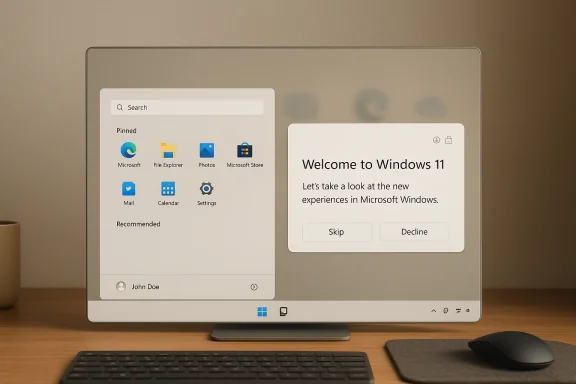 Overview
For years, Windows has walked a fine line between being an operating system and being a distribution channel for Microsoft’s broader product lineup. That tension has become especially visible in Windows 11, where the Start menu, onboarding flows, search surfaces, and system prompts have often doubled as places to promote Microsoft Edge, OneDrive, Microsoft 365, and increasingly Copilot. The result has been a platform that feels more cluttered than its predecessors, even when the core OS itself is technically stable.The new messaging matters because it comes from inside Microsoft rather than from critics on the outside. Scott Hanselman’s comments about a “calmer and more chill OS with fewer upsells” suggest that the company is not merely responding to user complaints, but acknowledging that the balance may have tilted too far toward monetization and ecosystem steering. That is important because product culture at Microsoft tends to move slowly unless leadership decides the user experience problem is strategic, not cosmetic.
This would not be the first time Microsoft has adjusted its Windows marketing posture after backlash. Over the years, the company has periodically eased pressure on Windows 10 users, toned down some setup experiences, and tweaked default-browser behavior in response to regulatory scrutiny and user frustration. But Windows 11 has been different: Microsoft has paired more aggressive promotion with a broader push into AI, subscriptions, and cloud services, which made the OS feel less like a neutral platform and more like an invitation to sign up for more Microsoft products.
At the same time, Microsoft has not stopped investing in the kind of product changes that suggest a larger rethink is underway. Recent Windows and Microsoft blog posts have emphasized a more polished, secure, and user-friendly Windows experience, with cleaner design language, deeper settings integration, and more attention to trust and consent. That makes the current shift feel less like a one-off apology and more like an attempt to rebalance the entire Windows value proposition.
Background
The roots of this issue go back well before Windows 11. Microsoft has long used Windows to surface its own services, but the strategy became much more visible in the Windows 10 era, when Start menu suggestions, browser prompts, and app recommendations became common enough to provoke recurring criticism. What changed under Windows 11 was not just the frequency of these nudges, but their placement inside the most visible parts of the desktop experience.Windows 11 was introduced with a cleaner visual style and a stronger emphasis on modern design, but many users quickly noticed that the elegance was being undercut by a steady drip of recommendations. Setup flows pushed Microsoft account creation, OneDrive backup, Edge, and Microsoft 365 trials. Later, the OS introduced more promotional placements in settings, search, and the Start menu, making the system feel less like a tool and more like a storefront. That perception matters because people do not just evaluate Windows by feature count; they judge it by trust and predictability.
Microsoft has also been pushing Windows deeper into an AI-first phase, and that makes upsells even more visible. New features such as Copilot, Windows agents, and AI-powered suggestions are often framed as productivity improvements, but they also increase the number of moments when Microsoft can steer users toward a cloud-connected service or subscription. In other words, the line between helpful guidance and commercial promotion has become increasingly blurred.
Why the backlash stuck
Users are usually tolerant of occasional suggestions if they feel relevant and easily dismissible. Windows 11 crossed a different threshold because prompts began to appear in places where people expected the OS to stay out of the way. The friction was not only about content, but about timing, frequency, and tone.- Prompts often appeared during setup, when users are least interested in marketing.
- Start menu recommendations sometimes looked like app entries rather than ads.
- System-wide nudges could make the OS feel noisy even when nothing was wrong.
- Repeated promotions made some users feel they were configuring a product they already paid for.
Why Microsoft may be changing now
This shift is likely a mix of user feedback, competitive pressure, and strategic realism. Apple continues to sell premium hardware with a comparatively quieter OS experience, while many Linux desktop environments remain notably free of commercial persuasion. On the PC side, Microsoft may be concluding that Windows cannot afford to feel annoying at the exact moment it needs to justify upgrades to Windows 11 and Copilot+ PCs.Another factor is trust. Microsoft has spent the last two years talking about security, privacy, and responsible AI, and persistent upselling undermines that message. If the company wants Windows to feel like a modern, secure, and dependable platform, it cannot keep letting promotional clutter dominate the story.
The Start Menu Problem
The Start menu is the symbolic center of Windows, which is why promotional content there has drawn so much criticism. It is the first place many users click after logging in, and it is where they expect to launch apps—not browse recommendations, discover trials, or sift through suggested services. When Microsoft uses that real estate for promotions, the experience feels less like personalization and more like interference.The problem is not simply that ads exist. It is that the Start menu carries a special trust relationship with users, and anything that compromises that trust can make the entire OS feel less dignified. Even modest promotional changes become more controversial because they land in a space people associate with control, not marketing.
Microsoft seems to understand that distinction now. A cleaner Start menu would not necessarily mean a completely ad-free future, but it could mean fewer promotional placements, clearer labeling, and more restraint around recommended content. That would be a meaningful improvement, especially if it reduces the sense that the Start menu is constantly trying to redirect attention away from the user’s own workflow.
Start menu trust is fragile
The Start menu must be fast, readable, and boring in the best possible sense. The moment it begins to resemble a commerce surface, users start to question every recommendation inside it. That skepticism spreads quickly because the Start menu sits at the intersection of habit and necessity.A more restrained design would likely help Microsoft in three ways:
- It would reduce the feeling that Windows is trying to monetize every click.
- It would make the Start menu easier to scan under pressure.
- It would improve the OS’s perceived professionalism in enterprise environments.
- It could lower the number of accidental clicks on promoted content.
System Prompts and Setup Flows
Some of the most frustrating Windows experiences happen before the user even reaches the desktop. Setup flows have increasingly been used to nudge people toward a Microsoft account, cloud backup, browser defaults, and subscription services. Even when these prompts are technically optional, they often create the impression that the OS is trying to guide users into a preferred commercial path.That matters because first impressions have a long tail. A user who feels pushed around during installation is more likely to begin their Windows journey in a defensive frame of mind. By the time the system asks for another consent, another trial, or another “recommended” setting, the emotional damage may already be done.
Microsoft’s recent emphasis on trust and consent suggests an effort to rebuild that relationship. The company has talked about more transparent system behavior, clearer prompts, and more consistent decision-making across Windows. If those principles are applied to setup and onboarding, the experience could become significantly less irritating without removing useful guidance entirely.
The difference between guidance and pressure
There is nothing inherently wrong with helping users discover features. The issue is whether those discoveries feel optional and helpful or mandatory and sales-driven. In practice, many Windows prompts have been written and timed like conversion funnels rather than onboarding aids.A better model would likely include:
- Clear explanation of what a prompt changes.
- One-click decline options that are easy to find.
- Fewer repeated reminders after a decision is made.
- Less emphasis on Microsoft-branded defaults during setup.
- More neutral language when offering services or trials.
AI Integration and the New Windows Identity
Windows is now being repositioned as the home for AI on the PC, and that introduces a new layer of complexity. Microsoft wants Copilot, settings agents, and context-aware assistance to feel like natural extensions of the desktop, but AI features also create more opportunities for cross-promotion. The more the system can understand what you are doing, the more it can recommend something else.That is where the user-experience challenge becomes strategic. If AI-powered recommendations feel genuinely helpful, they can strengthen Windows. If they feel like another vehicle for upsells, they will reinforce the same criticism Microsoft is trying to escape. The company needs to prove that intelligence and restraint can coexist.
Recent Windows messaging has focused heavily on making the OS more intuitive, accessible, and useful, especially on Copilot+ PCs. That is a promising direction, but the tone has to match the functionality. Users are willing to accept AI assistance when it saves them time; they become skeptical when it feels like a funnel into subscriptions, services, or branded experiences.
AI can help, but it can also crowd the interface
AI surfaces occupy valuable attention on the screen. That makes them powerful, but it also makes them risky. Every suggestion that appears in the interface has to justify its presence, and that bar is higher in a desktop OS than in a web app.- AI should reduce friction, not add another layer of noise.
- Suggestions must be contextual, not generic.
- Users need predictable controls to disable or customize them.
- The interface should prioritize action over promotion.
Enterprise Versus Consumer Impact
The enterprise case for fewer Windows upsells is arguably even stronger than the consumer case. IT departments want Windows to be predictable, policy-driven, and easy to support at scale. Promotional prompts create uncertainty, complicate help desk scripts, and undermine the value of standard images and management baselines.Consumers, meanwhile, may simply feel annoyed. But in businesses, annoyance can turn into real cost. A few extra minutes spent dismissing prompts across thousands of devices becomes a measurable productivity drag, and any feature that creates support noise will eventually face scrutiny from administrators. Microsoft knows this, which is why a calmer default experience would likely be welcomed in managed environments.
At the consumer level, the benefit is emotional as much as operational. A quieter Windows 11 would feel more premium and less exhausting. It could also make the platform friendlier for less technical users who are easily confused by setup choices or app recommendations.
Different users, different tolerance levels
Enterprise buyers usually care about control, auditability, and standardization. Consumers care more about convenience and a sense of being left alone. A better Windows could satisfy both groups if Microsoft trims the commercial clutter without removing useful signposting.The key distinction is simple:
- Enterprises need fewer interruptions and less policy friction.
- Consumers need fewer distractions and less confusion.
- Both groups want transparency.
- Neither group wants to feel trapped inside a product pitch.
Competitive Pressure and Market Positioning
Microsoft does not operate in a vacuum, and its design choices are being judged against other ecosystems. macOS does not feel clutter-free in every respect, but it is generally perceived as less aggressively promotional than Windows. ChromeOS, for its part, is tightly tied to Google services, but it also feels more focused because the commercial tradeoff is more obvious and narrower in scope.Windows has always benefited from breadth. It supports a huge range of hardware, software, and workflows, which makes it indispensable. But that same breadth makes every layer of promotional noise more noticeable, because users do not expect the OS to be trying to narrow their choices. The platform wins when it feels like infrastructure; it loses when it feels like a sales surface.
There is also a hardware angle. Microsoft wants Windows 11 and Copilot+ PCs to feel like the future, not the compromise. If the OS is perceived as bloated, noisy, or overly commercial, that weakens the appeal of new devices even when they are technically impressive. A cleaner interface is not just a design preference; it is part of the pitch for the next generation of Windows hardware.
Microsoft’s broader ecosystem bet
The company’s business model still benefits from service attachment. Microsoft 365 subscriptions, OneDrive storage, Edge usage, and Copilot engagement all reinforce the broader ecosystem. That means Microsoft is unlikely to abandon promotion entirely; instead, it will probably search for a more disciplined balance.That balance may become the defining product question for Windows over the next cycle. If Microsoft can reduce clutter while preserving discovery, it may strengthen long-term loyalty. If it removes too little, the complaints will continue; if it removes too much, the company risks weakening the cross-sell engine that powers parts of its consumer strategy.
What Might Actually Change
The most realistic outcome is not a dramatic one-day transformation, but a series of smaller cuts across multiple surfaces. Microsoft could reduce recommended content in Start, simplify setup prompts, and make it easier to dismiss or avoid offers. It may also tone down language that makes optional features feel urgent or default.There is also room for UI cleanup beyond advertising. Windows 11 has often been criticized for inconsistent settings, scattered controls, and a mix of modern and legacy elements. If Microsoft is genuinely trying to make the OS feel calmer, then visual simplification and prompt reduction should go hand in hand.
The challenge is that some of the most visible Windows annoyances are deeply entwined with product strategy. Microsoft may be able to hide them better, but it cannot easily eliminate the tension between a platform business and a service-selling business. The real test is whether users feel the difference in daily use, not whether a press quote sounds better.
Likely near-term improvements
- Fewer recommendations in the Start menu.
- Less aggressive setup-time marketing.
- More obvious opt-out choices for promotional features.
- Cleaner system prompts with less marketing language.
- Better separation between OS functionality and Microsoft service promotion.
Strengths and Opportunities
Microsoft’s pivot toward a quieter Windows could pay off if the company commits to consistency rather than cosmetic adjustments. A less intrusive OS would improve trust, reduce friction, and make Windows 11 feel more polished at a time when the broader platform narrative needs help.- It could restore confidence in the Start menu as a pure launcher.
- It would likely improve the onboarding experience for new users.
- It could reduce IT support noise in managed environments.
- It would make Windows feel more premium and less ad-heavy.
- It could help Microsoft present Copilot as useful rather than pushy.
- It may improve the appeal of Windows 11 on lower-spec devices where clutter feels more obvious.
- It creates a stronger contrast with the more aggressive promotional tone of recent years.
Risks and Concerns
The biggest risk is that Microsoft may only soften the presentation while leaving the underlying behavior intact. Users are very good at detecting when a company changes the packaging but not the product, and that kind of half-step can make skepticism worse rather than better.- Prompts could be reduced but still feel repetitive.
- Ads may move from obvious places to subtler ones.
- AI features could become the new vehicle for upsells.
- Enterprise users may still see policy headaches if defaults remain too opinionated.
- Microsoft could overcorrect and make discovery of genuinely useful features harder.
- The company may struggle to balance monetization with trust.
- Any mismatch between promise and execution will be very visible to longtime Windows users.
Looking Ahead
The next few Windows releases will reveal whether Microsoft is serious about changing the tone of the platform or simply trimming the rough edges. If the company is listening carefully, it will understand that the goal is not just fewer ads, but a more respectful relationship with the person sitting in front of the PC. That means clearer choices, fewer interruptions, and a stronger sense that Windows belongs to the user first.It will also be worth watching how Microsoft handles Copilot, account sign-in, and default-service nudges. Those are the pressure points where a cleaner Windows could either prove its value or stumble back into the same old patterns. The opportunity is real, but so is the skepticism, and Microsoft will need more than a promise to win people over.
- Watch for changes to Start menu recommendations and app promotions.
- Watch for setup and account-creation prompts to become less aggressive.
- Watch for Copilot integration to shift from promotional to genuinely assistive.
- Watch for enterprise policy tools to gain more control over system suggestions.
- Watch for Microsoft to keep testing the limits of what users will tolerate.
Source: Digital Trends The future of Windows could include fewer ads and distracting upsells
