

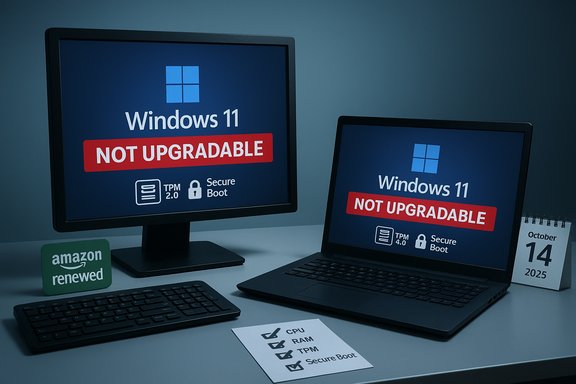
Amazon Renewed listings for budget refurbished PCs quietly continued to promise Windows 11 or otherwise fail to disclose that the machines could never be upgraded after Microsoft ended Windows 10 support — and shoppers who bought those “lemon” systems face a fast-closing returns window because Amazon will not extend its standard 90- or 30-day policies.
Microsoft set a hard calendar deadline: Windows 10 reached end of support on October 14, 2025. After that date Microsoft stopped providing routine security updates and feature updates for Windows 10; the company recommends users move to Windows 11 or enroll in limited Extended Security Updates (ESU) as a temporary bridge. Windows 11 enforces a stricter hardware floor than Windows 10 — notably TPM 2.0, UEFI Secure Boot, a supported processor family, 4 GB RAM and 64 GB storage — and Microsoft publishes explicit processor compatibility lists. That combination leaves a sizable installed base of perfectly functional Windows 10-era machines ineligible for a supported Windows 11 upgrade. Amazon Renewed is a major marketplace for refurbished and reconditioned electronics; the program promises multi-point inspection and is backed by the Amazon Renewed Guarantee, which is typically a 90-day return/replacement window (with some Renewed Premium items showing a 365-day period in product copy). However, Renewed protections are only available when a listing explicitly displays the guarantee and when the product is sold under Renewed program terms.
For anyone who purchased a renewed PC in the weeks around Microsoft’s October 14, 2025 end-of-support deadline: stop, document, check your device with PC Health Check, and if the machine is ineligible, initiate a return now. If the return window is closed, assemble your evidence (screenshots of the listing, your order, and the PC Health Check) and escalate through Amazon’s A-to-Z process. The immediate practical risk is not just buyer regret — it is a genuine, measurable security exposure for devices that may no longer be entitled to future security updates.
Bold, machine-readable compatibility badges and stricter Renewed enforcement would reduce buyer risk and help the recommerce market scale responsibly. Until that happens, refurbishment bargain hunters must verify processor family, TPM firmware and Secure Boot capability before trusting any low-cost Renewed PC to carry them safely past the Windows 10 end-of-support cliff.
Source: Techlicious Time’s Running Out to Return Lemon PCs Sold on Amazon Renewed
 Background
Microsoft set a hard calendar deadline: Windows 10 reached end of support on October 14, 2025. After that date Microsoft stopped providing routine security updates and feature updates for Windows 10; the company recommends users move to Windows 11 or enroll in limited Extended Security Updates (ESU) as a temporary bridge. Windows 11 enforces a stricter hardware floor than Windows 10 — notably TPM 2.0, UEFI Secure Boot, a supported processor family, 4 GB RAM and 64 GB storage — and Microsoft publishes explicit processor compatibility lists. That combination leaves a sizable installed base of perfectly functional Windows 10-era machines ineligible for a supported Windows 11 upgrade. Amazon Renewed is a major marketplace for refurbished and reconditioned electronics; the program promises multi-point inspection and is backed by the Amazon Renewed Guarantee, which is typically a 90-day return/replacement window (with some Renewed Premium items showing a 365-day period in product copy). However, Renewed protections are only available when a listing explicitly displays the guarantee and when the product is sold under Renewed program terms. What Techlicious found — the headline facts
- Techlicious reported that, in the weeks after Windows 10’s end-of-support date, it found dozens of Amazon Renewed listings for laptops and desktops that lack the hardware needed to be upgraded to Windows 11, yet many did not disclose that limitation and some listings claimed Windows 11 was installed. Microsoft validated a sample set of 32 flagged listings as ineligible, and Amazon removed those specific listings after being notified.
- Techlicious also documented that other suspect listings continued to appear in spot checks, indicating partial enforcement and gaps in the marketplace’s vetting of refurbished inventory and seller claims. The reporting made clear that an unsupported Windows 11 install can be created by bypassing Microsoft’s checks — but that those installs are explicitly unsupported and may not receive updates. Techlicious did not independently verify whether individual units were running Windows 11 through official upgrade paths or unsupported hacks; that remains unverified in many cases.
- Critically for buyers, Amazon told Techlicious that it would not make a special exception to extend return windows beyond the normal 30- or 90-day windows on Renewed purchases — even for buyers who only discovered the compatibility problem after the standard window closed. Amazon’s public Renewed documentation reiterates the 90-day baseline (and a longer period for some Renewed Premium items) but leaves Amazon scope to apply those rules listing-by-listing.
Why this matters: security, updates and the illusion of “Windows 11”
A PC that cannot be upgraded through an official, supported path to Windows 11 but that appears to run Windows 11 creates a dangerous illusion of safety.- Microsoft’s policy is explicit: installing Windows 11 on hardware that fails the minimum requirements is not supported and such devices “are not guaranteed to receive updates, including but not limited to security updates.” That creates real exposure: attackers will continue to find and exploit vulnerabilities patched only for supported systems.
- Independent workarounds exist and are widely used: registry tweaks, patched installers, and custom installation media (tools like Rufus) can bypass CPU/TPM checks and let Windows 11 be installed on unsupported hardware. Those methods can make a system look modern while stripping it of the vendor guarantees and update entitlements that keep systems secure over time. Microsoft and security analysts warn that this is an unsafe trade-off for mainstream users.
- Many low-cost Renewed devices sold for under $300 (often well under $200) use older CPU generations or lack TPM 2.0 support outright. These machines may have been resold broadly because they still boot and run basic apps — but their security posture after Windows 10 EOL is significantly diminished unless the buyer takes corrective action (upgrade hardware, enroll in ESU, or move to a supported OS).
The marketplace failure: where enforcement broke down
Refurbish-and-resell marketplaces face a classic enforcement problem: sellers supply inventory and marketplaces must verify claims at scale.- Amazon’s Renewed program requires qualified refurbishers and lists program rules, but the program relies heavily on seller honesty, test buys and complaint-driven enforcement. Listings that omit clear compatibility details or that claim “Windows 11 installed” without machine-side verification exploit that asymmetry between seller knowledge and buyer expertise.
- Techlicious’ reporting shows the system can work — Amazon removed the specific listings flagged by the publication — but it also demonstrates that enforcement is reactive and fragmented. The flawed listings were live during a time-sensitive migration: Microsoft’s end-of-support date meant that buyers had a compressed window for safe returns or for enrolling in ESU.
- Amazon’s refusal to extend returns for affected Renewed buyers raises a hard fairness question. Renewed inventory moves fast; a buyer who assumes a device is Windows 11-capable and keeps it beyond a 30- or 90-day window can be left without a remedy even when the listing was arguably misleading. Techlicious asked Amazon for an exception; Amazon instead pointed to its standard Renewed Guarantee terms.
What buyers should do now — a short, practical checklist
Time is the enemy here because return windows expire. The following steps are prioritized and sequential.- Check your order and the listing copy
- Open Your Orders and save a screenshot of the product page as it appeared when you bought it (price, seller, Renewed label, and the exact spec bullets).
- Confirm whether the product page explicitly displayed the Amazon Renewed Guarantee or Renewed Premium language. That matters for return entitlement.
- Run PC Health Check and document the result
- Use Microsoft’s PC Health Check app or Settings > Privacy & Security > Windows Update to confirm if the device is offered the official Windows 11 upgrade. Save screenshots showing ineligible messages or the specific requirement blocking the upgrade (CPU, TPM, Secure Boot). Microsoft’s documentation shows how the checks are surfaced.
- If your device is ineligible, initiate a return immediately
- Start a return through Amazon’s Order page while you still fall within the 30- or 90-day window. Use the Amazon Renewed Guarantee channel if the listing included it. Even if you’re close to the window’s end, initiating a return now preserves your right to a refund.
- If the return window has already closed, file an A-to-Z or seller complaint
- Document the listing copy (screenshots), the PC Health Check results, and your correspondence with the seller and Amazon. File an A-to-Z Guarantee claim or escalate through Amazon customer service; include the compatibility evidence. Success is not guaranteed, but the documentation is necessary.
- Consider short-term mitigations while you resolve the return
- If you must use the device temporarily, disconnect sensitive accounts, avoid banking or primary authentication, and install independent security software. For many users, the safer path is to reinstall a supported OS (Windows 10 with ESU enrollment) or pivot to a secure alternative like ChromeOS Flex or a modern Linux distro — but only after backing up and confirming app compatibility.
- If you prefer a long-term fix, buy a genuinely Windows 11–capable refurb
- Look for refurb units with Intel 10th/11th Gen or newer (or equivalent AMD Ryzen 3000/4000+ lists), explicit mention of TPM 2.0, and Renewed Premium copy that includes a 365-day window. Prefer “Sold & Shipped by Amazon” or vendors with strong reputations for accurate SKU disclosure.
Legal and consumer-protection angle — broader implications
This episode touches on three systemic issues: disclosure, enforcement and post-sale remedies.- Disclosure standards: refurbished marketplaces must adopt clear, machine-verified compatibility badges (for example: “Windows 11 verified — PC Health Check screenshot included”) to remove ambiguity. Techlicious recommended that marketplaces require tangible proof for “Windows 11 compatible” claims rather than seller assertions.
- Enforcement mechanisms: marketplaces can scale enforcement through automated checks (cross-referencing SKU/CPU lists against listing metadata), sample buys and stiffer penalties for repeat misrepresenters. Amazon’s existing controls removed flagged listings, but the problem persisted in other pages — showing that patchwork moderation is insufficient.
- Returns and remedies: when systemic misinformation affects a large user base during a vendor lifecycle event (like an OS EOL), platforms should consider time-limited policy carve-outs — even a modest extension of return windows for affected categories would be a reasonable consumer protection step. Amazon declined to extend returns in this case, leaving buyers with limited options.
Strengths and limitations of the available evidence
- Strengths: Techlicious’ reporting paired listing-level review with verification from Microsoft on a sample of flagged listings, forcing immediate takedowns for at least those entries. That demonstrates that journalism can prompt remediation at scale.
- Limitations and unverifiable claims: Techlicious explicitly notes that it did not independently verify whether suspect units actually had Windows 11 installed via unsupported hacks or were merely misadvertised. That distinction is important: a listing that claims Windows 11 is installed could be a straight misrepresentation, or it could reflect an unsupported install that masks a longer-term update/patching problem. Those on-device details are often only determinable after the buyer unboxes and runs health checks. Treat any seller claim of “Windows 11 installed” on older hardware as unverified until you can confirm with PC Health Check and vendor documentation.
Risk assessment for different buyer types
- Casual users and families: High risk. If you rely on automatic security patches, a refurbished PC that cannot reliably receive updates is a poor choice. Budget constraints are real, but the cost of compromised data or cleaning a malware infection can quickly eclipse the device savings.
- Small-business users and nonprofits: Very high risk. Unsupported systems jeopardize compliance, remote access security, backups and trust. For these buyers, insist on explicit verification that refurbished systems are supported or invest in a device that is pre-certified for Windows 11.
- Power users and tinkerers: Moderate risk. Experienced users can often get by with unsupported installs, Linux replacements, or periodic manual patching — but they must accept the trade-off and have robust backup and recovery plans.
What marketplaces and refurbishers should do next
- Require machine-verified evidence for compatibility claims: a screenshot from PC Health Check or an SN/firmware signature demonstrating TPM 2.0 and Secure Boot.
- Add a mandatory compatibility checkbox and a visible “Windows 11 Support: Verified / Not Verified” banner on every Renewed PC listing.
- Offer a temporary, enhanced Renewed window (for example, 180 days) for older laptop and desktop categories during major platform transitions, explicitly for buyer protection.
- Improve seller onboarding and test-buy cadence for Renewed vendors who list budget inventory in high volumes.
Conclusion
Microsoft’s hardware gate for Windows 11 and the formal end of Windows 10 support created a narrow window of consumer exposure. Techlicious’ reporting exposed how that timing intersected with marketplace mechanics: some Amazon Renewed listings either failed to disclose Windows 11 incompatibility or claimed Windows 11 was installed on machines that couldn’t be supported, and Amazon’s decision not to extend return windows left some buyers with a fast-closing remedy timeline.For anyone who purchased a renewed PC in the weeks around Microsoft’s October 14, 2025 end-of-support deadline: stop, document, check your device with PC Health Check, and if the machine is ineligible, initiate a return now. If the return window is closed, assemble your evidence (screenshots of the listing, your order, and the PC Health Check) and escalate through Amazon’s A-to-Z process. The immediate practical risk is not just buyer regret — it is a genuine, measurable security exposure for devices that may no longer be entitled to future security updates.
Bold, machine-readable compatibility badges and stricter Renewed enforcement would reduce buyer risk and help the recommerce market scale responsibly. Until that happens, refurbishment bargain hunters must verify processor family, TPM firmware and Secure Boot capability before trusting any low-cost Renewed PC to carry them safely past the Windows 10 end-of-support cliff.
Source: Techlicious Time’s Running Out to Return Lemon PCs Sold on Amazon Renewed
