

Microsoft is leaning hard into a commitment to quality for Windows 11, and the latest March 2026 update cycle shows why that messaging matters. The company is no longer selling monthly servicing as just a security chore; it is positioning quality updates as the mechanism that keeps Windows 11 stable, supportable, and increasingly intelligent about what each device should receive. That shift is visible in the newest cumulative updates, which bundle security fixes with non-security improvements and, in some cases, expanded device-targeting logic for sensitive rollouts such as Secure Boot certificate deployment.
For Windows users, the headline is simple: Microsoft wants updates to feel less disruptive and more reliable. For IT departments, the more important story is that Windows 11 servicing is becoming more data-driven, more phased, and more tightly integrated with management tools like Intune and Windows Autopatch. That is a meaningful change in both philosophy and mechanics, and it could shape how enterprises think about patching in 2026 and beyond.
Microsoft’s modern Windows update model has been evolving for years, but the current direction is especially clear. The company now treats monthly servicing as a primary vehicle for not just security fixes, but also reliability improvements, quality corrections, and selective feature delivery. On Windows 11, that approach is reinforced by continuous innovation, where new capabilities can arrive via servicing rather than waiting for a major version jump.
That matters because Windows has long carried the reputation of being powerful but occasionally unpredictable during update cycles. Microsoft’s answer has been to make each update more cumulative, more observable, and more controlled through phased rollout methods. The March 2026 updates are a good example: Microsoft says they include the latest security fixes plus non-security improvements from the prior month’s optional preview release, which is exactly how the company wants the modern cadence to work.
The “quality” framing also reflects a broader industry reality. In a world of frequent software release cycles, a patch is no longer just a patch; it is a deployment event that can affect endpoint compliance, application compatibility, and even identity or firmware trust chains. Microsoft has responded by building more intelligence into Windows quality updates, including device-targeting data that helps determine whether a device should receive certain sensitive changes, such as Secure Boot certificates.
There is also a business angle behind the message. Microsoft knows that organizations are more likely to trust Windows 11 if it can demonstrate not only new capabilities, but also consistency in servicing. That is why the company keeps emphasizing manageability, validation, and staged rollout in the same breath as quality improvements. In practice, quality is becoming a competitive feature, not just a maintenance goal.
This also aligns with Microsoft’s broader shift toward servicing-based innovation in Windows 11. Instead of treating features and fixes as separate silos, the company increasingly delivers them through the same machinery, which can make the platform feel more cohesive. The upside is speed and consistency; the downside is that a poorly handled rollout can now affect more than just one isolated bug fix.
The March 2026 updates underline that point. Microsoft’s support documentation says the current cumulative updates include both the latest security fixes and non-security updates from the prior preview cycle, which is a classic sign of the service model maturing. That structure allows Microsoft to validate changes with a smaller preview audience before moving them into the mainstream monthly release.
That is a big deal because Secure Boot is part of the trust chain that helps ensure only signed and trusted software loads during startup. When Microsoft uses quality updates to stage changes in that trust infrastructure, it shows how far Windows servicing has moved beyond ordinary bug fixing. This is not the kind of update mechanism most consumers think about, but it is exactly the kind of change that enterprise admins must understand.
Microsoft is also embedding management guidance alongside the release notes. The company points users and administrators to the Windows release health dashboard and update history pages for visibility into known issues and rollout status. That transparency is part of the quality story, because predictable servicing depends on users being able to see what is changing and when.
This is the kind of workflow that enterprise customers have been asking for: fewer surprises, clearer staging, and more predictable outcomes. It also helps explain why Microsoft uses terms like production-quality and controlled and phased rollout so often in its servicing notes. The company is not just shipping updates; it is trying to prove that update behavior itself is now a managed quality metric.
For consumers, the preview model is less visible, but it still matters. The optional release often seeds fixes that become part of next month’s mandatory cumulative update, which means early adopters are effectively helping Microsoft harden the code path. That can be beneficial, though it also means the boundary between “optional” and “mainline” is not as distinct as casual users might expect.
That recursive approach has obvious advantages. When the update engine is more stable, the rest of the patch process tends to improve with it. But it also means Microsoft must be careful not to overpromise: a more reliable update pipeline does not automatically eliminate the possibility of regressions, compatibility problems, or driver conflicts. Quality in this context is a process, not a guarantee.
Microsoft Intune also plays an important role, especially around quality updates during provisioning and out-of-box experience scenarios. The company’s messaging suggests it wants administrators to bring patching closer to device setup rather than treating it as a later maintenance task. That is a subtle but important shift because it pushes update hygiene earlier in the device lifecycle.
This is where Microsoft’s quality language gets most persuasive. By embedding update controls into the management stack, Microsoft can argue that Windows 11 is not merely easier to patch, but easier to govern at scale. That is a strong enterprise story, provided customers trust the rollout telemetry and see fewer post-update disruptions.
At the same time, the enterprise burden does not go away. More intelligent updates can still break line-of-business apps, interfere with drivers, or require coordination with third-party tools. Microsoft’s model improves the odds of a clean rollout, but it does not remove the need for testing rings, change windows, and rollback planning.
That is especially important because Windows 11 has often been judged on polish as much as capability. A quality-first update strategy can gradually improve the platform’s reputation if it delivers stable installs and fewer headline-grabbing failures. But consumers are also unforgiving; a few high-profile bad patches can undo months of trust-building. Consistency is the real currency here.
There is also a subtle benefit for mainstream users: the line between “optional” and “mandatory” becomes less stressful when Microsoft is more careful about what moves from preview to Patch Tuesday. If the preview channel does its job, the monthly update should feel less like a gamble and more like a confirmation of what has already been validated. That is the ideal outcome, even if it is not always achieved in practice.
This approach also helps Microsoft protect the Windows 11 brand at a time when users are increasingly sensitive to disruption. If quality updates can be framed as a reason to trust the platform, then Microsoft gets a competitive advantage that is less about marketing and more about everyday experience. That is a very Windows-specific kind of moat.
At the same time, the more Microsoft ties innovation to servicing, the more it risks making the update channel the public face of Windows health. That can be good when things go well, but it can be punishing when they do not. In that sense, Microsoft is competing against expectations as much as against rival platforms.
Microsoft now has the tools to make quality a real platform differentiator: optional previews, cumulative servicing, phased rollout, management integrations, and richer update-health signals. What remains to be seen is whether those tools consistently produce the kind of calm, invisible maintenance experience users want. The company has set the direction; the next few update cycles will show whether the execution matches the message.
Source: Mix93.3 Inside Story | Mix93.3 | Kansas City's #1 Hit Music Station | Kansas City, MO
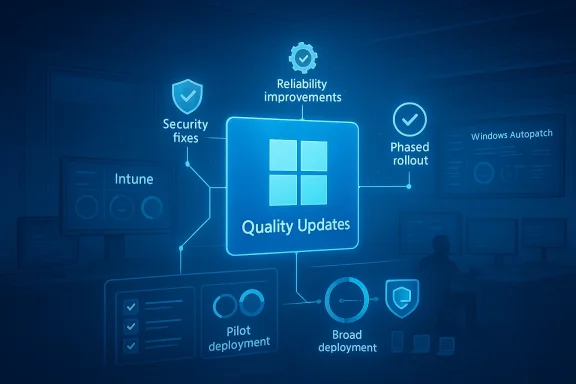
For Windows users, the headline is simple: Microsoft wants updates to feel less disruptive and more reliable. For IT departments, the more important story is that Windows 11 servicing is becoming more data-driven, more phased, and more tightly integrated with management tools like Intune and Windows Autopatch. That is a meaningful change in both philosophy and mechanics, and it could shape how enterprises think about patching in 2026 and beyond.
 Overview
Microsoft’s modern Windows update model has been evolving for years, but the current direction is especially clear. The company now treats monthly servicing as a primary vehicle for not just security fixes, but also reliability improvements, quality corrections, and selective feature delivery. On Windows 11, that approach is reinforced by continuous innovation, where new capabilities can arrive via servicing rather than waiting for a major version jump.That matters because Windows has long carried the reputation of being powerful but occasionally unpredictable during update cycles. Microsoft’s answer has been to make each update more cumulative, more observable, and more controlled through phased rollout methods. The March 2026 updates are a good example: Microsoft says they include the latest security fixes plus non-security improvements from the prior month’s optional preview release, which is exactly how the company wants the modern cadence to work.
The “quality” framing also reflects a broader industry reality. In a world of frequent software release cycles, a patch is no longer just a patch; it is a deployment event that can affect endpoint compliance, application compatibility, and even identity or firmware trust chains. Microsoft has responded by building more intelligence into Windows quality updates, including device-targeting data that helps determine whether a device should receive certain sensitive changes, such as Secure Boot certificates.
There is also a business angle behind the message. Microsoft knows that organizations are more likely to trust Windows 11 if it can demonstrate not only new capabilities, but also consistency in servicing. That is why the company keeps emphasizing manageability, validation, and staged rollout in the same breath as quality improvements. In practice, quality is becoming a competitive feature, not just a maintenance goal.
The New Servicing Philosophy
The central change is philosophical: Microsoft is signaling that quality updates are the foundation of a healthy Windows ecosystem. That means better reliability, fewer surprises, and a stronger emphasis on cumulative fixes that arrive in a predictable cadence. This approach has been visible in Microsoft’s own servicing guidance for years, but it is becoming more prominent in the way the company describes Windows 11 updates today.Why the wording matters
Words matter in platform strategy. By highlighting “commitment to quality,” Microsoft is telling users and administrators that the update pipeline is no longer just about closing vulnerabilities after the fact. It is about actively shaping device behavior, reducing support friction, and making update quality a measurable outcome. That is especially important for organizations that have had to build internal processes around patch testing, rings, and rollback planning.This also aligns with Microsoft’s broader shift toward servicing-based innovation in Windows 11. Instead of treating features and fixes as separate silos, the company increasingly delivers them through the same machinery, which can make the platform feel more cohesive. The upside is speed and consistency; the downside is that a poorly handled rollout can now affect more than just one isolated bug fix.
The March 2026 updates underline that point. Microsoft’s support documentation says the current cumulative updates include both the latest security fixes and non-security updates from the prior preview cycle, which is a classic sign of the service model maturing. That structure allows Microsoft to validate changes with a smaller preview audience before moving them into the mainstream monthly release.
- Quality is now a platform promise, not a side effect.
- Cumulative servicing reduces fragmentation across devices.
- Preview releases act as a validation layer.
- Phased rollout lowers the blast radius of mistakes.
- Telemetry-backed targeting enables more precise deployments.
What Changed in the March 2026 Updates
The most concrete evidence of Microsoft’s approach is in the March 10, 2026 cumulative updates. For Windows 11 version 24H2 and 25H2, Microsoft says KB5079473 delivers the latest security fixes plus non-security updates from February’s optional preview release. For Windows 11 version 23H2, KB5078883 follows the same model, bringing quality improvements alongside security patches.The Secure Boot angle
One of the most notable items is the expanded Secure Boot certificate rollout. Microsoft says Windows quality updates now include additional high-confidence device targeting data to increase the pool of eligible devices that can automatically receive new Secure Boot certificates. Devices only get those certificates after they show sufficient successful update signals, which suggests a deliberately cautious rollout.That is a big deal because Secure Boot is part of the trust chain that helps ensure only signed and trusted software loads during startup. When Microsoft uses quality updates to stage changes in that trust infrastructure, it shows how far Windows servicing has moved beyond ordinary bug fixing. This is not the kind of update mechanism most consumers think about, but it is exactly the kind of change that enterprise admins must understand.
Microsoft is also embedding management guidance alongside the release notes. The company points users and administrators to the Windows release health dashboard and update history pages for visibility into known issues and rollout status. That transparency is part of the quality story, because predictable servicing depends on users being able to see what is changing and when.
Why this matters for Windows 11 24H2 and 25H2
The overlap between 24H2 and 25H2 reinforces the idea that Microsoft wants servicing continuity, not isolated product spikes. These releases are managed through the same update systems, and Microsoft has been stressing that newer Windows 11 builds share much of the same servicing backbone. In practical terms, that reduces friction for upgrades and makes monthly servicing more central to the overall product experience.- March 2026 updates combine security and quality improvements.
- Secure Boot gets a more controlled rollout process.
- Microsoft is using device targeting data to broaden safe eligibility.
- Release health dashboards remain a key visibility tool.
- The servicing model favors continuity over big-bang change.
Windows Update as a Controlled Delivery System
Microsoft’s servicing strategy increasingly resembles a controlled delivery platform rather than a simple patch pipeline. The company has spent years refining its use of optional preview releases, cumulative monthly updates, and phased rollouts to reduce uncertainty. What was once a blunt monthly patch has become a finely tuned distribution system.Preview releases and production quality
The role of optional preview updates is especially important. Microsoft describes them as production-quality updates that ship ahead of the next security release, giving IT teams time to validate fixes and features before broad deployment. That preview step is a central part of the quality narrative because it allows Microsoft to gather feedback and make incremental corrections before code reaches the larger installed base.This is the kind of workflow that enterprise customers have been asking for: fewer surprises, clearer staging, and more predictable outcomes. It also helps explain why Microsoft uses terms like production-quality and controlled and phased rollout so often in its servicing notes. The company is not just shipping updates; it is trying to prove that update behavior itself is now a managed quality metric.
For consumers, the preview model is less visible, but it still matters. The optional release often seeds fixes that become part of next month’s mandatory cumulative update, which means early adopters are effectively helping Microsoft harden the code path. That can be beneficial, though it also means the boundary between “optional” and “mainline” is not as distinct as casual users might expect.
The servicing stack and update plumbing
Another reason Microsoft can talk credibly about quality is the servicing stack itself. The servicing stack is the component that installs Windows updates, and Microsoft has repeatedly used updates to improve the reliability of that mechanism as well. In other words, Windows quality updates are not only fixing the operating system; they are also improving the machinery that delivers the fixes.That recursive approach has obvious advantages. When the update engine is more stable, the rest of the patch process tends to improve with it. But it also means Microsoft must be careful not to overpromise: a more reliable update pipeline does not automatically eliminate the possibility of regressions, compatibility problems, or driver conflicts. Quality in this context is a process, not a guarantee.
- Optional previews validate changes before broader release.
- Cumulative updates reduce patch fragmentation.
- Servicing stack improvements strengthen installation reliability.
- Phased rollout helps isolate issues before they spread.
- The update platform itself is now part of the quality story.
Enterprise Impact: Better Control, Higher Expectations
For enterprises, Microsoft’s quality message is arguably more significant than the feature headlines. Administrators care less about shiny interface changes and more about whether updates can be deployed safely, consistently, and on schedule. Microsoft is clearly trying to reassure those customers that Windows 11 servicing is built for operational discipline.Autopatch, Intune, and update governance
Windows Autopatch is a major piece of that puzzle. Microsoft says the service is designed to improve clarity, reporting, automation, and control around update readiness, with stronger quality update reports and actionable alerts for deployment health. That kind of telemetry-heavy workflow is exactly what enterprise patch teams need when they are balancing compliance against uptime.Microsoft Intune also plays an important role, especially around quality updates during provisioning and out-of-box experience scenarios. The company’s messaging suggests it wants administrators to bring patching closer to device setup rather than treating it as a later maintenance task. That is a subtle but important shift because it pushes update hygiene earlier in the device lifecycle.
This is where Microsoft’s quality language gets most persuasive. By embedding update controls into the management stack, Microsoft can argue that Windows 11 is not merely easier to patch, but easier to govern at scale. That is a strong enterprise story, provided customers trust the rollout telemetry and see fewer post-update disruptions.
Compliance and risk management
Security teams will likely appreciate the increased emphasis on phased deployment and device targeting. The Secure Boot rollout shows that Microsoft wants to use evidence from successful updates to decide who receives higher-stakes changes next. In a corporate environment, that cautious approach can reduce exposure while still advancing platform integrity.At the same time, the enterprise burden does not go away. More intelligent updates can still break line-of-business apps, interfere with drivers, or require coordination with third-party tools. Microsoft’s model improves the odds of a clean rollout, but it does not remove the need for testing rings, change windows, and rollback planning.
- Windows Autopatch adds reporting and automation.
- Intune can bring quality updates into provisioning.
- Phased rollout supports change control.
- Secure Boot updates show a risk-aware rollout philosophy.
- Enterprises still need testing rings and rollback plans.
Consumer Impact: Fewer Surprises, More Invisible Maintenance
For home users, the quality message should translate into a quieter Windows experience. That means fewer dramatic update interruptions, fewer unexplained regressions, and a system that handles maintenance in a more measured way. If Microsoft succeeds, most people will notice quality only because their PCs feel more stable.What consumers actually see
The average user does not need to understand servicing stacks or Secure Boot certificate targeting. What they do notice is whether Windows Update behaves predictably, whether reboots are disruptive, and whether monthly patches resolve more problems than they create. Microsoft’s current strategy is designed to make those experiences boring in the best possible sense.That is especially important because Windows 11 has often been judged on polish as much as capability. A quality-first update strategy can gradually improve the platform’s reputation if it delivers stable installs and fewer headline-grabbing failures. But consumers are also unforgiving; a few high-profile bad patches can undo months of trust-building. Consistency is the real currency here.
There is also a subtle benefit for mainstream users: the line between “optional” and “mandatory” becomes less stressful when Microsoft is more careful about what moves from preview to Patch Tuesday. If the preview channel does its job, the monthly update should feel less like a gamble and more like a confirmation of what has already been validated. That is the ideal outcome, even if it is not always achieved in practice.
The hidden tradeoff for consumers
The tradeoff is that more quality management can also mean more invisible complexity. Users may never see the phased logic, the device targeting, or the telemetry-based decisions behind an update, but those systems are increasingly shaping their experience. That makes Windows feel more intelligent, yet also more opaque.- Updates should feel less disruptive.
- More fixes may arrive before users notice them.
- Consumers benefit from cumulative reliability.
- Update success becomes less visible but more important.
- Trust depends on the absence of surprise regressions.
The Competitive Angle
Microsoft’s emphasis on update quality is not just an internal engineering story; it is part of how the company competes in the modern PC ecosystem. Reliability is one of the few areas where Windows can still meaningfully differentiate itself from rivals, especially in enterprise environments where manageability matters as much as hardware design. A smoother update story strengthens that position.Windows versus other ecosystems
Compared with other desktop platforms, Windows has long had the more complex update challenge because of its enormous hardware and software diversity. That diversity is a strength, but it also makes update quality harder to guarantee. Microsoft’s answer is to rely on telemetry, staged deployment, and stronger management tooling to keep the system stable across a vast range of devices.This approach also helps Microsoft protect the Windows 11 brand at a time when users are increasingly sensitive to disruption. If quality updates can be framed as a reason to trust the platform, then Microsoft gets a competitive advantage that is less about marketing and more about everyday experience. That is a very Windows-specific kind of moat.
At the same time, the more Microsoft ties innovation to servicing, the more it risks making the update channel the public face of Windows health. That can be good when things go well, but it can be punishing when they do not. In that sense, Microsoft is competing against expectations as much as against rival platforms.
The strategic upside
If Microsoft can keep monthly servicing reliable, it can normalize a faster innovation cycle without making Windows feel unstable. That would let the company ship more improvements through the same pipeline and reduce the need for disruptive feature releases. For Microsoft, that is an elegant solution; for users, it is a promise that Windows can evolve without constantly demanding attention.- Windows can compete on manageability.
- Quality updates reinforce platform trust.
- Better servicing supports faster innovation.
- Enterprise customers value predictable cadence.
- Reliability is a competitive feature, not a back-office detail.
Strengths and Opportunities
Microsoft’s quality-first Windows 11 messaging has real strengths, especially because it lines up with the company’s actual servicing architecture rather than just its marketing language. The more the company can prove that cumulative updates are stable, phased, and transparent, the more it can reduce update anxiety for both consumers and IT teams. That opens the door to a cleaner platform reputation and a more resilient ecosystem overall.- Predictable monthly servicing improves trust.
- Optional previews allow earlier validation.
- Telemetry-based targeting can reduce rollout risk.
- Enterprise tooling strengthens governance.
- Secure Boot management improves platform integrity.
- Cumulative updates simplify support and troubleshooting.
- Continuous innovation keeps Windows 11 fresh without major disruption.
Risks and Concerns
The biggest risk is that a quality-first strategy creates expectations Microsoft cannot always meet. If the company talks up reliability and then ships a buggy cumulative update, the backlash can be sharper because the promise was so explicit. In that sense, the quality message raises the bar for every release, which is good in theory but unforgiving in practice.- A bad patch can damage trust quickly.
- More intelligent rollouts can still fail.
- Telemetry-driven targeting may feel opaque.
- Enterprises may need to spend more time validating changes.
- Consumers may not understand why updates behave differently across devices.
- Critical fixes bundled with quality changes can complicate troubleshooting.
- Invisible complexity can make Windows feel harder to reason about.
Looking Ahead
The key question is whether Microsoft can sustain this approach without turning servicing into a black box. If quality updates keep improving reliability while becoming less disruptive, Windows 11 will gain a meaningful advantage in both enterprise and consumer markets. If not, the “commitment to quality” line will read like a slogan rather than a durable operational shift.Microsoft now has the tools to make quality a real platform differentiator: optional previews, cumulative servicing, phased rollout, management integrations, and richer update-health signals. What remains to be seen is whether those tools consistently produce the kind of calm, invisible maintenance experience users want. The company has set the direction; the next few update cycles will show whether the execution matches the message.
- Watch for how Microsoft handles future Secure Boot rollouts.
- Monitor whether monthly updates become more stable and less disruptive.
- Track Windows Autopatch and Intune adoption in enterprises.
- Pay attention to release health dashboard notes after Patch Tuesday.
- See whether Microsoft continues to merge quality, security, and innovation into one servicing story.
Source: Mix93.3 Inside Story | Mix93.3 | Kansas City's #1 Hit Music Station | Kansas City, MO
