

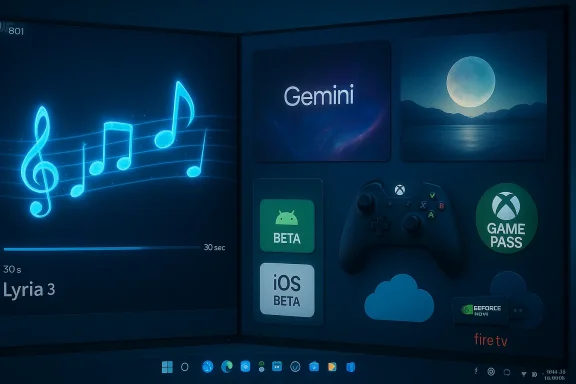
Microsoft’s product machine is humming again, but this week’s news cycle—captured neatly on Windows Weekly 971—reads like a study in contrasts: small, welcome reversals for classic Windows annoyances; a headlong sprint by Big Tech into creative AI; the slow, painful recalibration of Microsoft’s gaming strategy; and the everyday work of making Windows less… well, more usable for humans.
The headlines are familiar: Windows 11 continues to evolve in response to years of user frustration; Google is stuffing generative AI into every corner of its stack; Apple keeps pushing iterative updates to iOS; and Xbox is trying to find a path forward after a period of retrenchment. The conversation in the Windows ecosystem has shifted from “what’s new” to “what’s fixed, what’s dangerous, and what matters to you day-to-day.” That shift is important: it marks a maturing phase for platforms that, until recently, were defined by large, sometimes noisy launches. Now the story is incremental—small changes with outsized UX consequences, and new AI features that will be judged by how they change real creative workflows.
In the sections that follow I summarize the most consequential items from this week’s roundup, verify the technical claims where possible, and offer a critical look at what each development means for users, IT pros, and developers.
Why it matters:
This is a small but politically meaningful fix. It signals Microsoft listening to feedback and addressing long-standing UX regressions. But it also raises a question: why were such core customization capabilities removed to begin with? The slow restoration risks being perceived as remedial rather than progressive. For IT managers, the take-away is practical: plan for a phased roll-out in enterprise environments, test user workflows that rely on vertical taskbars, and be cautious with third-party tooling that once filled the gap—those tools may be redundant or destabilizing once Microsoft ships official options.
What to track:
Even small UI changes can break enterprise automation or user training. Test policies and imaging workflows before broad deployments.
Why this matters:
What to prepare:
Key technical highlights:
Practical note:
Companies that manage fleets of iPhones and iPads should patch test builds in a controlled environment before wide adoption; betas can change APIs and behavior quickly.
What to watch:
Xbox is pivoting from old playbooks—where console hardware and exclusive franchises were the centerpiece—to a subscription and cloud-forward approach. That’s sensible economically, but it’s disruptive culturally. The company needs a clear narrative for developers and consumers: high-value exclusives, predictable support for multiplatform development, and transparent Game Pass economics.
Implications:
Takeaway:
Caution:
Why it matters:
Why it’s useful:
User guidance:
Security implications:
Microsoft’s ecosystem is in a transitionary loop right now—repairing UX mistakes, navigating the implications of pervasive AI, and seeking a steady strategy for gaming and services. The week’s developments are not dramatic in isolation, but taken together they sketch how technical stewardship, product listening, and platform economics are reshaping our daily digital workspaces. The next months will test whether incremental fixes, clearer developer messaging, and responsible AI deployment can restore trust and deliver the practical gains users have been asking for all along.
Source: Thurrott.com Windows Weekly 971: Texas English
 Background
The headlines are familiar: Windows 11 continues to evolve in response to years of user frustration; Google is stuffing generative AI into every corner of its stack; Apple keeps pushing iterative updates to iOS; and Xbox is trying to find a path forward after a period of retrenchment. The conversation in the Windows ecosystem has shifted from “what’s new” to “what’s fixed, what’s dangerous, and what matters to you day-to-day.” That shift is important: it marks a maturing phase for platforms that, until recently, were defined by large, sometimes noisy launches. Now the story is incremental—small changes with outsized UX consequences, and new AI features that will be judged by how they change real creative workflows.In the sections that follow I summarize the most consequential items from this week’s roundup, verify the technical claims where possible, and offer a critical look at what each development means for users, IT pros, and developers.
Windows 11: A small but symbolic course correction
The taskbar shift: back to basics
For many longtime Windows users, the removal of a movable, resizable taskbar in Windows 11 was a low-level but constant annoyance. This week’s chatter—echoed by Windows Weekly—centers on Microsoft edging back toward giving power users the old flexibility: the ability to move and resize the taskbar. This is not just cosmetic. Taskbar placement matters for productivity workflows, multi-monitor setups, and accessibility.Why it matters:
- Users with ultrawide or multi-monitor setups prefer vertical taskbars to save vertical space and keep frequently used items close at hand.
- Accessibility scenarios (low-vision, motor-control differences) benefit when users can position important UI affordances where they’re easiest to reach.
- Microsoft appears to be reintroducing taskbar positioning and sizing options after years of complaints and third-party workarounds.
- Expect an Insider-first rollout and incremental refinements rather than a sudden global flip.
This is a small but politically meaningful fix. It signals Microsoft listening to feedback and addressing long-standing UX regressions. But it also raises a question: why were such core customization capabilities removed to begin with? The slow restoration risks being perceived as remedial rather than progressive. For IT managers, the take-away is practical: plan for a phased roll-out in enterprise environments, test user workflows that rely on vertical taskbars, and be cautious with third-party tooling that once filled the gap—those tools may be redundant or destabilizing once Microsoft ships official options.
Insider channels and feature timing
Windows 11’s release cadence continues to be channel-driven: Canary/Dev for experiments, Beta for vetted features, Release Preview for near-production builds. This week’s Release Preview items include quality-of-life additions: emoji updates, QoS/QMR fixes, a network speed test shortcut, and better widget/camera interactions.What to track:
- Feature toggles in enterprise images and MDM profiles.
- Any changes to default telemetry or privacy posture tied to new OOBE (Out-of-Box Experience) behavior.
Even small UI changes can break enterprise automation or user training. Test policies and imaging workflows before broad deployments.
AI and developer platforms: Google doubles down on creative audio and sets I/O dates
Gemini + Lyria 3: 30-second music tracks from text, photos, or video
Google introduced a generative music capability—Lyria 3—inside Gemini that can create short (roughly 30-second) audio tracks including instrumental backing and optional lyrics. It’s integrated into Gemini’s multimodal pipeline, accepts text and media prompts, and returns a share-ready mini-track with auto-generated cover art.Why this matters:
- Creative AI is moving from novelty to everyday utility. Quick audio jingles, thematic ambiences, and micro-soundtracks are now accessible to non-musicians.
- Integration with generative-image modules (cover art) and short-video tools makes Lyria 3 practical for social creators and product demos.
- Low barrier to entry: users can generate short tracks in seconds.
- Useful for ideation, placeholders, and quick social content.
- Copyright and stylistic mimicry remain thorny. Vendors claim mitigation measures (style-based outputs, watermarking), but the technology already blurs lines between inspiration and imitation.
- Track length and fidelity limit professional use. Thirty seconds is fantastic for a jingle or demo but not for finished content.
- Treat Lyria 3 as a rapid prototyping tool. For production audio, use human composers or vetted royalty-free sources.
- If you’re an enterprise content creator, track provenance and use watermarks or metadata that identify AI-generated audio.
Google I/O 2026: May 19–20, and the dev calendar
Google announced Google I/O for May 19–20. For the Android and AI ecosystem, I/O is where platform direction and developer APIs are clarified. Developers should expect deeper shows of Gemini integrations, Android evolutions, and tooling for multimodal experiences.What to prepare:
- Audit apps for new AI-powered integrations (e.g., content generation, summarization).
- Evaluate SDK/API compatibility with upcoming Android releases.
- Consider privacy and compliance implications of server-side vs. client-side inference.
Android 17 Beta and Apple’s iOS 26.4 Betas: a brisk, developer-focused season
Android 17 Beta 1: developer-forward, big-screen emphasis
Google shipped Android 17 Beta 1, focusing on adaptive apps, performance gains, and media/camera advances. Notably, Google is moving away from standalone Developer Preview builds and toward a continuous Canary track for rapid iterations.Key technical highlights:
- Bigger emphasis on large-screen/resizable window behavior and stricter app requirements for adaptive layouts.
- Under-the-hood runtime improvements (message queue and garbage collection optimizations) targeting smoother UI performance.
- Camera enhancements including more refined session management and constant-quality recording options.
- App compatibility on tablets and foldables is becoming a higher bar; businesses that deploy Android apps on varied hardware must test for resizability and orientation compliance early.
- The Canary channel could shorten the feedback loop—good for engaged dev teams, but it requires disciplined CI to avoid surprises.
Apple: iOS 26.4 beta seeds
Apple seeded iOS/iPadOS 26.4 developer betas shortly after iOS 26.3 public releases. Expect iterative feature work—emoji updates, incremental Siri enhancements, and possible pushes toward on-device AI features later in the 26.x cycle.Practical note:
Companies that manage fleets of iPhones and iPads should patch test builds in a controlled environment before wide adoption; betas can change APIs and behavior quickly.
Xbox and gaming: stabilizing, redirecting, and the cloud push
The state of Xbox leadership and strategy
Windows Weekly’s hosts noted a reduced public profile for Phil Spencer over recent months. Context matters: Microsoft Gaming has endured organizational shifts, studio consolidations, layoffs in prior quarters, and revenue pressure in the gaming segment. The macro picture shows Microsoft redirecting resources and emphasizing cloud and services while deciding how to invest in first-party content.What to watch:
- GDC 2026 will likely be a key moment for Microsoft to frame developer relationships, cloud tooling, and platform commitments rather than a big hardware reveal.
- Pay attention to signals on first-party release cadence, third-party incentives, and developer outreach programs.
Xbox is pivoting from old playbooks—where console hardware and exclusive franchises were the centerpiece—to a subscription and cloud-forward approach. That’s sensible economically, but it’s disruptive culturally. The company needs a clear narrative for developers and consumers: high-value exclusives, predictable support for multiplatform development, and transparent Game Pass economics.
Game Pass additions and platform moves
This week’s Game Pass updates included heavyweight catalog additions: Kingdom Come Deliverance II and The Witcher 3 (Complete Edition) were highlighted as coming to Game Pass, reinforcing Microsoft’s continued push to populate its subscription service with marquee content.Implications:
- Adding mature AAA titles broadens Game Pass appeal to users who want single-player epics.
- Day-one and premium additions remain powerful acquisition levers—watch which titles are excluded from full inclusion (premium vs. full) as Microsoft balances margins.
Avowed on PlayStation 5 + Anniversary Update
Obsidian’s Avowed received a substantial Anniversary Update and a PlayStation 5 port. The cross-platform move signals a pragmatic licensing posture from Xbox Game Studios/Pub: Microsoft can still expand reach and revenue by deploying some titles beyond its own consoles.Takeaway:
- Cross-platform releases reduce platform exclusivity as a guaranteed retention mechanism; instead, platform owners must compete on service quality and ecosystem benefits.
“Microsoft retiring user-created Xbox social clubs” — unverified claim
Windows Weekly mentioned that Microsoft plans to retire user-created Xbox social clubs in April. At the time of writing this article, I could not find authoritative confirmation from Xbox or Microsoft support channels. This may be an internal change communicated to select communities or an early-stage plan that hasn’t been widely published.Caution:
- Treat this particular claim as unverified until Microsoft publishes an official notice.
- If you run or moderate Xbox clubs, maintain backups of any important group content and monitor official Xbox channels for guidance.
GeForce Now on Fire TV sticks: cloud gaming expands in the living room
NVIDIA’s GeForce Now app launched on select Amazon Fire TV 4K sticks, bringing cloud-streamed PC gaming to inexpensive TV hardware. The rollout is initially limited to higher-end Fire TV Stick models and is capped at 1080p/60fps with stereo audio in the early build.Why it matters:
- Cloud gaming is now practical on commodity streaming hardware, lowering the barrier to entry for PC-quality experiences on the TV.
- This intensifies competition among cloud storefronts and streaming services and forces incumbent console ecosystems to justify hardware advantages beyond raw compute.
- Quality depends heavily on user network conditions; up to 1080p limits and SDR/stereo defaults reduce fidelity compared to local hardware.
- Controller compatibility and input latency are still variable; subjectively good but not universal across households.
Tips & Picks: pragmatic tools and warnings
De-Enshittify Windows 11 (Paul Thurrott)
Paul Thurrott is publishing early chapters of a book that guides users through restoring agency over Windows 11—removing unwanted telemetry, controlling default apps, and simplifying the OOBE. The content is practical and aimed at power users and sysadmins who want to minimize vendor-driven upselling and telemetry creep.Why it’s useful:
- Makes explicit the steps many IT pros already do as part of imaging and configuration.
- Provides a repeatable, documented approach for hardening consumer and small-business devices.
- Some steps (aggressive image trimming or use of third-party “slim” builds) can void warranties or complicate support. Use caution in managed environments.
App pick of the week: Bing Wallpaper (controversial)
Paul’s pick this week was the Bing Wallpaper app—useful if you want a quality daily wallpaper stream. But it’s not uncontroversial: independent researchers have highlighted behaviors that are aggressive in upsell and system integration, including default behaviors that open searches on desktop clicks and deep registry hooks.User guidance:
- If you install Bing Wallpaper, review its privacy settings and opt out of desktop-click features.
- For conservative deployments, prefer curated wallpaper services that do not integrate into browsers or track cookies.
RunAs Radio: Hacking using AI (Erica Burgess)
The RunAs Radio episode with Erica Burgess explores how large language models and agents are changing offensive security and red-team workflows. The key takeaways are pragmatic: LLMs accelerate reconnaissance, fuzzing, and exploit ideation, but human judgment is still required for orchestration, chain-of-exploit reasoning, and ethical considerations.Security implications:
- Organizations must treat LLM-accelerated reconnaissance as a rising threat vector.
- Defensive teams should adopt AI-assisted threat hunting and red teaming to keep pace.
- Defensive investments in detection, rate-limiting, and attacker-behavior profiling remain crucial.
Brown liquor pick: Lot 40 100% Pot Still Rye
For those who asked: a recommendation for a high-rye Canadian single pot-still expression—flavorful and spicy, and a nice treat for readers unwinding after a long day of patching and policy meetings.Analysis: what these threads mean together
- Small UX fixes (taskbar flexibility, taskbar improvements) matter more than flashy features. They change daily behavior for millions of users and, over time, drive sentiment more than ephemeral marketing messages.
- AI is moving from demo to utility. Short-form audio generation, multimodal content pipelines, and integrated creative tools mean product teams must plan for AI output management, provenance, and IP policy now—not later.
- The gaming business is in active rebalancing. Microsoft’s pivot toward services and cloud is economically rational, but it creates friction: developers need clarity on incentives; players need consistent first-party hits; and the platform must reconcile profitability with the cultural value of exclusivity.
- Privacy and bloat continue to be legitimate user concerns. Tools that add value (daily wallpapers, AI generation) can also become vectors for upsell or intrusive behavior. The pragmatic user stance is to evaluate value vs. control: adopt what improves productivity or creativity, and say no to what silently re-shapes defaults.
Practical recommendations for readers
- If you manage Windows fleets, schedule pilot testing of imminent taskbar updates and evaluate imaging scripts that assumed fixed bottom-only taskbars.
- For app developers: start testing Android 17 Betas and the Canary workflow early—especially if your app targets tablets, foldables, or resizable windows.
- Content teams: experiment with short-form AI music for demos and social media, but create a provenance trail and retain human oversight for any public-facing music.
- Security teams: treat LLM-assisted recon as a near-term threat and invest in AI-enabled defensive tooling and adversary emulation.
- Gamers and platform owners: watch Game Pass catalog updates and platform announcements at GDC for signals on Microsoft’s publishing and developer outreach priorities.
Microsoft’s ecosystem is in a transitionary loop right now—repairing UX mistakes, navigating the implications of pervasive AI, and seeking a steady strategy for gaming and services. The week’s developments are not dramatic in isolation, but taken together they sketch how technical stewardship, product listening, and platform economics are reshaping our daily digital workspaces. The next months will test whether incremental fixes, clearer developer messaging, and responsible AI deployment can restore trust and deliver the practical gains users have been asking for all along.
Source: Thurrott.com Windows Weekly 971: Texas English
