

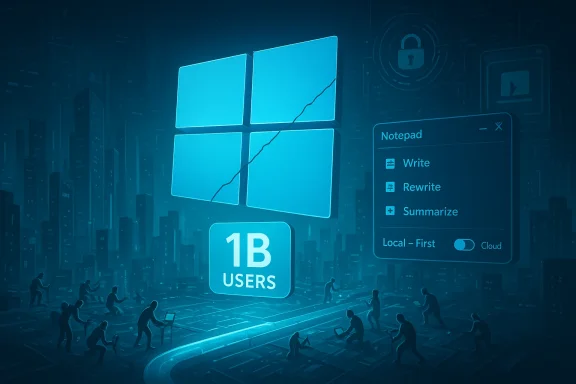
Windows 11 has officially crossed the 1 billion monthly‑active‑user mark — a milestone Microsoft cheered on its fiscal Q2, 2026 earnings call — but that triumph sits uneasily beside what can only be called a public trust deficit. In public comments and follow‑ups, Pavan Davuluri, Microsoft’s president of Windows and Devices, has acknowledged what many in the community already feel: growth and scale don’t equal goodwill. With a highly visible string of update regressions, privacy frictions from new AI experiences, and a vocal developer backlash to the company’s “agentic” vision for the OS, Davuluri’s early mandate is now less about selling novelty and more about proving that Windows can be stable, respectful of choice, and — critically — trustworthy again.
Windows 11’s 1 billion users number is striking for its speed. Measured from broad availability in October 2021, Microsoft said the OS reached the milestone in roughly 1,576 days — faster than the comparable timeline for Windows 10. That acceleration is real, but it’s also conditional: the enforced migration after Windows 10’s end‑of‑support in October 2025 created a powerful commercial incentive for enterprises and millions of users to upgrade in order to keep receiving security updates.
That “forced migration” is a vital part of the story. Adoption at this scale means Windows 11 is now everywhere, and that ubiquity raises the stakes for any regression. A bug that used to impact a small pilot can now cascade into helpdesk overloads, OTA patch backouts, and PR crises that erode confidence across millions of endpoints. The result: a paradoxical moment where Windows is simultaneously its widest and least trusted.
But in practice, the agentic push collided with three converging problems:
Two details made the change controversial:
The Notepad case exposes two central risk vectors for Microsoft’s agentic strategy:
Why that matters: UNMOUNTABLE_BOOT_VOLUME is not an application crash you can tolerate until later. It’s a kernel‑early failure that leaves devices unbootable until repaired in the Windows Recovery Environment (WinRE) or rebuilt. Microsoft acknowledged a “limited number of reports,” issued emergency out‑of‑band fixes for other regressions, and guided affected users to manual recovery steps. The company also indicated that many of the no‑boot cases occurred on machines left in an “improper state” following failed December servicing (i.e., rollbacks or incomplete installs), where the January update pushed a fragile baseline over the edge.
The immediate operational consequences were real and measurable: frantic helpdesk tickets, stalled deployments, and admins choosing to pause Windows Update en masse. But perhaps more damaging is the narrative: automatic updates — long marketed as a security and convenience benefit — now occasionally feel like a threat to device reliability. That perception corrodes default behaviors (users opt out or delay patches), which in turn increases security risk at scale.
Swarming is a recognized incident‑response tactic: small, empowered teams, tight telemetry, and rapid release loops aimed at isolating and fixing regressions. But success here requires three things that are harder than they sound:
Pavan Davuluri’s pivot — redirecting engineers to “swarm” on the fundamentals — is the necessary next act. It’s the right posture, but it must be executed as a program of engineering rigor, conservative defaults, and measurable transparency. Otherwise, the agentic identity Microsoft seeks to build will remain a promise that users are unwilling to accept.
The good news is that Microsoft has the capabilities to fix this: deep engineering talent, on‑device AI investments, and enterprise relationships that make disciplined rollouts both possible and enforceable. The hard part will be convincing the community that defaults have changed and that trust will be earned back with code and process, not rhetoric. If Davuluri can deliver a clear calendar of measurable outcomes — fewer emergencies, local‑first agentic experiences, auditable privacy guarantees, and a restored Insider feedback loop — then Windows 11’s next chapter will be about stewardship at scale rather than spectacle. If not, the 1 billion figure will be a historical moment that preceded a slow erosion of the platform’s most passionate supporters.
Source: digit.in The billion-user trust gap: Can Pavan Davuluri fix Windows 11’s ‘agentic’ identity crisis?
 Background: the milestone and the context
Windows 11’s 1 billion users number is striking for its speed. Measured from broad availability in October 2021, Microsoft said the OS reached the milestone in roughly 1,576 days — faster than the comparable timeline for Windows 10. That acceleration is real, but it’s also conditional: the enforced migration after Windows 10’s end‑of‑support in October 2025 created a powerful commercial incentive for enterprises and millions of users to upgrade in order to keep receiving security updates.That “forced migration” is a vital part of the story. Adoption at this scale means Windows 11 is now everywhere, and that ubiquity raises the stakes for any regression. A bug that used to impact a small pilot can now cascade into helpdesk overloads, OTA patch backouts, and PR crises that erode confidence across millions of endpoints. The result: a paradoxical moment where Windows is simultaneously its widest and least trusted.
Overview: the trust gap and the agentic identity crisis
Microsoft’s long‑term roadmap for Windows increasingly centered on what leaders call an agentic operating system: built‑in AI, contextual agents that surface solutions proactively, and tighter device-cloud integrations designed to reduce friction. In theory, agentic features promise productivity gains: natural language actions, cross‑app automation, and on‑device models that can speed routine tasks.But in practice, the agentic push collided with three converging problems:
- Regressions and reliability issues from 2025 into early 2026 that made the OS feel brittle.
- Privacy and telemetry concerns once obscure to mainstream users, now front‑and‑center with features that snapshot, index, or upload user content unless carefully controlled.
- A perception among power users and developers that Windows is drifting away from the control, composability, and predictability they rely on.
Notepad as a case study: feature creep, credential requirements, and community backlash
Few examples crystallize the dilemma better than Notepad — a four‑decade‑old utility prized for being tiny, offline, and reliable. In January 2026, Microsoft rolled Notepad updates into the Windows Insider Canary and Dev channels that added richer Markdown, tables, and three AI actions: Write, Rewrite, and Summarize. Those tools were engineered to stream partial results (reducing perceived latency) and to run locally on Copilot+ devices where hardware made that possible, or fall back to cloud inference otherwise.Two details made the change controversial:
- The AI actions require a Microsoft account sign‑in to be used when they route to cloud services.
- When cloud fallback is used, text is processed via Azure services rather than purely on the device.
The Notepad case exposes two central risk vectors for Microsoft’s agentic strategy:
- Perception risk: small, familiar utilities are a psychological “safe space” for many users; altering them can feel like an unexpected privacy or pushy‑commerce move.
- Operational risk: when a feature is hybrid local/cloud, the lines of responsibility — security, data residency, and latency — become complex for users and admins to reason about.
The January update collapse: KB5074109, UNMOUNTABLE_BOOT_VOLUME and the optics of breakage
January 2026’s Patch Tuesday is now an inflection point in this narrative. A cumulative update — KB5074109 — introduced a set of regressions that included shutdown and hibernate failures, Remote Desktop sign‑in errors, app‑level hangs on cloud sync, and, in a subset of machines already in a fragile state, a severe pre‑boot failure: the UNMOUNTABLE_BOOT_VOLUME stop code that prevented the system from mounting the boot volume.Why that matters: UNMOUNTABLE_BOOT_VOLUME is not an application crash you can tolerate until later. It’s a kernel‑early failure that leaves devices unbootable until repaired in the Windows Recovery Environment (WinRE) or rebuilt. Microsoft acknowledged a “limited number of reports,” issued emergency out‑of‑band fixes for other regressions, and guided affected users to manual recovery steps. The company also indicated that many of the no‑boot cases occurred on machines left in an “improper state” following failed December servicing (i.e., rollbacks or incomplete installs), where the January update pushed a fragile baseline over the edge.
The immediate operational consequences were real and measurable: frantic helpdesk tickets, stalled deployments, and admins choosing to pause Windows Update en masse. But perhaps more damaging is the narrative: automatic updates — long marketed as a security and convenience benefit — now occasionally feel like a threat to device reliability. That perception corrodes default behaviors (users opt out or delay patches), which in turn increases security risk at scale.
Davuluri’s “swarming” response: what it is and what it must deliver
Publicly, Microsoft described a change in posture: engineering teams are being redirected into cross‑disciplinary “swarm” squads focused on high‑impact regressions and the everyday pain points users report. The public list of priorities is straightforward: system performance, reliability, and experience polish (small UI inconsistencies, dark mode quirks, File Explorer responsiveness).Swarming is a recognized incident‑response tactic: small, empowered teams, tight telemetry, and rapid release loops aimed at isolating and fixing regressions. But success here requires three things that are harder than they sound:
- Clear production gating: conservative flighting and staged rollouts until metrics prove quality across real hardware diversity.
- Measurable KPIs: not PR talk but a dashboard of measurable delivery — fewer emergency OOB patches, reduction in update‑related no‑boot incidents, improved telemetry on cold‑start times, and lower support call volumes.
- Behavioral change: defaults matter. If agentic features or telemetry remain opt‑out and obscure, the community will continue to interpret new features as policy decisions rather than product choices.
Strengths in Microsoft’s position — what Davuluri can leverage
- Scale and resource depth. Microsoft can marshal server, device, and AI engineering resources at a scale no single hardware vendor can match. That matters when rearchitecting offline servicing, servicing stacks, and update pipelines.
- On‑device AI R&D. Copilot+ hardware and on‑device inference paths present a credible route to local‑first agentic experiences — if Microsoft commits to that path rather than defaulting to cloud fallbacks.
- Enterprise and OEM partners. OEMs, managed service providers, and large enterprises still depend on Windows; their pragmatic needs create leverage to insist on predictable quality gates and better admin controls.
Key risks and failure modes Microsoft must avoid
- Cosmetic fixes without systemic change. Shipping a collection of UI patches or dark‑mode tweaks will calm headline chatter but won’t address underlying servicing fragility.
- Over‑centralized agentic defaults. Turning on cross‑device snapshotting or AI indexing by default (or framing them as “on for best experience”) will continue to generate privacy backlash.
- Ignoring developer and power‑user signals. If Windows loses credibility as a platform for builders, Microsoft risks long‑term erosion of the app ecosystem and developer mindshare.
- Inadequate telemetery transparency. Users and admins must be able to audit what telemetry is collected, why it’s needed, and how it maps to bug resolution. Opacity here fuels distrust.
Practical steps Davuluri should prioritize now
The roadmap to earn back trust must be concrete and measurable. Below are operational recommendations that deliver both engineering rigor and community reassurance.- Re‑establish a conservative update pipeline
- Implement a stricter, telemetry‑driven staging process with higher thresholds before broad LCU rollouts.
- Expand and publicize Known Issue Rollback (KIR) tooling and make safe rollback experiences possible without full reinstalls.
- Make agentic features opt‑in by default and local‑first by policy
- Default to local inference on capable hardware and opt‑in cloud processing with an explicit consent flow.
- For features that capture or snapshot content, require explicit, context‑rich opt‑in during set‑up and make it trivial to revoke.
- Formalize an “Expert Mode” and Developer Fidelity Program
- Create an explicitly supported space for power users and developers with stronger opt‑outs, fewer UX nudges, and a documented compatibility commitment.
- Reinvigorate the Windows Insider program with better two‑way engagement and transparent bug‑triage visibility.
- Transparency and auditability
- Publish a quarterly “Windows Quality Report” with measurable metrics: update success rates, emergency patch counts, critical regressions, and Mean Time To Repair (MTTR) for major incidents.
- Provide admins a downloadable audit trail for any agentic feature that processes data (what was processed, where, and under what consent model).
- Strengthen recovery primitives
- Invest in making WinRE and recovery tooling more reliable, easier to use, and accessible offline (bootable recovery media that integrate improved rollback logic).
- Provide OEMs with certified recovery images and one‑click restore options that preserve enterprise configurations.
- Public roadmap for Recall and similar privacy‑sensitive features
- Maintain a documented security and privacy architecture for Recall‑style capabilities (TPM keys, VBS enclaves, Windows Hello gating) and third‑party audits that validate those claims.
What users and admins should do now
While Microsoft retools, organizations and advanced users should act defensively and pragmatically.- Pause wide deployments and stage updates. Validate major cumulative updates on a pilot cohort of representative hardware before enterprise rollouts.
- Harden update policies. Use policy tools (Windows Update for Business, WSUS, SCCM/Intune) to control cadence and enable controlled feature rollouts.
- Backup and recovery readiness. Ensure system images, offline recovery media, and tested WinRE workflows are in place so UNMOUNTABLE_BOOT_VOLUME or similar pre‑boot failures can be healed without protracted outages.
- Evaluate agentic features before enabling them. Treat Recall and other snapshotting features as optional — enable them only where the feature value outweighs the privacy footprint, and enforce strong access controls (Windows Hello).
- Consider Extended Security Update (ESU) or staged migration strategies for legacy devices that cannot meet Windows 11 hardware requirements — plan the upgrade treadmill carefully to avoid mass last‑minute migrations.
Measuring success: what will show Davuluri’s effort worked?
Trust is earned through consistent, measurable behavior. For the Windows engineering organization, success can be tracked with hard, public benchmarks:- Reduction in emergency out‑of‑band fixes per quarter (target: near‑zero once processes stabilize).
- Stable update success rates above a defined baseline across major OEM families.
- Demonstrable reduction in severe regressions (no‑boot, data loss) — ideally quantified quarterly.
- Positive sentiment recovery in developer and Insider communities, measured via structured feedback loops and NPS-like signals.
- Tangible default‑off posture on agentic features that involve persistent capture, with measurable opt‑in rates and audit logs.
Conclusion: scale without stewardship is brittle; restoration is possible but not automatic
Hitting 1 billion users is a company achievement that validates Windows 11’s reach. But scale amplifies failure modes, and what matters now is not how many users Microsoft reaches, but how many trust it to keep their devices secure, private, and stable.Pavan Davuluri’s pivot — redirecting engineers to “swarm” on the fundamentals — is the necessary next act. It’s the right posture, but it must be executed as a program of engineering rigor, conservative defaults, and measurable transparency. Otherwise, the agentic identity Microsoft seeks to build will remain a promise that users are unwilling to accept.
The good news is that Microsoft has the capabilities to fix this: deep engineering talent, on‑device AI investments, and enterprise relationships that make disciplined rollouts both possible and enforceable. The hard part will be convincing the community that defaults have changed and that trust will be earned back with code and process, not rhetoric. If Davuluri can deliver a clear calendar of measurable outcomes — fewer emergencies, local‑first agentic experiences, auditable privacy guarantees, and a restored Insider feedback loop — then Windows 11’s next chapter will be about stewardship at scale rather than spectacle. If not, the 1 billion figure will be a historical moment that preceded a slow erosion of the platform’s most passionate supporters.
Source: digit.in The billion-user trust gap: Can Pavan Davuluri fix Windows 11’s ‘agentic’ identity crisis?
