Windows 11 Update and Shut Down Now Truly Powers Off (KB5067036)

  • Thread Author
Microsoft has quietly corrected a long-standing Windows annoyance: the “Update and shut down” option that for many PCs applied updates and then returned the machine to a powered‑on state instead of honoring a true shutdown, and the repair is now documented in Microsoft’s preview release notes and optional October 28, 2025 preview package.

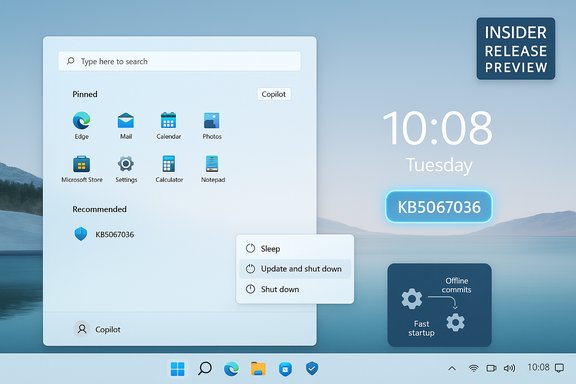
Laptop screen shows Windows update complete at 100%.Background / Overview​

For years some Windows users have reported a frustrating mismatch between the Start‑menu label Update and shut down and the actual outcome. Instead of installing updates and powering off, affected machines sometimes completed an update cycle and then restarted or landed at the lock screen — effectively leaving the device powered on. That behavior damaged user trust in a basic update workflow, caused overnight battery drain on laptops, and disrupted maintenance automation that relies on deterministic shutdowns.
Microsoft has now added a servicing‑level correction to Insider preview builds and bundled the same change into the October 28, 2025 optional preview cumulative update KB5067036 (OS builds 26200.7019 and 26100.7019). The KB entry explicitly lists: “Improved: Addressed underlying issue which can cause ‘Update and shutdown’ to not actually shut down your PC after updating.”

Why this bug mattered​

The underlying symptom sounds small but it had outsized, practical consequences.
  • Battery and energy waste: Laptops expected to be off overnight were left running, draining battery and keeping cooling subsystems active.
  • Operational friction: Administrators and automation scripts that assume a shutdown after an update saw those workflows fail intermittently.
  • Trust erosion: When a labeled UI action doesn’t do what it promises, users stop relying on it and adopt riskier workarounds.
Those real‑world effects are why the community tracked this issue across forums and feedback channels for years. The problem’s intermittency and hardware‑dependency — driven by Fast Startup, driver interactions, and multi‑phase servicing — made it difficult to reproduce and therefore harder to diagnose, which helped explain how the bug persisted.

What Microsoft shipped (builds, KBs, and timeline)​

Microsoft’s fix followed the standard Insider → Release Preview → mainstream rollout staging path.
  • September 29, 2025: Microsoft published Insider Preview release notes for Dev Channel Build 26220.6760 and Beta Channel Build 26120.6760 that include the remediation text “Fixed an underlying issue which could lead ‘Update and shutdown’ to not actually shut down your PC after.”
  • October 28, 2025: Microsoft included the same servicing correction in the optional preview cumulative update KB5067036 (OS Builds 26200.7019 and 26100.7019). The KB page’s Windows Update section lists the improvement in plain language.
  • Late 2025 (expected): The staged rollout model means the repair will be folded into mainstream cumulative updates (Patch Tuesday) after telemetry and validation; many commentators expect inclusion in the subsequent stable CU once testing is complete.
This sequence — landing in Insider flights, moving to an optional preview package, and then to broader cumulative updates — is Microsoft’s normal quality‑assurance path for servicing fixes that affect core orchestration logic.

Technical anatomy: why “Update and shut down” sometimes acted like a restart​

The update‑at‑shutdown flow in modern Windows is not a single atomic operation; it’s an orchestration between several subsystems:
  • Fast Startup (hybrid shutdown) changes the semantics of a shutdown by saving kernel session state. That hybrid state can interact poorly with offline servicing and lead to an intermediate restart instead of a cold power‑off.
  • Multi‑phase servicing: Many updates require staged commits; the servicing pipeline may request one or more reboots to finalize component swaps and driver replacements.
  • Sign‑in / finishing flows: Windows can use saved credentials to sign in after a restart and complete configuration tasks; if sign‑in finishing is blocked or unavailable, the servicing flow can stop at a desktop or lock screen.
  • Drivers and running handles: Certain drivers or processes need a full restart to replace in‑use files, nudging the orchestrator toward a restart path for stability.
When these conditional branches line up, the orchestrator can fail to respect the user’s final shutdown intent and instead leave the device on. The fix Microsoft implemented appears to adjust that orchestration so the final shutdown directive is preserved once offline servicing completes. Microsoft’s Insider notes frame the repair as a servicing/orchestration change, not a cosmetic relabeling, which indicates engineers corrected sequencing logic rather than merely changing text.

What the fix actually does (and what it doesn’t disclose)​

Microsoft’s public release notes are concise: they name the symptom and say it’s fixed. That is useful and verifiable, but the notes do not include a line‑by‑line engineering postmortem.
  • Concrete: Microsoft documented the fix in Insider flight notes and in KB5067036’s preview page. The packaging and build numbers are published.
  • Opaque: Microsoft did not publish an internal root‑cause analysis in public engineering notes, so the exact race condition or code path remains undisclosed. Any deeper assertions about the single code bug should therefore be treated as informed inference, not confirmed fact.
This level of disclosure is typical: public release notes confirm that a change was made and summarize expected user impact, while detailed forensic analysis often remains internal.

Independent verification and community testing​

Multiple independent tech outlets and Insider testers corroborated Microsoft’s notes: early Insider reports show that after installing preview builds, testers observed improved shutdown behavior when choosing Update and shut down. Coverage across Windows‑focused media tracked the same phrasing in release notes and confirmed the update’s packaging into KB5067036. That independent corroboration reduces the risk that the KB line was merely cosmetic. When testers see the behavior correct itself after installing the update, it strengthens the case that the servicing orchestration was changed.
However, the community also recorded a caution: preview packages sometimes introduce other regressions, which can appear as collateral effects of complex changes. One widely reported example connected to the October preview was a Task Manager regression (duplicate or orphaned taskmgr.exe processes) in some installations, demonstrating that seemingly narrow servicing fixes can have unexpected side channels. That regression was reproduced by testers and discussed in community posts. If you’ll be deploying preview packages, validate on non‑critical devices and monitor for regressions.

Practical guidance: what to do right now​

Your approach depends on your risk tolerance and whether you manage production devices.
  • Home users who want stability:
  • Wait for the fix to arrive in the mainstream cumulative update (safest). Microsoft will fold stable servicing changes into Patch Tuesday releases after validation.
  • If you rely on Update and shut down and can’t wait, consider applying the preview KB on a spare device first and test your configuration.
  • Power users / testers:
  • Join the Windows Insider Beta or Dev channel on non‑critical hardware to get the fix earlier. Use the Feedback Hub to report regression telemetry.
  • When installing optional preview packages like KB5067036, check the “Optional updates” area in Settings > Windows Update.
  • IT administrators:
  • Pilot KB5067036 or the forthcoming cumulative update in a small ring with representative hardware and software mixes.
  • Validate scripted shutdowns, imaging workflows, and remote management tools.
  • Monitor for any new regressions (Task Manager anomalies were reported in early preview installs).
Quick checklist before applying preview updates:
  • Back up critical data and ensure rollback procedures are in place.
  • Apply the update in a controlled test ring first.
  • Verify the Update and shut down behavior across typical user scenarios (Fast Startup enabled/disabled, different sign‑in policies, and driver sets).
  • Monitor telemetry (or Microsoft public guidance) for any follow‑up fixes.

Strengths of Microsoft’s response​

  • Transparency in release notes: Microsoft explicitly named the behavioral fix in Insider and KB notes, which made the change easy to verify. That clarity is a welcome change after months of community troubleshooting.
  • Standard staged rollout: Using Insiders → optional preview KB → mainstream CU allows Microsoft to gather telemetry across many hardware configurations before broad deployment.
  • Targeted remediation: The wording indicates a servicing/orchestration fix rather than a superficial relabel — meaning engineers attempted to correct the underlying behavior, not just change UI language.

Potential risks and caveats​

  • Preview regressions: Optional previews can bundle unrelated feature flights and UI changes in addition to servicing fixes. The October preview that included this fix (KB5067036) also included Start menu and shell updates, meaning installing it exposes devices to a wider change set. Community testing reported at least one notable regression around Task Manager duplication after installing the preview. That underlines the need for cautious deployment on production machines.
  • Incomplete coverage: Because the original symptom was configuration‑dependent, it may take time for telemetry to confirm that every affected hardware/driver combination is cured. Expect some residual edge cases until the fix has accumulated broad field validation.
  • Visibility of root cause: Microsoft’s public notes do not reveal the precise code path; absent a detailed engineering postmortem, third parties cannot fully audit the repair’s scope or rule out related race conditions.

How to verify the fix on your device​

  • Check your current OS build:
  • Press Windows key + R, type winver, and press Enter. The About Windows dialog shows your build and version.
  • If you’re on Insider channels:
  • Compare the build number to the Insider builds that include the fix (examples: Dev build 26220.6760 / Beta build 26120.6760).
  • If you’re not an Insider:
  • Open Settings > Windows Update > Optional updates. The October 28 preview (KB5067036) appears in optional/preview updates on systems Microsoft allows to see it.
  • Test the behavior:
  • Choose Update and shut down with a known pending update, leave the device offline for an hour, then power the device back on and confirm whether the system was off (expected) or left powered on (previous symptom).
  • If you spot regressions:
  • Collect diagnostics (Reliability Monitor, Event Viewer, and, if needed, process dumps) and submit feedback via Feedback Hub.

Broader context: Windows 10 end of support and why updating matters​

Microsoft ended free mainstream support for Windows 10 on October 14, 2025. After that date Microsoft no longer provides security updates or technical assistance for most Windows 10 devices, and the company strongly recommends upgrading to Windows 11 or enrolling eligible systems in Extended Security Updates (ESU). If you’re still on Windows 10, the operational importance of reliable update behavior is higher: you’ll need a clear upgrade or ESU plan for continued protection.

Final assessment — what this fix means for users​

This repair is a meaningful, quality‑of‑life improvement: it restores the basic promise of Update and shut down, reduces unintended battery drain, and simplifies update behavior for users and admins who rely on deterministic shutdowns. The public evidence (Insider release notes and the KB preview page) shows Microsoft made a servicing/orchestration change and staged it for wider validation. That said, the fix is not the end of the story. Because Windows updates touch many subsystems, the preview channel also surfaced collateral issues (notably a Task Manager regression), and the community should continue to validate the repair across diverse hardware. Administrators and cautious home users should pilot the preview or wait for the mainstream cumulative update; early adopters who install the preview should be prepared to report regressions and to roll back if necessary.

Quick recap (TL;DR for busy readers)​

  • Microsoft fixed the “Update and shut down” behavior in Insider previews and in the October 28, 2025 optional preview KB5067036 (Builds 26200.7019 / 26100.7019).
  • The fix is a servicing/orchestration change intended to ensure Update and shut down truly powers the PC off after updates.
  • Install KB5067036 on a test device if you want the fix early; otherwise, wait for Microsoft to include it in the mainstream cumulative update.
  • Be cautious: preview packages can introduce regressions; testers reported a Task Manager duplication issue in early installs.
This correction restores a small but important promise of the Windows update UX. Once broadly validated and rolled into the stable cumulative release cycle, it should remove a persistent annoyance for many users — but prudence in deployment remains essential until telemetry confirms wide coverage.

Source: CP24 Microsoft fixes longstanding ‘update and shut down’ bug that caused computers to restart
 

Microsoft has quietly resolved one of Windows’ most quietly irritating UX mismatches: the Start menu option “Update and shut down” now behaves like it says, after Microsoft shipped a servicing correction in the optional preview package identified as KB5067036 for Windows 11 versions 24H2 and 25H2.

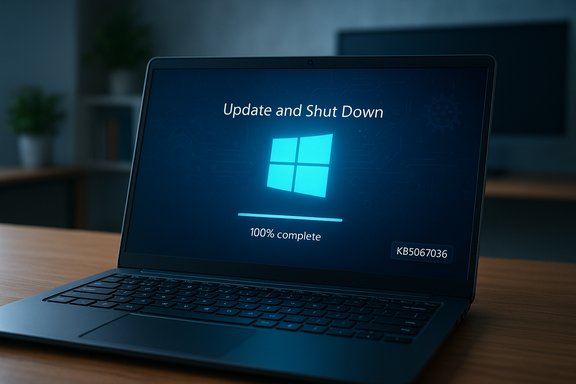
Windows-style desktop with Copilot panel, pinned apps, and an update/shutdown menu.Background / Overview​

For many Windows users the difference between Update and restart and Update and shut down has always been straightforward: one should reboot to finish updates now, the other should finish installing and then power the machine off. That simple expectation proved brittle in practice. For a non‑trivial, environment‑dependent subset of systems, selecting Update and shut down would result in the machine applying updates and then returning to an active state — often the lock screen or desktop — effectively performing a restart instead of powering off. The symptom was intermittent, difficult to reproduce, and therefore highly frustrating for home users and administrators alike.
Microsoft’s October 28, 2025 preview update package KB5067036 (OS builds 26200.7019 for 25H2 and 26100.7019 for 24H2) includes a terse but explicit entry fixing the problem: “Addressed underlying issue which can cause ‘Update and shutdown’ to not actually shut down your PC after updating.” That change has been validated in Insider preview channels and bundled into the optional Release Preview distribution ahead of the regular November Patch Tuesday rollout.

What KB5067036 actually contains​

KB5067036 is an optional, non‑security preview cumulative package that bundles both feature enhancements and servicing fixes. The package is notable for two kinds of changes:
  • User‑visible UX changes and features
  • Redesigned Start menu elements and layout adjustments.
  • File Explorer improvements, including an emphasized Recommended area and new Copilot/AI actions integrations.
  • Visual tweaks such as a battery percentage indicator and updated icons.
  • Servicing and reliability fixes
  • The explicit remediation for the Update and shut down orchestration bug.
  • Other stability and update‑install related corrections intended to reduce certain install failures and telemetry‑reported regressions.
Because KB5067036 is a preview (optional) release, Microsoft is staging the changes gradually: Insider → Release Preview → mainstream cumulative update (Patch Tuesday). The company’s published support page for the October 28 preview documents the OS build numbers and describes the update as a non‑security preview intended to improve functionality, performance, and reliability.

The technical anatomy: why “Update and shut down” sometimes acted like a restart​

The visible symptom — a menu item that doesn’t power off the machine — masks a complex coordination problem inside Windows’ servicing and power orchestration pipelines. Several subsystems interact during update installation and the final power‑state decision:
  • Multi‑phase servicing: Modern Windows updates often stage content while the OS is running and require offline commits during shutdown or boot. Some payloads need multiple commits or intermediary reboots to safely replace core components.
  • Fast Startup (hybrid shutdown): When Fast Startup is enabled, Windows performs a hybrid shutdown that preserves kernel session state for faster boot. That hybrid behavior changes shutdown semantics and can interact poorly with offline servicing logic.
  • Sign‑in finishing/resume flows: Features like Use my sign‑in info to finish setting up my device affect whether the system performs certain configuration steps after a restart or stays powered off.
  • Driver and process handoffs: If a driver or critical process cannot be safely updated without a live session, the servicing stack may prefer a restart to guarantee integrity.
These moving parts can create timing and orchestration conditions where the final step — truly powering off — is lost or superseded by a restart path. The fix Microsoft shipped modifies the orchestration layer that coordinates offline servicing, reboot requirements, and the final shutdown directive so a user’s explicit shutdown intent is honored when possible. This is a servicing‑stack change rather than a cosmetic relabeling.

Timeline and verification: how the fix reached users​

  • Insider channels (Dev/Beta): Microsoft first documented the servicing remediation in Windows Insider release notes in late September 2025, where preview builds included the line that the underlying issue was fixed. That allowed Microsoft to validate the change across diverse hardware and telemetry sources.
  • Release‑Preview / Optional preview package (October 28, 2025): The fix was packaged into the optional preview cumulative update KB5067036 and made available to Release Preview and optional‑update seekers. The KB support page lists the preview build numbers and the same remediation language.
  • Mainstream rollout (Patch Tuesday expected November 11, 2025): Microsoft planned to stage the fix into the regular Patch Tuesday cumulative update to reach a broader user base automatically after validating telemetry from preview flights. Administrators should expect the widespread promotion during the November Patch Tuesday cycle.
Multiple independent outlets and community test reports corroborated Microsoft’s notes and observed that installing the preview often restored deterministic shutdown behavior when using Update and shut down. That external verification provides additional confidence beyond the terse KB entry.

How to get the fix today (if you want it now)​

The October KB5067036 release is optional; it will not be pulled down and installed automatically unless you choose to install preview updates or Microsoft promotes it to the mainstream CU. If you choose to install it now, follow this conservative sequence:
  • Confirm your device is on a supported branch (Windows 11 24H2 or 25H2). Run winver to check the build.
  • Create a restore point and ensure backups are current. Optional preview packages can include unrelated feature changes.
  • Open Settings → Windows Update → Advanced options → Optional updates (or check the Release Preview path if you’re in the Insider Program).
  • Locate KB5067036 (listed as an optional preview) and select Download & install.
  • Reboot when prompted. After the update commits, validate by selecting Update and shut down from the Start menu and confirm the machine actually powers off.
If you prefer a lower‑risk path, wait for Microsoft to include this fix in the mainstream Patch Tuesday cumulative update; that rollout is designed to be safer for managed production environments.

Real‑world impact: why this fix matters​

This remediation is small in engineering text but meaningful in consequence:
  • Battery and energy savings: Laptop users who historically avoided Update and shut down to prevent waking up to a powered‑on machine will be able to rely on the UI again, reducing overnight battery drain.
  • Operational reliability for admins: Deterministic shutdown semantics remove a class of failure in scheduled maintenance windows and scripted automation that expects machines to be off after updates.
  • Restored user trust: UI controls must be honest. When labels and behavior diverge, users adopt workarounds (for example, always using Update and restart), which reduces convenience and can fragment update compliance.
In short, the fix restores a basic promise of the OS: when Windows says it will install updates and shut down, it should do exactly that.

A caveat: preview fixes can introduce regressions — the Task Manager issue​

An important counterpoint: the same optional preview package KB5067036 has been associated with a separate and more visible regression that can leave Task Manager windows duplicating or not closing normally. Several outlets and community reports describe a bug where closing the Task Manager spawns or leaves behind multiple taskmgr.exe processes, sometimes consuming memory and affecting performance; workarounds include using End task in Task Manager itself or issuing a taskkill command. Microsoft was investigating and users were advised to avoid installing the preview on production machines until the regression is resolved. Key practical guidance related to that risk:
  • If you install KB5067036 on a primary workstation, monitor the system closely for duplicate Task Manager instances.
  • If you encounter the Task Manager regression, use the command prompt as administrator and run:
  • taskkill /im taskmgr.exe /f
  • Or use Task Manager → Details → End task on the stray taskmgr.exe processes.
  • Consider waiting for the mainstream cumulative update if you cannot tolerate functional regressions on production devices.

What this change tells us about Windows servicing and user expectations​

There are three broader lessons embedded in this small fix:
  • Small UI promises have outsized value. A two‑word menu item can shape workflows, user habits, and even administrative scripts. Getting that promise right matters for trust and reliability.
  • Modern servicing is complex. The interaction of Fast Startup, multi‑stage servicing, driver handoffs, and sign‑in finishing meant this behavior was not a trivial UI bug; it was an orchestration issue touching multiple platform subsystems.
  • Staged delivery still matters. Microsoft’s Insider → Release Preview → Patch Tuesday path shows how the company balances early telemetry and risk mitigation. Preview channels catch regressions but also expose real users to potential issues; the tradeoff is early access vs. stability.

Action checklist for power users and IT administrators​

  • For early adopters who want the fix now:
  • 1. Install KB5067036 on a non‑critical test device.
  • 2. Validate Update and shut down behavior under your typical update payloads and power settings (Fast Startup on/off).
  • 3. Monitor for regressions such as Task Manager anomalies and collect logs (Event Viewer, Reliability Monitor, and Windows Update history).
  • For conservative admins:
  • 1. Wait for the fix to be promoted in the November Patch Tuesday cumulative update (scheduled promotion window).
  • 2. Pilot the cumulative update in a small ring before wide deployment.
  • 3. Keep standard rollback plans and image backups ready in case of regressions.
  • For everyone:
  • Disable Fast Startup as a diagnostic step if a device continues to misbehave with update‑at‑shutdown flows.
  • If deterministic shutdown is critical for a device now, use Update and restart followed by manual shutdown as a short‑term workaround.

Veracity and provenance: what can and cannot be verified​

  • The presence of the Update and shut down remediation text in Microsoft’s KB preview page and Insider notes is verifiable on Microsoft’s support site and Insider blog entries published in the October preview cycle. The optional package identifier KB5067036 and the OS build numbers are documented there.
  • Independent tech outlets and community test reports corroborate the remediation and describe user validation results in preview flights. That independent corroboration strengthens confidence that the underlying orchestration change was implemented and rolled into KB5067036.
  • Claims that this behavior has been a problem since 2021 are common in community posts, but the precise origin date is difficult to pin down definitively from public archives — community reports span multiple years and the intermittent nature of the bug means early reports vary by source. Treat specific year‑of‑origin claims as plausible but not universally corroborated without deeper audit of historical feedback logs.
  • Any characterization of future rollouts (for example, whether the mainstream cumulative on November 11 will be identical to the preview package) should be treated as likely but not guaranteed; Microsoft may adjust packaging or address regressions before wider distribution. Stay alert to Microsoft’s official release‑health updates.

Conclusion​

The correction inside KB5067036 that makes Update and shut down reliably power off machines after installing updates is a compact but meaningful quality‑of‑life improvement for Windows users and administrators. It replaces a persistent mismatch between label and behavior with deterministic action, restoring trust and removing a small but tangible source of energy waste and operational friction. That said, the preview package also highlights the tradeoffs of early access: the same bundle produced a Task Manager regression for some users, underlining the need for staged testing and conservative rollout practices in managed environments. Install the preview on test hardware if you want the fix immediately; otherwise, wait for Microsoft to promote the change through the usual Patch Tuesday delivery to reduce exposure to preview regressions.


Source: PCMag Microsoft Fixes 'Update and Shut Down' Bug That Doesn't Actually Turn Off Your PC
 

Back
Top