

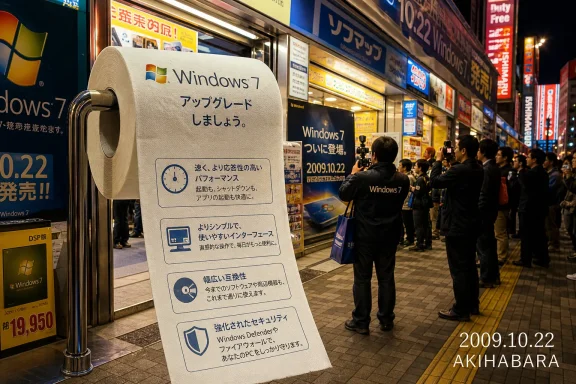
On October 22, 2009, as Windows 7 went on sale globally and Japanese retailers joined the launch-day spectacle, some stores in Akihabara and elsewhere promoted Microsoft’s new operating system with toilet paper rolls printed with upgrade pitches and feature explanations. It was ridiculous, tactile, and oddly on-message. Windows 7 was not merely being sold as software; it was being sold as relief after Vista. The toilet-paper gag worked because everyone understood the subtext: Microsoft needed to clean up a mess.
Windows launches used to be civic events in the PC world. They had midnight lines, boxed software, retail displays, celebrity appearances, and the kind of ambient excitement that now attaches more often to phones, game consoles, and GPUs. Japan’s Windows 7 launch fit squarely into that older retail culture, where Akihabara electronics shops could turn an operating system release into a street-level festival.
The toilet paper promotion has survived online because it compresses that whole moment into a single absurd object. A roll of paper printed with Windows 7 messaging is funny because it is so plainly unnecessary. Nobody needed a bathroom-ready explainer of Aero Peek, HomeGroup, BitLocker To Go, or Windows XP Mode.
But unnecessary is not the same as useless. In 2009, Microsoft’s problem was not that people had never heard of Windows. Its problem was that many people had heard too much about Windows Vista.
Vista had arrived with big promises and a reputation that quickly hardened around annoyance: driver problems, performance complaints, security prompts, compatibility headaches, and the sense that Microsoft had turned the PC into a more demanding machine without giving enough back. Windows 7 therefore had to do more than introduce features. It had to persuade users that the company had listened.
That is why the toilet paper matters as more than novelty. It was promotional junk, yes, but promotional junk with a job: take a complicated upgrade message and make it unavoidable, memorable, and domestic. Windows 7 was presented not as a revolution but as a more comfortable way to use the PC you already owned.
Windows 7’s marketing leaned hard into the opposite emotions. Faster startup. Better compatibility. Cleaner interface. Easier networking. Fewer distractions. More confidence. These were not random feature bullets; they were a map of Vista’s sore spots.
That is what makes the printed-roll format unexpectedly revealing. Toilet paper is intimate, disposable, and repetitive. The message was not a grand corporate manifesto but a loop of reassurance: Windows 7 is faster, more comfortable, more compatible, more secure. Read it once, tear it off, and the next sheet says it again.
The gag also carried a certain accidental honesty. Operating systems are infrastructure, and infrastructure is usually noticed only when it fails. Microsoft did not need people to contemplate Windows 7 like a luxury product. It needed them to believe Windows would get out of the way.
In that sense, the promotional roll was both lowbrow and precise. It put Windows 7 in the realm of daily routine, which is exactly where a successful desktop OS belongs.
Japanese electronics retail has historically been comfortable with tie-ins that seem bizarre from the outside but make perfect sense as attention machines. Novelty goods, mascots, character editions, themed packaging, and limited-run store promotions are not merely jokes. They are a way to make a commodity feel like an event.
Windows 7 particularly benefited from that treatment because boxed operating systems were already becoming less emotionally central to computing. Many consumers would encounter the OS preinstalled on a new PC. Enthusiasts and system builders still cared about editions, upgrades, DSP copies, and launch-night availability, but the broader market was drifting away from the idea of operating-system software as a thing one physically bought.
A novelty roll restored physicality to the launch. It made the upgrade pitch into an object. You could pick it up, photograph it, laugh at it, and share it. In 2009 terms, that was viral retail.
The fact that the item reportedly came from local retailer promotion rather than a massive Microsoft-led campaign makes it even more interesting. It shows how Windows still functioned as an ecosystem event. Retailers, OEMs, component vendors, and Microsoft all had incentives to turn Windows 7 into a reason for customers to visit stores and buy machines, parts, upgrades, or accessories.
The user interface message was equally pointed. Windows 7 refined Aero rather than abandoning it, but the refinements mattered: Aero Peek, Aero Shake, a less cluttered desktop, and a taskbar redesigned around pinned applications and previews. Microsoft was not trying to make Windows unrecognizable. It was trying to make the familiar feel less fussy.
The disappearance of the old Vista Sidebar was part of the same argument. Gadgets did not vanish immediately, but they were freed from the rigid sidebar metaphor. The change signaled that Windows 7 would keep the decorative and convenience features people liked while scraping away some of the feeling that the OS was managing the user instead of the other way around.
The taskbar revamp was perhaps the most important visible change. It made Windows feel more application-centric and less window-chaotic, pulling launch shortcuts, running apps, previews, and jump lists into one more coherent strip. It was a design move that anticipated how users increasingly bounced among browsers, media players, chat clients, productivity tools, and folders all day.
Then came security, where Microsoft had to thread the needle. Vista had been criticized for nagging users, but the underlying security push could not simply be discarded. Windows 7’s Action Center reframed the problem by consolidating maintenance and security alerts rather than scattering them across the experience.
BitLocker To Go, available in higher-end editions, reflected another shift: removable storage had become a real data-risk surface. USB drives were everywhere, and the idea of encrypting them without turning the process into an enterprise science project was a meaningful improvement. Windows 7 was trying to make security less theatrical and more habitual.
That reassurance was especially important for business users and power users. Enterprises do not upgrade operating systems because a taskbar has nicer previews. They upgrade when the support clock, hardware cycle, application stack, and security requirements finally align. Vista had disrupted that calculation for many organizations, and Windows 7 needed to restore trust.
Windows XP Mode was the most explicit acknowledgement of that problem. By bundling a virtualized Windows XP environment with certain editions, Microsoft effectively admitted that legacy applications remained a blocking issue. It was a pragmatic feature, not a philosophically pure one.
There was a catch, of course. XP Mode depended on hardware virtualization support, and not every PC in circulation could run it smoothly or at all. But its symbolic value was larger than its technical reach. Microsoft was telling customers: we know your old software matters, and we are not pretending otherwise.
That tone separated Windows 7 from Vista in the public imagination. Vista often felt like Microsoft insisting on the future. Windows 7 felt like Microsoft negotiating with the present.
HomeGroup was designed to make home networking less painful. Anyone who remembers manually configuring shared folders, permissions, workgroups, and printer access can understand the appeal. A shared password and simplified discovery were not glamorous, but they addressed a real household problem.
Windows Media Center represented another fork in the road. Microsoft still imagined the PC as a living-room hub, capable of handling TV, recordings, music, photos, and video playback. This was before streaming boxes, smart TVs, and subscription apps fully swallowed the media-center dream.
The shift toward downloadable Windows Live applications was more consequential. Microsoft was beginning to unbundle parts of the Windows experience and move services onto a faster, more web-connected track. Mail, photos, video, and online storage were no longer simply operating-system features in the old sense.
SkyDrive, the precursor to OneDrive, was part of that early cloud story. In 2009, cloud storage for consumers still felt like a convenience layer rather than the default substrate of personal computing. Today, file sync, identity, backup, and subscription services are central to Microsoft’s Windows strategy.
Seen from 2026, the Windows 7 toilet paper is funny partly because the feature list is so grounded in local computing. Faster boots, cleaner windows, desktop gadgets, media playback, USB encryption, and compatibility modes all belonged to a world where the PC itself was still the main stage. The cloud was present, but it had not yet taken over the script.
Windows 7’s promise was easier to grasp. Your PC will start faster. Your desktop will be less cluttered. Your old programs are more likely to work. Your home network will be easier. Your USB drives can be encrypted. These are claims a user could test directly.
That simplicity mattered. The Windows 7 era sat between two eras of Microsoft. Behind it was the boxed-software company that could still generate launch-night retail lines. Ahead of it was the services-and-subscriptions company that would push Microsoft 365, Azure, OneDrive, Windows as a managed endpoint, and eventually Copilot.
Windows 7 was therefore both a recovery product and a farewell product. It restored faith in the traditional desktop just as the industry was preparing to move beyond it. The iPhone had already changed expectations for consumer computing, netbooks were exposing demand for cheaper and lighter devices, and tablets were about to reshape the market again.
In that context, the toilet paper roll becomes a strange artifact of confidence. It assumes people care enough about an operating system launch to read feature copy in a store, laugh at a novelty item, and perhaps buy a boxed upgrade. That assumption was not yet absurd in 2009. It would become harder to sustain later.
The best operating-system upgrades are often the ones that reduce emotional temperature. They make fewer users angry. They make administrators less nervous. They make developers less likely to field strange compatibility complaints. They make hardware vendors less likely to become the villain because a driver failed at launch.
Windows 7 did that. It became the version many users wanted to stay on, sometimes long after Microsoft wanted them to move. Its popularity later became its own problem, especially as Windows 8 tried to drag the desktop into a touch-first design experiment that many keyboard-and-mouse users rejected.
That arc made Windows 7 look even better in retrospect. Vista was remembered as the stumble before it; Windows 8 as the overreach after it. Windows 7 occupied the sweet spot: modern enough to move forward, familiar enough not to frighten the installed base.
The toilet paper promotion accidentally captured that balance. It was silly on the surface, but the copy itself was conservative. It did not promise to reinvent computing. It promised to make Windows less annoying.
Much of modern software marketing does the opposite. It begins with the vendor’s strategic priority: AI transformation, cloud migration, subscription value, endpoint intelligence, data gravity, zero trust, or ecosystem synergy. Those may matter, especially to IT leaders, but they do not automatically translate into user trust.
Windows 7’s messaging was more grounded. It told people that their PCs would behave better. That is the kind of promise users understand because it begins with their daily experience rather than the vendor’s quarterly narrative.
This is especially relevant now, as Microsoft pushes more AI functionality into Windows and related hardware. Copilot+ PCs, neural processing units, Recall-style features, and cloud-connected assistance all require Microsoft to ask users for more trust. The Windows 7 episode is a reminder that trust is easier to earn when the practical benefit is obvious.
The danger for Microsoft is not that people dislike new technology. Japan’s Windows 7 launch showed the opposite: enthusiasts will show up for a good launch when the product feels meaningful. The danger is that users begin to suspect the operating system is serving someone else’s roadmap before it serves their own.
That is fitting because operating systems live in the mundane. They are not only used during demos and launch events. They are used when someone is late for work, recovering a document, plugging in a projector, sharing a printer, watching TV, copying files, or trying to make an old accounting application run for one more year.
The toilet paper roll took Windows 7 out of the abstract and put it into the everyday. It reduced the operating system to repeated claims about speed, comfort, reassurance, compatibility, and security. In doing so, it captured the product more clearly than a glossy campaign might have.
It also showed how much of Windows 7’s identity was relational. The OS was defined not only by what it was, but by what it was not. It was not Vista’s reputation. It was not a break with the familiar desktop. It was not an upgrade that asked users to discard everything they knew.
That negative space was powerful. Microsoft did not need to make Windows 7 sound magical. It needed to make Windows sound safe to upgrade again.
 Windows 7 Needed a Launch People Could Feel
Windows launches used to be civic events in the PC world. They had midnight lines, boxed software, retail displays, celebrity appearances, and the kind of ambient excitement that now attaches more often to phones, game consoles, and GPUs. Japan’s Windows 7 launch fit squarely into that older retail culture, where Akihabara electronics shops could turn an operating system release into a street-level festival.The toilet paper promotion has survived online because it compresses that whole moment into a single absurd object. A roll of paper printed with Windows 7 messaging is funny because it is so plainly unnecessary. Nobody needed a bathroom-ready explainer of Aero Peek, HomeGroup, BitLocker To Go, or Windows XP Mode.
But unnecessary is not the same as useless. In 2009, Microsoft’s problem was not that people had never heard of Windows. Its problem was that many people had heard too much about Windows Vista.
Vista had arrived with big promises and a reputation that quickly hardened around annoyance: driver problems, performance complaints, security prompts, compatibility headaches, and the sense that Microsoft had turned the PC into a more demanding machine without giving enough back. Windows 7 therefore had to do more than introduce features. It had to persuade users that the company had listened.
That is why the toilet paper matters as more than novelty. It was promotional junk, yes, but promotional junk with a job: take a complicated upgrade message and make it unavoidable, memorable, and domestic. Windows 7 was presented not as a revolution but as a more comfortable way to use the PC you already owned.
The Joke Worked Because Vista Was the Punchline
By the time Windows 7 reached stores, Microsoft had spent much of the Vista era trying to rebut a narrative it could never fully control. Vista was not the catastrophe of popular memory in every technical respect, and it introduced important security and driver-model changes that mattered for the long-term health of Windows. But consumer computing is not graded on architectural intent. It is graded on whether the printer works, the game launches, the laptop feels slower, and the dialog boxes stop interrupting dinner.Windows 7’s marketing leaned hard into the opposite emotions. Faster startup. Better compatibility. Cleaner interface. Easier networking. Fewer distractions. More confidence. These were not random feature bullets; they were a map of Vista’s sore spots.
That is what makes the printed-roll format unexpectedly revealing. Toilet paper is intimate, disposable, and repetitive. The message was not a grand corporate manifesto but a loop of reassurance: Windows 7 is faster, more comfortable, more compatible, more secure. Read it once, tear it off, and the next sheet says it again.
The gag also carried a certain accidental honesty. Operating systems are infrastructure, and infrastructure is usually noticed only when it fails. Microsoft did not need people to contemplate Windows 7 like a luxury product. It needed them to believe Windows would get out of the way.
In that sense, the promotional roll was both lowbrow and precise. It put Windows 7 in the realm of daily routine, which is exactly where a successful desktop OS belongs.
Akihabara Was the Right Stage for the Absurd
The promotion also made sense because of where it appeared. Akihabara has long been more than a shopping district; it is a theater for enthusiast technology, retail spectacle, gaming culture, PC parts, collectibles, and promotional weirdness. A conventional poster in that environment risks becoming wallpaper. A toilet-paper roll printed with Windows copy gets remembered.Japanese electronics retail has historically been comfortable with tie-ins that seem bizarre from the outside but make perfect sense as attention machines. Novelty goods, mascots, character editions, themed packaging, and limited-run store promotions are not merely jokes. They are a way to make a commodity feel like an event.
Windows 7 particularly benefited from that treatment because boxed operating systems were already becoming less emotionally central to computing. Many consumers would encounter the OS preinstalled on a new PC. Enthusiasts and system builders still cared about editions, upgrades, DSP copies, and launch-night availability, but the broader market was drifting away from the idea of operating-system software as a thing one physically bought.
A novelty roll restored physicality to the launch. It made the upgrade pitch into an object. You could pick it up, photograph it, laugh at it, and share it. In 2009 terms, that was viral retail.
The fact that the item reportedly came from local retailer promotion rather than a massive Microsoft-led campaign makes it even more interesting. It shows how Windows still functioned as an ecosystem event. Retailers, OEMs, component vendors, and Microsoft all had incentives to turn Windows 7 into a reason for customers to visit stores and buy machines, parts, upgrades, or accessories.
The Printed Pitch Was a Time Capsule of Microsoft’s Priorities
The reported text on the paper reads today like a compact syllabus for Windows 7’s sales strategy. Startup performance came first because Vista had taught users to associate a new Windows version with heavier demands. Windows 7 needed to feel lighter even if it was still a modern NT-based operating system with substantial graphical and security machinery beneath it.The user interface message was equally pointed. Windows 7 refined Aero rather than abandoning it, but the refinements mattered: Aero Peek, Aero Shake, a less cluttered desktop, and a taskbar redesigned around pinned applications and previews. Microsoft was not trying to make Windows unrecognizable. It was trying to make the familiar feel less fussy.
The disappearance of the old Vista Sidebar was part of the same argument. Gadgets did not vanish immediately, but they were freed from the rigid sidebar metaphor. The change signaled that Windows 7 would keep the decorative and convenience features people liked while scraping away some of the feeling that the OS was managing the user instead of the other way around.
The taskbar revamp was perhaps the most important visible change. It made Windows feel more application-centric and less window-chaotic, pulling launch shortcuts, running apps, previews, and jump lists into one more coherent strip. It was a design move that anticipated how users increasingly bounced among browsers, media players, chat clients, productivity tools, and folders all day.
Then came security, where Microsoft had to thread the needle. Vista had been criticized for nagging users, but the underlying security push could not simply be discarded. Windows 7’s Action Center reframed the problem by consolidating maintenance and security alerts rather than scattering them across the experience.
BitLocker To Go, available in higher-end editions, reflected another shift: removable storage had become a real data-risk surface. USB drives were everywhere, and the idea of encrypting them without turning the process into an enterprise science project was a meaningful improvement. Windows 7 was trying to make security less theatrical and more habitual.
Compatibility Was the Real Upgrade Feature
The most important promise around Windows 7 was not a shiny desktop effect or a bundled app. It was compatibility. After Vista, Microsoft had to reassure customers that their hardware, applications, peripherals, and workflows would survive the transition.That reassurance was especially important for business users and power users. Enterprises do not upgrade operating systems because a taskbar has nicer previews. They upgrade when the support clock, hardware cycle, application stack, and security requirements finally align. Vista had disrupted that calculation for many organizations, and Windows 7 needed to restore trust.
Windows XP Mode was the most explicit acknowledgement of that problem. By bundling a virtualized Windows XP environment with certain editions, Microsoft effectively admitted that legacy applications remained a blocking issue. It was a pragmatic feature, not a philosophically pure one.
There was a catch, of course. XP Mode depended on hardware virtualization support, and not every PC in circulation could run it smoothly or at all. But its symbolic value was larger than its technical reach. Microsoft was telling customers: we know your old software matters, and we are not pretending otherwise.
That tone separated Windows 7 from Vista in the public imagination. Vista often felt like Microsoft insisting on the future. Windows 7 felt like Microsoft negotiating with the present.
HomeGroup and Windows Live Showed a PC World in Transition
The toilet-paper pitch also highlighted HomeGroup, Windows Media Center improvements, and Windows Live services. Those features now feel like artifacts from a different computing era, but in 2009 they captured Microsoft’s attempt to modernize the home PC without surrendering the desktop.HomeGroup was designed to make home networking less painful. Anyone who remembers manually configuring shared folders, permissions, workgroups, and printer access can understand the appeal. A shared password and simplified discovery were not glamorous, but they addressed a real household problem.
Windows Media Center represented another fork in the road. Microsoft still imagined the PC as a living-room hub, capable of handling TV, recordings, music, photos, and video playback. This was before streaming boxes, smart TVs, and subscription apps fully swallowed the media-center dream.
The shift toward downloadable Windows Live applications was more consequential. Microsoft was beginning to unbundle parts of the Windows experience and move services onto a faster, more web-connected track. Mail, photos, video, and online storage were no longer simply operating-system features in the old sense.
SkyDrive, the precursor to OneDrive, was part of that early cloud story. In 2009, cloud storage for consumers still felt like a convenience layer rather than the default substrate of personal computing. Today, file sync, identity, backup, and subscription services are central to Microsoft’s Windows strategy.
Seen from 2026, the Windows 7 toilet paper is funny partly because the feature list is so grounded in local computing. Faster boots, cleaner windows, desktop gadgets, media playback, USB encryption, and compatibility modes all belonged to a world where the PC itself was still the main stage. The cloud was present, but it had not yet taken over the script.
The Promotion Looks Silly Because Windows Marketing Became Abstract
One reason the story still circulates is that modern Windows marketing rarely feels this tangible. Today’s Windows message is built around productivity, security baselines, hybrid work, AI assistants, endpoint management, and silicon-backed features. These are real concerns, but they are harder to print on a gag object.Windows 7’s promise was easier to grasp. Your PC will start faster. Your desktop will be less cluttered. Your old programs are more likely to work. Your home network will be easier. Your USB drives can be encrypted. These are claims a user could test directly.
That simplicity mattered. The Windows 7 era sat between two eras of Microsoft. Behind it was the boxed-software company that could still generate launch-night retail lines. Ahead of it was the services-and-subscriptions company that would push Microsoft 365, Azure, OneDrive, Windows as a managed endpoint, and eventually Copilot.
Windows 7 was therefore both a recovery product and a farewell product. It restored faith in the traditional desktop just as the industry was preparing to move beyond it. The iPhone had already changed expectations for consumer computing, netbooks were exposing demand for cheaper and lighter devices, and tablets were about to reshape the market again.
In that context, the toilet paper roll becomes a strange artifact of confidence. It assumes people care enough about an operating system launch to read feature copy in a store, laugh at a novelty item, and perhaps buy a boxed upgrade. That assumption was not yet absurd in 2009. It would become harder to sustain later.
Microsoft Won by Making Windows Boring Again
The great achievement of Windows 7 was not that it made Windows exciting. It made Windows acceptable again. That sounds like faint praise, but for an operating system deployed across homes, schools, shops, factories, offices, and government agencies, acceptability is the foundation of dominance.The best operating-system upgrades are often the ones that reduce emotional temperature. They make fewer users angry. They make administrators less nervous. They make developers less likely to field strange compatibility complaints. They make hardware vendors less likely to become the villain because a driver failed at launch.
Windows 7 did that. It became the version many users wanted to stay on, sometimes long after Microsoft wanted them to move. Its popularity later became its own problem, especially as Windows 8 tried to drag the desktop into a touch-first design experiment that many keyboard-and-mouse users rejected.
That arc made Windows 7 look even better in retrospect. Vista was remembered as the stumble before it; Windows 8 as the overreach after it. Windows 7 occupied the sweet spot: modern enough to move forward, familiar enough not to frighten the installed base.
The toilet paper promotion accidentally captured that balance. It was silly on the surface, but the copy itself was conservative. It did not promise to reinvent computing. It promised to make Windows less annoying.
The Retail Gag Understood Something Modern Tech Often Forgets
There is a lesson here for today’s platform vendors, and it is not “print your AI roadmap on bathroom products.” The lesson is that successful technology marketing often starts by acknowledging the user’s existing irritation. Windows 7’s pitch worked because it answered a felt problem.Much of modern software marketing does the opposite. It begins with the vendor’s strategic priority: AI transformation, cloud migration, subscription value, endpoint intelligence, data gravity, zero trust, or ecosystem synergy. Those may matter, especially to IT leaders, but they do not automatically translate into user trust.
Windows 7’s messaging was more grounded. It told people that their PCs would behave better. That is the kind of promise users understand because it begins with their daily experience rather than the vendor’s quarterly narrative.
This is especially relevant now, as Microsoft pushes more AI functionality into Windows and related hardware. Copilot+ PCs, neural processing units, Recall-style features, and cloud-connected assistance all require Microsoft to ask users for more trust. The Windows 7 episode is a reminder that trust is easier to earn when the practical benefit is obvious.
The danger for Microsoft is not that people dislike new technology. Japan’s Windows 7 launch showed the opposite: enthusiasts will show up for a good launch when the product feels meaningful. The danger is that users begin to suspect the operating system is serving someone else’s roadmap before it serves their own.
The Roll of Paper Said the Quiet Part Out Loud
The enduring appeal of the story is that it makes a corporate recovery strategy look human. Windows 7 was a massive engineering, partner, and marketing effort. Yet the artifact that cuts through history is not a keynote slide or a product matrix. It is toilet paper.That is fitting because operating systems live in the mundane. They are not only used during demos and launch events. They are used when someone is late for work, recovering a document, plugging in a projector, sharing a printer, watching TV, copying files, or trying to make an old accounting application run for one more year.
The toilet paper roll took Windows 7 out of the abstract and put it into the everyday. It reduced the operating system to repeated claims about speed, comfort, reassurance, compatibility, and security. In doing so, it captured the product more clearly than a glossy campaign might have.
It also showed how much of Windows 7’s identity was relational. The OS was defined not only by what it was, but by what it was not. It was not Vista’s reputation. It was not a break with the familiar desktop. It was not an upgrade that asked users to discard everything they knew.
That negative space was powerful. Microsoft did not need to make Windows 7 sound magical. It needed to make Windows sound safe to upgrade again.
The Akihabara Bathroom Briefing Still Explains Why Windows 7 Landed
The toilet-paper promotion was a joke, but the joke has lasted because it pointed at real truths about Windows 7’s launch and Microsoft’s recovery after Vista. Strip away the novelty and the message was disciplined: Windows 7 would be faster, cleaner, safer, and less hostile to the hardware and software people already owned.- Windows 7 launched globally on October 22, 2009, with Japan joining the same-day rollout and retailers turning the release into a visible consumer event.
- The toilet-paper promotion appears to have been a local retail novelty rather than the centerpiece of a formal Microsoft campaign.
- The printed messaging emphasized the exact areas where Vista had struggled in public perception: performance, compatibility, interface clutter, and security friction.
- Features such as XP Mode, Action Center, BitLocker To Go, HomeGroup, and the redesigned taskbar were marketed as practical fixes rather than abstract innovations.
- The promotion’s survival as an internet curiosity shows how physical retail culture once made operating-system launches feel communal, collectible, and strange in ways today’s cloud-era rollouts rarely do.
- The broader lesson for modern Windows is that users respond best when Microsoft explains how a new feature solves a problem they already recognize.
References
- Primary source: TechEBlog -
Published: Sun, 14 Jun 2026 16:37:55 GMT
Loading…
www.techeblog.com - Official source: news.microsoft.com
Loading…
news.microsoft.com - Related coverage: arstechnica.com

Windows 7 arrives on October 22 (Updated)
Microsoft has revealed the ship date for Windows 7. The October 22 release … arstechnica.com
- Related coverage: computerworld.com
Loading…
www.computerworld.com - Related coverage: phys.org
Loading…
phys.org