

Microsoft's terse vision statement — that "Windows is evolving into an agentic OS" — detonated across social feeds and developer forums this week, forcing an unusually public, rapid-response effort from Windows leadership to soothe power users and developers furious about the platform's AI-first posture. What began as a promotion for Microsoft Ignite quickly became a broader conversation about priorities: reliability, control, privacy, and whether an OS that can "take initiative" should be the immediate priority when many users still complain about day-to-day polish.
In early November a short public post from Pavan Davuluri, who runs Windows and Devices at Microsoft, described a future where Windows connects devices, cloud, and AI to "unlock intelligent productivity and secure work anywhere." That single phrase — agentic OS — was intended as a thematic teaser for Microsoft Ignite but instead triggered a wave of backlash that broadened from enthusiast forums to mainstream tech coverage. The reaction sharpened pre-existing grievances about in-OS prompts, telemetry choices, update regressions and perceived upsell behavior. At the same time, Microsoft continues to build concrete AI primitives into Windows: Copilot features, a Windows AI Foundry runtime, support for protocols like the Model Context Protocol (MCP), and a hardware category called Copilot+ PCs — devices Microsoft says ship NPUs capable of 40+ TOPS to enable richer on-device AI. Those engineering signals make the "agentic OS" statement technically plausible — and controversial in equal measure.
If Microsoft chooses to couple ambitious engineering with disciplined defaults, modular delivery, independent audits, and an explicit "classic/power-user" switch, the agentic OS idea can deliver meaningful value while preserving trust. If not, the company risks a persistent, vocal segment of users defecting to alternatives and a long-term credibility hit that may blunt enterprise and consumer adoption.
The technical path forward is plausible; the harder work is political and UX-focused. That is where this story will be decided — not in product demos, but in the defaults Microsoft ships, the transparency it offers, and the respect it shows for the people who keep the platform running: the developers and power users.
Source: Windows Latest After Windows 11 AI OS backlash, Microsoft tells angry power users ‘we care deeply about you’
 Background / Overview
In early November a short public post from Pavan Davuluri, who runs Windows and Devices at Microsoft, described a future where Windows connects devices, cloud, and AI to "unlock intelligent productivity and secure work anywhere." That single phrase — agentic OS — was intended as a thematic teaser for Microsoft Ignite but instead triggered a wave of backlash that broadened from enthusiast forums to mainstream tech coverage. The reaction sharpened pre-existing grievances about in-OS prompts, telemetry choices, update regressions and perceived upsell behavior. At the same time, Microsoft continues to build concrete AI primitives into Windows: Copilot features, a Windows AI Foundry runtime, support for protocols like the Model Context Protocol (MCP), and a hardware category called Copilot+ PCs — devices Microsoft says ship NPUs capable of 40+ TOPS to enable richer on-device AI. Those engineering signals make the "agentic OS" statement technically plausible — and controversial in equal measure. What Pavan Davuluri actually said — and why wording mattered
Pavan Davuluri's message was short and promotional, aimed at Ignite attendees and partners. It framed Windows as a connective substrate for AI: devices, cloud, and models working together. But the word agentic has weight. In common usage it implies initiative — systems that act rather than simply respond.- For many longtime Windows users that implication crossed a line. Initiative-taking software suggests autonomous actions that require new guardrails around consent, auditing, and reversibility. That latent fear collided with years of UI churn and perceived upsells, creating an outsized reaction to a single sentence.
- The backlash was visible and vocal: the post accrued hundreds of thousands of views and thousands of replies before replies were closed, and media outlets reported developers and power users publicly weighing whether to migrate to macOS or Linux instead.
What people are angry about: the complaint map
The fervor around "agentic" is best understood as an overlay on existing, concrete complaints. The following are the pain points repeatedly cited by forums, public posts, and technical commentaries.- Reliability regressions: frequent Insider bugs, occasional blue-screen reports, and update rollbacks have eroded trust. Many users feel routine polish — dialog consistency, context menus, predictable behavior — is being deprioritized.
- Perceived monetization and upsells: in-OS nudges to adopt Microsoft 365, OneDrive, or taped-in Store experiences make users wary that agentic automation could become an upsell vector.
- Privacy and telemetry concerns: features like Recall (desktop activity snapshots) and other AI experiences that learn from user content have raised alarms about what gets stored, for how long, and who can access it. Users want readable audit logs and simple, durable opt-out controls.
- Loss of user agency: power users prize deterministic control. Changes that push Cloud-first flows (Microsoft account in OOBE), or that limit local account creation, are perceived as moves away from an OS you own toward an experience you subscribe to.
- UI regressions and small annoyances that stack up: visible examples like the small taskbar icons feature that shrinks icons but leaves the taskbar physically large have become emblematic — not because they are technically catastrophic, but because they signal a gap between feature marketing and polished execution.
What an “Agentic OS” actually means — a practical primer
The term is new in mass discourse but can be defined in engineering terms:- An agentic OS provides platform-level support for persistent, multimodal agents that maintain context, understand intent, and can orchestrate actions across applications with scoped permissions.
- It requires primitives for:
- Multimodal input (voice activation, vision/screen context),
- Model management and runtime sandboxes (local models vs cloud fallbacks),
- Permissioning, audit logs, and explicit consent flows,
- Performance and hardware acceleration to keep latency low (NPUs on Copilot+ devices).
Copilot+ and the hardware stratification — 40+ TOPS and what it implies
Microsoft has created a Copilot+ PC tier that it says will deliver the fastest, most private on-device AI experiences thanks to a 40+ TOPS NPU guideline. This is not marketing fluff: Microsoft’s own Copilot+ pages and developer documentation explicitly describe an NPU performance floor and list features that will be targeted to these devices. Why this matters:- Performance stratification: the best agentic experiences will likely be gated by silicon. Devices with a 40+ TOPS NPU will run more inference locally, reducing cloud trips and perceived privacy exposure, while older hardware will get a subset of features or cloud-backed fallbacks. That stratifies the user experience across price points and device classes.
- Real-world validation needed: TOPS is a vendor-level metric that varies by model type, precision, and application. The industry will need reproducible benchmarks for Copilot workloads to correlate TOPS claims to user-visible latency and throughput. Until independent benchmarking exists, the 40+ TOPS figure is a vendor-provided guideline, not an absolute guarantee of specific experiences.
- Developer impact: for creators of native apps or agent integrations, device heterogeneity complicates testing. Developers will have to decide whether to target Copilot+ features that only run fully on certain NPUs or degrade gracefully on mainstream hardware. This increases product complexity but also creates a path for compelling local experiences.
Microsoft's public response and the credibility gap
Microsoft’s publicly visible response to the backlash has two layers:- Reassurance from leadership that the company hears feedback and cares about developers and power users. The statement emphasized listening to product feedback systems and direct comments, and acknowledged there is work to do on reliability, performance, and the power‑user experience.
- Ongoing product pushes: announcements, previews, and hardware programs (Copilot+, Windows AI Foundry) continue to roll forward, indicating the roadmap itself has not been abandoned. That mix — listening while pushing — is what many users are reacting against.
- Strength: Microsoft is not speaking in generalities — it has shipped concrete primitives and detailed hardware guidance, which lends technical credibility to the agentic OS thesis. The Copilot+ program and developer docs show investment at multiple levels (software, APIs, and silicon partnerships).
- Weakness: The timing and tone matter. A marketing-forward message about autonomy is being released while many users still experience reliability problems and aggressive nudges. The cognitive gap between a lofty technical vision and daily user experience creates distrust — and that trust deficit is the largest single risk to adoption.
- Operational risk: Without durable, discoverable, opt‑out defaults, or a clearly documented audit model, agentic features risk being perceived as telemetry-collecting upsell surfaces. Independent audits, machine‑readable retention policies, and sandboxing proofs would materially reduce this risk. Several community analysts and forums have urged precisely these mitigations.
Strengths of Microsoft’s approach — why the vision could succeed
- Unified engineering: Microsoft has centralized teams, APIs, and platform primitives that make system-level agent orchestration technically tractable — an advantage no small vendor can replicate overnight. The Windows AI Foundry and MCP plumbing provide developer-friendly hooks for building safe, integrated agents.
- Hardware partnerships: By aligning OEMs around an NPU performance floor, Microsoft can optimize certain experiences for local inference, reducing cloud latency and enabling offline-first scenarios — a real win for privacy and responsiveness when done correctly.
- Enterprise continuity: For organizations that adopt Copilot+ hardware and embrace AI workflows, Windows as an orchestration layer could centralize device management, policy enforcement, and audit trails in a way that benefits compliance and productivity. The platform-level approach can simplify enterprise rollouts of vetted agents.
The substantive risks — where Microsoft must course-correct
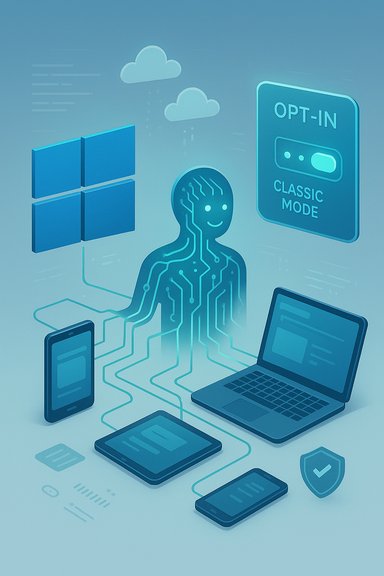
- Default opt-in risk: If agentic behaviors are enabled by default with buried opt-outs, the company will face a persistent trust tax. The single easiest fix is to make initiative-taking features opt‑in and provide a one-click “classic/power” mode. Many community proposals have converged on this recommendation.
- Auditability and retention: Agent logs must be human-readable and machine-auditable. Without transparent retention policies, claims of local inference or privacy gains will be met with skepticism. Microsoft should publish machine‑readable policies and invite third‑party audits.
- Modular delivery: The agentic stack should be modular. Shipping agentic components as separate, removable modules — with a lean core OS preserved for legacy hardware — would reduce performance regressions and perceived forced upgrades.
- Independent benchmarking: TOPS claims and other vendor metrics require independent reproducible benchmarks for Copilot workloads. Without those, customers and reviewers will struggle to validate Microsoft’s performance claims.
- User education and consent: Initiative-taking features require clear, contextual consent screens and accessible revocation controls. Good developer and installer UX will determine whether agents are seen as assistants or intrusions.
Practical steps Microsoft should take (and can ship quickly)
- Make all agentic features opt-in at OOBE with a visible toggle and an explicit "Power User / Classic Mode" that:
- Disables agent initiative,
- Removes promotional nudges,
- Reduces telemetry to a clear minimum.
- Publish a short, machine-readable policy for agent data collection and retention, and commission an independent third‑party security/privacy audit within 90 days.
- Ship a persistent, discoverable "Disable Agent" setting in Settings → Privacy & Security that survives updates and is easy to find.
- Publish reproducible benchmarks for Copilot workloads, and partner with third-party labs for transparent performance claims.
- Prioritize polish on basic UX pain points that have been repeatedly raised (reliable taskbar behavior, consistent dialogs, update stability) before widening agent deployment.
What power users and developers can do now
- Audit your settings: Review Privacy → Diagnostics and Feedback, and make sure background AI or data-collection toggles are set per your comfort level.
- Use a local account when appropriate: For machines that will not rely on cloud features, create a local account or leverage enterprise provisioning options (Autopilot, unattend.xml) to preserve choice.
- Test agent features in controlled environments: Developers should evaluate Copilot+ APIs and agent primitives on isolated devices before deploying to production; hardware variances matter.
- Demand transparency: Ask OEMs and Microsoft for reproducible benchmarks and readable retention policies. Public pressure is an effective lever.
- Consider alternative platforms where appropriate: If deterministic control is a non‑negotiable requirement for specific workflows, macOS and Linux still offer strong command-line and developer-focused experiences without the same level of integrated agentic ambitions. Several developers have publicly stated they are moving some workflows away from Windows for this reason.
Verifiability and cautionary notes
- The phrase “agentic OS” and the public reaction are documented in multiple independent outlets and captured in community threads; those facts are verifiable.
- Microsoft’s Copilot+ 40+ TOPS guidance and the list of targeted experiences are explicitly published on Microsoft pages and in developer docs; the hardware guidance is a company-provided baseline and should be treated as such until independent benchmarks confirm real-world performance. TOPS is a useful shorthand but workload-dependent; independent testing is required to quantify user-visible benefits.
- Claims that Microsoft “won’t stop adding AI features” are interpretive. Microsoft has signaled an ongoing AI-first roadmap; leadership messages emphasize continued investment. However, any summary that frames that as an absolute policy (“we will never stop”) is an extrapolation rather than a documented, contractual pledge. Readers should treat such absolutes cautiously and look for specific product or support commitments from Microsoft.
- Where community reporting includes anecdotal accounts of errors (e.g., BitLocker hangs, Blue Screens), those reports are real but not universal; they are symptomatic of a broader quality debate, not definitive proof that all devices are affected. Technical due diligence and replication are necessary before generalizing.
Conclusion — a pivotal moment for Windows
Microsoft’s agentic OS rhetoric has catalyzed an important public test: can the company simultaneously deliver compelling AI-driven productivity gains and maintain the durable defaults, auditability, and polish that seasoned Windows users demand? The pieces are in place — APIs, runtimes, and an OEM-backed hardware tier — but the social contract is strained.If Microsoft chooses to couple ambitious engineering with disciplined defaults, modular delivery, independent audits, and an explicit "classic/power-user" switch, the agentic OS idea can deliver meaningful value while preserving trust. If not, the company risks a persistent, vocal segment of users defecting to alternatives and a long-term credibility hit that may blunt enterprise and consumer adoption.
The technical path forward is plausible; the harder work is political and UX-focused. That is where this story will be decided — not in product demos, but in the defaults Microsoft ships, the transparency it offers, and the respect it shows for the people who keep the platform running: the developers and power users.
Quick reference — five concrete things Microsoft can ship quickly
- Opt‑in agent defaults at OOBE with a visible "Enable Agents" toggle.
- One-click "Power User / Classic" mode to disable agent initiative and promotional nudges.
- Machine-readable retention and telemetry policy for agent data.
- Independent performance benchmarks for Copilot+ workloads.
- A durable, discoverable "Disable Agent" setting that survives updates.
Source: Windows Latest After Windows 11 AI OS backlash, Microsoft tells angry power users ‘we care deeply about you’
