

Paul Thurrott’s RunAsRadio appearance — recorded as episode #1016 — framed 2025 as a decisive, messy year for Windows: leadership changes, a renewed engineering re-unification, an aggressive hardware-first AI strategy, and renewed enthusiasm for Windows on Arm that together set the stage for a consequential 2026. The episode distilled one clear theme: Microsoft is trying to turn Windows into an “agentic” platform, but doing so requires fixing long‑standing product friction, making hard platform bets on silicon and on-device AI, and managing an impatient public that wants results without losing control of their machines.
Paul Thurrott’s conversation covers three tightly connected developments: an internal leadership reorganization centered on Pavan Davuluri, the practical product reality of Copilot and Copilot+ (the on‑device AI story), and the evolving fortunes of Windows on Arm — notably Qualcomm’s new Snapdragon X2 family. Those threads intersect: leadership and organizational structure determine how quickly product, engineering, and silicon teams can coordinate; Copilot+ requires both software and capable NPUs; and Arm‑optimized Windows builds are becoming the practical proving ground for Microsoft’s vision of local, fast, private AI experiences.
Two framing points are essential before we dig into specifics:
Source: Thurrott.com RunAsRadio #1016: What Windows Wants for Christmas with Paul Thurrott
 Background / Overview
Paul Thurrott’s conversation covers three tightly connected developments: an internal leadership reorganization centered on Pavan Davuluri, the practical product reality of Copilot and Copilot+ (the on‑device AI story), and the evolving fortunes of Windows on Arm — notably Qualcomm’s new Snapdragon X2 family. Those threads intersect: leadership and organizational structure determine how quickly product, engineering, and silicon teams can coordinate; Copilot+ requires both software and capable NPUs; and Arm‑optimized Windows builds are becoming the practical proving ground for Microsoft’s vision of local, fast, private AI experiences.Two framing points are essential before we dig into specifics:
- This is a year of transition — many announcements are strategic and engineering‑level rather than pure consumer features. That’s why some deliverables are experimental or tied to specific OEM hardware.
- A significant portion of the public reaction is about expectations: Microsoft’s language (“every PC will be an AI PC”) pitches ubiquity, but Copilot+ is deliberately premium and hardware‑accelerated, which has generated confusion and some criticism.
The Leadership Move: Pavan Davuluri and a Reunified Windows Engine
What changed
Microsoft’s most consequential organizational shift in 2025 was the elevation of Pavan Davuluri to lead the consolidated Windows organization and devices efforts. The company reunited previously split engineering teams — notably bringing client‑facing Windows work and lower‑level platform teams closer under one leadership structure — to shorten the feedback loops between device silicon partners, system software, and the Windows shell itself. This reorganization is explicitly aimed at speeding AI integration into the OS.Why it matters
The split between client/experiences and core platform teams had grown over several years, with some low‑level work tied more closely to Azure and cloud infrastructure. Consolidation reduces friction:- Faster cross‑team decisions on features that need kernel, driver, and UI changes.
- Better alignment with silicon partners (Qualcomm, Nvidia, others) for optimized on‑device AI.
- A single executive owner for device design, firmware, and platform reliability.
Risks and realities
Organizational repacking is necessary but not sufficient. Past reorganizations have sometimes created short‑term churn and uncovered ownership gray areas (what sits in Azure vs. Windows vs. device firmware). Getting the right engineers working together is only the start; making those teams productive across OS, driver, and silicon stacks — while preserving security, update reliability, and enterprise manageability — is the harder part.Copilot, Copilot+, and the AI-first Windows Strategy
Two flavors of Copilot
Microsoft’s AI story is usefully split into two buckets:- Copilot: cloud‑backed assistant features that are broadly available and rely on remote inference.
- Copilot+: on‑device, hardware‑accelerated capabilities that require NPUs (neural processing units) and specialized drivers to deliver fast, private, and sometimes offline experiences.
Why on‑device matters
On‑device inference brings clear benefits:- Lower latency: conversational and interactive features feel instantaneous.
- Privacy and cost: local execution avoids continuous cloud calls and the associated privacy and monetization questions.
- Resilience: offline or intermittent connectivity scenarios still work.
The UX tradeoffs
Agentic features introduce new UX and control questions: how proactive should the OS be, what automation is acceptable, and how are privacy and telemetry disclosed? The public reaction when Microsoft and some execs talked about AI integration suggested unease about agents acting without clear guardrails — a point Paul Thurrott raised and that community voices have amplified. These are product design problems as much as technical ones: transparency, rollback, user control, and enterprise policy are core requirements if agents are to be trusted.Windows on Arm: Momentum, Hardware, and Snapdragon
The practical case for Arm
Windows on Arm is no longer a prototype exercise. Recent Qualcomm platforms have closed critical gaps — native app support has improved, major apps (Adobe, Google Drive components, and more) have shipped Arm builds, and Microsoft has advanced emulation and binary translation where needed. For many workloads, Snapdragon‑based Windows laptops now deliver competitive battery life and unique AI features that rival x86 devices for certain productivity scenarios. Paul Thurrott pointed to this as one of the brighter notes for Windows in 2025.Snapdragon X2 family: what the silicon promises
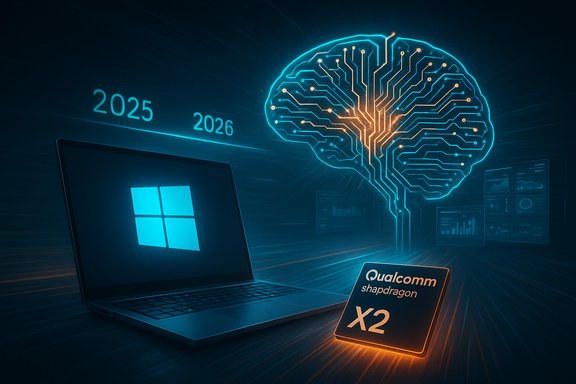
Qualcomm’s Snapdragon X2 Elite/Extreme series was revealed as the company’s next major PC push. Public reporting and Qualcomm materials indicate the new chips are built on a 3nm process, target high boost clocks (some variants claim up to a 5.0 GHz dual‑core boost in lab figures), and include an 80 TOPS Hexagon NPU designed for concurrent Copilot+ experiences. Vendors expect devices in early 2026; Microsoft has prepared a platform‑only branch (26H1) to support new platform features these chips require.- Key Snapdragon X2 claims reported broadly:
- Up to 80 TOPS of NPU performance for on‑device AI.
- Higher CPU and GPU efficiency and performance vs prior generation.
- Platform features for USB4, PCIe, and modern connectivity.
Verification and caveats
Independent hardware coverage strongly corroborates Qualcomm’s announcements, but early benchmarks and Linux porting stories show the practical experience can differ by OS and firmware. Tom’s Hardware and other outlets have published mixed results for Qualcomm silicon under Linux, and some Linux‑first OEM projects have paused due to support gaps. The Windows experience, however, remains the priority for Qualcomm’s initial shipments and the primary axis for Copilot+ performance tuning. This split between Windows and Linux performance is real and worth noting for enthusiasts and IT pros evaluating Arm devices today.The Product Roadmap: 26H1, Feature Enabling, and the Windows 12 Question
26H1 and platform‑only updates
Microsoft’s internal versioning shows that not every new build is a consumer feature update. The Canary build labeled 26H1 is a platform‑only release intended to enable new silicon and low‑level platform features required by next‑gen Arm chips. It’s not a broad feature drop for the general installed base — it’s compatibility engineering at the OS core. The practical effect is that some new hardware will ship with tailored OS builds to avoid breaking the servicing model and preserve stability for existing users.What about “Windows 12”?
Speculation about Windows 12 has been persistent in the press and among enthusiasts. Several outlets have published timelines and rumor pieces suggesting a major OS refresh could appear between late 2025 and early 2026. These pieces typically describe deeper AI integration, UI refinements, and tighter cloud/edge features. However:- Microsoft has not announced a consumer product formally called “Windows 12.”
- Many reports are speculative and aggregate product wishes, patents, and engineering priorities into a single narrative.
- Expect credible Microsoft signals — official blogs, OEM partner briefings, or Insider program artifacts — before treating Windows 12 as more than a rumor.
Community Reaction and Practical Concerns
Public reaction to Copilot+ and leadership messaging
When Microsoft and leaders framed the vision of “every PC as an AI PC,” the public pushed back on the implied meaning. Users worried about:- Fragmentation: feature availability tied to hardware creates tiers of capability.
- Control: agentic features that act autonomously raise consent and rollback concerns.
- Costs: whether Copilot+ will be subscription‑gated or depend on special hardware.
IT, enterprise, and update churn
Enterprises care most about predictability, security, and manageability. The movement to unify core teams is good for integrated engineering, but it raises immediate questions for IT admins:- How will Copilot features be governed by group policy and MDM?
- Will on‑device AI expand attack surface or improve security by reducing cloud dependency?
- How will rollbacks be handled if an AI‑driven feature interferes with business workflows?
What Microsoft Needs to Get Right in 2026
1. Clear, honest messaging and entitlements
Confusion around Copilot vs. Copilot+ should be resolved with straightforward product tiers, clear hardware and policy requirements, and transparent pricing (if any). Marketing that implies universal parity but ties features to premium hardware erodes trust.2. Enterprise‑grade controls
Ship rich admin tooling on day one:- Policy flags to disable agentic behaviors.
- Telemetry transparency and user‑action ledgers for AI decisions.
- Easy rollback and feature‑gating for staged rollouts.
3. Robust silicon and driver ecosystems
Windows on Arm will only scale if drivers, firmware updates, and OEM tooling are mature. Qualcomm’s X2 shows the right direction for raw capability, but broad success requires predictable firmware updates, robust kernel support, and consistent battery/thermal behavior across varied OEM designs. Early Linux port challenges are a reminder that cross‑platform maturity can lag hardware announcements.4. Product design that respects user agency
Agentic features should be clearly discoverable, reversible, and explainable. A “pro” mode that reduces system nudges, preserves defaults, and treats telemetry with explicit, auditable consent is one path to maintaining trust among power users — a theme that echoes ongoing community proposals.A Practical Checklist for Power Users and IT Pros
- If you manage fleets, delay aggressive Copilot+ pilots until admin controls and rollback semantics are confirmed.
- For enthusiasts considering Arm laptops: test real workloads and verify driver maturity for your apps, and follow early reviews for battery/thermal behavior on both Windows and Linux.
- Backup and test update rollbacks on any preview builds; platform‑only updates like 26H1 can have low‑level changes with broad effects.
- Demand clarity: ask vendors (OEMs and Microsoft) about Copilot+ entitlements, local data handling, and enterprise policy controls before deployment.
Strengths, Weaknesses, and the Bottom Line
Strengths
- Vision + silicon alignment: Microsoft’s organizational changes plus Qualcomm’s aggressive X2 roadmap create a credible path for true on‑device AI in Windows.
- Real engineering focus: Building platform‑only branches and unifying teams signals long‑term engineering discipline rather than ad hoc feature drops.
- Windows on Arm momentum: Native app support and platform features have matured sufficiently to make Arm a practical choice for many productivity users.
Weaknesses / Risks
- Messaging mismatch: Promises of universality are colliding with hardware realities, producing skepticism.
- Fragmentation risk: Hardware‑gated features can create uneven user experiences and complicate support.
- Integration complexity: Shipping agentic features safely requires more than fast silicon — it requires exceptional coordination across kernel, drivers, apps, security, and admin tooling.
The bottom line
Microsoft’s moves in 2025 position Windows to be a serious platform for on‑device AI, but success depends on execution: clear communications, mature OEM ecosystems, honest enterprise controls, and human‑centered design for agentic features. The ingredients are present; the next 12 months will show whether Microsoft can translate them into dependable, widely adoptable experiences. Paul Thurrott’s RunAsRadio conversation captured both the opportunity and the hazards — and his core message is a practical one: the company can do powerful things here, but only if it respects control, transparency, and the engineering reality of shipping an operating system.Final assessment and what to watch in 2026
- Watch for OEM device launches with Snapdragon X2 silicon at CES and in H1 2026; these will be the proving ground for Copilot+.
- Expect Microsoft to publish more detailed admin guidance and telemetry controls if enterprise pilots are to expand beyond controlled labs.
- Treat “Windows 12” talk as speculative until Microsoft or major OEM partners produce official product timelines; rumor coverage is plentiful but unverified. Rumors are signals, not commitments.
Source: Thurrott.com RunAsRadio #1016: What Windows Wants for Christmas with Paul Thurrott
