

Microsoft’s short social post — that “Windows is evolving into an agentic OS” — touched off an unusually raw and immediate backlash that cut across enthusiast forums, social media, and enterprise chatter, turning a marketing line meant for Microsoft Ignite into a wider conversation about trust, control, and what users actually want from their desktop operating system.
Background / Overview
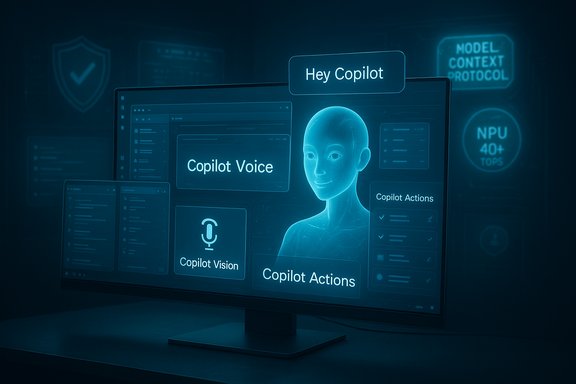
Microsoft’s Windows leadership has been explicit about moving the platform beyond a passive UI into a layered system where agents — multimodal AI components that can reason, plan, and act — are first‑class citizens of the OS. The short public summary from Pavan Davuluri, president of Windows & Devices, framed the company’s vision as Windows “connecting devices, cloud, and AI to unlock intelligent productivity and secure work anywhere,” language that crystallized into the phrase “agentic OS” and quickly became the focal point of public reaction.That vision bundles concrete engineering efforts now shipping or in preview:
- Copilot Voice (wake‑word voice activation) and Copilot Vision (screen‑aware assistance designed to be explicitly opt‑in).
- Copilot Actions, a set of agentic workflows intended to perform multi‑step tasks under permissioned controls.
- Platform plumbing such as a Windows integration of the Model Context Protocol (MCP), a Windows AI Foundry runtime to run local models, and a Copilot+ hardware tier that targets high‑performance NPUs for richer on‑device inference.
Why the phrase “agentic OS” mattered
Words shape expectations. “Agentic” is not neutral product parlance — it implies initiative. For many users that’s a red flag: software that takes initiative is qualitatively different from assistants that respond only when asked. The public reaction made three things clear:- A large segment of Windows users interpret “agentic” as potential for autonomous actions, not merely helpful suggestions. That interpretation amplified privacy and control fears.
- The phrase hit a community already primed by years of contentious UX changes, upsell nudges (OneDrive, Edge, Microsoft accounts), and frequent UI churn; the reaction was thus as much cumulative distrust as it was a response to a single sentence.
- The audience for Davuluri’s post was likely enterprise and partner‑facing (Microsoft Ignite previews), but the message leaked into broader consumer channels where context and nuance were lost and fears were magnified.
What Microsoft is actually shipping and the engineering facts
Separate the marketing narrative from the engineering plumbing: the underlying technologies Microsoft is building are real and trackable. Multiple public documents and previews show the company pushing on three engineering axes:Multimodal inputs and session models
- Wake‑word and voice sessions: “Hey, Copilot” returns a wake‑word model and session model that can be bounded and visually indicated. Microsoft’s implementation emphasizes local wake‑word detection to reduce unnecessary audio uploads.
- Screen awareness: Copilot Vision is framed as opt‑in and session‑bound, designed to operate only on selected windows or shared regions rather than constantly scanning the screen. Nonetheless, the existence of a screen‑aware OS assistant materially changes the threat model for privacy and raises concerns about defaults, retention, and scope.
Agentic actions and the permission model
- Copilot Actions: This is Microsoft’s agentic choreography layer — agents that can chain operations (reorganize files, summarize documents, draft/send email) under a permissioned execution model and sandboxing. The company describes auditing and scoped access, but much of the user‑facing detail (defaults, retention, rollback) remains to be proven in shipping builds and enterprise policies.
Platform primitives and local inference
- Model Context Protocol (MCP): MCP is an open agent‑tooling standard Microsoft is embedding into Windows so local agents can discover and call “capability providers” (apps, files, services) through a registry and explicit permission model. This is the plumbing that theoretically lets agents operate without unfettered system access.
- Windows AI Foundry & runtimes: Tooling to run smaller models locally across CPU/GPU/NPU and to hybridize with the cloud. The runtime work aims to reduce latency and provide local first privacy options for enterprise scenarios.
- Copilot+ hardware and the NPU story: Microsoft and partners have signalled a premium “Copilot+” experience enabled by NPUs that meet a performance guidance often cited as 40+ TOPS. That guidance is intended to identify devices that can keep more inference local and provide the lowest latency experiences, while older hardware falls back to cloud‑based reasoning. The TOPS number is a vendor‑provided shorthand and varies by workload. Independent benchmarks will be required to confirm real‑world performance.
The user backlash: themes and reality checks
The public reaction after Davuluri’s post boiled down into a set of recurring grievances — many of which have a factual basis in past behavior, while others reflect anxiety about future monetization and surveillance:- Perceived neglect of fundamentals: Many long‑time users demanded fixes for performance, stability, and predictable UI behavior before a major platform experiment. These are tangible concerns: recent Insider builds and feature rollouts have produced reports of regressions and inconsistencies that fuel this call.
- Privacy and sensor anxiety: A screen‑aware assistant and wake‑word voice model change the attack surface. Even when features are opt‑in, users worry about defaults, retention, and what leaves the device. Microsoft’s earlier controversies around features that indexed local content (e.g., some “Recall” experiments) contributed to that distrust.
- Monetization optics: The presence of Copilot, OneDrive, and subscription nudges in the shell has primed users to see agentic features as another channel for upselling, a perception that harms trust even before any such behavior is actually implemented.
- Hardware gating and two‑tier OS fears: Messaging about Copilot+ and 40+ TOPS makes users fear a future where the “best” Windows features require new, expensive hardware — creating a perception of forced upgrades and fragmentation. The technology argument for NPUs is real, but the optics are politically sensitive.
Technical tradeoffs and security considerations
Turning an OS into a platform that runs agentic workflows creates new classes of engineering and security problems. These are not theoretical — they’re practical, measurable, and in many cases precedent exists.Attack surfaces grow with agentic capability
- Agents need context (files, windows, calendars) to be useful. That context is valuable and sensitive, and any system that aggregates it increases exposure. Prompt‑injection attacks, malicious documents that attempt to trick agents, or compromised connectors can all result in unintended actions. Robust sandboxing, ability to audit and roll back actions, and strict connector vetting are essential.
Human‑in‑the‑loop and auditable actions
- The cost of an erroneous multi‑step agent action can be larger than a wrong chat reply. Implementing auditable logs, clear human confirmation for high‑impact actions, and one‑click rollback mechanisms are not optional — they are necessary mitigations. Microsoft has promised auditing and permission models, but the real test is in the UX details and enterprise policy controls.
Privacy guarantees must be machine‑readable and verifiable
- Promises of “local first” or encryption mean little without clear defaults, retention policies, and third‑party audits. Enterprises and privacy advocates will insist on machine‑readable policies and independent audits for MCP, telemetry, and the agent permission surface. The company’s statements point in this direction, but details remain to be published and independently verified.
Fragmentation and developer expectations
- A two‑tier experience (Copilot+ vs Classic/Lite) can solve engineering friction but complicates developer testing and enterprise management. Developers need deterministic feature sets to target; IT needs predictable management surfaces. Microsoft can reduce friction by modularizing the shell and making richer AI components optional packages that install only on compatible hardware.
The Copilot+ and NPU question — what 40+ TOPS really means
The repeated reference to 40+ TOPS in public briefings and partner materials deserves careful parsing. TOPS as a metric is a vendor‑level shorthand for raw integer arithmetic throughput; it is not a direct guarantee of model latency, energy efficiency, or user‑perceived responsiveness across real workloads.- The technical case for NPUs is sound: dedicated accelerators reduce latency and energy consumption for common neural workloads compared with CPU/GPU for certain models. Multiple silicon vendors (AMD, Intel, Qualcomm) have product lines targeting these workloads.
- The caveat: TOPS claims vary by microarchitecture, model type, memory subsystem, and thermal behavior. A device that claims 40 TOPS in marketing may perform very differently on various inference workloads. Independent benchmarking by neutral labs will be essential to validate whether a Copilot+ device delivers the promised local experience at scale.
Business and policy implications
The move to an agentic OS has consequences beyond UX. It reshapes procurement, compliance, and competitive dynamics.- Enterprises will demand auditable controls and contractual guarantees about agent access to corporate data. Pilot programs and strict acceptance testing will be necessary before broad rollouts.
- Governments and regulators will watch how defaults are set, what telemetry is collected, and how consent is recorded. Transparent retention policies and third‑party audits will be part of the compliance story.
- For consumers, the perception that agentic features could become monetized surfaces must be actively countered by Microsoft with clear, persistent user choice and visible, persistent toggles for disabling agent behavior or restoring a “power user” mode.
What Microsoft should — and probably will — do next
The path forward for Microsoft is both product and political. Based on the engineering work announced and the contours of the backlash, several pragmatic steps would materially reduce the “trust tax” of agentic Windows:- Make agentic features opt‑in by default with clear, discoverable onboarding and audit logs that are readable by administrators and regular users alike.
- Ship a persistent “power user” or “classic” mode that disables promotional nudges, nonessential telemetry, and agentic autoblend — a single, discoverable switch that survives updates.
- Modularize the OS so that NPU‑heavy, polished agentic experiences install only on Copilot+ devices; preserve a lean core OS for legacy hardware to avoid performance regressions and the perception of forced upgrades.
- Publish independent audits and machine‑readable retention policies for MCP access, agent connectors, and telemetry collection; invite third‑party red teams to validate the sandboxing model.
- Publish reproducible NPU benchmarks for Copilot workloads so enterprises and reviewers can judge the difference between vendor TOPS claims and real‑world performance.
Conclusion — innovation with a steep trust tax
There is real potential in making Windows more capable: screen‑aware help can dramatically improve accessibility; agentic workflows can automate repetitive, multi‑step tasks; and local inference on NPUs can reduce latency and the need to send sensitive content to the cloud. The engineering trajectory Microsoft is pursuing — MCP, Windows AI Foundry, Copilot Voice/Vision/Actions, and Copilot+ hardware — is coherent and technically plausible.However, the public reaction to the phrase “agentic OS” is a timely reminder that how these features are introduced matters as much as what they do. Defaults, transparency, rollback, and auditability are not optional niceties; they are the minimum ingredients of a trustworthy platform shift. Without them, the company risks generating a persistent, vocal segment of users who will resist, disable, or — at scale — migrate to alternatives.
Microsoft can still chart a path where Windows becomes a helpful, privacy‑respecting platform for AI‑driven productivity — but it will require disciplined defaults, modular releases, independent verification of hardware claims, and credible third‑party audits. The fallout from a single executive tweet should be treated as a constructive signal: the market cares deeply about control, privacy, and value, and those priorities must be built into any agentic future for the OS.
Source: Tom's Hardware Top Microsoft exec's boast about Windows 'evolving into an agentic OS' provokes furious backlash - users fed up with forced AI features


