

As the latest wave of alarmist headlines around a supposed “Windows crisis” washes over tech social feeds, the reality is far more nuanced: Windows remains the dominant desktop platform, but the debate driving the crisis narrative is not about market disappearance — it’s about trust, transition costs, and the shape of an AI‑first future that many organizations are still assessing.
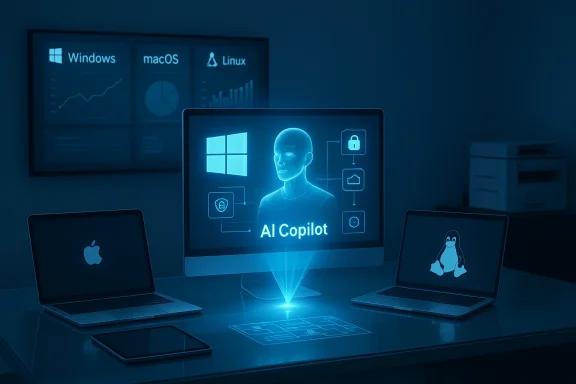
The past three years have seen two simultaneous trends reshape how IT leaders and end users evaluate operating systems. First, competitive and specialized platforms — macOS for creative workflows, Linux for developer and security-conscious workloads — are claiming more attention and pockets of adoption. Second, Microsoft’s push to bake AI into the OS experience, primarily via Copilot, has raised fresh questions about data exposure, governance, and perceived control.
Taken together, these dynamics make for a dramatic narrative: one side frames them as an existential collapse for Windows; the other sees gradual diversification. The most credible reading places us between those extremes: a dominant platform facing strategic and operational headwinds thaagement rather than panic.
Why the discrepancy between viral claims of “collapse” and these numbers? Two reasons. First, visibility bias: developer communities, privacy forums, and media outlets amplify niche migrations that feel significant inside their bubbles. Second, functionality bias: when new Windows features or policies impact tooling, security, or hardware, those disruptions can be loud and concentrated, producing dramatic anecdotes that get amplified as proof of a brnderlying data, though, shows a platform that is evolving — not imploding.
Enterprises that postponed hardware refreshes now face difficult choices:
The result is often a localized, painful migration story: a retail chain that delayed register upgrades because its receipt printers lack updated drivers, or a transportation yard that kept legacy kiosks running to avoid downtime. These are pragmatic tradeoffs — and when described loudly, they feed the broader crisis narrative.
This is the “analog antidote” to hyperbolic narratives: practical, costly, human choices — not instant migrations — determine what happens next. The net effect is that platform shifts happen chronologically and sectorally, not instantaneously.
That evolution brings both opportunity and cost. The constructive response for CIOs and IT teams is to assess risk deliberately, pilot AI with guardrails, prioritize security updates where the risk is highest, and budget device refreshes strategically. Those concrete steps will turn a fearful crisis narrative into a manageable transition — one that preserves business continuity while positioning teams to benefit from the next wave of productivity‑focused innovation.
Source: domain-b.com https://www.domain-b.com/technology...-crisis-narrative-perception-vs-reality-2026/
 Background
The past three years have seen two simultaneous trends reshape how IT leaders and end users evaluate operating systems. First, competitive and specialized platforms — macOS for creative workflows, Linux for developer and security-conscious workloads — are claiming more attention and pockets of adoption. Second, Microsoft’s push to bake AI into the OS experience, primarily via Copilot, has raised fresh questions about data exposure, governance, and perceived control.Taken together, these dynamics make for a dramatic narrative: one side frames them as an existential collapse for Windows; the other sees gradual diversification. The most credible reading places us between those extremes: a dominant platform facing strategic and operational headwinds thaagement rather than panic.
Overview: perception versus measurable reality
Market share — the baseline fact
Public measurements of desktop OS usage show that Windows continues to lead the global desktop market, holding well over half of the installed base and frequently reported in the low‑70% range depending on methodology. That dominance has not evaporated. At the same time, Linux on the desktop is growing incrementally, typically cited in the low single digits, and macOS continues to expand in certain markets and verticals. These numbers vary by survey vendor and geography, but the broad picture is consistent: Windows is still the default for general productivity and legacy enterprise applications, while alternatives are expanding in specific roles.Why the discrepancy between viral claims of “collapse” and these numbers? Two reasons. First, visibility bias: developer communities, privacy forums, and media outlets amplify niche migrations that feel significant inside their bubbles. Second, functionality bias: when new Windows features or policies impact tooling, security, or hardware, those disruptions can be loud and concentrated, producing dramatic anecdotes that get amplified as proof of a brnderlying data, though, shows a platform that is evolving — not imploding.
What’s actually driving the “crisis” narrative
1) AI integration: promise, prejudice, and practical governance
Microsoft’s Copilot program — the company’s effort to make AI a consistent assistant across Windows, Office, Edge, and cloud services — is central to the debate. Copilot is a visible symbol of Microsoft’s AI-first strategy and has been rolled into core experiences on Windows and in Microsoft 365. The goal is productivity gains through automation and contextual assistance, but the rollout has ignited three core concerns for organizations:- Data control and privacy: Copilot’s usefulness comes from access to user context and organization data. Enterprises worry about where prompts and results are processed and how sensitive content might be exposed if controls are not tightly enforced. Microsoft has introduced administrative controls and governance tooling, but adoption and configuration are uneven across customers.
- Security risk surface: Attack patterns aimed at AI assistants — notably prompt injection and targeted URL‑based “reprompt” exploits — have shown that an AI connection point can become a new vector for data exfiltration or session hijacking. Researchers disclosed a Reprompt attack affecting Copilot that forced a quick patch, illustrating how feature complexity can introduce emergent vulnerabilities that are not purely hypothetical. That’s the sort of headline that fuels alarm.
- Adoption and ROI: Microsoft reports growth in Copilot availability and feature breadth, but paid adoption and day‑to‑day reliance vary. There’s a gap between declared strategic priority and the measurable business value reported by many organizations — at least in the short term. That gap breeds skepticism and sharp commentary, particularly where upgrading hardware or changing workflows is costly.
2) Hardware and upgrade friction
The Windows 11 transition laid bare a painful truth for many enterprises: modern Windows feature sets increasingly expect modern hardware. TPM 2.0, Secure Boot, and a supported CPU line are explicit prerequisites for many current Microsoft security and management features. While Microsoft has some flexibility for legacy devices, the policy is firm: a baseline of hardware security is non‑negotiable for the most advanced OS protections. This creates both a security upside and an upgrade tax.Enterprises that postponed hardware refreshes now face difficult choices:
- Accept reduced security posture on older hardware.
- Invest in mid‑cycle hardware refreshes.
- Use virtualization, VDI, or managed cloud PCs to extend device utility.
3) Legacy peripherals, printer drivers, and the “breakage” story
One of the most practical, least glamorous sources of migration friction has been printing. Microsoft’s move to favor IP‑based, Mopria‑compliant inbox drivers and the gradual end of servicing for legacy third‑party V3/V4 printer drivers has compelled some organizations to reevaluate long‑running device fleets. Microsoft’s published end‑of‑servicing timeline (staged across 2026–2027) clarifies the intent: move the ecosystem toward a universal, inbox‑class driver model that reduces vendor driver proliferation and improves security. But in practice, that transition can impose real costs on businesses that rely on specialized, embedded printers in retail, logistics, healthcare, and manufacturing.The result is often a localized, painful migration story: a retail chain that delayed register upgrades because its receipt printers lack updated drivers, or a transportation yard that kept legacy kiosks running to avoid downtime. These are pragmatic tradeoffs — and when described loudly, they feed the broader crisis narrative.
The enterprise reaction: diversification, not desertion
The dominant trend among responsible IT organizations is multi‑platform pragmatism, not wholesale abandonment. That looks like:- macOS or Linux for specialized roles: development, creative teams, or security‑sensitive analytics workloads.
- Windows for legacy applications, desktop productivity suites, and broad end‑user support.
- Cloud and virtualization to decouple endpoints from local hardware constraints where appropriate.
- Strong governance for AI: careful pilot programs, limited scopes for Copilot connectors to corporate data, and proactive monitoring.
Technical realities worth emphasizing
The metrics are noisy — methodology matters
Different measurement vendors use different methodologies: telemetry from browsers, panel sampling, or ISP‑level aggregation. Those differences explain why market share figures can range (for example, in some public measures Windows is reported around low‑70s percentage points while other datasets show somewhat lower values). The safe reading is that Windows remains the largest desktop OS by a comfortable margin, but exact percentages can vary — and small year‑to‑year shifts can escalate into dramatic headlines if interpreted without context.AI features evolve faster than governance
AI capabilities are being deployed at a faster cadence than many organizational governance processes can adapt. That mismatch creates temporary security gaps and policy disputes. Microsoft has begun to ship administrative and management tooling — such as the Copilot Control System and enterprise connectors that can be set to opt‑in — but translating those tools into accepted processes takes time. IT teams should treat AI features like any third‑party service: pilot, measure, secure, and then scale.Printer driver modernization is a legitimate but manageable pain point
The shift to Mopria/IPP inbox drivers and Print Support Apps improves overall reliability and reduces driver proliferation, yet it requires coordination with hardware vendors for devices that are outside the standard. Microsoft’s documented end‑of‑servicing schedule gives administrators clarity on timelines and options, including continued vendor installs where necessary. This is a migration problem — not an unsolvable one — and it’s one that should be planned, budgeted, and executed with prioritized device lists.Practical guidance for IT leaders (a recommended checklist)
- Inventory: Create a prioritized inventory of endpoints, printers, and mission‑critical peripherals that could be affected by driver or hardware policies.
- Pilot AI with guardrails: Enable Copilot features for small, instrumented groups; test connectors and data access policies before a broad rollout.
- Harden legacy devices: Where hardware can’t be refreshed immediately, use virtualization or network segmentation to reduce blast radius.
- Measure ROI: Track time‑saved and incident reduction from AI features with clear metrics; don’t rely on vendor PR alone.
- Budget for targeted refreshes: Focus upgrades on security‑critical systems (e.g., devices with access to regulated data) and high‑value productivity hosts.
- Communicate with vendors: For specialized printers and embedded devices, coordinate firmware/drivers updates and plan replacements where necessary.
Strengths and opportunities in Microsoft’s approach
- Scale and continuity: Windows continues to offer unmatched compatibility for legacy enterprise software and broad device support. This is a major strategic moat.
- Integrated AI vision: Microsoft’s Copilot narrative — baked into OS, cloud, and productivity apps — can deliver real productivity gains when deployed thoughtfully and governed well. If realized, this is a long‑term differentiator.
- Security baseline modernization: Raising requirements for TPM 2.0 and Secure Boot strengthens the long‑term security posture of the platform and reduces the attack surface for hardware‑level threats.
Risk assessment: where organizations should be cautious
- Trust and exposure: AI assistants that connect to personal and enterprise data increase the potential for inadvertent exposure and exploitation. Recent research demonstrating Reprompt‑style attacks underscores the need for caution. Keep connectors opt‑in and monitor for anomalous access patterns.
- Cost of forced upgrade cycles: Rapid hardware expectations can create capital pressures. Plan refresh programs over realistic multi‑year timelines and consider hybrid approaches that use cloud‑backed Windows instances where hardware upgrades are impractical.
- Operational disruption from peripheral modernization: Printer and embedded device transitions require careful sequencing. A sudden “rip and replace” is risky; phased migration with fallback options is safer.
How the narrative can mislead readers — and how journalists should cover it
Two common pitfalls exacerbate misunderstanding:- Overgeneralization: Anecdotes from niche industries (e.g., a retailer struggling with receipt printers) are presented as proof of a platform‑wide collapse.
- Conflation: Critiques of particular Microsoft policies (driver servicing changes, AI rollout) become framed as existential failures rather than transitional policy changes with tradeoffs.
The analog antidote: why “real world” systems slow narratives
One reason the Windows story is rarely as simple as headlines claim is analog infrastructure inertia. Enterprises contain physical assets, industrial equipment, and peripheral devices that were never designed for rapid, cloud‑centric upgrades. That inertia forces conservatism: businesses will often accept slightly older software or slower feature adoption in service of operational continuity. That same inertia also creates visible pain points when vendors change assumptions, which is precisely the moment that pundits and social media seize upon.This is the “analog antidote” to hyperbolic narratives: practical, costly, human choices — not instant migrations — determine what happens next. The net effect is that platform shifts happen chronologically and sectorally, not instantaneously.
A short FAQ, updated and verified
- Is Microsoft facing a real market‑share crisis?
- No. Public market metrics and multiple independent trackers show Windows remains the global desktop leader, though exact percentages differ by methodology. Interpret claims that Windows is being “overtaken” with caution and ask for the data source and methodology.
- Is Linux overtaking Windows on the desktop?
- Not at a global scale. Linux desktop adoption is growing in targeted segments (developers, privacy‑sensitive teams), but it remains a small percentage of the general desktop market.
- Should organizations fear Copilot and AI features?
- Organizations should treat AI features as valuable but requiring governance. Implement pilot programs, use the vendor’s enterprind apply the usual security lifecycle to connected agents. Recent vulnerabilities demonstrate the need for vigilance.
- Is printer support “broken”?
- No. Microsoft is shifting to inbox, Mopria/IPP class drivers and ending servicing of legacy driver models over a staged timeline. This transition can create work for shops with older or specialized printers, but it is a managed, documented change with vendor options. Plan and prioritize replacements or specialized driver paths where necessary.
Conclusion
The “Windows crisis” story makes for clickable headlines because it packages multiple anxieties — security, AI trust, upgrade costs, and the end of long‑running device support — into a single narrative. Those anxieties are real, and they demand attention from IT leaders and vendors alike. But the data and the practical operating choices of most organizations point to a different reality: Windows is not collapsing; it is evolving.That evolution brings both opportunity and cost. The constructive response for CIOs and IT teams is to assess risk deliberately, pilot AI with guardrails, prioritize security updates where the risk is highest, and budget device refreshes strategically. Those concrete steps will turn a fearful crisis narrative into a manageable transition — one that preserves business continuity while positioning teams to benefit from the next wave of productivity‑focused innovation.
Source: domain-b.com https://www.domain-b.com/technology...-crisis-narrative-perception-vs-reality-2026/
