

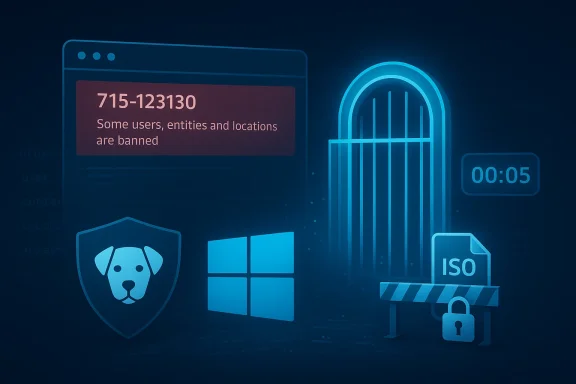
The February surge of download failures that left Windows Insiders and power users staring at a terse Microsoft block page has once again put the spotlight on how Microsoft distributes ISO images — and whether the company is intentionally choking off third‑party tooling like Rufus from retrieving Insider preview ISOs. Evidence compiled from developer statements, GitHub threads, community reproductions, and contemporary reporting shows the symptoms are real and repeat a pattern the ecosystem has seen before: automated or out‑of‑context requests to Microsoft’s tokenized ISO endpoints are being rejected with a message referencing banned “users, entities and locations” and an internal code, most commonly shown as 715‑123130. ([windowscentral.coscentral.com/microsoft/windows-11/rufus-calls-out-microsoft-for-blocking-windows-11-iso-downloads)
Microsoft’s ISO distribution model has long relied on short‑lived, tokenized links created by an interactive flow rather than static, scrapeable URLs. That architecture allows Microsoft to apply session context, embed telemetry, and mitigate automated abuse — but it also creates friction for third‑party tools that historically replicated the interactive sequence programmatically. One such helper, widely known as Fido, powers Rufus’s built‑in ISO downloader and has been adapted repeatedly to match server behavior when Microsoft adjusts its download endpoints. The current wave of failures, centered on Insider preview artifacts, mirrors earlier breakages and has produced the same visible symptoms: interactive downloads initiated from a browser or the Media Creation Tool (MCT) generally succeed, while scripted requests — whether from Rufus/Fido or other automation — can be rejected with the anti‑abuse message and code 715‑123130.
Multiple independent technology outlets and community threads corroborate the sequence and the builds involved. Reports specifically reference Insider Canary build 28020.1611 and Server preview build 29531 as among the artifacts affected by this rejection behavior, with user reports and developer reproductions clustering in mid‑February.
Third‑party tools like Rufus automate this sequence by reconstructing the minimal API calls needed to obtain the token and linked ISO. Historically, developers have done this successfully, but Microsoft has in the past tightened validation to enforce stricter session context, which requires ongoing maintenance from third‑party developers.
For end users and administrators the immediate course is pragmatic: use Microsoft’s Media Creation Tool or interactive download flows for now, verify image integrity carefully, and follow Rufus’s GitHub for updates. For the broader ecosystem this incident is a reminder that platform vendors and independent tooling projects must find cooperative pathways — whether by clearer server contracts, sanctioned automation APIs, or whitelisting mechanisms — to avoid collateral damage when anti‑abuse measures evolve. The tradeoff between security and openness is not new, but how that balance is managed will determine whether community tools like Rufus remain a resilient part of the Windows experience or become relics of a more permissive era.
Source: HotHardware Rufus Accuses Microsoft Of Blocking Users Trying To Download Windows 11 Insider ISOs
Source: thewincentral.com Rufus Devs Accuse Microsoft of Blocking Windows 11 Insider ISOs
 Background / Overview
Microsoft’s ISO distribution model has long relied on short‑lived, tokenized links created by an interactive flow rather than static, scrapeable URLs. That architecture allows Microsoft to apply session context, embed telemetry, and mitigate automated abuse — but it also creates friction for third‑party tools that historically replicated the interactive sequence programmatically. One such helper, widely known as Fido, powers Rufus’s built‑in ISO downloader and has been adapted repeatedly to match server behavior when Microsoft adjusts its download endpoints. The current wave of failures, centered on Insider preview artifacts, mirrors earlier breakages and has produced the same visible symptoms: interactive downloads initiated from a browser or the Media Creation Tool (MCT) generally succeed, while scripted requests — whether from Rufus/Fido or other automation — can be rejected with the anti‑abuse message and code 715‑123130.Multiple independent technology outlets and community threads corroborate the sequence and the builds involved. Reports specifically reference Insider Canary build 28020.1611 and Server preview build 29531 as among the artifacts affected by this rejection behavior, with user reports and developer reproductions clustering in mid‑February.
What happened: the observable timeline
The trigger and early reports
- Mid‑February: Windows Insiders began reporting immediate failures when attempting to download recent Insider ISOs. The error page shown by Microsoft included the language “Some users, entities and locations are banned from using this service” and the code 715‑123130. Reports originated from Microsoft’s own forums, Reddit, and support channels.
- Rufus Developer Response: Pete Batard, the author of Rufus, and contributors to the Fido project reproduced the failures and publicly suggested that the pattern looks like server‑side detection of the Fido script and other scripted downloaders. Batard characterized the change as requiring intentional server work to break script downloads, a claim he supports with the fact that Fido is open source and thus detectable. That view has been widely reported and debated in community threads.
Community reproductions and mitigations
- Community testers found the same ISO could often be successfully retrieved when using an interactive browser session or the Media Creation Tool, but failed when the same flow was automated by Fido, suggesting the server enforces context checks beyond the raw API call.
- Workarounds that succeeded for some users included generating the ISO link through the official site in an interactive session and then opening that generated link on the target machine, or using the Media Creation Tool to obtain the image. These are practical stopgaps but do not address the underlying restriction on scripted retrieval.
Corporate silence and uncertainty
- At the time of reporting, Microsoft had not issued a public statement directly confirming an intentional policy to block third‑party downloaders. Corporate responses in community threads and public Q&A have instead cited anti‑abuse measures and recommended the Media Creation Tool when users encounter the block. That gap leaves intent ambiguous: an intentional gating policy, a spike in anti‑abuse heuristics, or an unintentional misconfiguration could all explain the behavior.
Technical analysis: how Microsoft’s download flow works and why tools break
Tokenized, session‑bound distribution
Microsoft’s download pipeline for ISO images typically follows a tokenized model: an interactive front‑end page establishes a session and produces a short‑lived token; the client uses that token to call a backend endpoint that returns a download link or stream. This model protects against large‑scale scraping, allows issuance of signed URLs with limited lifetime, and enables server‑side enforcement of contextual checks such as referrer, origin headers, cookies, and session tokens.Third‑party tools like Rufus automate this sequence by reconstructing the minimal API calls needed to obtain the token and linked ISO. Historically, developers have done this successfully, but Microsoft has in the past tightened validation to enforce stricter session context, which requires ongoing maintenance from third‑party developers.
Common server‑side controls at play
- Referrer/Origin validation: Servers can require a consistent referrer or origin header that matches an interactive page flow. Scripts that omit or mismatch these headers get rejected.
- Cookie / token state: Some endpoints require cookies or short‑lived tokens set by an earlier interactive page; without the cookie context the downstream call fails.
- IP reputation & rate limiting: Aggregate abuse protection can block IP ranges that produce too many requests or match proxy/VPN patterns.
- User‑agent & fingerprinting: Servers may detect scripted clients via nonstandard user‑agent strings or request timing/fingerprint differences.
- Build gating for Insider artifacts: Pre‑release builds often carry stricter access controls and shorter token lifetimes to limit distribution beyond their intended audience.
Why Rufus / Fido is particularly exposed
- Open source and deterministic flows: Fido’s source code is public, which makes it straightforward for server engineers to fingerprint or explicitly exclude requests originating from its call patterns.
- Automation vs. interactive heuristics: Fido simplifies the token exchange into a reproducible script. If servers enforce handshake checks that are difficult to replicate non‑intrusively (for example, requiring browser platform signals), scripts will fail unless developers build increasingly complex simulators.
- Prior history: This is not a novel failure for Rufus; the project’s GitHub and changelogs show previous episodes where Microsoft hardened download endpoints and temporarily broke scripted downloaders until adaptations were made. Those historical episodes provide a precedent and technical path for resolving the present issue — but only if Microsoft’s changes are fixable via client adjustments rather than being an explicit policy to block third‑party access.
The developers’ perspective and the claim of intentionality
Pete Batard and contributors have argued publicly that breaking Fido’s script would require active intervention on Microsoft’s servers — in other words, an intentional effort rather than an accidental misconfiguration. That assertion rests on two observations:- The failure discriminates between scripted and interactive flows in a reproducible way.
- The Fido codebase is open, so the specific request patterns that identify it are discoverable.
Practical impact: who is affected and how badly
Affected groups
- Windows Insiders and power users: Users who prefer to obtain ISO images manually (for VMs, dual‑boot setups, or offline installations) can be blocked from downloading recent preview images via third‑party tools or scripted methods.
- IT pros and system builders: Administrators who use scripted workflows to automate deployments could see continuous integration/deployment pipelines fail if they rely on automated ISO retrieval.
- Third‑party tooling ecosystem: Rufus and similar utilities that offer one‑click convenience for selecting specific builds and creating install media are degraded in capability, undermining a longstanding free utility ecosystem.
- Security researchers and testers: People needing to deploy specific pre‑release builds for compatibility or security testing may lose a convenient distribution channel.
Severity and scope
- The problem appears concentrated on Insider preview artifacts rather than retail releases. Retail ISO distribution tends to be more stable in practice, and official MCT remains a fall‑back channel for obtaining images.
- The block’s pervasiveness varies: some users can work around it by using interactive flows, switching networks, or generating links from a browser session. For automated environments and tooling-dependent workflows, those workarounds may not be acceptable.
Risks, tradeoffs, and the broader implications for platform openness
Microsoft’s tokenized delivery model and hardened anti‑abuse systems serve legitimate security and operational goals: they mitigate large‑scale scraping, reduce accidental bandwidth storms, and allow the company to control the distribution lifecycle of preview artifacts. However, the same controls can also produce collateral damage:- Erosion of community autonomy: Enthusiast tools like Rufus provide frictionless ways for users to manage Windows images. Blocking or degrading those tools concentrates distribution through Microsoft’s official channels, limiting alternatives.
- Operational brittleness: Automated tooling and reproducible scripts are the backbone of many development and testing workflows. Tight server heuristics that distinguish scripted from interactive clients can break legitimate automation.
- Perception and developer relations: Even if the changes are motivated by abuse mitigation, developer communities will interpret deliberate, non‑transparent changes as hostile — especially when a popular open‑source tool is impacted.
- Security tradeoffs: Forcing users to use only Microsoft’s front‑end or MCT might reduce some forms of abuse, but it also creates a single, centralized distribution path that attackers could target.
What users and administrators should do now (practical checklist)
If you’ve been affected or manage systems that rely on scripted ISO retrieval, follow this prioritized checklist:- Try the Media Creation Tool (MCT) first: it remains Microsoft’s supported path for obtaining Windows images and often succeeds where direct ISO endpoints reject requests.
- Use an interactive browser session to generate the ISO link, then open that link on your target machine to download the file directly. This workaround helped some community members.
- If automation is essential, temporarily switch to an alternative, supported distribution strategy: use corporate volume licensing channels, Microsoft business support, or officially sanctioned image repositories where available. Escalate through Microsoft support if you require enterprise artifacts.
- Update Rufus and Fido when new releases appear: if the issue is fixable client‑side (for example, by adapting request headers or token handling), the Rufus project will likely issue a patch. Monitor the Rufus GitHub issues for changelogs and fixes.
- Verify every ISO’s integrity: always check SHA‑256 checksums or official signatures after acquisition — particularly when using workarounds or alternative sources. Never skip integrity checks.
- Consider network workarounds sparingly: some users reported success by switching networks (mobile hotspots or different ISPs). This is not a robust solution and can trigger anti‑abuse heuristics; use only as a last resort.
How developers and the community should respond
- Rufus/Fido maintainers should continue to investigate server responses, add non‑invasive telemetry to help fingerprint the exact rejection criteria, and publish safe mitigation steps. Transparency about the exact request patterns that fail will help the broader community. The Rufus GitHub issue history shows past collaboration between maintainers and community contributors to adapt to Microsoft changes; similar cooperative engineering can narrow the fix path.
- Microsoft should consider issuing clear guidance: if intentional, publish a policy explaining the aims and scope of the block (e.g., preventing abuse while allowing legitimate tooling), or if accidental, fix the configuration and communicate the resolution status. Clearer diagnostics in the block message (beyond the opaque code) would reduce confusion. Community trust benefits when platform vendors communicate intent and remediation steps.
- Enterprises and IT teams should avoid brittle reliance on web scraping for deployment workflows. Use sanctioned enterprise distribution channels and automation tools built for volume licensing or corporate provisioning.
Legal, policy, and ethical considerations
The current episode touches on several non‑technical points worth scrutinizing:- User agency vs. platform control: Platform vendors have a duty to secure distribution channels, but they also wield power that can reshape user choice. Abrupt, opaque changes to distribution access can be interpreted as gatekeeping that disadvantages independent tools.
- Transparency and accountable enforcement: Anti‑abuse systems must balance confidentiality (to prevent evasion by bad actors) with transparency for legitimate partners. Providing a way for legitimate tooling to be whitelisted or for developers to request remediation would reduce friction.
- Potential regulatory interest: If platform control becomes a recurring mechanism to favor first‑party tooling over community alternatives, regulatory scrutiny could intensify in regions with competition law enforcement. That’s not an immediate outcome here, but it’s a broader context to watch. (This is an analytical observation, not a claim that any authority is ecific incident.)
Cross‑verification and journalistic assessment
To avoid premature conclusions, we triangulated the principal claims across multiple independent sources:- The presence of the block message and code 715‑123130 has been corroborated in community threads, the Rufus FAQ and GitHub history, and multiple news outlets reporting on the February incidents.
- The specific claim that Microsoft intentionally blocked scripted downloaders comes from Rufus maintainers and is reported by several outlets; however, Microsoft had not published an explicit policy statement confirming intentional targeting at the time of reporting. That means intentionality remains an allegation supported by circumstantial and technical evidence but not by an explicit Microsoft admission. Readers should treat the developer’s conclusion as a reasoned hypothesis, not a proven fact.
- The practical workarounds (MCT, browser‑generated links, network changes) and the historical precedent — Microsoft hardened endpoints in 2022 and broke scripted downloaders until client adaptations were made — are well documented and provide a credible route to either remediation or client updates.
What to watch next
- Official Microsoft communication: Watch for an explicit support bulletin or community post clarifying whether this is an intentional gating policy or a misconfiguration/bug. Microsoft’s guidance will materially change how the community frames remediation and trust.
- Rufus/Fido releases and changelogs: If the issue is solvable client‑side, the Rufus project will publish an update or a technical workaround. Monitor its GitHub issues for patch notes and safe implementation guidance.
- Community reproductions isolating server checks: Engineers and interested parties will attempt to identify whether referrer headers, token lifetimes, IP reputation, or fingerprinting are the decisive factor. Clear reproducible tests will clarify the precise server checks being enforced.
- Enterprise escalation channels: For organizations reliant on automated provisioning, watch whether Microsoft offers an alternate sanctioned API or whitelisting for legitimate automation. That would be the most robust enterprise fix.
Conclusion
The recent wave of ISO download failures — manifesting as Microsoft’s block page with code 715‑123130 — is real, reproducible, and disruptive for anyone relying on scripted retrieval or third‑party tooling like Rufus. Technical evidence and developer testimony point to server‑side changes that discriminate between interactive and scripted flows, and history shows Microsoft’s download endpoints have been hardened before, with similar consequences. That said, the claim that Microsoft intentionally blocked Rufus and Fido remains an allegation: the company has not published a definitive policy statement to confirm that intent.For end users and administrators the immediate course is pragmatic: use Microsoft’s Media Creation Tool or interactive download flows for now, verify image integrity carefully, and follow Rufus’s GitHub for updates. For the broader ecosystem this incident is a reminder that platform vendors and independent tooling projects must find cooperative pathways — whether by clearer server contracts, sanctioned automation APIs, or whitelisting mechanisms — to avoid collateral damage when anti‑abuse measures evolve. The tradeoff between security and openness is not new, but how that balance is managed will determine whether community tools like Rufus remain a resilient part of the Windows experience or become relics of a more permissive era.
Source: HotHardware Rufus Accuses Microsoft Of Blocking Users Trying To Download Windows 11 Insider ISOs
Source: thewincentral.com Rufus Devs Accuse Microsoft of Blocking Windows 11 Insider ISOs
