

Microsoft’s case for a near-term workplace revolution is no longer a thought experiment: the company’s product leaders now argue that AI agents will act as digital coworkers, enabling small teams to run global campaigns in days, accelerate scientific discovery, and shore up stressed healthcare systems — provided organizations pair those agents with rigorous governance, identity controls, and smarter compute infrastructure. This feature unpacks Microsoft’s “seven trends to watch in 2026” narrative, verifies the headline claims against public evidence, and evaluates what Windows-focused IT teams, developers, security professionals and digital creators should prepare for now.
Microsoft’s public roadmap and commentary — summarized in a corporate “7 trends to watch in 2026” briefing — shifts the conversation from AI as a personal assistant to AI as a team member with identity, governance and production runtimes. That platform story stitches together product elements such as Copilot Studio, an Agent Store, Azure AI Foundry, and agent identity in Microsoft Entra, with an operational fabric (the Model Context Protocol and runtime routing) intended to let agents act on behalf of teams inside Microsoft 365 and Teams. The uploaded briefing material and related forum analysis lay out how Microsoft imagines agents moving from ephemeral helpers to auditable, lifecycle-managed directory objects.
Microsoft’s framing is reflected across independent reporting and Microsoft’s own blog posts: the company positions 2026 as a tipping point where agents, smarter infrastructure, repository-aware developer tooling and domain-specific research assistants converge to deliver measurable productivity gains. Key company leaders — from Aparna Chennapragada (AI experiences) to Mark Russinovich (Azure CTO) — have articulated that the priority is intelligent orchestration and safety, not just building ever-larger models or datacenters.
Aparna Chennapragada — Microsoft’s chief product officer for AI experiences — frames the change as an amplification of human teams: small, three-person teams will be able to “launch a global campaign in days” because agents will handle heavy lifting — data analysis, content generation, A/B testing and personalization — while humans retain strategy, creative judgment and final approvals. This claim appears in Microsoft’s “7 trends” narrative and is mirrored in multiple independent reports summarizing the company’s view.
Source: Quantum Zeitgeist Microsoft Predicts AI-Powered Teams Will Launch Campaigns In Days By 2026
 Background / Overview
Microsoft’s public roadmap and commentary — summarized in a corporate “7 trends to watch in 2026” briefing — shifts the conversation from AI as a personal assistant to AI as a team member with identity, governance and production runtimes. That platform story stitches together product elements such as Copilot Studio, an Agent Store, Azure AI Foundry, and agent identity in Microsoft Entra, with an operational fabric (the Model Context Protocol and runtime routing) intended to let agents act on behalf of teams inside Microsoft 365 and Teams. The uploaded briefing material and related forum analysis lay out how Microsoft imagines agents moving from ephemeral helpers to auditable, lifecycle-managed directory objects.Microsoft’s framing is reflected across independent reporting and Microsoft’s own blog posts: the company positions 2026 as a tipping point where agents, smarter infrastructure, repository-aware developer tooling and domain-specific research assistants converge to deliver measurable productivity gains. Key company leaders — from Aparna Chennapragada (AI experiences) to Mark Russinovich (Azure CTO) — have articulated that the priority is intelligent orchestration and safety, not just building ever-larger models or datacenters.
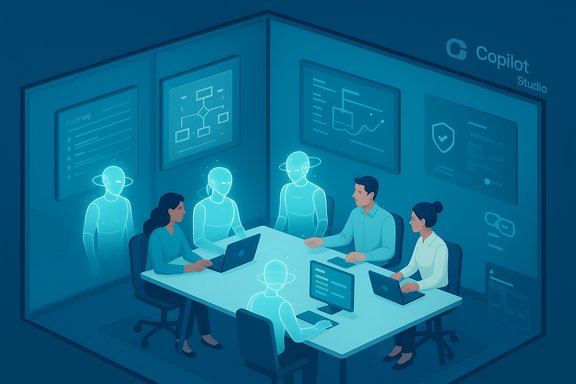
AI Agents as Digital Coworkers
What Microsoft is promising
Microsoft’s product leads describe a near-term reality where AI agents act as teammates: they attend group chats, hold shared memory for teams (so context doesn’t live in individual queries), run multi-step workflows, and call external tools. That stack includes no-code/low-code authoring, an in-product agent catalog, identity and lifecycle controls, and a runtime that can route model calls and tie agent actions to audit logs. This is not hypothetical: preview features such as Teams Mode (Copilot Groups), the Facilitator role agent, and agent catalog constructs have public footprints in Microsoft’s product messaging.Aparna Chennapragada — Microsoft’s chief product officer for AI experiences — frames the change as an amplification of human teams: small, three-person teams will be able to “launch a global campaign in days” because agents will handle heavy lifting — data analysis, content generation, A/B testing and personalization — while humans retain strategy, creative judgment and final approvals. This claim appears in Microsoft’s “7 trends” narrative and is mirrored in multiple independent reports summarizing the company’s view.
Why it’s plausible
- AI tooling today already speed-automates discrete tasks (drafting copy, generating imagery, segmenting audiences).
- Agent frameworks extend this by enabling persistent memory, multi-step orchestration and connectors to ad platforms, CRM systems, and analytics pipelines.
- Low-code agent authoring (Copilot Studio and similar tools) lowers the bar for business users to assemble workflows and chain model calls into production actions.
Critical caveats
- Speed ≠ strategic quality. Campaign quality and brand safety depend on human oversight, testing regimes, and content governance.
- Economic friction: always-on, multi-step agentic workflows increase inference costs. Without quota controls and strict auditability, cloud spending can outpace benefits.
- Operational risk: autonomous multi-step actions can cascade errors (e.g., mass publishing of mis-personalized content). Enterprises must insist on rollbacks, human-in-the-loop gates, and immutable logs.
Research, Discovery and the New Lab Assistant
From summarizer to collaborator
Microsoft and its research leads predict that AI will move from summarizing literature to participating in the scientific method — generating hypotheses, suggesting experiments, and orchestrating instrumented runs. That is the core of the company’s research-forward trend: AI becomes a lab assistant that recommends protocols, automates parts of experiments and flags anomalies for human investigators. Microsoft Research’s Peter Lee is quoted as saying AI will “generate hypotheses, use tools and apps that control scientific experiments, and collaborate with both human and AI colleagues.”Practical impacts
- Faster iteration cycles for simulation-heavy fields (materials science, computational chemistry).
- Increased reproducibility if AI-generated experiment scripts and instrument logs are stored and audited.
- Democratization of discovery: smaller teams can run more designs-of-experiment and screening funnels with AI orchestration.
Risks and verification needs
- Lab automation requires hardware integration, regulatory compliance, and reproducible traceability. Current gains are primarily in simulation and planning; full wet-lab automation at scale remains contingent on validated instrument integrations.
- Ethical and safety reviews are mandatory for AI-proposed experiments that could have biosafety implications — these systems must be governed like research proposals, not like marketing drafts.
Healthcare: Diagnostics, Triage and the MAI-DxO Result
What Microsoft announced
Microsoft published a public demonstration of its Microsoft AI Diagnostic Orchestrator (MAI‑DxO) showing markedly improved results on a curated set of diagnostically complex cases. The company reported MAI‑DxO solved roughly 85.5% of 304 NEJM case-study problems in its benchmark when configured for maximum accuracy, versus a reported ~20% mean accuracy for a panel of 21 practicing generalist physicians in the test conditions. Microsoft’s writeup and multiple news outlets summarized the result and noted the system’s cost-optimization logic and model-orchestration approach.Context: global workforce gaps
WHO’s workforce data shows a projected shortfall of roughly 11 million health workers by 2030, and public health monitoring has repeatedly indicated billions of people lack access to essential services (figures in the 4.5–4.6 billion range appear in UHC reporting). Microsoft and others position clinical AI tools as one partial mitigation path for access gaps — particularly for triage and decision support in resource-limited settings.How to read MAI‑DxO’s results
- The MAI‑DxO results were benchmarked on complex, teaching cases from the New England Journal of Medicine — intentionally difficult and unrepresentative of routine primary‑care presentations.
- The human physicians in the study were constrained (no colleague consultation, no reference materials), while the AI had full model access and an orchestrator to run deliberative reasoning and test-ordering logic.
- Microsoft’s tests show a technical milestone for model orchestration in sequential diagnosis; they are not regulatory clearances nor clinical-trial evidence of safety or improved outcomes in live care settings. Independent clinical trials and real-world evaluation will be necessary before MAI‑DxO-like systems can be deployed as clinical decision-making tools.
Opportunity and risk snapshot
- Opportunity: scaled triage and second-opinion support could reduce diagnostic delays, especially in underserved regions.
- Risk: over-reliance on model outputs, dataset bias, and the absence of clinical validation pipelines could produce harm if deployed prematurely.
- Practical: healthcare providers and regulators must demand prospective trials, explainability audits, and integration with standard-of-care processes before wide adoption.
Software Development: Repository Intelligence and the GitHub Surge
The numbers
GitHub’s Octoverse 2025 reported record activity: developers pushed nearly 1 billion commits in 2025 (roughly +25% year-over-year) and ~43.2 million pull requests merged per month on average. These metrics point to a dramatic growth in code activity and, importantly, in the intersection of code and AI — Copilot adoption and coding agents are reshaping developer workflows.What “repository intelligence” means
- Beyond autocomplete: repository intelligence refers to systems that understand commit history, code ownership, architecture and dependency graphs — not just pattern-fitting for single-file code completion.
- Higher-fidelity suggestions: by incorporating changelog patterns, test history and issue trackers, an AI can offer safer refactor suggestions and detect architectural regressions.
- Automation of routine fixes: candidate PRs, test-driven suggestions, and CI-driven remediations can be proposed or partially enacted by agents — with human approvals baked into the pipeline.
Benefits and hazards
- Benefits: increased throughput, fewer trivial bugs, faster onboarding.
- Hazards: automated code changes require trust frameworks; improperly configured agents can introduce regressions at scale.
- Recommended controls: sandboxed agent PR flow, mandatory code reviews for production-affecting changes, and observable traceability of any agent-originating commit.
AI Infrastructure: Smarter Than Bigger
The shift in operational thinking
Microsoft’s Azure leadership argues the next phase of infrastructure is about efficiency and routing, not simply raw datacenter scale. Mark Russinovich has described an “air-traffic control” model: compute should be densely packed and dynamically routed so that idle cycles are minimized and workloads are placed where they are most efficient. The messaging calls for globally distributed, flexible “superfactories” that coordinate compute, power and networking to lower cost and environmental impact.Concrete implications
- Job schedulers and model routers will be as important as GPU count.
- Energy-aware workload placement and preemptible resource strategies will drive cost-per-inference down.
- Hybrid and sovereign deployments will blend local edge inference with remote heavy training and orchestration to meet regulatory and latency needs.
What to watch
- Investment in newer VM classes (GPU variants and liquid-cooled racks).
- Emerging standards for multi-cloud model routing and inter-op protocols between agent runtimes.
- Increasing importance of observability tools that show not only system-level metrics, but model-level cost and latency profiles.
Security, Governance and the Identity Problem
Agents as managed identities
Microsoft’s platform view treats agents as directory principals with lifecycles, access policies and audit trails. That converts the abstract security question — “how do we control AI?” — into a practical program: enroll agents in identity systems (conditional access, enrollment reviews), limit their connectors, and log every action. Forum briefings and Microsoft product messaging stress that agents must be governed as if they were human staff.What defenders must implement
- Least privilege and ephemeral credentials for agent connectors.
- Tamper-evident audit trails for agent actions.
- Human-in-the-loop approvals for high-risk actions.
- Attack surface analysis focused on agent-to-agent and agent-to-tool channels (agents that can call external APIs create new lateral movement vectors).
New defensive roles
- AgentOps (or Agent Operations) will join MLOps and DevOps as a discipline: monitoring agent behavior, tuning evaluators (automated verifiers), and managing incident responses where agents behave unexpectedly.
Regulatory and Ethical Considerations
- Regulatory timelines (for example, the EU AI Act) create operational deadlines: organizations offering agentic services to EU residents will require compliance plans by enforcement dates. Compliance must be part of any production rollout.
- Clinical-grade AI requires medical-device pathways. Microsoft’s MAI‑DxO is research-stage; clinical deployment requires prospective trials and regulatory clearances.
- Data residency and sovereign cloud needs will shape whether certain agentic workloads can run in a region or must be containerized inside national clouds.
Practical Next Steps for Windows Users, IT Admins and Developers
- Establish an agent pilot program.
- Start with a narrow, auditable use case, measure outcome KPIs (time-saved, error reduction) and instrument for cost.
- Treat agents as identities.
- Enroll them in directory services, apply conditional access, log actions to central SIEM.
- Apply least privilege and human approvals.
- No agent should publish or delete without explicit human sign-off for production effects.
- Run cost and performance pilots.
- Monitor inference spend and compute utilization; set quotas and failure-mode behavior for expensive jobs.
- Invest in observability and evaluator tooling.
- Automated verifiers (evaluators) reduce the risk of agent drift and regression.
- Update procurement and SLA contracts.
- Demand model provenance, retraining cadence, and incident response guarantees from vendors.
Strengths, Weaknesses and What Could Go Wrong
Notable strengths
- Productivity amplification: agents can compress multi-day workstreams into hours or days for certain domains (creative campaigns, analytic reports, scheduled ops).
- Domain acceleration: research and diagnostics show early wins where sequential reasoning and model orchestration matter.
- Platform coherence: Microsoft’s integration strategy (Copilot Studio, Agent Store, Entra identity and Azure runtimes) addresses many operational gaps that previously stalled enterprise AI pilots.
Significant risks
- Operational surprise: agents acting autonomously introduce new failure modes (cascading misactions) that are poorly understood at scale.
- Cost and carbon: naive adoption without scheduling and pooling will create runaway compute costs and energy use.
- Governance and legal exposure: incorrect agent actions can have compliance, contractual and reputational fallout.
- Overgeneralization: extrapolating research-stage results (MAI‑DxO) into immediate clinical deployment would be irresponsible without clinical validation.
Verification and Attribution: What’s Confirmed (and What Needs Caution)
- Confirmed: Microsoft’s MAI‑DxO benchmark result (85.5% on curated NEJM cases) and the company’s public blog about the experiment. This is supported by Microsoft’s own report and independent news coverage.
- Confirmed: WHO workforce projections indicating approximately an 11 million health-worker shortfall by 2030 and the scale of the global access gap (roughly 4.5–4.6 billion lacking essential services in UHC metrics).
- Confirmed: GitHub activity surge and “1 billion commits / 43.2M PRs per month” figures appear in GitHub’s Octoverse 2025 release. These are platform-level statistics, publicly published by GitHub and amplified by independent coverage.
- Company projections and predictions (e.g., “three-person teams launching global campaigns in days”) should be treated as strategic forecasts and product positioning — plausible given current tooling but not a universal guarantee. These claims reflect Microsoft’s platform vision rather than a guaranteed outcome for all teams.
Conclusion: How Windows-Centric IT Should Respond
Microsoft’s 2026 thesis is organizational and operational more than purely technical: agents are a product and governance problem, not only an algorithmic one. For Windows professionals and IT leaders, the path forward is pragmatic:- Pilot with strict boundaries, measurable KPIs and human approvals.
- Treat agents as managed identities and instrument them like any enterprise service.
- Prepare cost controls and observability before granting agents broad privileges.
- Demand independent validation for domain-critical claims (especially in healthcare).
- Invest in skills for AgentOps — the people and processes that will supervise digital coworkers.
Source: Quantum Zeitgeist Microsoft Predicts AI-Powered Teams Will Launch Campaigns In Days By 2026
