

Microsoft is hosting its November 20, 2025 Windows Office Hours — a one-hour, chat-based Q&A with product teams covering Windows 11 adoption, device management (Intune, Configuration Manager), deployment automation (Autopilot, Windows 365), and security best practices including Zero Trust — and the session is explicitly positioned to help IT teams speed migrations, harden endpoints, and plan hybrid cloud workloads.
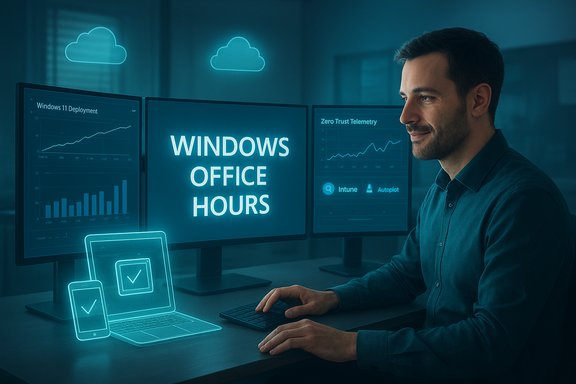
Windows Office Hours is a recurring Tech Community event where Microsoft engineers, product managers, servicing experts, and FastTrack advisors answer real-world IT questions in the event comments. The November 20 session is scheduled for 8:00–9:00 AM Pacific Time and will be chat-only (no video), with Microsoft encouraging pre-posted questions up to 48 hours in advance. This edition emphasizes four practical themes: adopting Windows 11 at scale, proactively implementing Zero Trust, keeping device estates up to date, and moving workloads toward cloud-native models while supporting on-premises or hybrid constraints. The cross-product presence of Windows, Intune, Configuration Manager (ConfigMgr), Windows 365, and Autopilot teams makes this a focused opportunity to get operational answers rather than high-level marketing.
Prepare targeted questions, gather the right telemetry, and use the session to convert strategic goals (Zero Trust, cloud attach, migration) into operational tasks that can be executed and measured in the weeks that follow. Conclusion: The November 20 Office Hours is a high‑value, time‑boxed chance to align your Windows device strategy with Microsoft’s current engineering guidance; with the right preparation you can extract pragmatic steps to reduce risk, accelerate Windows 11 adoption, and make meaningful progress toward Zero Trust and cloud‑native operations.
Source: Microsoft - Message Center Windows Office Hours: November 20, 2025 | Microsoft Community Hub
 Overview
Windows Office Hours is a recurring Tech Community event where Microsoft engineers, product managers, servicing experts, and FastTrack advisors answer real-world IT questions in the event comments. The November 20 session is scheduled for 8:00–9:00 AM Pacific Time and will be chat-only (no video), with Microsoft encouraging pre-posted questions up to 48 hours in advance. This edition emphasizes four practical themes: adopting Windows 11 at scale, proactively implementing Zero Trust, keeping device estates up to date, and moving workloads toward cloud-native models while supporting on-premises or hybrid constraints. The cross-product presence of Windows, Intune, Configuration Manager (ConfigMgr), Windows 365, and Autopilot teams makes this a focused opportunity to get operational answers rather than high-level marketing. Background: why this matters now
Windows lifecycle and security realities in late 2025 make this Office Hours particularly timely. Microsoft’s servicing calendar and recent patch cycles have accelerated the urgency for admins to modernize device fleets, close critical vulnerabilities, and adopt cloud-backed management that supports Zero Trust practices.- Microsoft is actively managing upgrades for consumer Windows 11 devices and has been rolling forward servicing across 24H2/25H2 branches to keep supported builds in market. Keeping an estate on an unsupported branch can leave it without security and quality updates.
- Patch cycles through 2025 have included high-priority fixes (kernel elevation, GDI+ remote code execution) that demand rapid, coordinated patch orchestration and reporting across large fleets. Administrators need reliable update telemetry and staged deployment plans.
- Zero Trust has moved from concept to operational program, with Microsoft publishing adoption resources and partnering with agencies like CISA to provide tactical microsegmentation and planning guidance. For many organizations, the endpoint — and how devices are managed and attested — is the single most important domain for Zero Trust progress.
What Microsoft will and won’t cover in this session
What’s on the agenda
- Windows 11 adoption at scale — migration paths, compatibility testing, and hardware readiness considerations.
- Zero Trust implementation and monitoring — conditional access, device attestation, endpoint health signals, and integrating Defender for Endpoint with Intune/Entra.
- Keeping devices updated — Windows Update client policies, Windows Update for Business, OOBE update behaviors, and strategies for orchestrating updates through Intune, WSUS, or ConfigMgr.
- Cloud-native workloads & hybrid operations — cloud attach, Windows 365, Autopilot provisioning flows, and co-management scenarios using Configuration Manager and Intune.
What to expect from the format
- Real-time, text-based answers in the event comments from Microsoft experts — no slides, no video, and no formal demos. This is a rapid Q&A format designed for targeted guidance.
What they explicitly are not promising
- Individual, environment-specific troubleshooting that requires access to tenant data or logs (those typically need support tickets or FastTrack engagements). The session is oriented to operational guidance and recommended practices rather than deep tenant diagnostics.
Key technical realities and verifications
The following technical facts are important for any IT team participating; each has been verified against Microsoft documentation and independent community coverage.- Event logistics: November 20, 2025, 8:00 AM PT; chat-only Tech Community Office Hours.
- Windows Update policy controls: Windows Update client policies are configurable for Windows 10/11 via Group Policy or MDM such as Microsoft Intune, and they allow devices to be pointed to Windows Update for direct servicing. This is the recommended path for many modern update strategies.
- Autopilot and co-management caveats: Windows Autopilot supports co-management scenarios, but there are documented limitations around pre-provisioning, hybrid join and certain workloads; administrators must follow the documented co-management settings and prerequisites to avoid provisioning timeouts. These caveats are described in Microsoft’s Autopilot and ConfigMgr guidance.
- Zero Trust guidance: Microsoft’s Zero Trust model is policy-driven across identities, endpoints, apps, data and network; implementation relies on signals (device health, authentication risk) and enforcement (conditional access, least-privilege) and is aligned with government guidance such as CISA’s microsegmentation planning. Adoption must be phased and measurable.
Practical recommendations for IT teams (actionable and sequential)
The November Office Hours is an opportunity to validate these steps with product owners. Use the following prioritized checklist to prepare questions and ground actions after the session.- Inventory and baseline
- Build a hardware and software inventory that maps devices to Windows build/version, enrollment state (Azure AD joined, hybrid joined, or on-prem), and management authority (Intune vs. ConfigMgr). This is the single most useful dataset for migration planning.
- Confirm which devices are eligible for Windows 11 upgrades and which require extended security options or replacement.
- Harden update cadence and telemetry
- Adopt Windows Update client policies or Windows Update for Business for cloud-managed devices; configure maintenance windows, set deployment rings, and enforce quality updates through Intune or WSUS/SCCM where needed.
- Instrument reporting: ensure Intune, ConfigMgr, or Azure Monitor provides clear success/failure signals for update compliance and feature update readiness. Use these reports to define phased rollout rings.
- Prepare Autopilot and co-management plans
- Validate Autopilot hardware IDs and provisioning profiles; test Autopilot flows in a lab for both Microsoft Entra joined and hybrid‑joined scenarios. Review co-management advanced settings if ConfigMgr clients will be involved.
- Advance Zero Trust pragmatically
- Start with identity and device attestation: implement multifactor authentication, conditional access policies tied to device compliance, and Defender for Endpoint integration for device health signals.
- Use a phased microsegmentation plan and baseline lateral movement risk for critical assets; leverage CISA and Microsoft guidance when designing segmentation. Flag any legacy network dependencies that prevent true segmentation.
- Practice patch orchestration for high-risk fixes
- For critical and actively exploited vulnerabilities, prioritize a three-ring deployment: pilot/test, targeted high-risk, and broad deployment within short windows. Confirm servicing stack updates (SSUs) and prerequisite KBs before mass rollout.
- Prepare clear, specific questions for Office Hours
- Bring sample telemetry (counts, update failure codes, enrollment percentages) rather than generic asks — the more concrete the data, the more prescriptive a product expert can be in chat.
Strengths of Microsoft’s Office Hours approach
- Direct access to deep product expertise: Having Intune, ConfigMgr, Autopilot and Windows servicing staff in one chat lowers the friction for cross-product, practical answers that reflect current engineering guidance.
- Low-friction format for busy admins: Chat-based Q&A fits tight schedules; posting questions ahead speeds response times and allows the experts to prepare concise, accurate replies.
- Focus on operational readiness: The event’s explicit mix of adoption, Zero Trust, update orchestration and hybrid cloud topics aligns with the most important operational tasks for device estate owners in late 2025.
Risks, limitations and what to watch for
- Chat format limits deep troubleshooting: Complex, tenant-specific or log-heavy issues will need formal support tickets or FastTrack engagements; expect expert answers to be high-value but generalized when tenant data is required.
- Dependency on accurate inventory: Guidance that assumes certain enrollment states or OS builds may be inapplicable if inventory is stale; bring validated numbers to get useful, applicable steps.
- Rapidly shifting patch landscape: Monthly and out‑of‑band security updates can change KB IDs, prerequisites, and mitigation steps. Always confirm patch identifiers and prerequisites against Microsoft’s Security Update Guide before applying at scale.
- Partial support for edge cases in Autopilot/co-management: Certain Autopilot workflows (pre-provisioning into co-management, PKI certificate flows, hybrid join during ESP) have documented limitations; attempting to mix unsupported workflows risks provisioning failures. Validate these points in session and in Microsoft docs.
Suggested Office Hours questions to get to immediate, actionable answers
- “Given my estate has X% hybrid‑joined and Y% Entra‑joined devices, which Autopilot co‑management settings minimize provisioning timeouts for new devices?”
- “For organizations that cannot immediately update all endpoints, what compensating controls are recommended for the November/December 2025 kernel and GDI+ patches?”
- “What telemetry from Intune/ConfigMgr should I collect to prove Zero Trust device compliance for conditional access enforcement?”
- “Which Windows Update client policies are recommended for hybrid organizations that use both WSUS/ConfigMgr and Intune?”
How to operationalize learnings after the event
- Translate any guidance into a 30‑60‑90 day action plan with owners, measurable KPIs (update compliance, Autopilot enrollment success rate, percentage of devices reporting Defender signals), and rollback criteria.
- Use deployment rings for feature updates and security patches; pilot with a representative cross-section of hardware and software configurations.
- Document exceptions (unsupported apps, legacy drivers, hardware incompatibilities) and create a remediation backlog with prioritization based on risk and business criticality.
- If Zero Trust gaps are identified, map them to compensating controls and a remediation cadence; update conditional access and device compliance policies iteratively rather than attempting a one‑shot migration.
Final assessment
Windows Office Hours on November 20, 2025 is an efficient opportunity for IT teams to obtain direct, operational guidance from Microsoft product teams at a time when Windows servicing, security fixes, and cloud management patterns are converging into complex operational demands. The event’s practical focus — Autopilot provisioning, Intune/ConfigMgr co-management, Windows Update orchestration, and Zero Trust implementation — aligns with the top pain points administrators face when protecting and modernizing endpoint estates. This forum is most valuable when attendees arrive prepared: bring precise metrics, clear business constraints, and specific scenarios. Microsoft will provide actionable guidance within the chat format, but follow-up work — tenant-level validation, staged testing, and formal support engagements — will still be necessary for complex remediation and deep troubleshooting. Be ready to validate any KB or troubleshooting step against the official security advisories and product documentation before large-scale automation.Prepare targeted questions, gather the right telemetry, and use the session to convert strategic goals (Zero Trust, cloud attach, migration) into operational tasks that can be executed and measured in the weeks that follow. Conclusion: The November 20 Office Hours is a high‑value, time‑boxed chance to align your Windows device strategy with Microsoft’s current engineering guidance; with the right preparation you can extract pragmatic steps to reduce risk, accelerate Windows 11 adoption, and make meaningful progress toward Zero Trust and cloud‑native operations.
Source: Microsoft - Message Center Windows Office Hours: November 20, 2025 | Microsoft Community Hub
