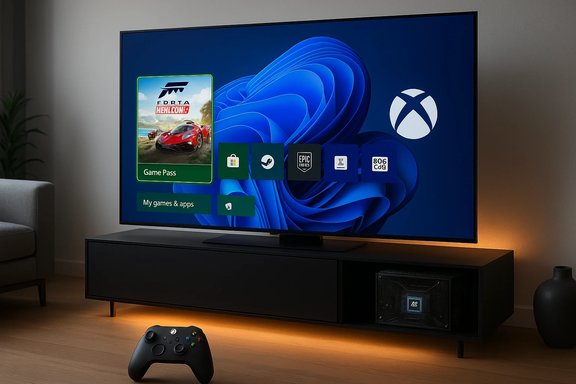
Microsoft’s plan to fold a console‑style Xbox shell into a Windows 11 core is no longer just rumor — it’s a visible program of work, preview builds, and executive signals that point to a deliberate strategy: build the next Xbox as a high‑end, Windows‑powered, console‑like device that can also act as an open PC. Reports show Microsoft is expanding the Xbox Full Screen Experience (FSE) across Windows 11 devices, redesigning the Xbox PC app, and positioning Windows as the underlying runtime for future Xbox hardware — all while the industry grapples with rising memory costs that could push next‑gen console launches or force higher retail pricing.
Microsoft’s Xbox group and Windows teams have steadily converged around a single idea: deliver a controller‑first, living‑room gaming experience while keeping Windows’ openness and compatibility intact. The concept first surfaced publicly through the ROG Xbox Ally handhelds — Windows 11 devices that boot by default into an Xbox‑style full‑screen shell — and Microsoft has since moved that shell into Windows Insider preview builds for a wider set of PCs. That shell — the Xbox Full Screen Experience — presents the Xbox PC app as a full‑screen home UI, trims desktop services during a gaming session, and aims to aggregate titles from Game Pass, the Microsoft Store, and discovered installs from other storefronts like Steam, Epic, Battle.net and GOG. At the same time, reporting from veteran Xbox observers claims Microsoft intends for the next full‑sized Xbox console to run “full‑bore” Windows (a full Windows 11 stack) with a TV‑optimized Xbox shell layered on top. The platform strategy reportedly preserves the familiar console onboarding and curated Xbox experience while allowing users to exit into the full Windows desktop to run PC storefronts or productivity apps. Jez Corden of Windows Central has been a primary source for the “Windows‑on‑Xbox” narrative; subsequent outlets have reiterated and expanded the reporting. These moves come with an explicit hardware framing from Xbox leadership: Xbox president Sarah Bond described the next device as a “very premium, very high‑end curated experience,” suggesting Microsoft is aiming for a more expensive, capability‑dense console than typical past generations. That positioning feeds directly into conversations about component costs — especially RAM — that analysts warn could increase build costs and influence launch windows.
Microsoft is effectively experimenting in public: the ROG Xbox Ally family is a real‑world testbed, Windows Insider builds expose the technical plumbing, and executive language sets a premium expectation. Between now and the next big developer or hardware events, the industry will be watching three things closely: whether Microsoft can translate Windows‑level openness into a consistent, living‑room UX; whether memory market conditions permit an affordable, broadly accessible device; and whether developers embrace the new tooling in a way that delivers the smoother, console‑like play Microsoft promises. The answer to those questions will determine whether this vision becomes a generational shift in consoles — or another ambitious platform experiment that needs more time to mature.
Source: GamingBolt Next Xbox – Microsoft Reportedly Prepping “Major Updates” for Windows 11 Full Screen Experience
 Background
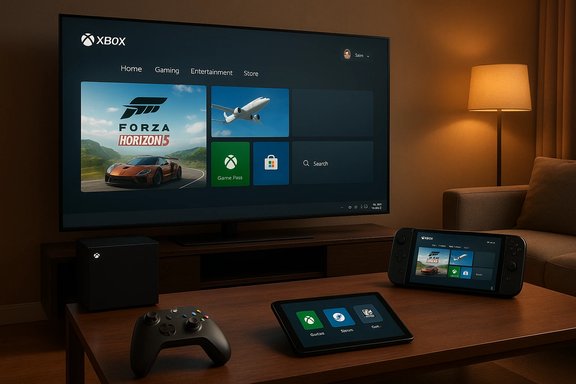
Microsoft’s Xbox group and Windows teams have steadily converged around a single idea: deliver a controller‑first, living‑room gaming experience while keeping Windows’ openness and compatibility intact. The concept first surfaced publicly through the ROG Xbox Ally handhelds — Windows 11 devices that boot by default into an Xbox‑style full‑screen shell — and Microsoft has since moved that shell into Windows Insider preview builds for a wider set of PCs. That shell — the Xbox Full Screen Experience — presents the Xbox PC app as a full‑screen home UI, trims desktop services during a gaming session, and aims to aggregate titles from Game Pass, the Microsoft Store, and discovered installs from other storefronts like Steam, Epic, Battle.net and GOG. At the same time, reporting from veteran Xbox observers claims Microsoft intends for the next full‑sized Xbox console to run “full‑bore” Windows (a full Windows 11 stack) with a TV‑optimized Xbox shell layered on top. The platform strategy reportedly preserves the familiar console onboarding and curated Xbox experience while allowing users to exit into the full Windows desktop to run PC storefronts or productivity apps. Jez Corden of Windows Central has been a primary source for the “Windows‑on‑Xbox” narrative; subsequent outlets have reiterated and expanded the reporting. These moves come with an explicit hardware framing from Xbox leadership: Xbox president Sarah Bond described the next device as a “very premium, very high‑end curated experience,” suggesting Microsoft is aiming for a more expensive, capability‑dense console than typical past generations. That positioning feeds directly into conversations about component costs — especially RAM — that analysts warn could increase build costs and influence launch windows. What Microsoft has already shipped and previewed
The Xbox Full Screen Experience (FSE)
- FSE debuted on ASUS ROG Xbox Ally and ROG Xbox Ally X handhelds, where Windows 11 boots directly into a console‑style Xbox home. Microsoft has confirmed it is expanding FSE to additional Windows handhelds and previewing it for laptops, desktops and tablets via Windows Insider builds. The mode is surfaced in Settings → Gaming → Full screen experience, and can be toggled or configured to enter on startup.
- Importantly, FSE is a session posture layered on top of Windows — not a replacement operating system. When FSE is active, Windows still provides the kernel, drivers, DRM and anti‑cheat subsystems; Explorer and many desktop services are deferred or suppressed to reclaim runtime resources. This layered approach aims to deliver a console‑like UX while preserving compatibility with PC apps and storefronts.
Cross‑stack performance features shipping alongside FSE
Microsoft’s push is broader than UI changes. The company is coordinating OS, graphics, and distribution work to reduce shader compile stutters, stabilize frame pacing on thermally constrained devices, and provide OS‑level upscaling using NPUs. Key pieces include:- Advanced Shader Delivery (ASD): shipping precompiled shader bundles with games or downloading them at install time to reduce first‑run shader compile hitches.
- Auto Super Resolution (Auto SR): an OS‑level AI upscaler that uses on‑device NPUs to upscale lower internal resolutions with minimal GPU cost.
- DirectX and Agility SDK updates (DXR 1.2 features like Opacity Micromaps and shader execution optimizations).
The next Xbox as a Windows‑powered device: what’s reported and what’s confirmed
What is being reported:- The next Xbox will run a full Windows 11 stack with the Xbox Full Screen Experience as the default shell on first boot, enabling a console‑like onboarding while preserving the ability to switch to desktop Windows to run third‑party storefronts and PC apps. It will support running existing Xbox One and Xbox Series X|S titles and promise deep backward compatibility.
- FSE is real, deployed on shipping handheld hardware and available in Windows Insider preview builds. The Xbox PC app is evolving into an aggregated launcher that can discover and surface titles from other stores, and Microsoft has stated that FSE is being previewed on more Windows 11 device form factors. Those are verifiable product actions.
- Formal architecture and retail details of the “next‑gen Xbox” device (APU specs, exact memory configuration, price, and final shipping software stack) have not been publicly detailed by Microsoft. Reporting that Microsoft will ship a specific memory footprint or precise pricing, or that the device will definitely launch in a particular window, should be treated as rumor until official specs are released. Multiple outlets are analyzing supply chain data and leaker claims, but those are not definitive confirmations.
Why Microsoft would pursue a Windows‑first Xbox
There are strategic and engineering rationales that make this approach attractive:- Single engineering platform: a Windows‑based console reduces duplicated investment across separate OS stacks and enables tighter Windows/Xbox team collaboration on performance features (ASD, Auto SR, scheduler tweaks).
- Market openness: allowing Steam, Epic, Battle.net and other stores to run natively expands what the device can offer users, potentially increasing adoption among PC‑centric households.
- Developer reach: developers already shipping to PC can more easily support Xbox hardware if they can test and optimize against a familiar Windows stack, potentially lowering friction for PC‑first studios to publish on Xbox.
- Feature convergence: features like precompiled shader delivery and system‑level upscaling provide practical quality‑of‑life improvements that benefit both PC and console experiences.
Technical implications and engineering challenges
Memory and thermal constraints
Running Windows 11 under a console surface increases the platform’s baseline memory footprint compared with a highly optimized, stripped‑down console OS. Microsoft’s session posture mitigations reclaim a measurable amount of RAM by deferring Explorer and heavyweight background services, but for a TV‑facing console running 4K or 8K workloads, the demands on system memory and cooling remain significant. That’s one reason observers believe Microsoft is targeting a high‑end price tier for the next Xbox: to ship larger APUs, more RAM, and beefier cooling.Anti‑cheat, DRM and low‑level compatibility
Windows’ openness means multiple storefronts and DRM/anti‑cheat systems must coexist. Many PC anti‑cheat solutions operate close to the kernel, and commercial PC titles can have complex launch flows that differ from console certs. Microsoft’s retention of Windows kernel/driver stacks simplifies this from a compatibility perspective, but it also means the company must ensure robust, consistent anti‑cheat behavior and maintain a strong QA pipeline for games that will launch on a living‑room device. Failure here can cause fragmentation and seriously harm the platform’s reputation.Performance plumbing
To make Windows “feel like a console,” Microsoft must continue cross‑stack work: driver and scheduler improvements, precompiled shader delivery, and OS‑level upscalers. The company is already shipping parts of this stack, but success depends on broad studio adoption and OEM/driver partner cooperation. The risk: if shader precompilation and ASD are optional or inconsistently applied, users will still see first‑run hitches that undermine the console‑grade promise.Business and market implications
Pricing and component cost pressures
Reports and analyses across the industry point to rising DRAM prices and memory supply constraints — driven in part by data‑center and AI demand — as a real headwind for next‑gen console economics. Several reputable outlets note that manufacturers are debating later launch windows (pushed beyond 2027/2028 in some scenarios) or preparing to absorb higher BOM costs that could translate to higher retail prices. These macroeconomic dynamics likely inform Microsoft’s “very premium” device messaging and caution around launch timing. Treat these as market signals rather than confirmed product decisions.Platform openness vs discoverability tradeoffs
A Windows‑powered Xbox that supports multiple storefronts solves a consumer convenience problem — a single box that can play Game Pass games, Steam games, and other PC titles. But it also creates discoverability challenges: Microsoft’s own store has historically struggled with quality signals and curation, while an open storefront environment introduces the risk of fragmented discovery and “store noise.” For Microsoft, the business calculus involves weighing broader platform reach against reduced control and potential dilution of Game Pass incentives.Developer economics
Microsoft has been nudging toward more open publishing economics on PC (more favorable revenue splits for PC titles). A Windows‑based Xbox makes it easier for PC‑first developers to support Xbox without committing to a closed console pipeline, but the company still needs to align incentives for porting, certification, and QA. The short‑term challenge is convincing studios that the console experience will be a worthwhile target for optimization, especially if the installed base for new hardware is initially small and higher priced.Consumer impact — what gamers should expect
- A console‑first onboarding that preserves the familiar Xbox home experience at first boot.
- The ability to exit to a full Windows 11 desktop and run PC storefronts and apps, if desired.
- Tighter integration between Xbox Game Pass, the Xbox PC app, and discovered installs from other storefronts, creating a more aggregated library experience.
- Practical performance boosts on supported hardware (precompiled shaders, OS upscaling, scheduler fixes) — but only where developers and OEMs adopt the new tooling.
Risks, tradeoffs and open questions
- Price sensitivity and adoption: Positioning a console as “very premium” risks narrowing the early adopter base. High BOM costs driven by RAM and silicon could push retail prices into territory that dampens mainstream adoption. Multiple analyses list RAM inflation as a key factor in potential delays or price increases — these are economic realities that will shape launch choices.
- Complexity of multi‑store UX: Aggregating Steam, Epic, Battle.net and Game Pass in a controller‑first UI is attractive but technically and legally complex. DRM and anti‑cheat handoffs, per‑store licensing behavior, and UI consistency all need careful handling to avoid a fragmented user experience.
- Developer incentives: If the next Xbox is a high‑end, potentially niche device at first, studios may prioritize existing mass‑market consoles and PC builds. Microsoft must align revenue and technical support incentives to drive parity.
- Trust and reputation risk: Microsoft’s history of platform shifts and business decisions has created skepticism among some fans. Delivering a polished FSE, ensuring backward compatibility, and transparent pricing will be critical to rebuilding goodwill.
- Regulatory and antitrust attention: A Windows‑based Xbox that aggregates multiple storefronts will still place Microsoft at the center of platform economics. Regulators and competitors will watch how Microsoft uses that centrality — especially if the company bundles services or applies preferential treatment to owned content. This is a future risk to monitor. (Flagged as likely but currently speculative.
Timeline and what to watch next
- Windows Insider and Xbox Insider previews (ongoing): FSE and associated Windows 11 features continue to roll out via Insider builds; these previews are the earliest way to measure Microsoft’s technical progress and UX polishing. Instructions on entering the preview are already published and observable.
- GDC 2026 (March): Multiple industry observers expect Microsoft to share more concrete details about how the Xbox and Windows teams will support developers and publishing models for the new strategy at Game Developers Conference 2026. If Microsoft plans to accelerate this transition, GDC is a logical stage to announce developer tooling and certification changes. (Reporters have specifically suggested GDC as a timing possibility.
- Hardware announcements and leaks: Watch for controlled leaks or partner briefings that clarify APU architecture, RAM configuration, and pricing strategy. Until Microsoft confirms specs, leaks should be treated cautiously.
- Memory market signals: DRAM price trajectories and supply commitments from major memory manufacturers will materially affect console BOM calculations. Follow industry memory market reports for evidence of easing or worsening supply pressure.
Practical advice for stakeholders
- For developers:
- Join Windows and Xbox Insider programs to test FSE scenarios and ASD/Auto SR flows early.
- Evaluate shipping precompiled shaders and test anti‑cheat behavior under FSE session posture.
- Plan for optional console‑grade QA if Microsoft’s next device targets premium hardware with unique capabilities.
- For OEMs and partners:
- Focus on thermal design and memory bandwidth to deliver sustained performance in TV and handheld postures.
- Coordinate driver and firmware delivery for ASD and Auto SR features.
- For consumers considering upgrades:
- If you want a straightforward console purchase with the lowest friction, wait for broad reviews after any launch.
- If you value PC game access and flexibility, the Windows‑powered approach could be compelling — but expect a premium price on day one.
Final analysis — strengths and existential risks
Microsoft’s Windows‑first Xbox vision is a bold reframing of what a console can be: an appliance that combines the polish and simplicity of a console with the breadth and openness of a Windows PC. Technically, the strategy is defensible: the company is shipping the building blocks today (FSE, ASD, Auto SR and DirectX improvements) and has practical validation via OEM handhelds. Strategically, leveraging Windows reduces duplicated engineering work, enhances reach to PC ecosystems, and could make Xbox uniquely attractive to gamers who straddle console and PC habits. Yet the plan carries notable risks. High component costs — particularly DRAM pressure caused by AI/data‑center demand — threaten to push retail prices higher and may delay mainstream adoption. The technical complexity of unifying multiple storefronts, DRM and anti‑cheat approaches under a single, controller‑first UI is non‑trivial and will require careful execution. Finally, Microsoft must manage perception and regulatory scrutiny while ensuring the user experience genuinely feels as immediate and reliable as a traditional console. Observers should treat the current wave of reporting as a clear directional signal: Microsoft is committed to this experiment, but the final product details and market impact remain to be proven.Microsoft is effectively experimenting in public: the ROG Xbox Ally family is a real‑world testbed, Windows Insider builds expose the technical plumbing, and executive language sets a premium expectation. Between now and the next big developer or hardware events, the industry will be watching three things closely: whether Microsoft can translate Windows‑level openness into a consistent, living‑room UX; whether memory market conditions permit an affordable, broadly accessible device; and whether developers embrace the new tooling in a way that delivers the smoother, console‑like play Microsoft promises. The answer to those questions will determine whether this vision becomes a generational shift in consoles — or another ambitious platform experiment that needs more time to mature.
Source: GamingBolt Next Xbox – Microsoft Reportedly Prepping “Major Updates” for Windows 11 Full Screen Experience