

Marie Wiese’s recent conversation on the AI Agent & Copilot Podcast crystallizes what many IT leaders already suspect: the technology story of the next three years will be written as much by people and processes as by models and APIs. Her comments—about practical pilots, honest failure stories, and the human work of adoption—aren’t just feel‑good soft skills; they’re the strategic glue that turns Copilot promises into measurable business outcomes. This piece synthesizes Wiese’s remarks, verifies the event and book details she discussed, and offers a practical playbook for Windows‑centric IT teams preparing to adopt Copilots and agentic AI at scale.
Marie Wiese, CEO of Marketing Copilot and a Microsoft MVP, joined the AI Agent & Copilot Podcast to discuss real‑world adoption patterns for Copilots and agents, the importance of change management in AI rollouts, and her editorial work on the anthology You're On Mute, which examines women’s experiences in tech and AI. Her participation also connects directly to the AI Agent & Copilot Summit (March 17–19, 2026, in San Diego), where she helped curate sessions as a Programming Committee Board member and will lead a session tied to her book. Multiple event pages confirm the Summit’s March 17–19, 2026 schedule at the Hilton La Jolla Torrey Pines, and the AI Agent & Copilot community materials state the event focuses on Copilot and agent deployment, masterclasses, and industry use cases.
These signals matter for WindowsForum readers because Microsoft’s Copilot ecosystem is increasingly baked into the Windows productivity stack, Dynamics 365, Fabric, and Azure AI services. That makes the Summit—and the practical lessons Wiese emphasizes—highly relevant for Windows admins, security teams, and business application owners who must plan pilots, governance, and scale.
Cloud Wars and the AI Agent & Copilot community materials note that Wiese will lead a Fireside Chat connected to the book on March 19 during the Summit—an example of the event’s mix of technical and human‑centered programming. For organizations trying to make AI adoption equitable, this is a reminder that tools alone won’t fix systemic barriers; program design and inclusion practices matter.
For Windows Forum readers, the takeaway is straightforward: treat Copilot adoption as a change program first and a technical program second. Pilot with clear KPIs, align governance to data sensitivity, and invest in the human work of training and trust. Do that, and the Copilot era will look less like an unpredictable race and more like a series of manageable, high‑impact upgrades to how organizations operate. (copilot.summitna.com)
Marie Wiese’s conversation—and the Summit she helped shape—are practical invitations to bring honesty, metrics, and human‑centered design into your Copilot strategy. If your team is planning its first Copilot pilot, start with one problem, measure it well, and be ready to tell the story of what went wrong and how you fixed it; that story is often the most useful asset you can bring home from any conference.
Source: Cloud Wars AI Agent & Copilot Podcast: Marie Wiese on Real-World AI Adoption, Innovation, and the Human Side of Change
 Background / Overview
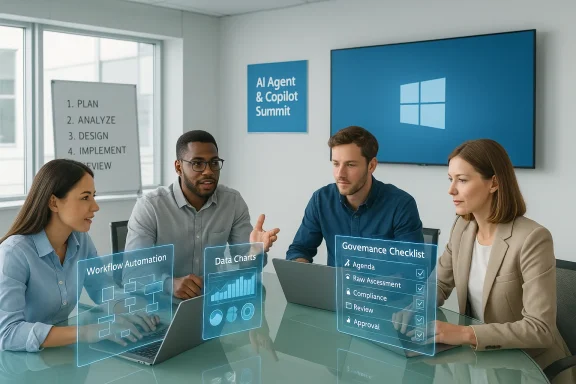
Marie Wiese, CEO of Marketing Copilot and a Microsoft MVP, joined the AI Agent & Copilot Podcast to discuss real‑world adoption patterns for Copilots and agents, the importance of change management in AI rollouts, and her editorial work on the anthology You're On Mute, which examines women’s experiences in tech and AI. Her participation also connects directly to the AI Agent & Copilot Summit (March 17–19, 2026, in San Diego), where she helped curate sessions as a Programming Committee Board member and will lead a session tied to her book. Multiple event pages confirm the Summit’s March 17–19, 2026 schedule at the Hilton La Jolla Torrey Pines, and the AI Agent & Copilot community materials state the event focuses on Copilot and agent deployment, masterclasses, and industry use cases. These signals matter for WindowsForum readers because Microsoft’s Copilot ecosystem is increasingly baked into the Windows productivity stack, Dynamics 365, Fabric, and Azure AI services. That makes the Summit—and the practical lessons Wiese emphasizes—highly relevant for Windows admins, security teams, and business application owners who must plan pilots, governance, and scale.
Why Wiese’s message matters now
Adoption of Copilots and agents has shifted from experiments to outcomes-driven programs. Wiese stresses that the difference between a demo and a durable deployment is rarely the model itself; it’s the organization’s ability to adopt, iterate, and manage change. That distinction is central to several points she made on the podcast:- Leaders want honest case studies—what tried to work, what failed, and how teams recovered—rather than polished marketing demos.
- Innovation means more than flashy features; it means integrating agents into workflows so they take action (API calls, data updates, orchestration) and produce measurable outcomes.
- Human adoption—training, trust, and change management—will be the gating factor for ROI. Wiese repeatedly called out the human side as an essential piece of the adoption playbook.
Curating an event agenda: what Wiese was looking for
Wiese served on the Programming Committee Board for the AI Agent & Copilot Summit and described a simple but revealing filter: she prioritized submissions that showed innovation in practice and candidly discussed setbacks and iterative learning. The result is an agenda built around:- Real-world vertical use cases (sales, field service, finance) showing agents completing tasks and improving throughput.
- Masterclasses on Copilot Studio, Azure AI Foundry, and Fabric as a cloud data foundation—technical tracks designed to move teams from proof‑of‑concept to production. (copilot.summitna.com)
- Responsible AI and governance sessions—an acknowledgement that security, privacy, and regulatory compliance are central to adoption.
What this means for session attendees
Attendees who want to leave with actionable plans should look for sessions that include:- Concrete KPIs (time saved, cost avoided, conversion lift).
- Implementation artifacts (architecture diagrams, governance checklists, test plans).
- Cross‑functional lessons (how IT, security, and business owners collaborated).
The human side of change: Wiese’s central argument
Wiese’s core message returns to people more than technology. She argues organizations must treat Copilot adoption as a multi‑phase change program that deliberately addresses:- Trust and explainability for end users.
- Training and competency building for power users and admins.
- Communication plans for executives and boards.
- Mechanisms to collect and act on user feedback.
- Start small with targeted pilots that have a defined success metric and a rollback plan.
- Use honest, public case narratives (internally and at events) to lower organizational anxiety about risk and failure.
Responsible AI, private models, and enterprise decisions
Wiese highlighted the practical debate between public models and private, enterprise‑trained models. Her view reflects a common enterprise calculus:- Public models deliver speed and breadth but raise concerns about data exfiltration, IP leakage, and regulatory compliance.
- Private models (or private deployments of foundation models) offer stronger data control and often better relevance for proprietary datasets—but they require more operational investment (data pipelines, retraining, monitoring).
You're On Mute: the book, the fireside chat, and the gender lens on AI
Wiese co‑edited You're On Mute: 13 Lessons for Women Frustrated with the Tech Sector, an anthology that amplifies women’s experiences in technology and explores whether AI helps or hinders inclusion. The Women Talk Tech project pages and podcast episodes confirm the anthology’s existence and its framing as a set of personal stories and strategy‑oriented essays that question how structural bias persists in tech workplaces. Wiese and co‑editor Maddie Yule have been actively promoting contributor interviews on the Women Talk Tech podcast.Cloud Wars and the AI Agent & Copilot community materials note that Wiese will lead a Fireside Chat connected to the book on March 19 during the Summit—an example of the event’s mix of technical and human‑centered programming. For organizations trying to make AI adoption equitable, this is a reminder that tools alone won’t fix systemic barriers; program design and inclusion practices matter.
Why this discussion matters for AI adoption
- Diverse teams produce better prompts, richer data curation decisions, and more relevant guardrails—so inclusion isn’t ancillary to technical success; it’s part of model quality and safety.
- Wiese’s anthology and public sessions push the conversation beyond “can AI do X” to “who gets to shape how AI is used,” an essential governance question for organizations deploying Copilots.
Event expectations: what to look for at the Summit
If you attend, prioritize sessions and interactions that provide:- Real deployments and ROI numbers rather than hypothetical benefits.
- Security & compliance guardrails specific to Microsoft‑centric deployments.
- Cross‑functional playbooks (CoE formation, pilot design, rollout cadence).
- Networking with peers who can be direct references for vendor claims.
Strengths in Wiese’s approach
There are notable strengths worth replicating:- Emphasis on iterative learning: Pilots with short feedback loops prevent overinvestment in brittle systems.
- Cultural change orientation: Treating Copilot rollouts as people projects reduces the risk of low adoption or misuse.
- Curated honesty: Making failure visible accelerates collective learning and avoids repeated mistakes across organizations.
Risks and blind spots to watch for
Wiese’s pragmatic stance doesn’t mean adoption is risk‑free. Key risks include:- Data leakage and compliance gaps if public models are used for sensitive workflows. Organizations must map data sensitivity to hosting choices and implement DLP and monitoring controls.
- Overly broad rollouts without clear KPIs. Rapidly enabling Copilots across many groups can produce inconsistent results and user distrust.
- Skills and support gaps. Copilot deployments introduce new admin tasks—prompt engineering, model monitoring, and incident response—that many teams underestimate.
A practical five‑step plan for Windows teams
- Define one measurable pilot that solves a real business problem.
- Pick a use case with clear inputs, outputs, and KPIs (e.g., reduce first‑response time for support tickets by X%).
- Choose the right model hosting strategy.
- Map data sensitivity: public hosted model for low‑risk tasks, private model or on‑tenant solution for sensitive data.
- Build a mini‑CoE (Center of Excellence) with roles for product, security, data ops, and end‑user advocates.
- Keep the CoE lightweight: document success metrics, playbooks, guardrails, and escalation paths.
- Instrument governance and monitoring from day one.
- Implement telemetry for both performance and safety (prompt drift, hallucination rates, data access logs).
- Scale iteratively with training and change management.
- Use short sprints, internal case studies, and transparent communication to build trust and repeatable practices.
What to ask vendors and partners (quick checklist)
- Where will my data be processed and stored? Can you guarantee no external model training with my data?
- What are the concrete KPIs from your reference deployments?
- How do you detect and mitigate model drift and hallucinations?
- What role does human review play in your workflows?
- Can you provide an integration plan specific to Microsoft 365, Windows endpoints, and Azure services?
Conclusion — the human operating system for AI
Marie Wiese’s remarks on the AI Agent & Copilot Podcast are a timely reminder: Copilots and agents promise productivity, but whether that potential becomes value depends on how organizations manage people, process, and governance. The AI Agent & Copilot Summit (March 17–19, 2026, San Diego) will be a practical forum for the kind of honest case studies and masterclass learnings Wiese champions, and her Fireside Chat about You're On Mute underscores the ethical and inclusion dimensions every IT leader should factor into their strategy.For Windows Forum readers, the takeaway is straightforward: treat Copilot adoption as a change program first and a technical program second. Pilot with clear KPIs, align governance to data sensitivity, and invest in the human work of training and trust. Do that, and the Copilot era will look less like an unpredictable race and more like a series of manageable, high‑impact upgrades to how organizations operate. (copilot.summitna.com)
Marie Wiese’s conversation—and the Summit she helped shape—are practical invitations to bring honesty, metrics, and human‑centered design into your Copilot strategy. If your team is planning its first Copilot pilot, start with one problem, measure it well, and be ready to tell the story of what went wrong and how you fixed it; that story is often the most useful asset you can bring home from any conference.
Source: Cloud Wars AI Agent & Copilot Podcast: Marie Wiese on Real-World AI Adoption, Innovation, and the Human Side of Change
