

Windows Weekly’s latest episode lands like a briefing note with a hangover: Week D arrived late, Android keeps iterating, Microsoft’s Copilot-first ambitions keep expanding into device-level exclusives, the AI ethics debate keeps boiling over, Valve quietly bet on Arm, and Game Pass shuffled another batch of big-name titles into December’s first half — all of it pointing to a platform landscape in motion where hardware, AI, and distribution are being rewritten in parallel.
Windows Weekly's panel — Leo Laporte, Paul Thurrott, and Richard Campbell — spent the episode unpacking a dense set of stories that collectively show how Microsoft’s push to make Windows an “agentic” platform is colliding with the realities of shipping at scale, regulatory pressure, and shifting industry priorities. The conversation touched on the delayed but consequential Week D update for Windows 11, the expanding set of Copilot+ PC experiences (some of which remain gated by hardware), Android’s incremental stability work via Android 16 QPR2, and broader industry moves in AI and gaming that are reshaping expectations for consumers and IT pros alike. These episode notes are consistent with the public recaps and community summaries that have tracked the Windows Insider program and the Week D rollout.
This feature will unpack the technical details and strategic consequences behind the headlines: what Microsoft shipped (and broke), what Google and device makers are doing with Android 16, why Valve’s pivot toward Arm matters to Windows users, and how the AI transparency debate — from Epic’s Tim Sweeney to platform labeling — is playing out in real decisions developers and publishers must make.
For Windows users, IT managers, and gamers the practical advice is unchanged but sharpened by context: validate preview updates in test environments, assume AI features will be gated by hardware for the near term, and demand provenance and auditability where AI is involved in content creation. The Week D delay and the File Explorer regression are friction points, but they’re also valuable reminders: modernizing a decades‑old platform is messy, and the community’s role — through rigorous testing, reporting, and governance — remains essential as these changes land.
Source: Thurrott.com Windows Weekly 961: Petroleum Exchange Expert
 Background / Overview
Windows Weekly's panel — Leo Laporte, Paul Thurrott, and Richard Campbell — spent the episode unpacking a dense set of stories that collectively show how Microsoft’s push to make Windows an “agentic” platform is colliding with the realities of shipping at scale, regulatory pressure, and shifting industry priorities. The conversation touched on the delayed but consequential Week D update for Windows 11, the expanding set of Copilot+ PC experiences (some of which remain gated by hardware), Android’s incremental stability work via Android 16 QPR2, and broader industry moves in AI and gaming that are reshaping expectations for consumers and IT pros alike. These episode notes are consistent with the public recaps and community summaries that have tracked the Windows Insider program and the Week D rollout.This feature will unpack the technical details and strategic consequences behind the headlines: what Microsoft shipped (and broke), what Google and device makers are doing with Android 16, why Valve’s pivot toward Arm matters to Windows users, and how the AI transparency debate — from Epic’s Tim Sweeney to platform labeling — is playing out in real decisions developers and publishers must make.
Windows 11 Week D: a late patch that matters
What landed, and why the timing mattered
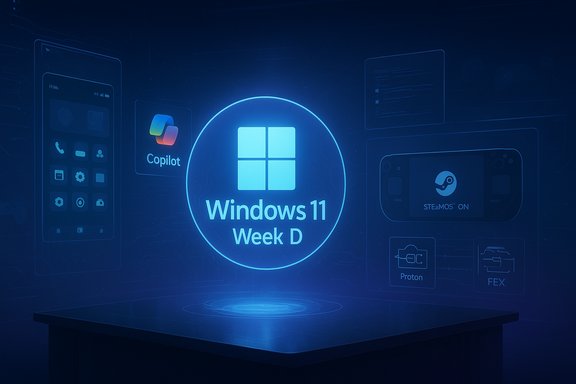
Microsoft’s so-called Week D release — a preview stage cumulative update ahead of the regular Patch Tuesday cadence — arrived later than expected and bundled a mix of user-facing polish and problematic regressions. The update aimed to finish dark-mode coverage in File Explorer and ship a set of Copilot‑adjacent UI improvements, but some of the rollout’s visible side effects created immediate operational headaches. Community and independent reporting reproduced a brief but highly visible white‑flash regression in File Explorer when users run dark mode; Microsoft acknowledged the issue in its known‑issues guidance for the preview and signaled a fix was on the way. Those observations were rapidly corroborated by multiple independent outlets and community testing. Why this matters: File Explorer is a daily high‑frequency UI for millions; a sudden luminance spike is not only jarring — it has real accessibility implications and makes enterprises cautious about deploying preview builds broadly. The incident illustrates the tension Microsoft faces: finishing long‑promised visual consistency across legacy and modern UI paths is technically tricky, and the painting/timing differences between Win32 and modern WinUI surfaces can surface regressions even when the feature intent is sound. Independent technical writeups made that root‑cause reasoning explicit.Copilot+ PC: features, exclusives, and the hardware gating
The Week D preview also documented further expansion of Copilot+ PC experiences — a set of on‑device or hybrid AI features Microsoft ties to validated device hardware and OEM drivers. Notable items that were highlighted for insiders include:- Click to Do improvements: richer contextual actions when selecting text/images (for example, Draft with Copilot in Word, Convert to table in Excel), and a streamlined context menu that surfaces Copilot actions. These changes are being rolled out gradually and in some cases gated by device type and region.
- Windows Studio Effects on additional cameras: a toggle to use AI-powered camera enhancements with secondary webcams on compatible Copilot+ PCs, with an initial roll‑out to Intel devices and staged availability for AMD and Qualcomm later.
- Agents in Settings: the “agent” concept shows up in Settings as an intelligent search/result layer that can suggest, navigate to, and sometimes enact fixes or settings changes. This is being deployed initially to specific locales and Copilot+ hardware groups.
The business and IT perspective
For IT leaders and enthusiasts, the Week D outcome is instructive in three ways:- Feature gating by hardware increases deployment complexity. Organizations will have to manage devices not only by OS version but by the Copilot/driver compatibility matrix if they want consistent Copilot+ behavior.
- Preview builds can contain accessibility‑critical regressions. The File Explorer white‑flash issue underscores why preview packages must be treated as non‑production unless fully validated in lab environments.
- Agentic features require policy thinking. On‑device agents that can enact fixes or change system settings need clear governance, auditability, and enterprise controls (MDM/Group Policy) that many organizations will insist on before permitting automatic agent actions at scale.
Android 16 QPR2: incremental polish, not revolution
What QPR2 brings (and what’s verifiable)
Google’s Android 16 QPR2 (Quarterly Platform Release 2) is the latest evolution of Android 16, and its beta stream — culminating in Beta‑3 and iterative betas — contains a wide set of mostly additive improvements: expanded dark theme and icon‑shape controls, improved garbage collection in ART, enhanced Health Connect exercise tracking, and quality-of-life UI updates like easier app‑shortcut pinning and PDF annotation support. The official Android release notes are explicit that QPR2 is focused on stabilization and developer‑friendly changes with API bumps from 36 → 36.1 where relevant. Those release notes are the canonical source for the feature list and dates. Android Authority, Android Central, and other outlets documented the beta cadence, noted device eligibility (Pixel 6 and newer, Pixel Tablet, and Pixel 10 family compatibility), and reported that the QPR2 stable release was planned for early December 2025. Practical changes like custom app icon shapes, the Generational CMC garbage collector, and SMS OTP delivery protections are detailed in the official notes and corroborated by independent coverage. A cautionary callout: social‑media hyperbole that claims QPR2 contains “about 1,000 new features” is not substantiated by the release notes; QPR2 is a focused maintenance and polish release intended to minimize developer churn, not a major flagship rework. Treat large quantitative claims about feature counts skeptically unless backed by a vendor or engineering breakdown.Why Android matters to Windows readers
There were two cross‑platform implications worth noting:- Android’s steady, measured QPR cadence shows a different update philosophy than Windows’. Google has pushed smaller, additive QPRs that provide app compatibility stability while shipping incremental features, whereas Microsoft’s more monolithic Windows servicing model still struggles with complex UI regressions when trying to modernize legacy surfaces. The contrast is a useful operational lesson about continuous vs. heavy‑lift update strategies.
- For Windows users who rely on Android integration (Phone Link, cross‑device sharing, App streaming), a more stable and featureful Android ecosystem is a net positive. It eases cross‑platform development and reduces the friction of mobile‑to‑PC workflows.
AI slop, disclosure debates, and the "Made with AI" controversy
The debate in brief
The industry is having the same argument in multiple rooms: how much transparency is required when creators use generative AI? The gaming world’s flashpoint — Valve/Steam’s “AI‑generated content disclosure” label — drew a public rejoinder from Epic Games CEO Tim Sweeney, who argued that requiring a “Made with AI” label on game store pages “makes no sense” because AI will be involved in nearly all future production. Sweeney’s remarks are public and have been reported and contextualized by multiple outlets; they reflect a broader division between those who view AI disclosures as necessary ethical transparency and those who see them as a clumsy, unenforceable taxonomy.Where the nuance lives
There are three distinct, practical threads that get conflated in the public debate:- Assistance vs. authorship. Using AI as an assistant (tooling a pipeline, auto‑cleanup, animation interpolation) is materially different from shipping fully AI‑generated assets (voices, art, or dialogue) without human oversight. Consumers and licensing markets may reasonably demand different types of disclosure depending on that boundary.
- Legal / IP risk. Labels don’t fix licensing or provenance problems. The legal and technical work — provenance, opt‑out mechanisms, rights clearances — is what actually mitigates copyright and voice‑cloning risk; labels are a consumer transparency mechanism, not a legal solution.
- Economic and reputational pressure. For certain studios and creators, advertising “human‑made” content has marketing value; for others, AI is a productivity multiplier. The landscape will sort into practices and norms rather than a single regulatory regime, at least in the short term.
OpenAI's “code red”: competition and product focus
What happened and the reading of it
OpenAI’s CEO Sam Altman reportedly declared a company‑wide “code red” — reprioritizing resources to improve ChatGPT — following Google’s high‑profile release of Gemini 3 and the wave of competitive momentum that followed. The memo (reported by multiple outlets) instructed employees to concentrate on the core ChatGPT experience (speed, reliability, personalization) and to pause other initiatives including some advertising and agent work until the user experience questions were addressed. Multiple major outlets covered the memo and the surrounding market reaction. Why this matters: we’re seeing a new rhythm where competitive product pushes between the major AI players (Google, OpenAI, Anthropic, Meta) trigger internal emergency responses and tactical pivots. For enterprises that built early workflows on ChatGPT or are evaluating generative AI partners, this means vendor roadmaps and timelines are more volatile than the marketing commitments imply.Practical implications for Windows and Microsoft users
- Microsoft — a major OpenAI partner and investor — will be watching this contest closely, because ChatGPT’s traction affects Copilot expectations across Windows and M365. Rapid iteration cycles at OpenAI may benefit Microsoft’s Copilot products in the short run, but they also increase integration risk if the partner’s priorities shift under competitive pressure.
- Organizations should plan for product drift: features that appear in AI services today may be paused or deprioritized tomorrow. Contracts and procurement should therefore emphasize SLAs, rollback options, and test environments that decouple internal critical workflows from external AI feature instability.
Xbox and Game Pass: December’s first wave
Microsoft and Xbox announced a first batch of Game Pass additions for December that included several notable entries — most prominently Mortal Kombat 1 arriving to the service in the first half of December. Multiple outlets aggregated the Game Pass calendar and confirmed the day‑one windows and platform coverage for the titles being added. For Game Pass subscribers, the December window continued Microsoft’s strategy of combining smaller releases with high‑profile catalog additions to maintain perceived value. Operational note for gamers and IT: Game Pass’s calendar approach (rolling two waves each month) means libraries are fluid; organizations managing gaming‑capable Windows devices in shared spaces should plan storage and bandwidth accordingly around big additions and removals.Valve’s Arm bet: SteamOS, Proton, and translation layers
The technical move and what Valve shipped
Valve quietly validated a stack that brings SteamOS and the Steam ecosystem to Arm hardware by combining a ported SteamOS with compatibility layers (Proton) and an x86→Arm translation/emulation layer (commonly discussed as FEX / Fex). Valve’s new hardware announcements (including the Steam Frame VR headset) use Snapdragon/Arm silicon and explicitly rely on translation layers to run a range of x86-only titles. The technical work is substantial: it requires driver support, kernel compatibility layering, and emulation/translation that can handle DRM, anti‑cheat, and performance constraints for many Windows games. Multiple outlets and community trackers documented the specs and the architectural choices Valve made public.Why this matters for Windows users
- Architectural diversity is coming. Valve’s validation of Arm for SteamOS opens the door to Arm‑based handhelds, notebooks, and other form factors that could compete with traditional x86 Windows devices for certain workloads (gaming, streaming, and mobile productivity).
- Compatibility plumbing is everything. Valve’s Proton + translation layer strategy reduces the need for per‑game ports, but it does not eliminate performance and anti‑cheat concerns. For Windows gamers and IT, this matters because end‑user expectations for “it just works” on new shells can be optimistic; some titles, particularly those that rely on kernel‑level anticheat, may be excluded or require vendor updates.
- Opportunity and risk for developers. Game developers need to consider whether they will ship Arm‑native binaries, rely on Valve’s translation, or offer explicit Arm builds. The tradeoffs are between test surface area and reach vs. performance and control.
Practical tips & community picks
- Tip of the week — Cull recurring costs. Now is a good time to audit recurring subscriptions and cloud services you’re paying for but never use. The holiday season is a natural trigger to prune unused services, consolidate storage, and reduce attack surface. (Editorial observation.
- Tip #2 — Year in review data. Several services (YouTube, Apple Music, Spotify) continue to push personalized year‑in‑review features; it’s a good moment to collect exports of your data for long‑term archival if you care about preserving playlists, photos, or activity logs. (Practical housekeeping.
Risk assessment and the road ahead
Strengths in the current moment
- Product momentum across ecosystems. Microsoft, Google, and Valve are shipping tangible device and software advances; Android 16 QPR2 stabilizes mobile expectations while Windows continues to add agentic capabilities. The market is active and building.
- Practical AI integration. Many of the new Copilot features are genuinely useful (selection‑to‑action, on‑device studio effects), and the decision to gate by hardware can help ensure consistent, reliable user experience on validated devices.
Risks and unresolved questions
- Fragmentation and fairness. Hardware gating creates a two‑tier Windows experience: Copilot+ validated devices vs. the rest. That’s a strategic choice that will complicate lifecycle management for enterprises and for consumers who expect parity across hardware.
- Quality control at scale. The Week D white‑flash regression is a reminder that visual and accessibility regressions can slip through even sophisticated release pipelines when legacy and modern rendering stacks are reconciled. More automated visibility testing (including luminance and accessibility checks) is required.
- AI governance and disclosure. The “Made with AI” debate is symptomatic of deeper issues — provenance, IP, and workforce impacts. Labels are necessary but insufficient; the industry needs stronger provenance standards and practical tooling for auditability.
- Vendor product volatility. The recent “code red” at OpenAI is a practical signpost: major AI vendors will reprioritize quickly under competition pressure, which affects roadmaps for integrated platforms (including Copilot). Contracts and procurement practices must anticipate product and priority volatility.
Conclusion
This Windows Weekly moment is a microcosm of how the platform landscape is evolving: Microsoft is attempting to shepherd Windows into a new era where intelligent agents, on‑device inference, and hardware validation matter as much as traditional OS stability. At the same time, Android’s measured QPR approach, Valve’s Arm investments, and the industry’s AI governance debates show that three powerful vectors — hardware, machine intelligence, and distribution economics — are reshaping every software road map.For Windows users, IT managers, and gamers the practical advice is unchanged but sharpened by context: validate preview updates in test environments, assume AI features will be gated by hardware for the near term, and demand provenance and auditability where AI is involved in content creation. The Week D delay and the File Explorer regression are friction points, but they’re also valuable reminders: modernizing a decades‑old platform is messy, and the community’s role — through rigorous testing, reporting, and governance — remains essential as these changes land.
Quick reference (what to look for next)
- Expect a follow‑up cumulative fix for the File Explorer white flash in the next Patch Tuesday cycle.
- Android 16 QPR2 stable channels were targeted for early December 2025; developers should confirm API 36.1 behavior before shipping wide updates.
- Valve’s Steam Frame and related Arm initiatives are signaling a genuine expansion of the Steam ecosystem to Arm devices; Windows‑on‑Arm stakeholders should track Proton/FEX translation progress and compatibility notes.
Source: Thurrott.com Windows Weekly 961: Petroleum Exchange Expert
