

Wipro’s new three‑year strategic partnership with Microsoft and the opening of a Microsoft Innovation Hub at Wipro’s Partner Labs in Bengaluru signal a significant acceleration in the race to industrialize enterprise AI — pairing Wipro’s consulting‑led, engineering‑centric delivery model and vertical IP with Microsoft’s Azure cloud, Microsoft 365 Copilot, GitHub Copilot and Azure AI Foundry to push large‑scale Copilot and agent deployments across regulated and enterprise sectors.
Wipro framed the deal as a three‑year collaboration designed to turn customers into what the companies call “Frontier Firms” — organisations that embed AI copilots and agentic workflows into core operations rather than treating AI as a string of point solutions. The partnership includes a physical Microsoft Innovation Hub inside Wipro’s Partner Labs in Bengaluru, co‑development of industry‑specific copilots and agents, and public commitments around internal activation and skilling that are meant to seed client offerings.
Key headline commitments announced by Wipro and repeatedly reported across industry coverage include:
Important operational elements the companies must address include:
That said, the announcement’s true value will be judged on hard metrics: activation rates, demonstrable ROI on pilot expansions, governance artefacts that satisfy regulators, and the degree to which skilling investments translate into measurable delivery improvements. Enterprises and procurement teams should treat the headline seat and training counts as commitments to verify, not proof of readiness. The pathway from promise to production runs through governance, integration and measurable outcomes — and that is where the next chapter of this partnership will be written.
Source: Free Press Journal IT Services Major Wipro Announces Strategic Partnership With Microsoft, Aimed At Propelling AI Adoption
 Background / Overview
Wipro framed the deal as a three‑year collaboration designed to turn customers into what the companies call “Frontier Firms” — organisations that embed AI copilots and agentic workflows into core operations rather than treating AI as a string of point solutions. The partnership includes a physical Microsoft Innovation Hub inside Wipro’s Partner Labs in Bengaluru, co‑development of industry‑specific copilots and agents, and public commitments around internal activation and skilling that are meant to seed client offerings.Key headline commitments announced by Wipro and repeatedly reported across industry coverage include:
- A formal, three‑year strategic partnership with Microsoft to co‑develop AI solutions and accelerators.
- Launch of a Microsoft Innovation Hub at Wipro’s Partner Labs in Bengaluru for client workshops, prototyping and co‑innovation.
- Integration of Wipro Intelligence™ and industry IP (for example, NetOxygen, Wealth AI and Falcon Supply Chain) with Microsoft’s Copilot family and Azure AI Foundry.
- Public scale targets: deployment of more than 50,000 Microsoft Copilot licences internally at Wipro and an upskilling program for 25,000+ Wipro employees on Microsoft Cloud and GitHub technologies.
Why this matters now
Platform momentum meets delivery scale
The timing of the Wipro–Microsoft pact coincides with a broader push by Microsoft to expand hyperscale cloud and AI capacity in India and to scale Copilot into enterprise workflows. Microsoft publicly announced a large multi‑year investment in India — a centerpiece of the context for this partnership — and used partner pacts to show how that infrastructure will be converted into enterprise usage. The Wipro alliance gives Microsoft a major global systems integrator channel to push Copilot and Azure AI consumption; for Wipro, the deal gives privileged access to Microsoft’s models, orchestration tooling and product roadmaps at a crucial moment for services differentiation.From pilots to production
Hyperscaler investment, large SI (systems integrator) partnerships and explicit “Customer Zero” internal activations create the conditions required to move AI projects from experimental pilots to production‑grade services. The Microsoft Innovation Hub is being positioned as the physical and virtual runway where end‑to‑end scenario testing, governance reviews and marketplace exposure happen — designed to de‑risk adoption for regulated buyers.What the partnership actually covers
Technology stack and integration patterns
The announced technical stack is layered and familiar: Azure as the cloud and data backbone; Microsoft 365 Copilot and vertical Copilots for knowledge‑work augmentation; GitHub Copilot for software engineering productivity; and Azure AI Foundry (Copilot Studio) for model lifecycle, orchestration, routing and governance. Wipro layers its delivery suite, Wipro Intelligence™, and vertical IP on top of the Microsoft primitives to produce prebuilt agents and domain copilots.Important operational elements the companies must address include:
- Identity and access integration (Microsoft Entra / Azure AD) so agents operate within least‑privilege boundaries.
- Data fabric and cataloguing so copilots consume timely, governed enterprise context rather than unmanaged data silos.
- Observability, audit trails and human‑in‑the‑loop checkpoints to satisfy regulators and risk teams.
- Connectors to ERPs, core banking, manufacturing execution systems and other transactional back‑ends.
The Microsoft Innovation Hub (Bengaluru)
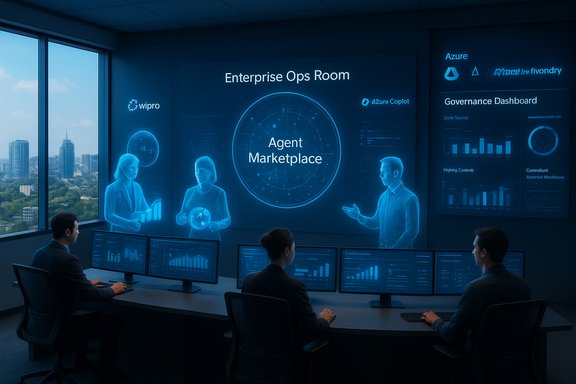
The Innovation Hub is described as a co‑innovation environment for rapid prototyping, client immersion workshops, pilot deployment and access to Wipro’s Agent Marketplace — a catalog of prebuilt agents and vertical copilots. The hub’s practical purpose is both technical (simulate production with realistic data and governance) and commercial (a showroom to convince risk‑sensitive buyers).Scale and skilling commitments
Wipro publicly stated plans to deploy over 50,000 Microsoft Copilot licences internally and to upskill more than 25,000 employees on Microsoft Cloud and GitHub technologies; these commitments are central to Wipro’s “Client Zero” approach, where internal activation becomes a source of packaged IP and referenceable outcomes for customers. These figures were repeated in partner briefings tied to Microsoft’s India announcements. Treat these numbers as strategic commitments rather than instantaneous evidence of full activation.Use cases and vertical focus
Wipro and Microsoft will co‑develop sector‑specific solutions with immediate applicability across:- Financial services — advisor copilots, automated KYC/AML workflows, fraud triage, personalized customer journeys powered by Wealth AI.
- Retail and supply chain — demand forecasting, inventory optimization and Falcon Supply Chain integrations for multi‑step fulfilment agents.
- Manufacturing — predictive maintenance, quality inspection assistants and operator copilots on the shop floor.
- Healthcare & Life Sciences — clinical decision support copilots, trial matching and administrative automation with compliance controls.
- Airports & transportation — passenger experience agents, resource allocation assistants and incident response coordination.
Strengths: What the deal does well
- Clear platform + partner playbook. Hyperscalers provide scale, models and governance primitives; systems integrators provide connectors, vertical semantics and delivery muscle. Combining these reduces time from POC to production.
- Tangible activation signals. The promise of tens of thousands of Copilot licences and a massive upskilling program creates visible commitments that can help close deals with cautious enterprise buyers.
- Physical co‑innovation runway. The Microsoft Innovation Hub offers a buyer‑facing environment for scenario testing and governance validation — especially important for regulated sectors that need demonstrable auditability.
- Packaged vertical IP accelerators. Wipro’s domain platforms help avoid the “blank slate” problem that slows many enterprise AI projects, enabling reusable agents and copilots.
Risks and caveats — what enterprises must watch for
1. Activation risk vs headline seat counts
Public announcements of license counts are a commercial and signalling tool. A declared purchase or licence commitment is not the same as meaningful, production usage by deployed business processes. Activation requires integration with identity, access, data sources and training; enterprises should ask for usage metrics, ROI dashboards and audit logs rather than accept seat counts at face value.2. Vendor concentration and operational dependence
Relying on a single hyperscaler + single SI for multiple layers — cloud, orchestration, copilots, agents and delivery — concentrates operational risk. This model simplifies procurement and support but can create lock‑in around Microsoft’s stack and Wipro’s packaged connectors. Enterprises should plan escape hatches, portability strategies and multi‑cloud failover where regulatory or continuity risk demands it.3. Governance, compliance and explainability
Agentic AI — agents that plan and execute multi‑step tasks — increases the governance burden. Enterprises must insist on explainability, human‑in‑the‑loop safeguards, verifiable audit trails and model provenance as preconditions for production rollouts in regulated domains such as banking and healthcare. The Microsoft tooling set provides primitives for provenance, but these must be integrated into organisational risk frameworks.4. Data residency and sovereign processing complexity
Microsoft’s announced investments in India are intended to reduce friction for in‑country processing, but implementing sovereign architectures can add latency, cost and engineering complexity. Enterprises with strict data residency needs should validate the exact deployment model for Copilot and agent inference (in‑region vs multi‑region fallbacks).5. Skills vs measurable productivity
Training 25,000 employees is a positive step, but outcomes matter more than completions. Enterprises should require proof that training converts into measurable productivity improvements and delivery capacity — for example, reductions in mean time to resolution (MTTR), cycle time improvements, revenue impacts per agent or documented cost savings in support operations.Practical advice for enterprise buyers
- Validate activation, not just purchase: request dashboards showing active Copilot sessions, task completions by agents, error rates and human override frequency.
- Require governance artefacts: model registries, versioning policies, retraining cadence, and audit trails for agent decisions.
- Scope pilots with narrow, measurable KPIs: target a single workflow with clear before/after metrics, and only expand after demonstrating reproducible outcomes.
- Insist on identity and least‑privilege integration: agents should never have unfettered access; role‑based access and short‑lived credentials reduce exposure.
- Negotiate portability and exit terms: define how IP, connectors and data exports are handled if you switch providers or adopt a multi‑cloud stance.
- Ask for case studies where training translated into delivery wins: get named use cases, measured outcomes and internal lessons learned rather than generic training counts.
Strategic implications for Wipro and Microsoft
For Microsoft
Partnering with Wipro converts Microsoft’s infrastructure investments into enterprise consumption of Copilot and Azure AI. Large SIs act as distribution channels that augment platform adoption, and Microsoft benefits from packaged, repeatable GTM plays that scale Azure‑hosted inference and model orchestration revenues. The deal also helps Microsoft demonstrate in‑country processing and sovereign apparatus in India — both commercially and politically important.For Wipro
The partnership is a bet on productised services: by embedding Copilot across its own operations and building an Agent Marketplace backed by Wipro Intelligence™, Wipro intends to convert internal activations into repeatable, saleable products and outcomes. The risk for Wipro is differentiating beyond being a delivery arm; success depends on the company’s ability to combine Microsoft tooling with distinctive vertical IP, integration expertise and measurable client ROI.Investor and market signals
This partnership is a market signal in two ways. First, it underscores the SI‑hyperscaler playbook that is becoming standard across the industry: platform responsibility for models and governance; SI responsibility for domain adaptation and delivery. Second, the public scale numbers (50k+ licences across multiple SI partners reported by Microsoft) function as demand signalling to enterprise procurement teams and competitors. However, investors and buyers should separate marketing momentum from realized revenue and cost savings; the latter will be shown in quarterly metrics, case studies and customer references — not in stage‑left announcements.Governance checklist for regulated industries
- Data lineage: enforce catalogues, classification and retention policies for training and inference data.
- Model provenance: ensure version control, data snapshots and model evaluation records are stored with immutable audit trails.
- Human oversight: design human‑in‑the‑loop decision points for high‑risk actions and define escalation procedures.
- Security controls: apply least‑privilege execution for agents and instrument token rotation for all service accounts.
- Privacy reviews: conduct DPIAs (Data Protection Impact Assessments) where agents process personal data.
- Continuous monitoring: deploy telemetry to detect drift, performance degradation, anomalous outputs and access pattern changes.
Bottom line — measured optimism
The Wipro–Microsoft partnership offers a credible route to industrialise agentic AI for enterprises that need domain‑aware copilots, production governance and repeatable delivery. The combination of Wipro’s vertical IP and Microsoft’s Copilot and Azure tooling is logically compelling and pragmatically effective for reducing engineering lift and procurement friction. The Microsoft Innovation Hub in Bengaluru provides a physical runway for validating outcomes and convincing risk‑sensitive buyers.That said, the announcement’s true value will be judged on hard metrics: activation rates, demonstrable ROI on pilot expansions, governance artefacts that satisfy regulators, and the degree to which skilling investments translate into measurable delivery improvements. Enterprises and procurement teams should treat the headline seat and training counts as commitments to verify, not proof of readiness. The pathway from promise to production runs through governance, integration and measurable outcomes — and that is where the next chapter of this partnership will be written.
Conclusion
Wipro’s strategic alliance with Microsoft — anchored by a three‑year pact, a Microsoft Innovation Hub in Bengaluru and large internal Copilot and skilling commitments — crystallises the platform‑plus‑partner approach that will dominate enterprise AI adoption over the coming years. For customers, the opportunity is clear: faster time to production for industry copilots and agents. For risks, the work remains in activation, governance, portability and measurable ROI. The coming quarters will determine whether this partnership becomes a template for safe, scaled AI deployment or another well‑publicised set of commitments that needs rigorous scrutiny to convert into durable business value.Source: Free Press Journal IT Services Major Wipro Announces Strategic Partnership With Microsoft, Aimed At Propelling AI Adoption
