

wolfSSL has patched a denial‑of‑service weakness in its TLS 1.3 handshake code after researchers discovered that a specially crafted ClientHello containing duplicate KeyShareEntry values for the same group can force excessive CPU and memory use during ClientHello processing, leading to server-side DoS conditions in wolfSSL v5.8.2; the issue is tracked as CVE‑2025‑11936 and fixed in wolfSSL 5.8.4.
wolfSSL is a widely used lightweight TLS/SSL library embedded in IoT devices, networking appliances, and many server products. In late November 2025 the maintainers and independent trackers documented a vulnerability in their TLS 1.3 KeyShare parsing: when a ClientHello includes multiple KeyShareEntry records that declare the same group, wolfSSL v5.8.2 failed to validate and reject the duplicates, which could cause high resource consumption and memory leakage during handshake processing. This was published as CVE‑2025‑11936 and assigned a medium severity rating under modern scoring. The flaw is a protocol‑parsing/validation bug rather than a cryptographic weakness: the attack vector is a malformed TLS ClientHello from an unauthenticated remote client. Because the issue is triggered at handshake time, any service using wolfSSL as a TLS server (for example, web servers, mail servers, embedded HTTPS endpoints, or TLS‑enabled control planes) can be affected if it runs a vulnerable wolfSSL build and accepts external TLS connections. wolfSSL addressed the bug in its November 2025 release (v5.8.4), merging code to explicitly reject duplicate KeyShare entries and adding tests.
If you operate services that terminate TLS using wolfSSL, prioritize an immediate inventory and upgrade plan: upgrade to wolfSSL 5.8.4 where possible, engage vendors for firmware updates, and apply network rate limits and TLS termination workarounds only as temporary containment measures. These steps will remove the exposure to malformed KeyShareEntry attacks and restore a resilient TLS posture across your estate.
Source: MSRC Security Update Guide - Microsoft Security Response Center
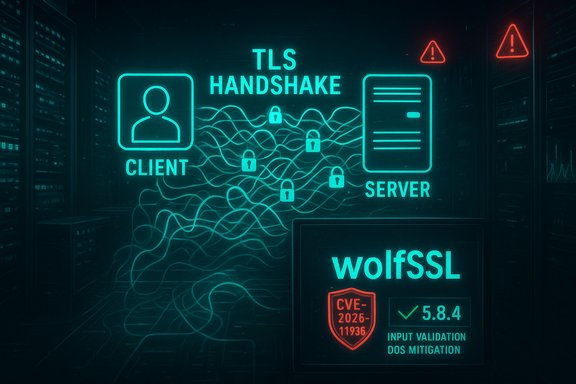 Background / Overview
wolfSSL is a widely used lightweight TLS/SSL library embedded in IoT devices, networking appliances, and many server products. In late November 2025 the maintainers and independent trackers documented a vulnerability in their TLS 1.3 KeyShare parsing: when a ClientHello includes multiple KeyShareEntry records that declare the same group, wolfSSL v5.8.2 failed to validate and reject the duplicates, which could cause high resource consumption and memory leakage during handshake processing. This was published as CVE‑2025‑11936 and assigned a medium severity rating under modern scoring. The flaw is a protocol‑parsing/validation bug rather than a cryptographic weakness: the attack vector is a malformed TLS ClientHello from an unauthenticated remote client. Because the issue is triggered at handshake time, any service using wolfSSL as a TLS server (for example, web servers, mail servers, embedded HTTPS endpoints, or TLS‑enabled control planes) can be affected if it runs a vulnerable wolfSSL build and accepts external TLS connections. wolfSSL addressed the bug in its November 2025 release (v5.8.4), merging code to explicitly reject duplicate KeyShare entries and adding tests. Technical analysis
What is a KeyShareEntry and why it matters in TLS 1.3
In TLS 1.3 the ClientHello uses the KeyShare extension to propose ephemeral key shares (public keys) for supported groups (e.g., X25519, P‑256). The server selects a compatible group and uses the corresponding key share to complete the handshake and derive session keys. Proper parsing of the KeyShare extension is critical: malformed or duplicate entries should be rejected according to the protocol, and implementations must carefully validate lengths and semantics before allocating resources. The discovered bug arises in the wolfSSL parser that examines KeyShareEntry items; duplicate entries for the same group were not correctly handled, leading to resource exhaustion.Root cause: improper input validation and resource handling
The vulnerability is classed under improper input validation (CWE‑20). A crafted ClientHello containing repeated KeyShareEntry fields for the same group caused the parser to accept or repeatedly process those entries and to allocate or manage memory in ways that left resources unreclaimed or consumed excessively. This behavior manifests as elevated CPU usage and memory consumption during ClientHello parsing—effectively a DoS condition because an attacker can repeat or parallelize such handshakes to overwhelm a server. The upstream fix adds explicit validation to reject duplicate KeyShareEntry entries and includes tests to prevent regression.Exploitability model
- Attack vector: Network (remote unauthenticated client sends malformed ClientHello).
- Privileges required: None — attacker need only be able to open TCP connections to the affected server.
- Complexity: Low — constructing a ClientHello with duplicate KeyShareEntry values is a straightforward protocol‑level manipulation for anyone able to craft TLS messages or modify an existing TLS client/fuzzer.
- Impact: Denial of Service (availability). The published CVSS v4 and vendor metadata place the severity around medium; some v3/v2 readings slightly vary, but all agree availability is the primary impact.
Affected products and distribution‑level exposure
wolfSSL versions and patch availability
The vendor acknowledges the issue affects wolfSSL v5.8.2 and lists the fix as part of the 5.8.4 release. The upstream pull request that enforces the duplicate‑group rejection was merged in August 2025 and bundled in the November 20, 2025 release notes for v5.8.4. Administrators should treat any server-side usage of wolfSSL 5.8.2 (and any other builds compiled from that code state) as vulnerable until upgraded to 5.8.4 or later.Linux distribution packages and vendor tracking
Distribution trackers (Debian security tracker and other vulnerability databases) show that various packaged wolfSSL versions used in distributions can remain vulnerable until maintainers update packages to include v5.8.4. Debian’s tracker lists the problem and points to the merge commit that fixes the fault, noting which binary/source packages are flagged vulnerable in each suite; this shows the operational reality: even when upstream publishes a fix, downstream packaging and appliance vendors must rebuild and ship updates. Organizations must inventory shipped wolfSSL packages in their appliances and container images to determine exposure.Impact assessment — who should worry most
- Embedded devices and network appliances that use wolfSSL as their TLS stack and expose services to the internet are high‑risk: many IoT devices and industrial products run versioned firmware that is slow to update.
- Public‑facing web or API servers that use wolfSSL directly (or via an embedded product) can be trivially scanned and probed with malformed handshakes; HTTP/TLS frontends that terminate large numbers of short connections are particularly sensitive.
- Software that bundles wolfSSL into containers, SDKs, or vendor appliances should be triaged immediately; some packages in common Linux distros were flagged vulnerable pending downstream updates.
Vendor response and technical remediation
- wolfSSL published v5.8.4 that contains the fix (the change was merged upstream in PR #9117 and release notes specifically reference CVE‑2025‑11936). The patch adds validation logic to reject duplicate KeyShare entries and includes tests. Administrators should upgrade to the vendor‑released stable version.
- Downstream distributions and vendors must rebuild packaging and ship updated firmware/software. Debian and other trackers document current package status and point to the upstream commit or the fixed release tag. Operators must verify the package version in their inventory and apply vendor updates or rebuilds as provided.
Short‑term mitigation if patching is delayed
- Restrict access to TLS endpoints that use wolfSSL to trusted networks or reverse proxies that can handle TLS termination with a different, patched library. Placing an updated TLS terminator (e.g., a modern reverse proxy) in front of vulnerable services limits remote exposure.
- Throttle and rate‑limit handshake attempts at the network edge (connection rate limits, SYN/proxy protections, and short‑lived connection caps). These measures don't fix the root cause but reduce the blast radius of mass scanning or automated DoS.
- Monitor and firewall off anomalous connection patterns to TLS ports; increase logging for handshake failures. These are compensating controls until vendor updates arrive. Note that such mitigations may have operational tradeoffs (latency, false positives).
Detection and hunting
Practical detection signals to add to monitoring and SIEMs:- Sudden spikes in short‑lived TLS connections followed by elevated CPU consumption in the TLS server process.
- Handshake failure counts rising without corresponding legitimate traffic increases.
- Repeated ClientHello messages with unusually large or malformed KeyShare extensions (capture a PCAP and inspect the ClientHello KeyShare extension entries).
- Memory allocation growth or leaks in the process handling TLS (monitor resident set size and heap usage trends).
- If the application exposes metrics, add alerts for increased TLS handshake durations or failure responses.
Why this matters to enterprise defenders — operational lessons
- Patching upstream libraries is necessary but not sufficient: vendor appliances and distribution packages must be updated too. Debian and other distro trackers show that even after an upstream fix is merged, packaged versions may lag. Inventory the wolfSSL usage lineage in your estate (embedded devices, SDKs, containers).
- Protocol parsing bugs are an enduring class of risk: malformed inputs that violate assumptions in parsing code frequently cause DoS or worse. TLS handshake parsing is a high‑value attack surface precisely because it is the gatekeeper to encrypted channels. The fix here is correct validation — rejecting duplicates per spec — but the operational fix path crosses release, packaging, and appliance vendor timelines.
- Where rapid vendor updates are not available, apply network controls and the principle of least exposure: terminate TLS at a hardened, patched perimeter proxy; restrict client access; and enforce rate limits. These mitigations are pragmatic but must be tracked and removed after patches are deployed to avoid extended reliance on brittle workarounds.
- Validate vendor advisories and package mappings: public CVE strings are helpful flags, but defenders must map the CVE to the exact package/build/firmware that their organization runs. Historical patterns demonstrate confusion between CVE tokens and the KB/package versions that actually fix them — confirm vendor package versions and release notes before declaring remediation complete.
Recommended remediation roadmap (operational checklist)
- Inventory: locate every instance of wolfSSL in your environment (binaries, SDKs, containers, vendor appliances). Use image scanning tools and software composition analysis to find wolfSSL artifacts and package versions.
- Prioritize: identify internet‑facing and production TLS servers, embedded devices on perimeter networks, and front‑line API endpoints using wolfSSL. Prioritize those for immediate remediation.
- Patch upstream: where you control the software, upgrade wolfSSL to v5.8.4 or later and rebuild/redeploy. Confirm the version via binary inspection and startup logs.
- Coordinate with vendors: for third‑party appliances and appliances with long vendor lifecycles, open support cases and request firmware or package updates that include the 5.8.4 fix. Track vendor timelines and apply temporary network mitigations until updates are available.
- Apply network mitigations: where immediate patching is impossible, move TLS termination to patched reverse proxies, restrict access to trusted networks, and apply handshake rate limits and connection caps. Monitor for anomalous ClientHello patterns.
- Validate: after patching, conduct functional tests and targeted fuzzing of TLS ClientHello variants to ensure the fixed code rejects duplicate KeyShareEntry values and does not regress. Add test cases to build pipelines to prevent future regressions.
Strengths and limitations of the public response
Strengths:- The vulnerability was responsibly handled upstream: the maintainers merged a targeted PR that enforces protocol‑correct behavior and shipped a release that bundles the fix. The release notes are explicit about CVE‑2025‑11936 and list the PR number, which helps downstream packagers and vendor teams validate their remediations.
- Multiple independent vulnerability trackers (Tenable, Debian, NVD mirrors) catalogued the issue quickly, which helps defenders locate and prioritize affected packages. This cross‑indexing speeds remediation in complex estates.
- Distribution lag: as with many library‑level fixes, downstream packages and firmware often lag the upstream release. This increases the window when appliances or packaged runtimes remain vulnerable despite a publicly available fix. Inventory and vendor coordination remain nontrivial and time consuming.
- Detection difficulty: because the attack is a malformed TLS handshake, some network devices or IDS/IPS systems that only inspect higher‑layer HTTP content will miss the anomaly. Effective detection requires TLS‑level visibility or collection of handshake metadata.
- Misclassification risk: early public scoring differences (v2/v3/v4 presentations) can confuse triage teams. Use authoritative vendor release notes and distribution package metadata to decide priority rather than raw CVSS numbers alone.
Developer and testing guidance
- Add unit and fuzz tests which generate malformed ClientHello messages containing duplicate KeyShareEntry groups and verify the implementation rejects them cleanly without leaking resources. The wolfSSL PR includes tests; teams should incorporate similar checks in their TLS stacks or wrappers.
- Sanity‑check memory allocations during handshake processing and use leak detection tooling in CI to catch regressions early. If your product wraps wolfSSL in a service, validate that the service enforces sane timeouts and connection limits even with malicious clients.
- For vendors shipping devices with wolfSSL embedded in firmware, provide a transparent security bulletin mapping CVE identifiers to firmware builds and document remediation timelines so customers can reliably triage. The gap between upstream fixes and appliance updates is the leading operational friction in these incidents.
Conclusion
CVE‑2025‑11936 is a clear example of how protocol parsing and input validation bugs in TLS stacks can yield practical availability risks. The vulnerability affects wolfSSL v5.8.2 and has been fixed in v5.8.4 via an explicit duplicate‑KeyShare validation patch (PR #9117). Organizations that run wolfSSL‑based servers, embedded devices, or vendor appliances must inventory impacted components, coordinate updates with vendors, and apply compensating network mitigations where immediate patching is impossible. The incident reinforces two perennial lessons: validate inputs per the protocol, and treat upstream library updates and downstream packaging as distinct steps in the remediation lifecycle.If you operate services that terminate TLS using wolfSSL, prioritize an immediate inventory and upgrade plan: upgrade to wolfSSL 5.8.4 where possible, engage vendors for firmware updates, and apply network rate limits and TLS termination workarounds only as temporary containment measures. These steps will remove the exposure to malformed KeyShareEntry attacks and restore a resilient TLS posture across your estate.
Source: MSRC Security Update Guide - Microsoft Security Response Center
