

Writer’s new Agent playbook is the clearest statement yet that some startups intend to move beyond “chat” and into automated, repeatable enterprise work — not by selling prettier chat windows, but by combining long‑context models, deep connectors, and no‑code automation so line‑of‑business users can design workflows that actually execute across systems.
Writer, the San Francisco enterprise AI startup founded in 2020, has publicly positioned itself as an enterprise‑first alternative to consumer‑origin model vendors. That positioning accelerated after a $200 million Series C last year that valued the company at $1.9 billion — a round and valuation reported by multiple business outlets. The company’s latest push is a unified product grouping it calls Writer Agent: a single interface that mixes conversational prompts with autonomous task execution, reusable workflow templates (“Playbooks”), scheduled automations (“Routines”), and enterprise connectors into back‑office systems. The vendor and press materials describe the goal simply: let anyone in the business describe a desired outcome — “build a branded partnership deck,” “summarize today’s sales calls and post action items to Slack,” or “generate an investment dashboard from PitchBook and FactSet” — and have the system plan, fetch, transform, and deliver the finished artifact with auditability and governance. Those claims are not being made in isolation. Writer has simultaneously marketed its proprietary Palmyra LLM family — most notably the new Palmyra X5 with a 1,000,000‑token context window — as the model backbone that enables agents to “remember” entire playbooks, contracts, meeting transcripts, and knowledge graphs in a single session, making end‑to‑end automation practical at enterprise scale. Palmyra X5 is available in Writer’s platform and in Amazon Bedrock. This piece evaluates what Writer has announced, verifies technical and commercial claims against independent sources where possible, highlights the enterprise strengths of their approach, and flags the operational and security risks that IT leaders must confront before letting agents act in production.
Writer’s wager is typical of challenger startups in this space: build a full‑stack enterprise product that makes agents usable and safe for business teams, then expand outward. If its engineering and governance deliver on the vendor’s promises, large customers may prefer a platform that “just works” for their workflows rather than stitching together hyperscaler primitives. If it does not, the entrenched distribution of Microsoft, Google, and OpenAI will remain hard to overcome.
The bottom line for IT leaders: Writer Agent is worth piloting where the candidate workflow needs cross‑system action, long context, and brand compliance. But rigorous operational controls, FinOps modeling, and legal clarity are mandatory prerequisites before agents are given authority to act at scale.
Writer’s launch crystallizes an essential lesson for the enterprise AI era: the winners won’t necessarily be the companies with the flashiest model numbers — they’ll be the vendors that make agentic models work inside complex organizations, with predictable costs, auditable behavior, and governance that satisfies risk teams. The technology is maturing fast; the enterprise discipline of turning pilots into safe, repeatable production systems will determine who wins the next chapter of automation.
Source: gamenexus.com.br Writer's AI agents can actually do your work—not just chat about it - GameNexus
 Background / Overview
Writer, the San Francisco enterprise AI startup founded in 2020, has publicly positioned itself as an enterprise‑first alternative to consumer‑origin model vendors. That positioning accelerated after a $200 million Series C last year that valued the company at $1.9 billion — a round and valuation reported by multiple business outlets. The company’s latest push is a unified product grouping it calls Writer Agent: a single interface that mixes conversational prompts with autonomous task execution, reusable workflow templates (“Playbooks”), scheduled automations (“Routines”), and enterprise connectors into back‑office systems. The vendor and press materials describe the goal simply: let anyone in the business describe a desired outcome — “build a branded partnership deck,” “summarize today’s sales calls and post action items to Slack,” or “generate an investment dashboard from PitchBook and FactSet” — and have the system plan, fetch, transform, and deliver the finished artifact with auditability and governance. Those claims are not being made in isolation. Writer has simultaneously marketed its proprietary Palmyra LLM family — most notably the new Palmyra X5 with a 1,000,000‑token context window — as the model backbone that enables agents to “remember” entire playbooks, contracts, meeting transcripts, and knowledge graphs in a single session, making end‑to‑end automation practical at enterprise scale. Palmyra X5 is available in Writer’s platform and in Amazon Bedrock. This piece evaluates what Writer has announced, verifies technical and commercial claims against independent sources where possible, highlights the enterprise strengths of their approach, and flags the operational and security risks that IT leaders must confront before letting agents act in production.What Writer announced — the product and the pitch
New product building blocks
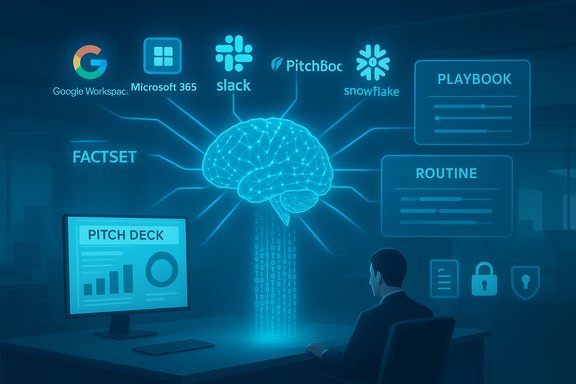
Writer’s public materials and recent press release enumerate a short list of features that together form the “Agent” experience:- Playbooks — reusable, multi‑step agent templates that encapsulate a sequence of actions across systems (research → create → finalize → distribute).
- Routines — scheduled or event‑triggered runs of Playbooks so work can be put “on autopilot.”
- Connectors — prebuilt integrations for major enterprise systems (Google Workspace, Microsoft 365, Snowflake, Slack, Asana, Gong, PitchBook, FactSet, Databricks, and more) so agents can read, write, and act against canonical sources of truth.
- Personality and governance — organization‑level tone/brand control and fine‑grained admin guardrails (permissions, data access controls, audit trails).
The Palmyra X5 claim: a one‑million token context window
Writer’s flagship model claim is that Palmyra X5 supports a 1,000,000‑token context window, letting an agent reason across extremely large inputs without brittle chunking and retrieval engineering. Writer’s model pages, an official press release, and the AWS Bedrock announcement document the same headline specs: the 1M token window, multi‑modal input, and token pricing advertised by the vendor. Writer states Palmyra X5 can ingest a million‑token prompt in roughly 22 seconds and delivers sub‑second function‑call responses for routine steps, with input/output pricing they publish on their model pages (e.g., roughly $0.60 per 1M input tokens and $6 per 1M output tokens for X5 as of the product pages). These are vendor‑published performance and pricing numbers and are verifiable by trial or contract with the vendor, but teams should benchmark with their representative workloads.Verifying the key claims (what checks were run)
- Funding and valuation: TechCrunch and Forbes independently reported Writer’s $200 million Series C and $1.9 billion valuation in November 2024. These stories are consistent and corroborated in multiple business outlets.
- Palmyra X5 token window and availability: Writer’s own blog and a BusinessWire press release describe Palmyra X5’s 1M token context window and list availability via Writer API and Amazon Bedrock, which is corroborated by AWS’s product announcement. That makes the context‑size and Bedrock availability verifiable on vendor pages and the AWS marketplace listing.
- Customers and traction: Writer’s press materials list household enterprise names (Accenture, Qualcomm, Uber, Vanguard, Marriott) and newer adopters (Comcast, TikTok, Keurig‑Dr Pepper, Aptitude Health, CAA). Vendor press releases plus coverage in VentureBeat and other outlets show those names repeatedly; they appear in Writer’s own client lists and product announcements. These customer names are therefore corroborated by both company and press reporting, though contractual details are rarely public.
- Commercial metrics (signed contracts / net retention): multiple secondary press pieces and reporting cite a net retention rate of roughly 160% and mention “over $50 million in signed contracts” with projections to double. These figures crop up across investor‑facing reporting and trade pieces; some of that reporting explicitly attributes the numbers to company disclosures or people close to the company rather than independent audits. That means these metrics are plausible and likely company‑provided, but they should be treated as vendor‑reported commercial statistics unless reconciliation to audited financials is required for procurement.
- Training cost discrepancy: public statements about Palmyra X5’s training cost differ. Writer’s official materials and BusinessWire said the model was trained with synthetic data for about $1 million in GPUs, whereas several press summaries repeated a figure near $700,000 for training costs. That inconsistency must be flagged as unverified — either figure could be rounded, estimated differently, or reflect different stages of model development (pretraining vs. fine‑tuning). Procurement teams should insist on a clarification if cost‑of‑training figures matter to contractual risk or IP questions.
Technical architecture and integrations: why this setup matters
Writer’s product pitch rests on three technical pillars that matter for enterprise adoption:- Long‑context LLMs (Palmyra X5) — A million‑token window materially reduces the need for RAG choreography, simpler context handling for long documents, and allows a single agent session to retain the “state” of a complex multi‑step plan. The vendor claims this simplifies agent design and lowers operational complexity. Public product pages and AWS availability make the long‑context claim verifiable, subject to per‑tenant gating or tiering.
- Prebuilt connectors and an integration fabric — By shipping connectors to mainstream enterprise systems, Writer reduces the integration burden for line‑of‑business users. That’s the implied productivity multiplier: agents can actually act inside Salesforce, Slack, Google Drive, PitchBook, FactSet, and other systems instead of returning a detached document. The Model Context Protocol (MCP) is mentioned as an integration standard in the industry; vendor messaging says Writer implemented MCP with additional enterprise‑grade controls. The details of connector isolation, credential scoping, and permission models are crucial to evaluate in each deployment.
- Observability, audit trails, and policy enforcement — Writer emphasizes showing the agent’s step‑by‑step plan, what data was accessed, and what code was generated. That visibility is necessary for enterprise governance and is a direct response to common objections that agents are a black box. Tools and platform vendors across the industry are now emphasizing an “agent ops” layer where agent identity, permissions, and logs are first‑class entities. Independent industry coverage shows this pattern is common among enterprise agent efforts.
Real-world use cases and early traction
Writer’s case studies and customer announcements show a range of vertical use cases:- Marketing operations: converting creative briefs (Asana tickets) into campaign assets, social carousels, and email sequences for mortgage lenders and consumer brands.
- Financial services: pulling structured data from PitchBook and FactSet to produce dashboards and investment briefs.
- Healthcare and clinical operations: summarizing trial documents and assisting with regulatory deliverables when grounded in specialized Palmyra variants (Palmyra Med, Palmyra Fin).
Strengths: where Writer’s strategy has merit
- Enterprise focus from day one. Unlike research labs that later productize enterprise features, Writer’s roadmap and product language are designed for procurement, compliance, and scale. That orientation influences their guardrails and feature priorities.
- Long context plus cost positioning. The combination of a large context window and the vendor’s published token pricing aims to make continuous, always‑on agentics economically feasible (especially versus stitching many smaller model calls and retrieval steps). Vendor pages and the AWS listing support the technical and pricing claims — but buyers should validate those cost forecasts with representative workloads.
- No‑code/low‑code agent construction for business builders. Playbooks and Routines lower the build barrier for non‑technical teams; this is a real productivity lever if governed appropriately. Observability features that show step‑by‑step decisions help with trust and auditability when implemented well.
- Connector breadth and orchestration. Prebuilt connectors to enterprise systems are the practical difference between an assistant and an executor; these integrations are foundational to the product’s value proposition.
Risks and operational caveats (what IT must watch)
- Marketing vs. contract reality. Many “headline” metrics (net retention, signed contract totals, per‑token speed) originate in company materials or investor decks; independent verification is limited. Treat them as decision inputs, not audited facts. For instance, the net retention number is widely reported, but much of that reporting cites company disclosures to investors or “people close to the company.” Procurement teams should require contract‑level metrics and references during negotiation.
- Agent action risk and attack surface. Agents that can act (write to CRM, post to Slack, update billing) create a larger attack surface than passive chat assistants. Misconfigured connectors or over‑permissive tokens can enable data exfiltration or unintended actions. Industry research and product reviews recommend staged autonomy (observe → require approval → automate narrow classes) and rigorous red‑teaming.
- Hallucinations and legal exposure. Even enterprise‑tuned models hallucinate. When an agent issues an automated customer communication or changes an invoice, the cost of error increases dramatically. Implement human‑in‑the‑loop checkers for any materially consequential actions and maintain auditable provenance for facts used in decisions.
- Cost and FinOps surprises. Million‑token sessions and scheduled Routines can spike compute usage. Vendors’ published per‑token pricing must be mapped against expected routine frequency, caching policies, and retention rules. Don’t base TCO on seat price alone; model consumption, function‑call frequency, and archival retention policy matter.
- Vendor differentiation and platform lock‑in. The very integration depth that accelerates time to value can create migration friction. Insist on exportable Playbooks, agent definitions in open formats, and contractual exit mechanics to avoid being trapped should licensing or model behavior become unacceptable. Independent industry guidance repeatedly flags this lock‑in trade‑off.
- Unverified or inconsistent technical claims. The training‑cost number illustrates how easily technical metrics can diverge in public reporting: Writer’s own press materials say one figure; secondary reporting sometimes repeats a different estimate. When a claim affects procurement risk (data residency, training data sources, non‑training guarantees), demand contractual clarity.
Buying checklist for IT and security teams
- Require exportable, auditable Playbook and Routine definitions and test the export/import process.
- Validate connector scopes in your test tenancy: confirm least‑privilege operation and revocation flows.
- Run a 30–60 day pilot on a narrow, non‑critical workflow (e.g., internal report generation) to capture token costs, latency, hallucination rates, and escalation frequency.
- Negotiate explicit contractual protections: data residency, non‑training clauses (if required), retention and deletion SLAs, and audit log export rights.
- Define an AgentOps process: owners, approval gates, red‑team testing cadence, and incident playbooks that include rewind/rollback procedures.
- Model FinOps impact across the organization — scheduled Routines can generate steady usage that compounds quickly.
How this stacks up against the hyperscalers
Hyperscalers (Microsoft, Google, OpenAI, Anthropic) are all racing to productize agent capabilities inside their broader ecosystems. The technical story is similar — long context, multimodal models, connectors, and governance — but there are practical trade‑offs:- Hyperscalers bring distribution advantages and deep in‑suite integrations (e.g., Copilot in Microsoft 365 or Gemini in Google Workspace) that can reduce friction in environment‑native shops.
- Specialist vendors like Writer emphasize enterprise‑first guardrails and vertical connectors out of the gate, and they package long‑context models built specifically for agentic workflows (Palmyra X5). That focus can accelerate certain cross‑system automations that are otherwise harder to assemble with general models.
- Cost, portability, and governance will largely determine winners in specific accounts: many enterprises will prefer the vendor that best maps to their security, contractual, and FinOps constraints rather than the vendor with the biggest model family. Independent industry analyses show organizations increasingly evaluate platform fit over raw model capability.
Final assessment — Where Writer can win, and where caution is warranted
Writer’s announcement is a credible and pragmatic attempt to move agentic AI from demos into production workflows that matter. The combination of a large‑context model (Palmyra X5), prebuilt connectors, reusable Playbooks, and a governance story appeals to the procurement patterns of large enterprises. The technical claims (1M token context, Bedrock availability, published token pricing) are publicly documented and verifiable with vendor tests and the AWS listing. That said, several core claims are vendor‑reported and should be validated in procurement:- Commercial metrics (net retention, signed contract totals) are widely reported but originate in company statements or investor documents; treat them as vendor metrics and verify references.
- Cost and latency claims (22‑second million‑token ingest, per‑token pricing) are on vendor pages and will hold only for representative benchmark runs—run those benchmarks in your environment.
- Any training‑cost narratives (e.g., $700k vs. $1M) should be clarified if they influence IP, indemnity, or procurement risk assessments. The public record shows inconsistent figures.
Writer’s wager is typical of challenger startups in this space: build a full‑stack enterprise product that makes agents usable and safe for business teams, then expand outward. If its engineering and governance deliver on the vendor’s promises, large customers may prefer a platform that “just works” for their workflows rather than stitching together hyperscaler primitives. If it does not, the entrenched distribution of Microsoft, Google, and OpenAI will remain hard to overcome.
The bottom line for IT leaders: Writer Agent is worth piloting where the candidate workflow needs cross‑system action, long context, and brand compliance. But rigorous operational controls, FinOps modeling, and legal clarity are mandatory prerequisites before agents are given authority to act at scale.
Writer’s launch crystallizes an essential lesson for the enterprise AI era: the winners won’t necessarily be the companies with the flashiest model numbers — they’ll be the vendors that make agentic models work inside complex organizations, with predictable costs, auditable behavior, and governance that satisfies risk teams. The technology is maturing fast; the enterprise discipline of turning pilots into safe, repeatable production systems will determine who wins the next chapter of automation.
Source: gamenexus.com.br Writer's AI agents can actually do your work—not just chat about it - GameNexus
