

A subtle type‑confusion in the X.Org cursor code — tracked as CVE‑2024‑0409 — can corrupt the SELinux labeling context and has been patched upstream; administrators running Xorg, Xwayland, Xephyr or affected VNC stacks should treat this as an availability‑first, high‑impact bug and apply vendor updates immediately.
The X.Org X server (xorg‑server) remains the historical backbone for graphical desktops and many remote/embedded display stacks on Linux. Components such as Xwayland (bridging X11 clients to Wayland compositors), Xephyr (nested X servers), and several VNC/Xvfb deployments reuse core X server code and data structures. That code uses an internal mechanism called privates to attach ancillary data to X server objects; each private entry has an associated type and size and must be allocated and consumed consistently. CVE‑2024‑0409 stems from an incorrect choice of private type when creating cursor data; that mistake can overwrite the XSELINUX private — the internal record that holds SELinux labeling information — leading to SELinux context corruption.
Why SELinux context corruption matters: SELinux is a Mandatory Access Control (MAC) system that enforces file, resource and process labels to constrain what subjects can do. When labeling structures are corrupted, the integrity of MAC decisions is undermined; in practical terms the bug can cause denial‑of‑service, allow access controls to be bypassed by local attackers, or create inconsistent enforcement that risks privilege escalation or data leakage in certain configurations. Multiple distributors and vulnerability databases assessed the flaw with a high severity rating and signalled both confidentiality and integrity impacts as realistic concerns.
Two additional operational realities raise urgency:
Key takeaways:
Source: MSRC Security Update Guide - Microsoft Security Response Center
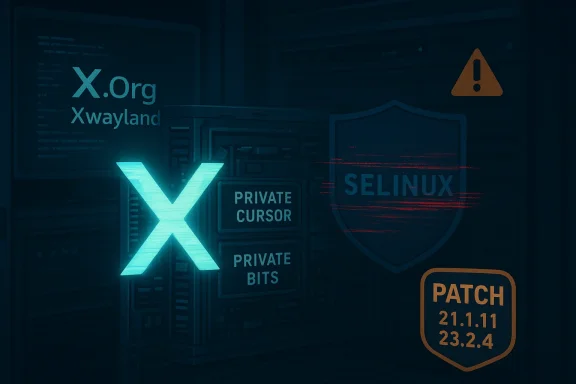 Background / Overview
The X.Org X server (xorg‑server) remains the historical backbone for graphical desktops and many remote/embedded display stacks on Linux. Components such as Xwayland (bridging X11 clients to Wayland compositors), Xephyr (nested X servers), and several VNC/Xvfb deployments reuse core X server code and data structures. That code uses an internal mechanism called privates to attach ancillary data to X server objects; each private entry has an associated type and size and must be allocated and consumed consistently. CVE‑2024‑0409 stems from an incorrect choice of private type when creating cursor data; that mistake can overwrite the XSELINUX private — the internal record that holds SELinux labeling information — leading to SELinux context corruption.Why SELinux context corruption matters: SELinux is a Mandatory Access Control (MAC) system that enforces file, resource and process labels to constrain what subjects can do. When labeling structures are corrupted, the integrity of MAC decisions is undermined; in practical terms the bug can cause denial‑of‑service, allow access controls to be bypassed by local attackers, or create inconsistent enforcement that risks privilege escalation or data leakage in certain configurations. Multiple distributors and vulnerability databases assessed the flaw with a high severity rating and signalled both confidentiality and integrity impacts as realistic concerns.
What the bug is — technical summary
The privates mechanism and the type mix‑up
- The X server stores per‑object auxiliary data via privates; each private slot is declared with a type and set to allocate a fixed size for the corresponding structure.
- The cursor subsystem maintains two related private keys: one for the cursor object and another for the cursor bits (the bitmap/shape).
- In code paths used by Xephyr and Xwayland, the cursor creation routine mistakenly allocates or assigns the cursor bits private where the cursor private was expected.
- When that mis‑typed private is initialized later, the write lands over neighbouring memory reserved for XSELINUX’s private, corrupting the SELinux context entry. That corruption can break MAC decisions or crash the server.
Timeline and fixes
- Disclosure date and upstream patch: The flaw was publicly disclosed in January 2024 in the coordinated X.Org advisory and fixed upstream in the release that produced xorg‑server 21.1.11 and xwayland 23.2.4; the upstream patch is recorded in the X server project repository.
- Distribution advisories: Major Linux distributors backported fixes or shipped updated xorg packages rapidly after disclosure. Red Hat, SUSE, Debian, Ubuntu, Oracle Linux and Amazon Linux each published security updates and errata addressing the issue across supported releases. Administrators should consult their vendor’s errata for the exact package names and version pins for their distribution.
- Affected range: Multiple vendor pages indicate the bug was introduced in older xorg‑server trees (traced back to xorg‑server‑1.16.0 in the upstream advisory) and therefore spans many older stable branches until the 21.1.11 / 23.2.4 fixes. That means long‑lived distributions that ship older xorg stacks or embedded products built from earlier sources are likely impacted unless explicitly patched.
Impact analysis — what administrators must assume
The core, load‑bearing impacts supported by cross‑referenced vendor advisories and the NVD record are:- Local exploitability with low privilege: a local, non‑interactive X11 request can trigger the condition. This means multi‑user systems, desktops with untrusted local users, or container/VM setups that expose X sockets to guests can be susceptible.
- High confidentiality/integrity/availability concerns in SELinux environments: because the vulnerability corrupts XSELINUX structures, SELinux enforcement can be undermined, creating direct confidentiality and integrity consequences in addition to availability loss (crashes). Vendors scored the issue with a high or important severity.
- Realistic DoS and plausible privilege escalation: at minimum an attacker can crash the display server, disrupting sessions and remote desktops; in specific memory layouts and attack chains the memory corruption could be extended toward privilege escalation or code execution pathways, although exploitation for arbitrary code execution requires additional conditions and is not universally confirmed in the wild. Multiple distributors therefore treat availability as the immediate operational risk and caution about the integrity risk as credible.
Verifying key technical details (cross‑references)
To ensure accuracy, the following independent corroborations were checked:- Upstream X.Org advisory and the commit that implements the fix are recorded in the X.Org lists and GitLab repository. These describe the privates/type mix‑up and identify the fixed releases (xorg‑server 21.1.11, xwayland 23.2.4).
- The NVD / MITRE and multiple vendor vulnerability trackers list the same description, CVSS vectors and attack properties; NVD and Red Hat published the CVSS‑style assessment (7.8 / AV:L/AC:L/PR:L/UI:N) and additional distributor pages provide remedial package versions.
- Distribution advisories (Red Hat RHSA, Oracle ELSA, SUSE update announcements, Amazon ALAS and Ubuntu security notices) report patched package names and date‑stamped errata. These are the sources administrators must follow to obtain vendor‑shipped fixes for production systems.
Practical mitigation and remediation checklist
The single corrective action that removes the vulnerability is to install the patched xorg/xwayland packages supplied by your OS vendor. Beyond that, operators should follow a short, practical checklist:- Inventory: Identify systems that run any of these components:
- xorg‑server / Xwayland / Xephyr
- TigerVNC, Xvfb, nested servers or containers that expose X sockets
- Systems using SELinux in enforcing mode where X is present
Use package tools (rpm, apt, dpkg, zypper) or your configuration management database to find versions. - Patch: Apply vendor errata that contain the fix. Examples of vendor advisories include Red Hat RHSA series (multiple RHSA IDs for RHEL 7/8/9 backports), SUSE updates, Debian/Ubuntu security notices and Amazon Linux ALAS packages. If you manage many systems, stage the vendor packages in your internal repo and roll them out with your normal update pipelines. Do not rely on rebuilding upstream sources unless you can precisely reproduce the distributor’s build flags and SELinux policy bindings.
- Restart display services: After package upgrade, restart the X server, display manager (gdm/lightdm/sddm) and any VNC service instances so the new libraries are loaded. On headless VMs that use Xvfb/Xwayland, restart the VM’s display stack or container. Plan for session disruption.
- Reduce local attack surface immediately if hotpatching is not possible:
- Avoid mapping host X sockets into untrusted containers or remote guests.
- Restrict access to /tmp/.X11‑unix or the X11 socket using filesystem ACLs where practical.
- Limit access to VNC services by network ACLs and authentication; do not expose VNC servers directly to untrusted networks.
- Detection and monitoring:
- Monitor system logs for X server crashes and abnormal segfaults following display requests.
- Watch for unexpected SELinux denials around X resources (which can be a symptom of context corruption or mis‑labeling).
- In multi‑user systems, look for unusual local processes creating many X client connections.
- Incident response if exploitation is suspected:
- Preserve memory and logs for forensic analysis before reboot.
- Isolate affected hosts from networks if you observe unexplained display server crashes together with privilege anomalies.
- Reapply vendor patches and fully restart services; consider rebuilding long‑lived systems that may have been compromised by local attackers.
Special considerations for cloud, containers and virtual desktops
- Containers that mount host X sockets: It's common to map /tmp/.X11‑unix or $DISPLAY into containers for GUI tooling. Those patterns effectively place unprivileged container processes in the position of local X clients; they must be treated as local attackers for this CVE. Avoid mapping host X into untrusted containers until patched.
- Wayland + Xwayland deployments: Because Xwayland provides binary compatibility for legacy X11 clients under Wayland compositors, the vulnerability applies to Wayland desktops that use Xwayland — even if the session overall is Wayland‑native. Apply Xwayland updates from your compositor vendor or distribution.
- Remote desktop and virtualization: VNC and virtual desktop products that embed X server code (TigerVNC, Xvfb, nested configurations) may be vulnerable. Vendors shipping those products have released updates; consult product advisories and update both host and guest images as necessary.
Threat actor and exploitability outlook
At disclosure time there was no evidence of widespread exploitation in the wild, and many vendor notices emphasize that the attack vector is local. However, the practical exploitability parameters — low complexity, no user interaction, and a broad affected codebase that appears in many desktop/remote stacks — mean the window between disclosure and weaponization in targeted environments could be short. Organizations with multiple local users, exposed remote desktop gateways, or embedded devices should therefore assume that attackers will attempt to weaponize the flaw and respond accordingly.Two additional operational realities raise urgency:
- The bug touches SELinux internals; once an attacker corrupts MAC state there is an outsized risk of subtle persistence or policy bypass that standard file‑based checks may not catch.
- The bug is reachable from typical desktop requests (cursor handling is a common operation), making detection after exploitation non‑trivial unless paired with robust logging, crash correlation and forensic memory capture.
Recommended patching timeline and prioritization
- Priority 1 (apply within 24–72 hours): Multi‑user systems, graphical jump hosts, shared workstations, desktop virtualization hosts, remote desktop gateways and any systems that expose X sockets into untrusted guests or containers. These are highest risk because local access is plausible.
- Priority 2 (apply within 7 days): Single‑user desktops, regular developer machines and non‑critical VMs where local access is restricted but not impossible.
- Priority 3 (apply during normal maintenance cycles): Embedded appliances or constrained systems that require vendor firmware updates; coordinate with vendor support channels and do not delay longer than necessary.
Strengths and weaknesses of the upstream and vendor responses
What was done well
- Upstream patching and disclosure were coordinated: the X.Org project published an advisory, fixed the code in designated point releases (21.1.11 / 23.2.4), and documented the root cause in the commit log, which is the correct technical posture for maintainers.
- Major Linux vendors issued timely errata and backports for supported trees (RHEL, SUSE, Debian, Ubuntu, Oracle Linux, Amazon Linux), allowing administrators on enterprise platforms to remediate without building from upstream sources.
Remaining risks and limitations
- The attack surface is not purely network‑facing and therefore patching windows are uneven in organizations that rely on long‑running desktop sessions, VDI pools, or embedded devices where updates are slow or controlled by OEMs.
- Detection is non‑trivial: SELinux context corruption can manifest as odd SELinux denials or crashes, but subtle policy bypass may evade simple file‑integrity checks. Organizations lacking memory capture and event correlation risk missing exploitation evidence.
Example operational checks (quick commands)
Use these patterns to find candidate systems; adapt the exact command to your distribution and management tooling.- Check installed xorg/xwayland package version (RPM‑based):
- rpm -qa | grep -i xorg
- rpm -q --last xorg-x11-server
- Debian/Ubuntu (dpkg):
- dpkg -l | grep -i xserver
- apt list --installed | grep xwayland
- Look for X server crashes in system logs:
- journalctl -u display-manager --since "24 hours ago"
- grep -i xorg /var/log/Xorg.0.log*
Final assessment and guidance
CVE‑2024‑0409 is a technically narrow but operationally consequential vulnerability: a localized type/privates bug corrupts SELinux labeling state inside the X.Org server, producing immediate availability impacts and credible integrity and confidentiality consequences in SELinux‑enforced environments. The vulnerability is patched upstream and by all major distributors; because the attack vector is local and trivial to trigger in typical multi‑user or containerized desktop setups, administrators must prioritize patching and reduce local exposure where immediate updates are not yet possible.Key takeaways:
- Apply vendor patches for xorg‑server, Xwayland and affected VNC stacks now; the upstream fixes are in xorg‑server 21.1.11 and xwayland 23.2.4.
- Treat any system that exposes host X sockets to containers or guests as high risk until patched.
- Monitor for display server crashes and unusual SELinux denials, preserve evidence if exploitation is suspected, and isolate affected hosts for forensic review.
Source: MSRC Security Update Guide - Microsoft Security Response Center
