

Musk’s AI empire is scaling faster than the grid can comfortably keep up, and that is now the defining tension behind xAI’s Colossus supercomputer. A new ranking, built from Epoch AI’s GPU-cluster database and public hardware estimates, places Colossus at the top of the world’s most powerful AI systems while also flagging it as one of the most energy-hungry. That combination matters because it captures the core reality of frontier AI in 2026: raw compute leadership increasingly comes with industrial-scale power demand. (epoch.ai)
The modern AI arms race has shifted from model architecture alone to the physical infrastructure needed to train and serve those models. In the early years of deep learning, a handful of GPUs in a lab could produce breakthroughs; today, leading systems are measured in tens or hundreds of thousands of accelerators, sprawling across purpose-built facilities. Epoch AI’s database reflects that shift, tracking more than 500 GPU clusters and noting that private-sector ownership now dominates global AI compute capacity. (epoch.ai)
What makes Colossus notable is not simply its size, but the speed at which xAI brought it online. xAI says the cluster was built in 122 days, later doubled to 200,000 GPUs in 92 days, and is headed toward a roadmap of 1 million GPUs. Whether one treats those claims as marketing or a serious engineering milestone, the company is clearly trying to define itself through speed, scale, and visible ambition. (x.ai)
That matters because AI infrastructure has become a strategic asset, not just an IT expense. Meta, Microsoft, Oracle, Tesla, and xAI are all building or leasing enormous AI clusters, while public-sector systems like El Capitan remain important but comparatively smaller in aggregate performance. Epoch AI notes that by May 2025 the largest known public AI supercomputer achieved less than a quarter of the computational performance of xAI’s Colossus, underscoring how decisively the center of gravity has moved to private industry. (epoch.ai)
The story also reflects a broader change in how power consumption is discussed. AI data centers once competed on efficiency, but the latest generation of systems is forcing a more blunt calculation: how much performance does a cluster deliver for every megawatt it burns? The TRG Datacenters analysis described in Digital Journal used H100-equivalent normalization to compare unlike systems on a common basis, which is important because the hardware mix now includes H100 and H200 chips, not just a single generation. That methodology does not eliminate uncertainty, but it does make cross-cluster comparisons more useful. (epoch.ai)
The ranking cited by Digital Journal, built from Epoch AI data, converts all systems into H100 equivalents, allowing different chip generations and architectures to be compared on the same yardstick. That is crucial because a system using H200s or mixed infrastructure can otherwise look smaller or larger depending on how one counts it. On that basis, Colossus reportedly reaches 275,796 H100 equivalents, nearly tripling the 100,000-H100-equivalent systems from Meta and the OpenAI/Microsoft camp. (epoch.ai)
This is where the article’s framing becomes especially important. The issue is not only that Colossus consumes a lot of energy; it is that frontier AI now resembles heavy industry. When a single facility requires power measured in hundreds of megawatts, the conversation moves from server procurement to utility planning, substation capacity, transmission rights, and local grid resilience. That is a very different operational world from the one most enterprise IT departments know. (epoch.ai)
That matters because xAI is trying to compress the same compute advantage that took rivals years to accumulate. OpenAI has Microsoft’s backing, Meta has enormous internal AI budgets, and Oracle has become a serious cloud contender. xAI’s answer is not to match them gradually, but to outbuild them quickly and make compute itself part of the brand story. That is an aggressive strategy, and it is unmistakably Muskian in its appetite for scale. (epoch.ai)
This approach offers clear advantages:
Microsoft and OpenAI occupy a similarly strategic position. Their Goodyear, Arizona cluster reportedly ties Meta’s 100,000-H100-equivalent system, illustrating how much infrastructure underpins products like ChatGPT and Copilot. Unlike xAI, which markets its cluster as a singular achievement, Microsoft and OpenAI have to integrate training hardware into a broader enterprise and consumer cloud ecosystem. That gives them scale and distribution, but it can also make compute decisions more bureaucratic. (epoch.ai)
In competitive terms, the implication is simple: AI infrastructure is no longer a two-horse race between the biggest consumer platforms. It is a multi-front contest involving clouds, model labs, and vertically integrated firms.
That ecosystem has only become more visible in 2026. xAI’s site now lists “xAI joins SpaceX” among its latest news, and the company says SpaceX announced an acquisition of xAI on February 2, 2026. Whether that signals deeper strategic consolidation or merely an organizational structure change, it confirms that Musk’s companies are increasingly entwined around compute, models, launch systems, and capital allocation. (x.ai)
The model works best when viewed as a portfolio of related bets:
Still, efficiency claims in the AI era deserve caution. A cluster can look efficient because of hardware mix, datacenter engineering, or methodological assumptions, and those factors may not translate cleanly into real workload costs. In other words, better MW-per-compute ratios do not erase the fact that the absolute draw remains enormous. The question is not whether Colossus is efficient in an abstract sense, but whether the surrounding infrastructure can sustain its growth economically. (epoch.ai)
It also changes how competitors will allocate resources. If the top clusters now operate in the 100 MW to 350 MW range, then the barrier to entry is no longer simply access to GPUs. A serious contender must secure land, permits, cooling, transformers, interconnects, and a financing structure capable of supporting all of it at once. That is a much higher hurdle than buying chips on the open market. (epoch.ai)
The flip side is that concentration may reduce resilience. If a small number of American companies control most frontier AI compute, then the market becomes more exposed to supply shocks, power scarcity, and regulatory intervention. The competition may still be global in ambition, but it is now highly centralized in geography and ownership. That concentration can accelerate innovation, yet it also makes the entire sector less forgiving.
There are three questions worth watching closely. First, will xAI’s efficiency advantage hold as the cluster grows? Second, can utilities and regulators accommodate ever-larger AI campuses without backlash? Third, will rivals respond by building more clusters, or by making models more compute-efficient and less dependent on brute force? Those answers will shape the industry as much as any benchmark score.
Source: Digital Journal Musk has the world's most powerful supercomputer, but it is also the most energy hungry
 Background
The modern AI arms race has shifted from model architecture alone to the physical infrastructure needed to train and serve those models. In the early years of deep learning, a handful of GPUs in a lab could produce breakthroughs; today, leading systems are measured in tens or hundreds of thousands of accelerators, sprawling across purpose-built facilities. Epoch AI’s database reflects that shift, tracking more than 500 GPU clusters and noting that private-sector ownership now dominates global AI compute capacity. (epoch.ai)What makes Colossus notable is not simply its size, but the speed at which xAI brought it online. xAI says the cluster was built in 122 days, later doubled to 200,000 GPUs in 92 days, and is headed toward a roadmap of 1 million GPUs. Whether one treats those claims as marketing or a serious engineering milestone, the company is clearly trying to define itself through speed, scale, and visible ambition. (x.ai)
That matters because AI infrastructure has become a strategic asset, not just an IT expense. Meta, Microsoft, Oracle, Tesla, and xAI are all building or leasing enormous AI clusters, while public-sector systems like El Capitan remain important but comparatively smaller in aggregate performance. Epoch AI notes that by May 2025 the largest known public AI supercomputer achieved less than a quarter of the computational performance of xAI’s Colossus, underscoring how decisively the center of gravity has moved to private industry. (epoch.ai)
The story also reflects a broader change in how power consumption is discussed. AI data centers once competed on efficiency, but the latest generation of systems is forcing a more blunt calculation: how much performance does a cluster deliver for every megawatt it burns? The TRG Datacenters analysis described in Digital Journal used H100-equivalent normalization to compare unlike systems on a common basis, which is important because the hardware mix now includes H100 and H200 chips, not just a single generation. That methodology does not eliminate uncertainty, but it does make cross-cluster comparisons more useful. (epoch.ai)
Why Colossus Dominates the Ranking
Colossus stands out first because of its scale. xAI’s own site says the cluster has 200,000 GPUs and calls it the “world’s biggest supercomputer,” while also describing it as the “most powerful AI training system yet.” Those are company claims, but they align with the broader direction of independent dataset work that places Colossus ahead of competing clusters by a wide margin. (x.ai)The ranking cited by Digital Journal, built from Epoch AI data, converts all systems into H100 equivalents, allowing different chip generations and architectures to be compared on the same yardstick. That is crucial because a system using H200s or mixed infrastructure can otherwise look smaller or larger depending on how one counts it. On that basis, Colossus reportedly reaches 275,796 H100 equivalents, nearly tripling the 100,000-H100-equivalent systems from Meta and the OpenAI/Microsoft camp. (epoch.ai)
What the H100-equivalent method does and does not tell us
The H100-equivalent approach is helpful, but it is also an abstraction. It captures useful comparative compute value, yet it can flatten differences in architecture, networking, memory, and workload optimization. In other words, two clusters may look similar on paper while behaving differently in real training runs.- It enables apples-to-apples comparison across hardware generations.
- It makes energy ratios easier to normalize.
- It can hide real-world differences in memory bandwidth and networking.
- It should be read as a comparative estimate, not a literal chip count.
The Energy Problem Is the Bigger Story
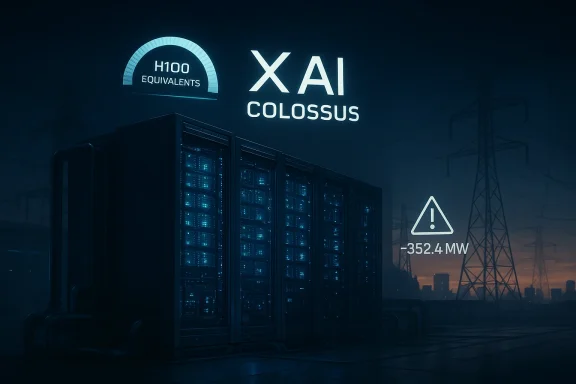
If the performance ranking is the headline, the electricity bill is the warning label. The Digital Journal report says Colossus draws about 352.4 megawatts, which is enormous by conventional data-center standards, and it also consumes less power per 10,000 H100 equivalents than several competitors. That makes Colossus both the biggest and, in relative terms, somewhat more efficient than some rivals—yet it still lands in a category of power use that strains normal assumptions about data-center deployment. (epoch.ai)This is where the article’s framing becomes especially important. The issue is not only that Colossus consumes a lot of energy; it is that frontier AI now resembles heavy industry. When a single facility requires power measured in hundreds of megawatts, the conversation moves from server procurement to utility planning, substation capacity, transmission rights, and local grid resilience. That is a very different operational world from the one most enterprise IT departments know. (epoch.ai)
Why megawatts now matter as much as model quality
A megawatt figure is not just a technical footnote. It determines where a facility can be built, how fast it can expand, and whether a utility can support it without major capital upgrades. For xAI, that means the competitive race is partly a race to secure dependable power before rivals do.- Higher power draw can accelerate training capacity.
- But it also increases operating complexity and costs.
- Grid access can become a bottleneck even when capital is available.
- Cooling systems add materially to the total burden; the report notes 30% to 50% overhead once cooling is included.
What xAI Is Really Building
Colossus is more than a vanity project. xAI says it is using the system to “solve intractable problems,” and the company’s product roadmap suggests a tight link between infrastructure and product ambitions such as Grok, Grok Enterprise, and other AI services. In practical terms, Colossus is xAI’s manufacturing base for model development, inference, and future product differentiation. (x.ai)That matters because xAI is trying to compress the same compute advantage that took rivals years to accumulate. OpenAI has Microsoft’s backing, Meta has enormous internal AI budgets, and Oracle has become a serious cloud contender. xAI’s answer is not to match them gradually, but to outbuild them quickly and make compute itself part of the brand story. That is an aggressive strategy, and it is unmistakably Muskian in its appetite for scale. (epoch.ai)
From model lab to industrial platform
A useful way to think about xAI is as a vertically integrated AI factory. The company is not just training a model; it is building the physical plant that supports repeated experimentation, rapid iteration, and large-scale deployment. The more reusable compute xAI can stockpile, the faster it can train new versions of Grok and support future products.This approach offers clear advantages:
- Faster model iteration cycles.
- Lower dependence on external cloud vendors.
- Greater control over training schedules.
- More room to optimize for xAI-specific workloads.
How Meta, Microsoft, and Oracle Fit Into the Race
Meta’s presence near the top of the ranking is a reminder that the AI race is not only about chatbots. The company reportedly has multiple clusters among the top 10, including a 100,000-H100-equivalent system and additional GenAI infrastructure. Meta’s challenge is different from xAI’s: it must support both frontier model training and the enormous runtime demands of consumer products across Facebook, Instagram, WhatsApp, and adjacent services. (epoch.ai)Microsoft and OpenAI occupy a similarly strategic position. Their Goodyear, Arizona cluster reportedly ties Meta’s 100,000-H100-equivalent system, illustrating how much infrastructure underpins products like ChatGPT and Copilot. Unlike xAI, which markets its cluster as a singular achievement, Microsoft and OpenAI have to integrate training hardware into a broader enterprise and consumer cloud ecosystem. That gives them scale and distribution, but it can also make compute decisions more bureaucratic. (epoch.ai)
Oracle’s quiet rise
Oracle may be the most interesting sleeper in the list. Its H200 supercluster ranks fourth in the Digital Journal summary, and the company has been steadily turning cloud infrastructure into an AI-native business rather than a legacy database story. The inclusion of H200 hardware also signals that the race is not frozen around one chip generation; providers are already trying to leverage newer memory and bandwidth advantages to keep pace.In competitive terms, the implication is simple: AI infrastructure is no longer a two-horse race between the biggest consumer platforms. It is a multi-front contest involving clouds, model labs, and vertically integrated firms.
- Meta is building for internal model development and product integration.
- Microsoft and OpenAI are pairing cloud reach with model ambition.
- Oracle is leveraging cloud infrastructure as a differentiation layer.
- xAI is betting on speed and concentration.
- Tesla uses compute for autonomy rather than general-purpose AI products.
Tesla Cortex and the Cross-Company Musk Ecosystem
Tesla’s Cortex cluster adds another layer to the story because it blurs the line between auto manufacturing and AI infrastructure. According to the Digital Journal summary, Cortex Phase 1 provides 50,000 H100 equivalents and exists to train Full Self-Driving software using real-world driving footage. That means Tesla’s compute strategy is not isolated from Musk’s broader AI ambition; it is part of a shared ecosystem of chips, talent, and infrastructure. (epoch.ai)That ecosystem has only become more visible in 2026. xAI’s site now lists “xAI joins SpaceX” among its latest news, and the company says SpaceX announced an acquisition of xAI on February 2, 2026. Whether that signals deeper strategic consolidation or merely an organizational structure change, it confirms that Musk’s companies are increasingly entwined around compute, models, launch systems, and capital allocation. (x.ai)
The strategic value of shared ambition
Musk’s advantage is not that every company he controls does the same thing. It is that they can reinforce one another. Tesla can generate autonomy data, xAI can train large models, and SpaceX can provide both strategic depth and narrative momentum. That is a rare form of corporate coordination, even if it also raises obvious governance questions.The model works best when viewed as a portfolio of related bets:
- xAI supplies frontier model development.
- Tesla supplies autonomy use cases and training data.
- SpaceX adds scale, capital symbolism, and strategic optionality.
- Shared talent and hardware sourcing can reduce duplication.
- The whole system strengthens Musk’s negotiating position with suppliers.
The Power Efficiency Claim Needs Context
One of the most interesting details in the ranking is that Colossus reportedly uses less power per unit of compute than several major rivals. The report assigns it 12.78 MW per 10,000 H100 equivalents, compared with 14.27 for Meta’s 100k cluster and the OpenAI/Microsoft cluster in Arizona. On paper, that suggests Colossus is not just bigger, but somewhat better optimized at least on this metric. (epoch.ai)Still, efficiency claims in the AI era deserve caution. A cluster can look efficient because of hardware mix, datacenter engineering, or methodological assumptions, and those factors may not translate cleanly into real workload costs. In other words, better MW-per-compute ratios do not erase the fact that the absolute draw remains enormous. The question is not whether Colossus is efficient in an abstract sense, but whether the surrounding infrastructure can sustain its growth economically. (epoch.ai)
Why “efficient” is not the same as “easy”
A frontier AI system can be highly efficient relative to peers and still be incredibly hard to run. That is because efficiency only tells part of the story. The total MW figure determines physical feasibility, while the ratio determines comparative discipline.- Better efficiency may lower marginal training costs.
- It may also improve strategic flexibility for future expansion.
- But it does not eliminate substation, cooling, or transmission bottlenecks.
- Nor does it guarantee that future generations of hardware will preserve the same advantage.
Industry-Wide Implications for AI and Data Centers
The most important takeaway from this ranking is that AI has become a utility business as much as a software business. The clusters near the top are no longer just racks in a building; they are energy projects, supply-chain projects, and municipal planning problems. That changes how AI companies need to think about real estate, capital expenditures, and the long-term economics of model training. (epoch.ai)It also changes how competitors will allocate resources. If the top clusters now operate in the 100 MW to 350 MW range, then the barrier to entry is no longer simply access to GPUs. A serious contender must secure land, permits, cooling, transformers, interconnects, and a financing structure capable of supporting all of it at once. That is a much higher hurdle than buying chips on the open market. (epoch.ai)
Enterprise versus consumer impact
For enterprises, the implication is that AI capacity will increasingly be rented from firms that own the biggest clusters, not built in-house. For consumers, the effect is indirect but substantial: better models, lower latency, and more capable assistants are all downstream of this infrastructure race. The consumer may never see Colossus, but they will feel its output in products like Grok and, potentially, in related services across Musk’s portfolio.The flip side is that concentration may reduce resilience. If a small number of American companies control most frontier AI compute, then the market becomes more exposed to supply shocks, power scarcity, and regulatory intervention. The competition may still be global in ambition, but it is now highly centralized in geography and ownership. That concentration can accelerate innovation, yet it also makes the entire sector less forgiving.
Strengths and Opportunities
The Colossus story is not just about raw consumption. It also shows how aggressively a focused company can move when it owns the stack from chips to datacenter design to product deployment. The current ranking suggests xAI has turned compute into a strategic moat, and that could compound quickly if it translates into model quality gains.- Massive scale gives xAI unusually large training throughput.
- Faster buildouts can compress product cycles.
- Vertical control reduces dependence on third-party cloud capacity.
- High visibility helps attract talent and investors.
- Compute abundance may improve frontier model experimentation.
- Cross-company synergies can lower strategic duplication.
- Improved efficiency ratios could reduce marginal training costs over time.
Risks and Concerns
The same scale that makes Colossus impressive also creates operational and reputational risks. The bigger the system, the more exposed it is to utility pricing, grid reliability, permitting friction, and scrutiny over whether the benefits justify the resource intensity.- Grid strain could limit future expansion.
- Cooling overhead increases total energy burden beyond headline figures.
- Methodology uncertainty means published rankings are estimates, not audits.
- Capital intensity raises the stakes of any slowdown in model progress.
- Public backlash may grow if local communities bear the infrastructure costs.
- Concentration risk ties performance to a few mega-sites.
- Competitive imitation means rivals may chase the same power-heavy strategy.
Looking Ahead
The next phase of this race will likely be defined by who can scale responsibly, not just who can scale fastest. That is especially true if xAI really intends to push toward the million-GPU era it has described, because each expansion step magnifies power, cooling, and operational complexity. In practice, the AI winners may be the firms that can combine engineering discipline with financial firepower.There are three questions worth watching closely. First, will xAI’s efficiency advantage hold as the cluster grows? Second, can utilities and regulators accommodate ever-larger AI campuses without backlash? Third, will rivals respond by building more clusters, or by making models more compute-efficient and less dependent on brute force? Those answers will shape the industry as much as any benchmark score.
- Whether xAI discloses more details about power sourcing and utilization.
- Whether Colossus expansion hits real grid or permitting limits.
- Whether Meta and Microsoft respond with larger or more efficient clusters.
- Whether Oracle continues to climb the AI infrastructure rankings.
- Whether public scrutiny forces better reporting on energy use.
Source: Digital Journal Musk has the world's most powerful supercomputer, but it is also the most energy hungry
