

After nearly two decades of building loyalty, Xbox now sits at a hinge moment: Phil Spencer, the architect of modern Xbox, has stepped away and Asha Sharma — a senior AI executive with a background in scaling services — has been tapped to lead Microsoft Gaming, while Microsoft teases a hybrid hardware future under the codename Project Helix. The change has exposed a raw fault line between long-time console-first fans and a product strategy that increasingly speaks to cross-device reach, services, and AI-driven platform engineering. This piece looks at what happened, why longtime players feel unsettled, where the strategy is headed, and what concrete steps would repair trust without surrendering ambition.
Xbox’s modern identity was forged under Phil Spencer: consolidation of first-party studios, a heavy push for Game Pass subscriptions, and a strategy that mixed hardware, services, and cross-platform access. That era emphasized games and a gamer-first narrative, even as Microsoft quietly built services and PC integration to expand reach.
In early 2026 Microsoft publicly reorganized gaming leadership. Phil Spencer retired after a long tenure, Matt Booty received new responsibilities focused on content, and Asha Sharma — previously head of Microsoft’s CoreAI product organization — was placed in charge of Microsoft Gaming. The public messaging that accompanied the change stressed a recommitment to hardware and content, but optics and timing left many fans suspicious.
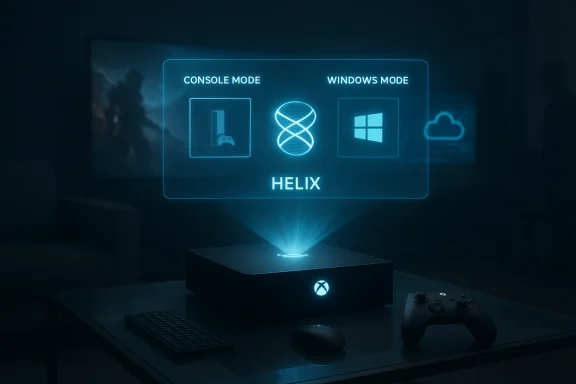
At roughly the same time, Microsoft began using the internal name Project Helix for its next-generation living-room hardware — messaging that promises something that will “lead in performance and play your Xbox and PC games.” Those three words are deliberately broad and have invited interpretations ranging from a console that’s simply more powerful to a Windows-rooted TV PC that blurs the line between Xbox and PC ecosystems. The company has not published final specs, prices, or a ship date, leaving a lot to expectations and speculation.
Context, however, is everything. Placing an AI executive at the top of a gaming organization during a noisy period of perceived product drift and community tension generated suspicion. Many players read the move as a signal that Xbox will prioritize AI and scale over the hardware, creative craft, and community roots that once defined the brand. The company and the new leadership have pushed back publicly, reaffirming a hardware focus and a desire to support first-party content, but skeptics remain vigilant.
A console has always promised a physical home base: a piece of furniture where you return to your library, your achievements, your friends, and a predictable, plug-and-play experience. When the product narrative foregrounds portability and ubiquity at the expense of that grounded home, longtime customers can interpret that as a shift in priorities — even when the company’s intent is merely to broaden value. The difference between “expand” and “replace” is small in messaging but huge in perception.
Practical fallout for players includes the loss of in-game discovery, historical data uncertainty, and the need to migrate communities to third-party platforms like Discord. For franchises built on shared social rituals, those shifts damage cohesion and goodwill. The company’s ability to provide migration tools, export APIs, or developer-supported alternatives will determine how much trust is lost.
Asha Sharma’s appointment signals a platform-and-AI-minded future that could materially improve performance, accessibility, and ecosystem scale — if it is applied with restraint and with clear guardrails that preserve the console’s home-base promise. Matt Booty’s role in content oversight is an important counterbalance, but structure is only as good as the decisions it produces.
The company can rebuild confidence quickly by releasing concrete operational details: a clear Helix runtime model, hands-on technical guidance for developers, explicit anti-cheat and storefront commitments, and practical migration tools for players affected by platform changes. Most importantly, Microsoft must align messaging with product realities: if the console remains the easiest, most complete way to enjoy Xbox experiences, demonstrate that in hardware, updates, and retailer messaging — not only in press statements.
Long-time fans are not immovable relics; many want Xbox to succeed. But success requires listening, clarity, and proof. If Microsoft can show early, meaningful wins — both technical and community-focused — the company can broaden its audience while honoring the base that built it. The next 12–24 months will decide whether Xbox’s identity expands into a genuinely inclusive ecosystem or fragments under mixed signals and operational missteps.
Source: Windows Central I'm still here with Xbox for now — but it has to work on its identity
 Background
Xbox’s modern identity was forged under Phil Spencer: consolidation of first-party studios, a heavy push for Game Pass subscriptions, and a strategy that mixed hardware, services, and cross-platform access. That era emphasized games and a gamer-first narrative, even as Microsoft quietly built services and PC integration to expand reach.In early 2026 Microsoft publicly reorganized gaming leadership. Phil Spencer retired after a long tenure, Matt Booty received new responsibilities focused on content, and Asha Sharma — previously head of Microsoft’s CoreAI product organization — was placed in charge of Microsoft Gaming. The public messaging that accompanied the change stressed a recommitment to hardware and content, but optics and timing left many fans suspicious.
At roughly the same time, Microsoft began using the internal name Project Helix for its next-generation living-room hardware — messaging that promises something that will “lead in performance and play your Xbox and PC games.” Those three words are deliberately broad and have invited interpretations ranging from a console that’s simply more powerful to a Windows-rooted TV PC that blurs the line between Xbox and PC ecosystems. The company has not published final specs, prices, or a ship date, leaving a lot to expectations and speculation.
The leadership shuffle: optics matter
Asha Sharma’s profile and the immediate reaction
Asha Sharma brings deep product and AI engineering experience to gaming leadership. Her résumé includes scaling large Microsoft services and leading CoreAI product work — credentials that make her a logical choice if Microsoft intends to accelerate AI-enabled platform capabilities across Xbox, cloud gaming, and Windows integrations.Context, however, is everything. Placing an AI executive at the top of a gaming organization during a noisy period of perceived product drift and community tension generated suspicion. Many players read the move as a signal that Xbox will prioritize AI and scale over the hardware, creative craft, and community roots that once defined the brand. The company and the new leadership have pushed back publicly, reaffirming a hardware focus and a desire to support first-party content, but skeptics remain vigilant.
What the promotion of Matt Booty means
Alongside Sharma’s appointment, Matt Booty’s elevation to Executive Vice President and Chief Content Officer was explicitly designed to reassure developers and players that content leadership remains strong. That structural separation — AI/platform engineering on one side, content stewardship on the other — is sensible on paper. For the shift to calm worries, it must translate into visible, consistent decisions that preserve studio autonomy and prioritize game quality.Messaging, brand identity, and the “home base” problem
Why marketing choices can erode trust
Brand messaging is not just marketing copy; it shapes how users feel about whether a product is for them. Recent ads and product messaging that emphasize the ability to play Xbox titles on phones or PCs have sometimes been read by console-first fans as implying “you do not need an Xbox.” That perception matters deeply to players whose habit, identity, and social history are tied to the hardware itself.A console has always promised a physical home base: a piece of furniture where you return to your library, your achievements, your friends, and a predictable, plug-and-play experience. When the product narrative foregrounds portability and ubiquity at the expense of that grounded home, longtime customers can interpret that as a shift in priorities — even when the company’s intent is merely to broaden value. The difference between “expand” and “replace” is small in messaging but huge in perception.
Rebuilding the sense of home without undoing openness
Asha Sharma’s early public comments reportedly include a reaffirmation of hardware commitment and caution toward unnecessary AI interventions; she has not ruled out exclusives and appears to understand the emotional importance of a return-to-home narrative. That’s promising. But talk must become tangible: a clear product positioning for the next Xbox, a retail story that explains why this hardware is distinct, and demonstrations that the console remains the most frictionless way to access Xbox’s ecosystem. Until those details exist, the identity friction will persist.Project Helix: opportunity, ambiguity, and risk
What Microsoft has publicly said — and what it hasn’t
Project Helix is presented as a device intended to “lead in performance” and play both Xbox and PC games. Public statements focused on codename and intent; Microsoft and its partners have not published MSRP, final hardware specs, a deterministic runtime model, or a formal ship date. Investors and partners have offered signals — such as AMD comments that semi-custom chip work could support a 2027 window — but supplier talk is not an official launch timeline. That gap between promise and product is the core operational risk.Three architectural possibilities — and their tradeoffs
From the public hints, there are three plausible technical models for Helix. Each delivers a different user experience and risk profile:- Native Windows mode: Helix ships as a full Windows 11 device with a controller-first Full Screen Experience (FSE) shell and the option to “exit to Windows” to access third-party PC storefronts.
- Pros: Maximum compatibility and openness; easy to run PC-native titles.
- Cons: Higher support complexity; less deterministic performance guarantees.
- Certified Console Mode runtime: A locked-down console-grade runtime (a hardened FSE) supports a curated set of PC titles certified to run in that environment, while other titles run only in full Windows.
- Pros: Balances reliability with selective openness; developers have clearer performance targets.
- Cons: Requires a certification program and may fragment experiences.
- Hybrid hardware with dual-mode firmware: A console-first runtime for most users and an explicit “developer mode” or “PC mode” that exposes full Windows for advanced users.
- Pros: Preserves console simplicity while enabling power-user flexibility.
- Cons: Complexity for support and unclear product messaging could confuse retail buyers.
The price/performance question
A hybrid device that blurs PC and console concepts will inevitably raise the price question: is Helix a premium living-room PC or a subsidized console? If the hardware is high-cost, Microsoft must justify that delta with exclusive content, service value, or a unique retail experience. If it is subsidized, it will need a high subscriber conversion model to make margins. Microsoft’s early messaging has intentionally avoided MSRP or SKU detail — a communication gap that needs to be closed to reassure retail buyers and media.Software and services: the pull toward openness
Xbox PC app and Windows integration
Microsoft has quietly evolved the Xbox PC app into a controller-friendly hub that aggregates installed games from multiple storefronts and offers a single “My Library” to launch titles. That shift makes Windows a more credible gaming surface and supports the idea of user libraries that travel across devices — a clear convenience win for many players. But it also underpins the messaging that Xbox content can live off-console, feeding the worry among hardware-first fans that the console itself is becoming optional rather than essential.Game Pass, exclusivity, and the balancing act
Game Pass is the service-level core of Microsoft’s gaming strategy: subscription value, discoverability, and recurring revenue. However, a service-led approach creates tension around exclusivity. Some readers want permanent, console-defining exclusives that reward hardware ownership. Others prefer cross-platform, day-one release strategies that maximize reach. Publicly, the company has signaled both ends of the spectrum; the future will depend on the balance between studio autonomy and platform calculus. The new content leadership structure — with Matt Booty focused on content — is meant to preserve studio trust while the platform team increases scale, but that separation is only meaningful if first-party roadmaps and exclusivity decisions are made transparently and with developer buy-in.Community frictions: Clubs, moderation, and handheld reliability
Xbox Clubs retirement and Forza Horizon 6
A concrete example of platform decisions bleeding into player experience: Microsoft announced it will retire Xbox Social Clubs in April 2026, a platform-level change that forced Playground Games to ship Forza Horizon 6 without in-game Clubs because the feature depended on Xbox’s Clubs backend. The result is immediate community disruption and a reminder that platform-level service changes can erase features studios built on top of Microsoft’s infrastructure. The removal underscores how platform-level pivots create ripple effects across first-party and third-party titles.Practical fallout for players includes the loss of in-game discovery, historical data uncertainty, and the need to migrate communities to third-party platforms like Discord. For franchises built on shared social rituals, those shifts damage cohesion and goodwill. The company’s ability to provide migration tools, export APIs, or developer-supported alternatives will determine how much trust is lost.
Moderation missteps and the “Microslop” moment
Community moderation choices also shaped the narrative. A moderation incident — where a token associated with criticism of Copilot was filtered — sparked mockery and reinforced fears that AI-first decisions were being prioritized over community discourse. Regardless of the technical intent (spam mitigation), the optics were damaging. The episode demonstrates that moderation tooling must be transparent and narrowly targeted; otherwise, it becomes a symbol for broader strategic worries. Microsoft’s response options are procedural: explain the technical reasons, publish a moderation FAQ, and recommit to open community dialogue.Handhelds, Windows updates, and console expectations
The Xbox Ally handheld family — a high-profile attempt to fold Xbox-first UX on top of Windows 11 — surfaced a usability mismatch when a Windows update left at least one device stuck in recovery, requiring a lengthy cloud restore. That incident exposed how Windows servicing cadence and recovery tooling can degrade the “just work” promise that console buyers expect. Handhelds positioned between PCs and consoles inherit the risks of both: broad ecosystem advantages and PC-level maintenance complexity. The company must reconcile Windows servicing realities with console-style update expectations if handhelds are to be a reliable home for gamers.What Xbox needs to do — concrete steps for re-earning trust
The company’s strategy is defensible: diversify value across devices, scale services, and lean into the economics of subscriptions and cloud. But execution must preserve the emotional and functional contract with long-time players. Here are practical moves that would address both strategic aims and community concerns.Short-term (next 3 months)
- Publish a clear hardware positioning whitepaper for Project Helix: describe the runtime model (Console Mode vs. Windows mode), anti-cheat commitments, and what “play your PC games” means on day one. This reduces retail ambiguity and counters speculation.
- Provide migration/export tools and timelines for retiring services (like Xbox Clubs). Preserve club histories where possible or give developers APIs to migrate community data.
- Host an open AMA with both platform and content leaders (Sharma and Booty) to directly address community questions about exclusives, hardware focus, and AI scope.
Medium-term (3–12 months)
- Release early developer SDK guidance that clarifies Console Mode guarantees, performance targets, and certification requirements to reduce developer anxiety about a hybrid runtime.
- Publish a Windows servicing plan for Xbox-branded handhelds and living-room devices to ensure fast recovery flows and predictable update windows — or offer a managed “console-grade” update channel separate from general Windows feature rollout.
- Demonstrate measurable, gamer-facing AI wins (e.g., accessibility tools, smarter matchmaking, server-side optimizations) rather than abstract AI branding, to convert skeptics by delivering tangible improvements.
Long-term (12+ months)
- Commit to a transparent exclusivity strategy that balances platform differentiation with the company’s broader ecosystem partnerships. Make studio commitments public where feasible to reduce rumor and speculation.
- Ensure retail clarity and SKU options that offer both a simple console-turn-on experience and an opt-in advanced mode for users who want full Windows control. The product packaging and retail messaging should make this choice explicit at purchase.
Strengths and vulnerabilities: a quick assessment
- Strengths
- Scale: Microsoft has the cloud, studio portfolio, and distribution reach to make a hybrid hardware-service proposition compelling.
- Technical scaffolding: Windows FSE work, Xbox PC app aggregation, and console-friendly Windows tweaks create a credible path to a console-like living-room PC.
- Leadership breadth: Separating platform and content leadership (Sharma and Booty) offers specialization that can be constructive when roles and responsibilities are clearly communicated.
- Vulnerabilities
- Messaging vs. experience mismatch: If marketing emphasizes ubiquity while retail and device experiences feel less console-like, longtime fans will feel betrayed.
- Platform fragility: Platform service retirements (Clubs) and Windows servicing issues (handheld recovery) show how platform-level changes can unexpectedly damage game experiences.
- Execution risk for Project Helix: anti-cheat, certification, third-party storefront play, and pricing are all unresolved. Without these, Helix is a strategic promise without operational guarantees.
Conclusion: cautious optimism, conditional on evidence
Xbox’s next chapter is neither preordained success nor guaranteed failure. The organization still holds enormous assets: studios, a subscription base, cloud infrastructure, and deep integration with Windows. The central challenge is trust: players who invested time, money, and identity into an Xbox ecosystem need visible signals that their platform matters.Asha Sharma’s appointment signals a platform-and-AI-minded future that could materially improve performance, accessibility, and ecosystem scale — if it is applied with restraint and with clear guardrails that preserve the console’s home-base promise. Matt Booty’s role in content oversight is an important counterbalance, but structure is only as good as the decisions it produces.
The company can rebuild confidence quickly by releasing concrete operational details: a clear Helix runtime model, hands-on technical guidance for developers, explicit anti-cheat and storefront commitments, and practical migration tools for players affected by platform changes. Most importantly, Microsoft must align messaging with product realities: if the console remains the easiest, most complete way to enjoy Xbox experiences, demonstrate that in hardware, updates, and retailer messaging — not only in press statements.
Long-time fans are not immovable relics; many want Xbox to succeed. But success requires listening, clarity, and proof. If Microsoft can show early, meaningful wins — both technical and community-focused — the company can broaden its audience while honoring the base that built it. The next 12–24 months will decide whether Xbox’s identity expands into a genuinely inclusive ecosystem or fragments under mixed signals and operational missteps.
Source: Windows Central I'm still here with Xbox for now — but it has to work on its identity