

Xbox’s move to bring its Gaming Copilot AI from PC and mobile onto “current‑generation consoles” is the kind of product decision that crystallizes a larger worry among players: that Xbox’s future will be shaped more by generative AI ambitions than by the traditional promises console customers expect—performance, exclusives, and predictable system behavior.
The last six months have been a period of rapid, high‑profile change for Microsoft’s gaming arm. Longtime Xbox leader Phil Spencer announced his retirement in February 2026, and Microsoft promoted Asha Sharma—previously the president of Microsoft’s CoreAI product—to lead Microsoft Gaming. That leadership change has reframed how journalists, developers, and players read every new Xbox announcement.
At the same time, Microsoft has been actively rolling out its Xbox‑branded AI assistant, Gaming Copilot (Beta), across platforms. The feature first arrived for Xbox Insiders on Windows via the Game Bar in August 2025 and expanded through the autumn to the Xbox mobile app and supported handheld devices such as the ROG Xbox Ally. Microsoft positions Gaming Copilot as an in‑game assistant that can offer tips, achievement tracking, and recommendations tailored to a player’s activity.
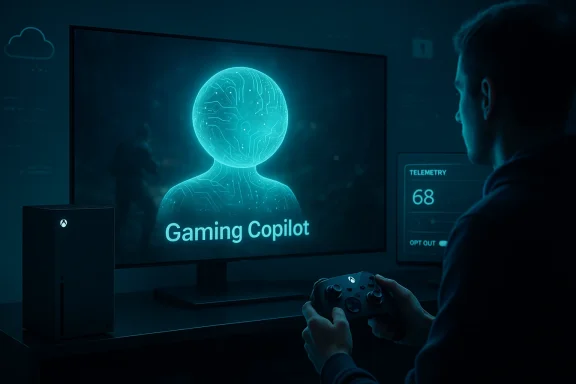
What changed this week at the Game Developers Conference is pitch‑black simple: an Xbox representative publicly said Gaming Copilot will be brought to “current‑generation consoles” later this year—a move that, if executed broadly, will place real‑time generative AI inside millions of Series X|S units.
Key capabilities highlighted by Microsoft include:
If not carefully designed, an always‑enabled Copilot could be a source of intermittent hitching or microstutter—exactly the kind of outcome console players react strongly to. Independent reporting and early user accounts from the PC beta already show mixed impressions about whether Copilot is “light touch” or intrusive.
That raises two questions for developers:
Community feedback indicates the following priorities for Microsoft:
Microsoft’s competitive advantage here is its vertical stack: Xbox OS, Azure, and a growing Copilot ecosystem. That same advantage carries responsibility. The company can avoid a backlash by defaulting to user control, transparent data governance, and developer agency. Fail to do that, and the feature risks reinforcing the worst fears players have when an AI executive replaces a gaming veteran: that convenience and platform monetization outpace the lived priorities of core console customers.
The company has the technical muscle and the cloud reach to make Copilot a genuinely helpful feature. But the social contract with players is fragile. Microsoft must show that Copilot is an option that empowers, not a background service that interrupts, harvests without clarity, or upends competitive integrity. The clock is ticking: the first months of the console rollout will set the tone for whether Copilot is embraced as a useful assistant or remembered as the moment Xbox let AI change the rules without asking the people who actually play.
Source: ComicBook.com Latest Xbox Console Announcement Is Exactly What Fans Feared
 Background
The last six months have been a period of rapid, high‑profile change for Microsoft’s gaming arm. Longtime Xbox leader Phil Spencer announced his retirement in February 2026, and Microsoft promoted Asha Sharma—previously the president of Microsoft’s CoreAI product—to lead Microsoft Gaming. That leadership change has reframed how journalists, developers, and players read every new Xbox announcement.At the same time, Microsoft has been actively rolling out its Xbox‑branded AI assistant, Gaming Copilot (Beta), across platforms. The feature first arrived for Xbox Insiders on Windows via the Game Bar in August 2025 and expanded through the autumn to the Xbox mobile app and supported handheld devices such as the ROG Xbox Ally. Microsoft positions Gaming Copilot as an in‑game assistant that can offer tips, achievement tracking, and recommendations tailored to a player’s activity.
What changed this week at the Game Developers Conference is pitch‑black simple: an Xbox representative publicly said Gaming Copilot will be brought to “current‑generation consoles” later this year—a move that, if executed broadly, will place real‑time generative AI inside millions of Series X|S units.
Where Gaming Copilot started and where it is now
From Game Bar experiment to cross‑device assistant
Gaming Copilot began as an experiment to bring Copilot‑style assistance into the gaming experience: a small overlay in Windows Game Bar that recognizes what you’re playing and offers context‑aware help. Microsoft opened the beta to Insiders in August 2025 and then pushed wider Beta rollouts through September and November, adding mobile companion functionality and device integrations.Key capabilities highlighted by Microsoft include:
- Contextual help during gameplay (walkthrough hints, boss strategies).
- Achievement and progress lookups without leaving the game.
- Personalized game recommendations based on play history.
- Voice and chat input for hands‑free assistance.
The console step: what was announced at GDC
Onstage at GDC, Sonali Yadav, Xbox’s gaming AI partner group product manager, said the company plans to bring Gaming Copilot to current‑gen consoles later this year. The remark was reported live and marks the clearest public confirmation that Copilot is moving from companion apps and PC overlays into the living room console environment. The announcement did not include a hard launch date or rollout details.Why players are anxious: leadership, AI, and trust
A leadership change that reframed expectations
The context matters: when leadership moves from a seasoned Xbox veteran to an AI executive, readers naturally expect priorities to shift. Asha Sharma’s track record at Microsoft is in building CoreAI products and scaling AI infrastructure—skills that align with platform‑level AI investments but not necessarily with console stewardship in the narrow sense of performance tuning, exclusive first‑party games, and hardware parity promises. Critics and commentators quickly connected the dots and read the Copilot expansion as confirmation of an AI‑first tilt under new leadership.The core fears
Gamers’ skepticism of in‑game AI features centers on a few recurring themes:- Performance overhead. Background AI services can consume CPU, GPU, memory, or network bandwidth—resources that console gamers understandably want dedicated to game performance.
- Privacy and data use. Copilot’s personalization requires telemetry: play history, achievements, and possibly live game state. Players want transparency and robust opt‑outs.
- Competitive integrity. Real‑time coaching raises questions in multiplayer and esports contexts about fairness and potential for cheating.
- Unwanted persistence. Users worry that even when they don’t request help, AI services might run in the background and be difficult to fully disable.
Technical implications of bringing Copilot to Xbox Series X|S
Two implementation models: local vs. cloud
At a high level there are two plausible architectures for delivering Copilot on consoles:- Local/edge inference: run lightweight models on the console SoC (possibly accelerated by specialized NPU or through optimized CPU/GPU paths). This minimizes latency and network dependence but pushes thermal and power budgets and could limit the assistant’s capabilities.
- Cloud‑assisted processing: stream prompts to Azure for heavy lifting and return answers. This enables larger models and more accurate responses but introduces network latency, bandwidth usage, user privacy surface area, and potential service availability issues.
Resource contention and UI integration
A console overlay that analyzes live game state and responds in real time is more than a simple chat window. To deliver accurate context, Copilot may need:- Hooks into the game engine or OS to learn the current scene/state.
- Capture of telemetry (player location, NPC status, objectives).
- Fast local rendering for UI overlays that don’t interrupt the game’s frame loop.
If not carefully designed, an always‑enabled Copilot could be a source of intermittent hitching or microstutter—exactly the kind of outcome console players react strongly to. Independent reporting and early user accounts from the PC beta already show mixed impressions about whether Copilot is “light touch” or intrusive.
Privacy, telemetry, and the data tradeoff
What Copilot needs to deliver personalized help
Useful, context‑aware help requires Copilot to know things about the player and the session:- Which game and which exact level or mission are active.
- Player progress, inventory, achievements.
- Past play history and behavioral signals to calibrate suggestions.
Transparency and legal/regulatory exposure
As regulators worldwide increase scrutiny on AI and consumer data, Xbox’s approach must satisfy not only user expectations but also legal obligations. That means:- Clear, machine‑readable explanations of what data Copilot uses and how.
- Granular opt‑ins/opt‑outs for telemetry and model learning.
- Options to localize processing for players in regulated jurisdictions where data export is constrained.
Competitive integrity: esports, ranked modes, and developer coordination
If an AI assistant can whisper optimal strategies, rotations, or micro‑timings to players in real time, its use in competitive contexts could be controversial. There are several mitigation paths:- Feature gating. Disable Copilot during ranked or esports matches.
- Developer hooks. Give game developers API controls to limit Copilot access to in‑game state in multiplayer modes.
- Certification. Create a certification or guidance program that outlines acceptable Copilot functionality for competitive titles.
The upsides: accessibility, discovery, and single‑player support
Not every consequence of Copilot’s move to consoles is negative. There are clear user‑facing benefits worth emphasizing:- Accessibility: Real‑time voice assistance and contextual guidance can make otherwise challenging games approachable for players with disabilities or for those who prefer a less punitive experience.
- Discovery and retention: Smart recommendations and friction‑reducing account-level features can help players find content on Game Pass or in store catalogs, improving long‑tail engagement.
- Single‑player support: For players who want hints rather than spoilers, Copilot’s contextual tips can reduce frustration without trashing the intended difficulty curve—if implemented with nuance.
How Microsoft should proceed: product and policy recommendations
- Prioritize opt‑out: Every console implementation must expose a single‑switch disable that truly stops background processing and telemetry collection for Copilot. Period.
- Implement developer controls: Ship an API so developers can restrict Copilot in multiplayer, ranked, or any mode where guidance would alter the competitive balance.
- Publish a transparency report: Quarterly disclosures on how Copilot data is used for model training, retention windows, and third‑party access—written plainly for non‑technical gamers.
- Performance caps and scheduling: Introduce strict scheduler rules so Copilot threads run only when the system is underutilized or when the player explicitly summons help.
- Regional parity and localization plans: Commit to a clear timeline for non‑English language support and regionally compliant data‑handling modes.
Developer economics and the platform strategy
Gaming Copilot is not merely a player feature; it’s a platform lever. Copilot’s ability to surface Game Pass content, recommend store purchases, and tie players back into Microsoft’s broader services makes it a strategic asset. Executives will therefore be tempted to bake promotional or business‑oriented nudges into the assistant.That raises two questions for developers:
- Will Copilot prioritize publisher‑paid promotions or organic relevance when recommending titles?
- How will Copilot’s suggestions interact with discoverability algorithms already disadvantaging smaller studios?
The console timeline and Project Helix
Microsoft has been talking about next‑generation ambitions—including the developer‑facing “Project Helix” work and a new full‑screen Xbox mode for Windows 11. Those moves, together with Copilot’s expansion, hint at a multi‑pronged strategy: evolve the platform’s software layer (Xbox mode, Copilot) while preparing next‑generation hardware and devkits that may better support AI features. Whether Helix will include hardware accelerators aimed at on‑device AI or whether Microsoft will rely on cloud augmentation is a vital technical and product question.What the community reaction tells us
Across social platforms and Reddit threads, reactions range from resigned acceptance to outright hostility. Some players are curious and see potential for accessibility and help; many are skeptical, worried that Copilot will be another always‑on service that’s hard to disable and that will sap system performance. The leadership transition amplified these fears—an AI executive at the helm is an easy shorthand for “expect more AI” in every product roadmap.Community feedback indicates the following priorities for Microsoft:
- Make Copilot fully optional (not just opt‑out but truly inert when off).
- Publish clear, non‑legalese documentation about data handling.
- Create visible developer controls and public commitments about competitive integrity.
Risks Microsoft must manage (and fast)
- Reputational risk if Copilot produces hallucinations or misleading in‑game advice that misdirects players in critical gameplay moments.
- Latency and performance regressions on consoles if Copilot consumes shared resources during intensive scenes.
- Regulatory and legal exposure if telemetry and model training practices aren’t sufficiently documented or if cross‑border data moves violate local rules.
- Developer backlash if Copilot undermines game design intent or is seen as favoring monetized recommendations.
Final assessment: why this matters for Xbox fans and the industry
Xbox bringing Gaming Copilot to Series X|S consoles is a turning point: it signals a commitment to embed generative assistance at the platform level. That promise has two faces. On one side, there are tangible benefits—accessibility, helpful hints, and cross‑device continuity. On the other side, there are real technical, privacy, and fairness dangers that will require careful engineering and policy design to mitigate.Microsoft’s competitive advantage here is its vertical stack: Xbox OS, Azure, and a growing Copilot ecosystem. That same advantage carries responsibility. The company can avoid a backlash by defaulting to user control, transparent data governance, and developer agency. Fail to do that, and the feature risks reinforcing the worst fears players have when an AI executive replaces a gaming veteran: that convenience and platform monetization outpace the lived priorities of core console customers.
What to watch next
- Microsoft’s rollout plan and whether Copilot ships as a full‑fledged feature or as a console beta expansion with tight developer opt‑ins.
- Official documentation clarifying Copilot’s data flows, telemetry retention, and training usage.
- Developer guidance and API surface for restricting Copilot in multiplayer or ranked modes.
- Performance measurements from independent reviewers and early adopters showing any frame‑time or input latency impacts on Series X|S hardware.
Conclusion
Gaming Copilot’s arrival on consoles is both a natural product evolution and a high‑stakes bet. It promises to bring smarter help and a more connected Xbox experience to millions of players—if Microsoft executes with restraint, transparency, and a relentless focus on not degrading the primary purpose of a console: playing games well.The company has the technical muscle and the cloud reach to make Copilot a genuinely helpful feature. But the social contract with players is fragile. Microsoft must show that Copilot is an option that empowers, not a background service that interrupts, harvests without clarity, or upends competitive integrity. The clock is ticking: the first months of the console rollout will set the tone for whether Copilot is embraced as a useful assistant or remembered as the moment Xbox let AI change the rules without asking the people who actually play.
Source: ComicBook.com Latest Xbox Console Announcement Is Exactly What Fans Feared
