

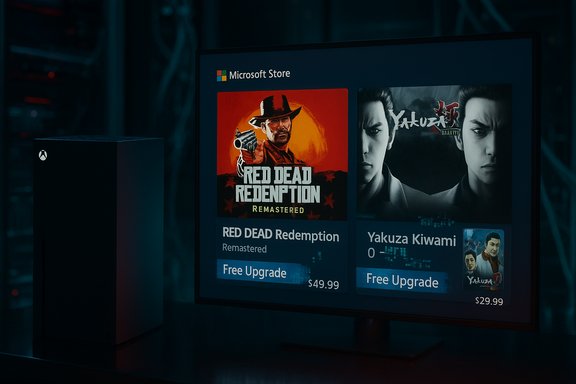
Xbox players who thought the holiday-season generosity of publishers meant painless free upgrades were rudely reminded that modern console ecosystems still trip over store entitlements: Rockstar’s Red Dead Redemption remaster suffered entitlement failures for Xbox owners, and now Ryu Ga Gotoku Studio’s Yakuza refreshes are facing the same problem — discounted upgrade pricing failing to apply on Xbox Series X|S, prompting an official apology and an investigation.
Background / Overview
Microsoft’s Xbox platform supports a variety of upgrade and entitlement flows that let owners of older digital editions claim current‑gen versions or discounted upgrades. Publishers often rely on those systems to deliver goodwill upgrades or paid, discounted updates when they re-release or remaster legacy titles for Xbox Series X|S. When those entitlement flows break, the result is immediate, visible customer pain: users either see full-price listings, are prompted to repurchase, or are simply unable to claim the new version despite owning the older edition. Recent launches show how brittle that process remains in practice.- Rockstar released a remastered Red Dead Redemption for current‑gen consoles and offered free upgrades to owners of the digital backward‑compatible Xbox 360 edition, but many Xbox users were initially unable to claim the free upgrade.
- Ryu Ga Gotoku Studio (RGG Studio) and Sega refreshed Yakuza titles for Series X|S (including Yakuza Kiwami 1 and 2 and Yakuza 0 Director’s Cut) and promised discounts or upgrade pricing for existing owners — but Xbox users reported the discounts not applying and incorrect prices appearing. RGG Studio issued an apology and said it was investigating the “incorrect discount prices.”
What went wrong: the mechanics of entitlement failures
How Xbox entitlements are supposed to work
When a publisher offers a free or discounted upgrade on Xbox, the flow generally involves a server-side mapping between the older SKU (the identifier for the version you own) and a new SKU (the upgraded edition). The Microsoft Store uses that mapping to present the correct price to the signed-in account and unlock the new download if the conditions are met.On the publisher side, the process typically includes:
- Registering a mapping/entitlement with Microsoft’s store backend.
- Submitting the new SKU for validation and approval.
- Coordinating the campaign/discount window and ensuring store metadata (eligibility flags, time windows, regions) are correct before launch.
Symptoms reported by players
Common, reproducible symptoms from the Red Dead and Yakuza incidents included:- The Store prompting owners to purchase the full new edition despite owning the previous digital version.
- Discounted price points appearing incorrectly (e.g., showing the discounted amount crossed out but not applied to the purchaser).
- Cases where the upgrade only appeared via specific Store entry points (for example, the mobile Store app or selecting an edition via the “Choose edition” UI) while other entry points showed the full price.
Confirmed facts and cross-checks
- Rockstar’s remaster upgrade: owners of the digital backward‑compatible Xbox 360 version should be able to upgrade to the Series X|S version for free, and Rockstar published help guidance confirming that. However, Xbox users reported entitlement failures and were temporarily unable to claim the free version. This issue was corroborated by player reports across Reddit and outlets covering the story.
- Yakuza (RGG Studio) pricing issue: Ryu Ga Gotoku Studio acknowledged that “incorrect discount prices were set” and apologized for a period during which discounts for existing purchasers were not applied; the developer said it was investigating and would correct the discount settings. Independent outlet coverage and community sites confirmed the studio post and the user reports.
- Pricing examples: storefront listings vary by region and edition. For Yakuza Kiwami and Kiwami 2 the new Series X|S editions are commonly shown at $19.99 in some markets, while Yakuza 0 Director’s Cut has been shown at $49.99; however, upgrade pricing for eligible owners differs by region and platform and was temporarily not being applied on Xbox. Always verify the price on your Microsoft account and the regionally relevant Store.
Why this keeps happening: plausible causes
1. Server-side entitlement propagation and caching
Store metadata and entitlement flags must propagate across Microsoft’s global storefront infrastructure. If propagation is incomplete or a cache contains stale data, some users will see the wrong price or no entitlement at all. That explains why some users saw the upgrade in one Store endpoint but not another.2. SKU mismatches and publisher submission errors
A minor mismatch between the SKU the publisher expects and the SKU registered with Microsoft will break the mapping. Publishers submit store metadata through their partner portals; mistakes or last-minute changes can push invalid mappings live. RGG Studio’s language about “incorrect discount prices were set” is consistent with such a configuration error.3. Microsoft approval and gating processes
Unlike PC storefronts where publishers can often run promotions unilaterally, Xbox involves an approval flow for certain entitlement operations. That adds steps and can become a bottleneck, especially during high-volume release windows (holiday season) when support or certification teams may be at reduced capacity. Windows Central’s reporting quotes developers who say Microsoft’s backend and approval processes are frequently a source of friction.4. Human factors and holiday staffing
When something goes wrong during a major release window, the combination of misconfiguration and reduced staffing (or high ticket volumes) can make it slower to detect and resolve the problem. Several outlets and community reports have speculated about holiday staffing shortages as a multiplier for the delay. This is plausible but remains speculative until either Microsoft or the publisher confirms staffing-related delays. Treat this as a reasonable hypothesis, not a confirmed cause.Practical guide: what Xbox owners should do now
If you own the older digital edition and are expecting a free or discounted upgrade, follow this checklist before repurchasing:- Sign in: Make sure you are signed into the same Microsoft account that originally owns the backward‑compatible or prior edition. The entitlement is account‑bound.
- Check the official support article or publisher announcements: Publishers often post instructions and troubleshooting steps (for example, Rockstar’s support article explicitly explains the upgrade steps).
- Try multiple endpoints:
- Check the Microsoft Store on the console.
- Check the Microsoft Store mobile app.
- Open the Store page and use the “Choose edition” or “Manage editions” UI (some users reported the entitlement appearing there).
- If you are asked to repurchase, do not immediately buy: wait 24–72 hours after contacting support unless the publisher explicitly confirms there is no entitlement for your variant (for example, physical discs often cannot be upgraded). A repurchase may be refunded if the publisher or Microsoft corrects the entitlement.
- Contact support and keep records:
- Open a ticket with the publisher (Rockstar, RGG Studio/Sega) and attach screenshots of the Store page and your purchase history.
- If directed to Microsoft support, request a case ID and keep copies of any support replies.
- Watch official channels: follow the publisher X/Twitter and support pages for updates; when studios acknowledge the problem publicly, they typically follow up when a fix is rolled out.
Developer perspective: why the Xbox model is different and sometimes brittle
On PC storefronts like Steam, Valve typically expects publishers to manage the entitlements and discount logic themselves. On Xbox, the platform enforces a centralized approval and certification flow for store metadata and entitlement changes. That centralization gives Microsoft control and consistency but introduces additional coordination steps:- Centralized approval means one party (Microsoft) must accept and propagate publisher-provided entitlement rules.
- The multi‑step validation and certification process increases the chance that last‑minute changes will misapply or fail.
- When publishers rely on Microsoft to apply discounts to existing purchasers, any miscommunication or misconfiguration can create a hard-to-diagnose failure that impacts end users.
What publishers can do to reduce risk
- Pre-approve entitlement mappings well ahead of public announcements and schedule the mapping to go live only after validation passes.
- Run a controlled rollout: enable entitlements for small regions or whitelisted accounts first to validate propagation before global activation.
- Provide fallback messaging in the Store listing so users know an entitlement is pending, rather than showing an ordinary purchase flow.
- Maintain transparent support guidance and a clear escalation path with the platform owner (Microsoft) to expedite fixes during high-traffic periods.
The reputational and consumer-risk cost
Broken entitlements harm trust in two ways:- Immediate financial frustration: players are asked to pay again or are uncertain whether to purchase, and that friction disproportionately affects those with limited budgets.
- Long-term perception: repeated entitlement failures across multiple publishers can create a narrative that the platform is unreliable for cross‑gen upgrades, reducing uptake for future remasters or upgraded editions.
Case studies: Red Dead and Yakuza — sequence and response
Red Dead Redemption remaster (Rockstar)
- Release: Rockstar released a current‑gen remaster and offered free upgrades to digital owners of the Xbox 360 backward‑compatible version.
- Problem: Many Xbox users could not claim the free upgrade and saw the retail listing instead. Support tickets proliferated; community threads documented inconsistent experiences. Rockstar published a support article explaining how to claim the upgrade and engaged with affected users.
- Outcome: Rockstar reported coordinating with Microsoft to resolve entitlement issues; resolution timelines varied by region and user. Community remediation involved store-side correction and direct support responses.
Yakuza Kiwami 1 & 2 and Yakuza 0 Director’s Cut (Ryu Ga Gotoku Studio / Sega)
- Release: RGG Studio and Sega launched upgraded versions for Series X|S and removed older versions from storefronts, offering discounted or free upgrade pricing for prior owners.
- Problem: Xbox users reported the discounts were not applied; incorrect prices were displayed. RGG Studio posted an apology, acknowledged incorrect discount settings, and said it was investigating to apply the correct discount settings.
- Outcome: As of the developer’s message, the issue was under investigation; users were advised to wait for the corrected pricing.
Risk assessment and broader implications for the holiday window
- Short-term: Consumers face confusion and potential double‑payments. Publishers risk refunds and negative press. Platform support queues swell.
- Mid-term: If the root causes are not addressed — better testing, improved propagation observability, and clearer manual override options for platform engineers — this category of error could become a recurring annual pattern around big release windows.
- Strategic: Centralized control of entitlements provides consistency but requires Microsoft to invest in faster-change windows and better rollback tools for publishers. Without improvements, some publishers may alter their upgrade strategies (for instance, offering voucher codes or in‑game unlocks) to avoid depending on Store entitlements.
Verdict and final analysis
This is a systems‑level reliability problem exposed by high‑visibility launches. The facts are clear: publishers announced upgrade/discount programs, users on Xbox experienced failures to claim them, and publishers (Rockstar, RGG Studio) acknowledged and started remediation. Key strengths in the current ecosystem:- The centralized Xbox store can, when working correctly, deliver seamless cross‑gen entitlements and protect consumers from repurchasing.
- Publishers and platform maintainers respond publicly and open investigations, which helps contain damage.
- Centralization makes the entitlement system a single point of failure during coordinated releases.
- The current approval and propagation processes appear brittle and insufficiently observable for rapid triage.
- Consumers are left guessing and sometimes pressured into repurchasing before problems are fixed.
- Players should exhaust the multi‑endpoint checks and support steps before repurchasing.
- Publishers should standardize pre-launch validation for entitlements and use controlled rollouts.
- Microsoft should invest in faster propagation checks, clearer entitlement diagnostics for publishers, and a fail‑safe UI message for “entitlement pending” to reduce consumer confusion.
Quick checklist — If you’re affected today
- Confirm the account that owns the original version.
- Try the Store on console and mobile; check the “Choose edition” UI.
- Open publisher support tickets with screenshots and timestamps.
- Hold off on repurchasing if you can; request a refund if the entitlement is fixed later.
- Watch official publisher posts for confirmation that discounts or entitlements have been fixed.
The recurring theme is simple: digital stores and entitlement systems must be both reliable and transparent. When they’re not, the consequences are not just lost sales — they are angry customers and a step backward for cross‑gen goodwill. The Red Dead and Yakuza cases are a pragmatic reminder that even relatively small backend mistakes can have outsized consumer and reputational effects during major release windows. The technical fixes exist; the industry challenge is making them routine rather than reactive.
Source: Windows Central https://www.windowscentral.com/gami...es-x-s-ryu-ga-gotoku-studio-offers-an-update/
