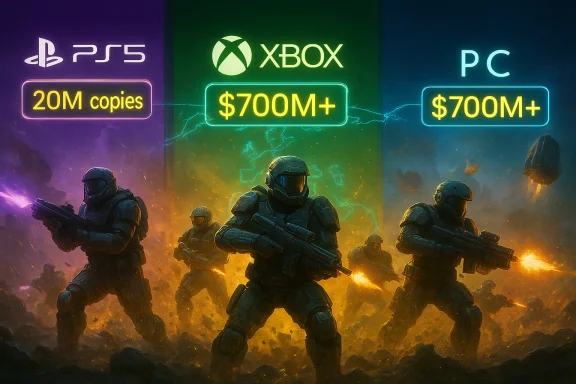
Microsoft’s Xbox Game Studios has quietly moved from “selective” porting to an explicit strategy of getting more first‑party games onto PlayStation 5 in 2026, a shift that redefines how exclusivity, subscriptions, and platform competition will work for the next console generation.
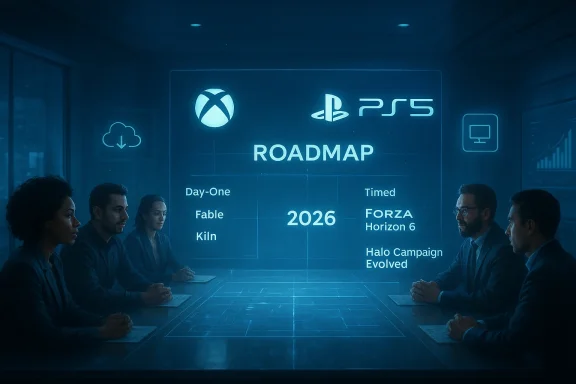
In January 2026 Microsoft used its Developer Direct showcase to underline a strategic pivot: several high‑profile first‑party titles confirmed for Xbox and PC will also appear on PS5 either at launch or shortly thereafter. The headline examples include Fable and Double Fine’s surprise Kiln as day‑one multiplatform releases, while Forza Horizon 6 will debut on Xbox and PC first with a planned PS5 release later in 2026. That approach — selective simultaneous launches plus timed ports — is now explicit company policy rather than ad‑hoc experimentation.
This story explains what Microsoft announced, why it matters for the console market and Game Pass economics, what the technical and operational costs are, and which strategic risks both companies and developers should watch in 2026. The analysis draws on the Developer Direct revelations, interviews with Xbox Game Studios leadership, and independent reporting that corroborates the new playbook.
Craig Duncan, head of Xbox Game Studios, has framed the approach succinctly: “We want our games to reach the most players that we can.” That quote — repeated across interviews during the Developer Direct cycle — encapsulates the commercial logic driving more PS5 releases. In short: larger player counts can increase multiplayer health, DLC and microtransaction revenue, and Game Pass conversion opportunities even if some unit sales on Xbox are lost.
The upside is clear: larger player bases, healthier multiplayer ecosystems, and more opportunities to monetize post‑launch content and subscriptions. The downside is equally concrete: porting costs, potential brand dilution, execution risk, and the need for careful measurement of lifetime value across platforms. For Microsoft, the strategy’s success will come down to execution — scaling porting capacity, maintaining quality parity, and proving that incremental engagement and subscription economics offset any lost hardware‑led sales. For players and competitors, this marks a phase where the console wars will increasingly be fought on services, community reach, and cross‑platform experience rather than on software gatekeeping alone.
(Analysis informed by the January 2026 Developer Direct coverage and leadership interviews; see reporting from GamesRadar+, Windows Central, and The Verge for original quotes and event summaries. Additional technical and industry context is drawn from internal briefing notes and platform porting case studies.)
Source: TechPowerUp Xbox To Redouble PS5 Game Launch and Port Efforts in 2026 | TechPowerUp}
 Overview
In January 2026 Microsoft used its Developer Direct showcase to underline a strategic pivot: several high‑profile first‑party titles confirmed for Xbox and PC will also appear on PS5 either at launch or shortly thereafter. The headline examples include Fable and Double Fine’s surprise Kiln as day‑one multiplatform releases, while Forza Horizon 6 will debut on Xbox and PC first with a planned PS5 release later in 2026. That approach — selective simultaneous launches plus timed ports — is now explicit company policy rather than ad‑hoc experimentation. This story explains what Microsoft announced, why it matters for the console market and Game Pass economics, what the technical and operational costs are, and which strategic risks both companies and developers should watch in 2026. The analysis draws on the Developer Direct revelations, interviews with Xbox Game Studios leadership, and independent reporting that corroborates the new playbook.
Background: how Xbox arrived here
From exclusivity to reach
Historically, platform exclusives were the clearest tool console manufacturers used to drive hardware sales and brand identity. Microsoft’s Xbox ecosystem leaned on franchises like Halo, Forza, and Fable as defining pillars of the platform. Over the past several years that posture softened as Microsoft built a services‑first model centered on Xbox Game Pass, cloud streaming, and cross‑device access. The result: the business case for exclusivity has shifted from hardware‑led lock‑in to subscription and lifetime value.Craig Duncan, head of Xbox Game Studios, has framed the approach succinctly: “We want our games to reach the most players that we can.” That quote — repeated across interviews during the Developer Direct cycle — encapsulates the commercial logic driving more PS5 releases. In short: larger player counts can increase multiplayer health, DLC and microtransaction revenue, and Game Pass conversion opportunities even if some unit sales on Xbox are lost.
What changed technically
Two technical trends made the move more feasible. First, modern engines and cloud‑centric architectures allow studios to ship thin clients that stream heavy assets, reducing platform‑specific porting friction. Second, third‑party studio partnerships and external porting houses give first‑party teams capacity to adapt builds to other consoles without derailing core schedules. Microsoft’s recent PS5 ports (for example, Forza Horizon 5 and Sea of Thieves in earlier windows) provided empirical data that ports can expand communities and revenue.What Xbox announced in January 2026 (and what they didn’t)
Confirmed multiplatform and timing
- Fable — confirmed as a day‑one release on Xbox Series X|S, Windows PC, and PS5 (autumn 2026); Game Pass on day one.
- Kiln (Double Fine) — surprise reveal and planned for Spring 2026 on Xbox, PC, and PS5, with early testing expected.
- Forza Horizon 6 — launches May 19, 2026 on Xbox Series X|S and PC, with PS5 to follow later in the year (timed multiplatform).
- Halo: Campaign Evolved — rebuilt and scheduled for Xbox, PC, and PS5 in 2026, marking the series’ most visible cross‑platform step.
Leadership messaging: optionality, not abdication
The message from Craig Duncan and other executives is not that exclusives are dead, but that Microsoft will maintain optionality. The company will prioritize doing right by platform players — sometimes that means simultaneous release, sometimes it means staggered ports to preserve quality or deliver platform‑specific features. Duncan has stressed the resource realities: teams are finite and shipping simultaneously everywhere isn’t always feasible without adding time or headcount.Why this matters: markets, subscriptions, and community effects
1) Services‑first commercial logic
The most important implication is a shift in how value is captured. Microsoft’s calculus now places more weight on lifetime player value — subscriptions, DLC, cosmetics, and cloud engagement — than on a pure hardware lock‑in strategy. Opening first‑party IP to PlayStation expands the addressable market for monetizable players and reduces friction in cross‑platform social play, which matters for long‑tail engagement.2) Multiplayer and community health
Multiplayer ecosystems scale with player population. When blockbuster titles arrive on PS5, player pools grow, matchmaking improves, and community content proliferates — all of which feed back into retention and monetization. Examples cited by Xbox leadership include the measurable engagement spikes after PS5 ports of Forza Horizon 5 and Sea of Thieves. Those empirical wins underpin the new strategy.3) Competitive pressure on Sony
Sony still controls hardware differentiation and platform‑level experiences (controller features, PS5 Pro enhancements, VR on PS VR2), and it retains a pipeline of platform exclusives. But Microsoft’s widening of first‑party availability reduces Sony’s ability to rely purely on software gatekeeping as a purchase driver. Expect Sony to respond by redoubling investments in platform exclusives, marketing, and subscription feature differentiation.The technical and operational costs of shipping to PS5
Porting is not a checkbox
Porting a modern AAA title is a significant engineering project. Even with portable engines like Unreal Engine 5 or modular in‑house tech, developers must:- Optimize rendering paths for different GPU architectures and memory subsystems.
- Ensure stable performance targets (30 fps vs 60 fps, ray tracing parity, resolution modes).
- Integrate platform APIs (trophies/achievements, social/friends systems, DRM, platform‑specific audio and controller features).
- Manage certification schedules and QA windows that can add weeks of work.
Scaling porting capacity
To make a durable multiplatform strategy routine, Microsoft must scale both in‑house and partner porting capacity. That means hiring platform engineers, building cross‑platform QA tooling, and contracting experienced porting houses. The alternative — relying on ad‑hoc porting for each title — risks inconsistent experiences and release slippage. Evidence from recent projects shows Microsoft is already leveraging external partners for ports and optimization work.Business implications: short term and long term
Short term winners
- Xbox Game Pass subscribers and PC players benefit from immediate access and infrastructure investments that push parity across ecosystems.
- Third‑party partners (and Microsoft’s studios) gain larger launch audiences and diversified revenue streams.
Potential long term advantages for Microsoft
- Broader discovery pipeline for first‑party IP, increasing potential for sequels, DLC buyers, and long‑tail monetization.
- Stronger community effects that make Game Pass and cloud services more attractive across platforms, including non‑Xbox hardware owners.
Cannibalization and measurement risk
Opening a game to PS5 can cannibalize some initial Xbox sales. Microsoft’s bet is that incremental subscribers, DLC buyers, and extended engagement from PS5 players will outstrip that loss over the game’s lifetime — but that requires precise measurement and disciplined long‑term monetization planning. The company will need to track cohort economics across platforms and control for variables like regional pricing and promotional timing.Strategic risks and downside scenarios
1) Brand dilution and identity loss
For a generation, franchises like Halo and Forza symbolized Xbox identity. Making them multiplatform risks eroding the distinctiveness that drove console consideration for some customers. Fans who value exclusivity may view the change as a loss of cultural ownership. Microsoft must balance reach with a retained sense of brand DNA.2) Quality and parity failures
The reputational cost of launching inferior ports is real. If PS5 releases ship with lower performance or missing features, Microsoft risks backlash that undermines the strategy. The company’s insistence on “doing it really well” is intended to blunt this risk, but implementation is nontrivial. Robust QA, platform‑specific tuning, and staged rollouts are necessary safeguards.3) Developer workload and morale
Increased porting demands raise studio workloads and can exacerbate crunch or attrition if not matched by funding and headcount. Microsoft will need to invest in hiring, tooling, and realistic timelines to avoid the human cost of a multiplatform push. This is a material operational risk that could degrade output quality across the portfolio if mishandled.4) Regulatory and competitive scrutiny
There are two competing regulatory considerations. On one hand, removing exclusivity can be framed as pro‑competitive. On the other hand, if Microsoft bundles or conditions cross‑platform access in ways that favor Game Pass or data capture, regulators may scrutinize the firm’s market conduct. Both outcomes are plausible and will depend on execution details.How Sony might — and probably will — respond
Sony’s strongest levers are hardware differentiation, exclusive IP, and platform experience. Likely responses include:- Doubling down on platform exclusives with bigger, more frequent first‑party releases.
- Emphasizing technical advantages (PS5 Pro, Tempest 3D audio, DualSense features) to highlight the best possible experience for flagship titles.
- Strengthening PlayStation Plus tiers and perks that create distinct subscription value.
- Negotiating timed exclusivity windows or content deals for specific franchises.
Practical guidance for developers and players
For studios and dev leads
- Build porting into project roadmaps early; platform engineering must be a first‑class concern.
- Invest in cross‑platform CI/CD and automated testing to reduce certification friction.
- Define minimum parity targets per platform and publish clear expectations for players to reduce negative surprises.
- Negotiate realistic timelines with publishers to avoid compressing QA for ports.
For players and consumers
- Expect more first‑party IP on the platform of your choice, but check which edition and which platform features are included at launch. Day‑one Game Pass availability on Xbox/PC will not automatically equal Game Pass parity on PS5.
- Watch patch notes and performance reports after launch; delayed ports often require early updates to reach parity.
- If you value console‑exclusive content long term, monitor which franchises remain platform‑anchored and which become multi‑platform staples.
What to watch in 2026: key milestones and indicators
- Will future tentpole franchises (e.g., next Gears entry) be multiplatform at launch or delayed ports? This will indicate whether the Developer Direct change was tactical or strategic.
- Game Pass metric disclosures: watch Microsoft’s disclosures on subscriber conversion from cross‑platform launches and cloud play hours to validate the economic thesis.
- Performance parity reports from independent media and player communities will reveal whether Microsoft’s porting capacity is keeping pace with ambitions.
- Sony’s counterprogramming: new exclusive content, subscription adjustments, or technical showcases will be informative of the competitive response.
Critical assessment: strengths, limits, and why the strategy is credible
Notable strengths
- Commercial pragmatism: Microsoft’s shift reflects realistic monetization levers in a subscription era; broader reach logically increases lifetime value potential.
- Community benefits: Larger cross‑platform player pools improve matchmaking and social features for multiplayer titles.
- Technical feasibility: Advances in thin‑client design, cloud streaming, and third‑party porting expertise make more frequent multiplatform launches operationally possible.
Key limits and cautionary notes
- Execution risk is high. Porting at scale without commensurate investment will produce inconsistent player experiences. This is the single largest operational hazard.
- Economic assumptions must be tested. The expectation that subscription and ancillary revenue outweigh lost hardware or box sales is plausible but not guaranteed for every franchise or region. Microsoft must transparently measure cohort LTV across platforms.
- Perception and identity costs. Longstanding fans may feel alienated if marquee franchises lose their platform exclusivity; Microsoft must manage messaging and value creation carefully.
Conclusion
Microsoft’s 2026 Developer Direct marks a deliberate evolution in Xbox’s strategy: move from a strict exclusivity posture to a pragmatic, services‑first model that prioritizes reach and long‑term player value. That change is grounded in measurable outcomes from prior ports, modern technical architectures that lower the barriers to cross‑platform engineering, and leadership signaling that the company will choose scale over scarcity when it makes sense.The upside is clear: larger player bases, healthier multiplayer ecosystems, and more opportunities to monetize post‑launch content and subscriptions. The downside is equally concrete: porting costs, potential brand dilution, execution risk, and the need for careful measurement of lifetime value across platforms. For Microsoft, the strategy’s success will come down to execution — scaling porting capacity, maintaining quality parity, and proving that incremental engagement and subscription economics offset any lost hardware‑led sales. For players and competitors, this marks a phase where the console wars will increasingly be fought on services, community reach, and cross‑platform experience rather than on software gatekeeping alone.
(Analysis informed by the January 2026 Developer Direct coverage and leadership interviews; see reporting from GamesRadar+, Windows Central, and The Verge for original quotes and event summaries. Additional technical and industry context is drawn from internal briefing notes and platform porting case studies.)
Source: TechPowerUp Xbox To Redouble PS5 Game Launch and Port Efforts in 2026 | TechPowerUp}