

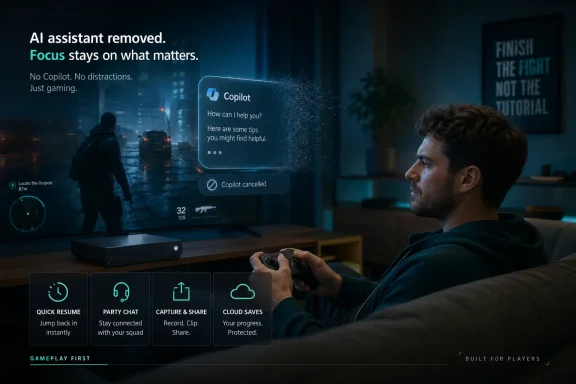
Xbox CEO Asha Sharma said at Bloomberg Live on June 4, 2026, that Microsoft killed Copilot for Xbox consoles because console players were not excited by the proposed AI assistant and because the feature did not solve a clear gaming problem. The remark matters because it turns a quiet product cancellation into a visible referendum on Microsoft’s AI-everywhere strategy. For Xbox, the decision is less about rejecting AI than about admitting that a console interface is not a dumping ground for every corporate priority. For Microsoft, it is an unusually public example of a division telling Redmond’s flagship software story: not here, not like this.
The most striking part of Sharma’s answer was not that Copilot for Xbox is dead. That had already been made clear in May, when Xbox said it would wind down Copilot on mobile and stop console development. The striking part was the reason: Xbox customers were not asking for it, were not energized by it, and did not seem to regard it as a missing piece of the console experience.
That is a sharper diagnosis than the usual corporate language about “realigning investments” or “focusing resources.” Sharma framed the cancellation as a product judgment. If an AI feature does not solve a real problem for players, it does not belong on the box simply because Microsoft has invested heavily in the Copilot brand.
The timing made the reversal look even more dramatic. Only weeks earlier, Microsoft had been showing how a Gaming Copilot might offer contextual help in games such as Forza Horizon, Diablo, and Sea of Thieves. The pitch was familiar: instead of searching YouTube, Reddit, or a wiki, players could ask an assistant for guidance while staying in the Xbox experience.
That sounds useful in a demo. It also sounds like the kind of feature that collapses under the weight of real living-room use. Console players already have phones, voice chat, Discord, walkthroughs, guides, friends, and increasingly good in-game tutorials. An AI helper needs to be faster, more accurate, less intrusive, and less embarrassing than all of those alternatives. “It exists” is not enough.
Copilot on Windows can at least be sold as a productivity layer. Users are writing documents, searching settings, debugging errors, summarizing emails, and managing files. Whether Copilot does those things well is a separate argument, but the category logic is obvious: PCs are general-purpose machines, and general-purpose machines create general-purpose confusion.
A console creates a different expectation. The dashboard is not supposed to become a conversational workspace. The best console features disappear into muscle memory: quick resume, party chat, capture sharing, controller pairing, cloud saves, store browsing, accessibility shortcuts. The minute a console feature feels like homework, it is already losing.
That is why Gaming Copilot always had a whiff of boardroom inevitability about it. Microsoft has Copilot. Xbox is Microsoft. Therefore Xbox must have Copilot. The reasoning is clean on a slide and dubious in a household where someone is just trying to finish a boss fight before dinner.
The strongest version of the idea is not absurd. A well-integrated, opt-in assistant that can understand a player’s current objective, avoid spoilers, provide accessibility support, translate jargon, or explain systems without leaving the game could be genuinely useful. But that is an extremely high bar, and it requires deep game-level integration, latency discipline, trust, privacy boundaries, and publisher cooperation. A generic console-layer assistant risks being the least useful version of a good idea.
That is why her comments about neural rendering are important. Sharma did not argue that AI has no place in gaming. She pointed instead toward AI that improves rendering, upscaling, device footprint, and graphics. In other words, she drew a line between AI as an exposed assistant and AI as an enabling technology.
That distinction is where the industry is likely to settle after the hype cycle burns off. Players may not want a chatbot perched on top of every experience, but they will gladly accept better frame rates, faster asset creation, smarter accessibility tools, improved localization, more responsive NPC behavior, and higher-quality image reconstruction if those features make games better without turning play into a customer-support session.
For WindowsForum readers, this is the part that should feel familiar. Microsoft has often been at its best when it turns complex machinery into infrastructure and at its worst when it turns infrastructure into branding. DirectX mattered because it gave developers a serious graphics platform. Auto HDR and variable refresh rate matter because they improve the experience without demanding a new ritual from the user. A console Copilot button, by contrast, asks the player to care about Microsoft’s platform narrative.
Sharma’s argument implicitly accepts that the AI label is not magic. If the feature is a wrapper around uncertainty, it becomes another surface to maintain, moderate, explain, and defend. If AI is buried inside rendering, performance, or development workflows, it can succeed on results rather than on the user’s willingness to talk to it.
That is the context in which Sharma’s “not excited” comment lands. Xbox players have been blunt for years about what they want: stronger first-party consistency, clearer hardware commitment, a better dashboard, better store performance, better Windows integration, less confusing messaging, and a subscription strategy that does not feel like it changes shape every quarter. An AI assistant was not high on that list.
The embarrassment for Microsoft is that this was visible from the outside. Console communities did not erupt with grief when Copilot’s console plans were scrapped. There was no mass campaign demanding its restoration. If anything, much of the reaction was relief, mockery, or indifference.
That does not mean every user hated the idea. It means the burden of proof sat with Microsoft, and Microsoft had not met it. When a platform holder introduces a new persistent layer to the console experience, the question is not “could someone use this?” The question is “does this deserve space in one of the most constrained, habit-driven interfaces Microsoft ships?”
By answering no, Sharma is signaling that Xbox’s rebuild will be judged by tangible improvements rather than corporate alignment. That is the right instinct. Xbox does not need more proof that it can ingest Microsoft strategy decks. It needs proof that it can improve the daily experience of people who already bought into the ecosystem.
Sharma’s answer, that it was an Xbox decision and that she had latitude to make the best decisions for players, was carefully phrased. It did not describe a rebellion. It described delegated authority. But even that is notable inside a company that has been pushing Copilot into almost every visible surface.
The episode suggests Microsoft may be learning a more mature lesson about AI deployment. The first wave was about ubiquity: put Copilot everywhere, establish the brand, normalize the interaction model, and make AI feel like a default part of Microsoft products. The next wave has to be about fit. If every product gets the same assistant-shaped overlay, the brand becomes noise.
There is a risk here for Microsoft beyond Xbox. Copilot fatigue is real, even among users who see genuine value in generative AI. When a company overextends a brand, users stop evaluating individual features on their merits and start reacting to the logo. The Xbox cancellation is a small but vivid sign that the company cannot assume enthusiasm simply because an AI feature has been installed.
For enterprise IT, the lesson is equally plain. Users do not adopt AI because a vendor declares it transformational. They adopt it when it reduces friction in a workflow they already care about. If a feature arrives before the problem is clear, the IT department inherits the support burden, the training burden, and the backlash.
Neural rendering is the cleanest example because it points at a player-visible outcome without demanding player-visible interaction. If AI-assisted rendering can help deliver better image quality, reduce storage requirements, improve upscaling, or make handheld and console hardware stretch further, players will judge it the way they judge any graphics technology: by whether it looks good and runs well.
That is a very different bargain from an assistant that offers advice mid-game. A graphics feature does not need to be charming. It does not need to know when to stop talking. It does not need to avoid spoiling a puzzle unless the user asks in precisely the right way. It just needs to help the game perform.
Developers may also be more receptive to AI that removes repetitive work than to AI that mediates the player’s relationship with their game. Studios already wrestle with certification, localization, patch pipelines, compatibility, telemetry, and content scaling. If Xbox can use AI to simplify those burdens, it may win goodwill from developers without forcing a Copilot mascot into the player’s face.
The danger, of course, is that “AI for developers” can become its own euphemism for cost-cutting, content sludge, or degraded creative labor. Sharma’s comments do not settle that debate. They simply suggest that Xbox’s AI strategy is being redirected toward areas where the value proposition is less performative and more measurable.
The hard part is everything around the demo. How does the assistant know where the player is without invasive context capture? How does it avoid spoilers? How does it handle live-service updates, balance changes, user-generated content, mods, and multiplayer etiquette? How does it respond when the best answer is not in Microsoft’s data?
There is also the matter of authority. Games are not spreadsheets. Players often do not want the maximally efficient answer. They want hints, vibes, encouragement, build ideas, lore context, or a nudge that preserves discovery. A bad AI assistant can flatten that experience into an answer machine.
Even when the assistant is right, it may still be unwelcome. Part of being stuck in a game is deciding how stuck you want to be. Some players want to push through. Some want a spoiler-free hint. Some want a full guide. Some want to ask a friend because the social exchange is part of the fun. A console-level Copilot risks treating all confusion as a support ticket.
That is why the phrase “solving a problem” matters. The problem was not that players lacked information. The problem, if any, was that help is scattered, inconsistent, spoiler-heavy, and sometimes hard to access without leaving the game. Solving that problem requires delicacy. A branded assistant bolted to the platform may have been too blunt an instrument.
That ambiguity may be strategically rational, especially after Microsoft’s acquisition of Activision Blizzard and its continued push on PC. But it created emotional drag among console owners who wanted to know whether the box under their TV was still the center of the story. Against that backdrop, Copilot looked less like a feature and more like another reminder that Xbox might be serving Microsoft’s corporate ambitions before its players’ immediate needs.
Sharma’s recent messaging has tried to reverse that perception by putting console experience, PC fundamentals, and community trust back at the center. Killing Copilot fits that reset because it is a visible sacrifice. It tells players that not every Microsoft initiative gets automatic passage through the Xbox dashboard.
That symbolism matters, but it is not enough. The next test is execution. If Xbox removes Copilot and then delivers a faster interface, better library management, cleaner cross-buy clarity, stronger Windows gaming behavior, and more reliable first-party cadence, the cancellation will look like the first sign of discipline. If the platform continues to drift, it will look like an easy target cut while harder problems remained.
The console audience is not anti-technology. It is anti-distraction. Players accepted SSD-driven quick resume because it changed how they played. They accepted modern capture tools because sharing became native to the experience. They accept visual reconstruction when the results are good. They reject features that feel like the company talking to itself.
Windows users are more tolerant of general-purpose assistance than console users, but they are also more sensitive to control. A sysadmin managing fleets of PCs does not want surprise AI surfaces creating policy questions. A power user does not want a search box that behaves unpredictably. A privacy-conscious user does not want unclear boundaries around context and telemetry.
The best Copilot experiences on Windows will likely be the ones that respect existing workflows rather than replacing them with a conversational layer. Summarizing a meeting transcript, drafting a PowerShell command with clear review, explaining an error log, or helping navigate settings can be useful. Shoving a chatbot into every corner of the shell because the brand needs oxygen is how useful tools become irritants.
Xbox is an extreme case because the console is so focused. But that focus makes it a useful warning system. If users can instantly smell that an AI feature is serving the vendor more than the customer, no amount of launch choreography will fix the perception.
Microsoft’s challenge is to stop treating Copilot as a universal answer and start treating it as a design material. Sometimes that material belongs in the foreground. Sometimes it belongs in the rendering stack. Sometimes it belongs in developer tooling. Sometimes it does not belong at all.
That is healthy. Xbox’s next phase needs sharper product editing, not more ambient ambition. The brand has enough reach. It needs coherence.
The clearest read on the Copilot reversal is this:
 Xbox Finally Says the Quiet Part Out Loud
The most striking part of Sharma’s answer was not that Copilot for Xbox is dead. That had already been made clear in May, when Xbox said it would wind down Copilot on mobile and stop console development. The striking part was the reason: Xbox customers were not asking for it, were not energized by it, and did not seem to regard it as a missing piece of the console experience.That is a sharper diagnosis than the usual corporate language about “realigning investments” or “focusing resources.” Sharma framed the cancellation as a product judgment. If an AI feature does not solve a real problem for players, it does not belong on the box simply because Microsoft has invested heavily in the Copilot brand.
The timing made the reversal look even more dramatic. Only weeks earlier, Microsoft had been showing how a Gaming Copilot might offer contextual help in games such as Forza Horizon, Diablo, and Sea of Thieves. The pitch was familiar: instead of searching YouTube, Reddit, or a wiki, players could ask an assistant for guidance while staying in the Xbox experience.
That sounds useful in a demo. It also sounds like the kind of feature that collapses under the weight of real living-room use. Console players already have phones, voice chat, Discord, walkthroughs, guides, friends, and increasingly good in-game tutorials. An AI helper needs to be faster, more accurate, less intrusive, and less embarrassing than all of those alternatives. “It exists” is not enough.
The Living Room Is a Terrible Place for a Maybe-Useful Chatbot
The console is not a PC with a controller attached, even when the silicon and services increasingly overlap. It is a deliberate appliance, built around the promise that a player can sit down, pick up a controller, and get to the game with minimal ceremony. That makes it a hostile environment for features that require explanation.Copilot on Windows can at least be sold as a productivity layer. Users are writing documents, searching settings, debugging errors, summarizing emails, and managing files. Whether Copilot does those things well is a separate argument, but the category logic is obvious: PCs are general-purpose machines, and general-purpose machines create general-purpose confusion.
A console creates a different expectation. The dashboard is not supposed to become a conversational workspace. The best console features disappear into muscle memory: quick resume, party chat, capture sharing, controller pairing, cloud saves, store browsing, accessibility shortcuts. The minute a console feature feels like homework, it is already losing.
That is why Gaming Copilot always had a whiff of boardroom inevitability about it. Microsoft has Copilot. Xbox is Microsoft. Therefore Xbox must have Copilot. The reasoning is clean on a slide and dubious in a household where someone is just trying to finish a boss fight before dinner.
The strongest version of the idea is not absurd. A well-integrated, opt-in assistant that can understand a player’s current objective, avoid spoilers, provide accessibility support, translate jargon, or explain systems without leaving the game could be genuinely useful. But that is an extremely high bar, and it requires deep game-level integration, latency discipline, trust, privacy boundaries, and publisher cooperation. A generic console-layer assistant risks being the least useful version of a good idea.
Sharma’s AI Credibility Makes the Rejection Harder to Dismiss
If Xbox had been run by a lifelong console traditionalist, the decision would be easy to caricature as institutional resistance. Sharma complicates that reading. She came to the role with an AI and product background, and Microsoft’s broader executive culture has spent the last several years treating Copilot as one of the company’s defining platforms.That is why her comments about neural rendering are important. Sharma did not argue that AI has no place in gaming. She pointed instead toward AI that improves rendering, upscaling, device footprint, and graphics. In other words, she drew a line between AI as an exposed assistant and AI as an enabling technology.
That distinction is where the industry is likely to settle after the hype cycle burns off. Players may not want a chatbot perched on top of every experience, but they will gladly accept better frame rates, faster asset creation, smarter accessibility tools, improved localization, more responsive NPC behavior, and higher-quality image reconstruction if those features make games better without turning play into a customer-support session.
For WindowsForum readers, this is the part that should feel familiar. Microsoft has often been at its best when it turns complex machinery into infrastructure and at its worst when it turns infrastructure into branding. DirectX mattered because it gave developers a serious graphics platform. Auto HDR and variable refresh rate matter because they improve the experience without demanding a new ritual from the user. A console Copilot button, by contrast, asks the player to care about Microsoft’s platform narrative.
Sharma’s argument implicitly accepts that the AI label is not magic. If the feature is a wrapper around uncertainty, it becomes another surface to maintain, moderate, explain, and defend. If AI is buried inside rendering, performance, or development workflows, it can succeed on results rather than on the user’s willingness to talk to it.
The Cancellation Is Also a Confession About Xbox’s Priorities
Xbox does not have the luxury of indulgent experiments right now. The platform is juggling a difficult identity problem: it wants to be a console brand, a PC gaming publisher, a subscription service, a cloud service, a handheld-adjacent ecosystem, and a cross-platform software giant. Every added initiative competes with the basics.That is the context in which Sharma’s “not excited” comment lands. Xbox players have been blunt for years about what they want: stronger first-party consistency, clearer hardware commitment, a better dashboard, better store performance, better Windows integration, less confusing messaging, and a subscription strategy that does not feel like it changes shape every quarter. An AI assistant was not high on that list.
The embarrassment for Microsoft is that this was visible from the outside. Console communities did not erupt with grief when Copilot’s console plans were scrapped. There was no mass campaign demanding its restoration. If anything, much of the reaction was relief, mockery, or indifference.
That does not mean every user hated the idea. It means the burden of proof sat with Microsoft, and Microsoft had not met it. When a platform holder introduces a new persistent layer to the console experience, the question is not “could someone use this?” The question is “does this deserve space in one of the most constrained, habit-driven interfaces Microsoft ships?”
By answering no, Sharma is signaling that Xbox’s rebuild will be judged by tangible improvements rather than corporate alignment. That is the right instinct. Xbox does not need more proof that it can ingest Microsoft strategy decks. It needs proof that it can improve the daily experience of people who already bought into the ecosystem.
Satya Nadella’s Copilot Machine Meets a Product-Market Wall
The most politically interesting part of the Bloomberg exchange was the Nadella angle. Microsoft’s CEO has been the company’s most important evangelist for Copilot as a unifying product layer across work, software development, search, Windows, and enterprise tooling. Asking whether he was comfortable with Xbox killing a Copilot integration was really asking whether Xbox has permission to resist the mothership.Sharma’s answer, that it was an Xbox decision and that she had latitude to make the best decisions for players, was carefully phrased. It did not describe a rebellion. It described delegated authority. But even that is notable inside a company that has been pushing Copilot into almost every visible surface.
The episode suggests Microsoft may be learning a more mature lesson about AI deployment. The first wave was about ubiquity: put Copilot everywhere, establish the brand, normalize the interaction model, and make AI feel like a default part of Microsoft products. The next wave has to be about fit. If every product gets the same assistant-shaped overlay, the brand becomes noise.
There is a risk here for Microsoft beyond Xbox. Copilot fatigue is real, even among users who see genuine value in generative AI. When a company overextends a brand, users stop evaluating individual features on their merits and start reacting to the logo. The Xbox cancellation is a small but vivid sign that the company cannot assume enthusiasm simply because an AI feature has been installed.
For enterprise IT, the lesson is equally plain. Users do not adopt AI because a vendor declares it transformational. They adopt it when it reduces friction in a workflow they already care about. If a feature arrives before the problem is clear, the IT department inherits the support burden, the training burden, and the backlash.
Gaming AI Will Survive by Becoming Less Visible
The irony is that AI may matter enormously to the future of Xbox precisely because Copilot on console is gone. The most consequential AI in gaming may never introduce itself to the player. It may live in render pipelines, build systems, asset workflows, moderation tools, accessibility layers, animation systems, and QA automation.Neural rendering is the cleanest example because it points at a player-visible outcome without demanding player-visible interaction. If AI-assisted rendering can help deliver better image quality, reduce storage requirements, improve upscaling, or make handheld and console hardware stretch further, players will judge it the way they judge any graphics technology: by whether it looks good and runs well.
That is a very different bargain from an assistant that offers advice mid-game. A graphics feature does not need to be charming. It does not need to know when to stop talking. It does not need to avoid spoiling a puzzle unless the user asks in precisely the right way. It just needs to help the game perform.
Developers may also be more receptive to AI that removes repetitive work than to AI that mediates the player’s relationship with their game. Studios already wrestle with certification, localization, patch pipelines, compatibility, telemetry, and content scaling. If Xbox can use AI to simplify those burdens, it may win goodwill from developers without forcing a Copilot mascot into the player’s face.
The danger, of course, is that “AI for developers” can become its own euphemism for cost-cutting, content sludge, or degraded creative labor. Sharma’s comments do not settle that debate. They simply suggest that Xbox’s AI strategy is being redirected toward areas where the value proposition is less performative and more measurable.
The Demo Was Never the Product
The March showcase did what demos are designed to do: it made an unfinished concept look coherent for a few minutes. A player asks a question, the assistant responds, and the audience imagines a future where stuck players never alt-tab to a guide again. That is the easy part.The hard part is everything around the demo. How does the assistant know where the player is without invasive context capture? How does it avoid spoilers? How does it handle live-service updates, balance changes, user-generated content, mods, and multiplayer etiquette? How does it respond when the best answer is not in Microsoft’s data?
There is also the matter of authority. Games are not spreadsheets. Players often do not want the maximally efficient answer. They want hints, vibes, encouragement, build ideas, lore context, or a nudge that preserves discovery. A bad AI assistant can flatten that experience into an answer machine.
Even when the assistant is right, it may still be unwelcome. Part of being stuck in a game is deciding how stuck you want to be. Some players want to push through. Some want a spoiler-free hint. Some want a full guide. Some want to ask a friend because the social exchange is part of the fun. A console-level Copilot risks treating all confusion as a support ticket.
That is why the phrase “solving a problem” matters. The problem was not that players lacked information. The problem, if any, was that help is scattered, inconsistent, spoiler-heavy, and sometimes hard to access without leaving the game. Solving that problem requires delicacy. A branded assistant bolted to the platform may have been too blunt an instrument.
Xbox’s Real Trust Deficit Is Not About AI
The cancellation also plays into a deeper trust issue for Xbox. For years, Microsoft has asked players to accept a constantly expanding definition of the brand. Xbox is a console, but also an app. It is a service, but also a publisher. It is hardware, but also cloud. It is exclusive, except when it is not. It is everywhere, which sometimes made the actual console feel strangely secondary.That ambiguity may be strategically rational, especially after Microsoft’s acquisition of Activision Blizzard and its continued push on PC. But it created emotional drag among console owners who wanted to know whether the box under their TV was still the center of the story. Against that backdrop, Copilot looked less like a feature and more like another reminder that Xbox might be serving Microsoft’s corporate ambitions before its players’ immediate needs.
Sharma’s recent messaging has tried to reverse that perception by putting console experience, PC fundamentals, and community trust back at the center. Killing Copilot fits that reset because it is a visible sacrifice. It tells players that not every Microsoft initiative gets automatic passage through the Xbox dashboard.
That symbolism matters, but it is not enough. The next test is execution. If Xbox removes Copilot and then delivers a faster interface, better library management, cleaner cross-buy clarity, stronger Windows gaming behavior, and more reliable first-party cadence, the cancellation will look like the first sign of discipline. If the platform continues to drift, it will look like an easy target cut while harder problems remained.
The console audience is not anti-technology. It is anti-distraction. Players accepted SSD-driven quick resume because it changed how they played. They accepted modern capture tools because sharing became native to the experience. They accept visual reconstruction when the results are good. They reject features that feel like the company talking to itself.
Microsoft Should Treat This as a Windows Lesson, Too
There is a Windows story hiding inside this Xbox story. Microsoft has been unusually aggressive about making Copilot a system-level presence across Windows PCs, and the same product-fit questions apply there. A feature can be technically impressive and still be badly placed.Windows users are more tolerant of general-purpose assistance than console users, but they are also more sensitive to control. A sysadmin managing fleets of PCs does not want surprise AI surfaces creating policy questions. A power user does not want a search box that behaves unpredictably. A privacy-conscious user does not want unclear boundaries around context and telemetry.
The best Copilot experiences on Windows will likely be the ones that respect existing workflows rather than replacing them with a conversational layer. Summarizing a meeting transcript, drafting a PowerShell command with clear review, explaining an error log, or helping navigate settings can be useful. Shoving a chatbot into every corner of the shell because the brand needs oxygen is how useful tools become irritants.
Xbox is an extreme case because the console is so focused. But that focus makes it a useful warning system. If users can instantly smell that an AI feature is serving the vendor more than the customer, no amount of launch choreography will fix the perception.
Microsoft’s challenge is to stop treating Copilot as a universal answer and start treating it as a design material. Sometimes that material belongs in the foreground. Sometimes it belongs in the rendering stack. Sometimes it belongs in developer tooling. Sometimes it does not belong at all.
The Xbox Reset Now Has a Very Public Yardstick
Sharma’s decision gives Xbox a cleaner story, but it also raises expectations. Once a leader says she is prioritizing features that make sense for players, every subsequent investment can be judged against that standard. The company has forfeited the excuse that corporate strategy alone explains the roadmap.That is healthy. Xbox’s next phase needs sharper product editing, not more ambient ambition. The brand has enough reach. It needs coherence.
The clearest read on the Copilot reversal is this:
- Xbox is winding down Copilot on mobile and has stopped development of the planned console version.
- Sharma says console players were not excited by the feature and that AI must solve a real gaming problem before it ships.
- Microsoft’s broader Copilot push remains intact, but Xbox has been allowed to opt out of an assistant-first implementation.
- AI is still likely to shape Xbox through rendering, upscaling, development tooling, accessibility, and performance work.
- The decision will only matter if Xbox follows it with visible improvements to console, PC, services, and first-party execution.
References
- Primary source: Pure Xbox
Published: 2026-06-05T17:00:36.512839
Loading…
www.purexbox.com - Related coverage: tomshardware.com
Loading…
www.tomshardware.com - Official source: developer.microsoft.com
Loading…
developer.microsoft.com - Related coverage: techspot.com
Loading…
www.techspot.com - Related coverage: winbuzzer.com
Loading…
winbuzzer.com - Related coverage: games.gg
Loading…
games.gg
- Related coverage: gamespot.com
Loading…
www.gamespot.com - Related coverage: bloomberg.com
Loading…
www.bloomberg.com - Related coverage: xboxygen.com
Loading…
www.xboxygen.com - Related coverage: windows.gadgethacks.com
Loading…
windows.gadgethacks.com - Related coverage: mwm.ai
Loading…
mwm.ai - Related coverage: gamestar.de
Loading…
www.gamestar.de - Related coverage: windowscentral.com
Loading…
www.windowscentral.com - Related coverage: t3.com
Loading…
www.t3.com - Related coverage: gamesradar.com
Loading…
www.gamesradar.com - Related coverage: pcgamer.com
Loading…
www.pcgamer.com - Related coverage: videogameschronicle.com

‘Our console players aren’t excited about that’: Xbox CEO Asha Sharma says it ditched Copilot because it didn’t solve a problem | VGC
AI tools like neural rendering are still “a great opportunity”… www.videogameschronicle.com
- Related coverage: tomsguide.com
Loading…
www.tomsguide.com - Related coverage: techradar.com
Loading…
www.techradar.com - Related coverage: newslocker.com
Loading…
www.newslocker.com - Related coverage: pocketgamer.biz
Loading…
www.pocketgamer.biz