

Microsoft acknowledged the publicly disclosed YellowKey BitLocker bypass on May 20, 2026, assigning it CVE-2026-45585 and publishing mitigations for affected Windows 11 and Windows Server 2025 systems rather than a full security update. The company’s response is technically useful, but it also exposes the awkward truth at the center of the incident: BitLocker’s default convenience model remains brittle when recovery components are trusted too generously. YellowKey is not a remote worm, and it does not magically defeat every BitLocker configuration, but for stolen laptops and unattended machines, that is not a comforting distinction. This is exactly the kind of flaw disk encryption is supposed to make boring.
YellowKey became public before Microsoft had a patch ready, after a researcher associated with the Chaotic Eclipse or Nightmare-Eclipse name released working exploit details. Microsoft’s advisory frames that publication as a violation of coordinated disclosure norms, and the company is not wrong to be unhappy about live exploit code landing before a vendor fix. But the operational reality for administrators is simpler and harsher: the clock started when the proof of concept became reproducible, not when the advisory became official.
The vulnerability is classified as a BitLocker security feature bypass with a CVSS score of 6.8. That score reflects the need for physical access, which sharply narrows the attack surface compared with a network-exploitable bug. It also risks making the flaw sound less consequential than it is, because physical access is precisely the scenario full-disk encryption is meant to survive.
Microsoft says the affected platforms include Windows 11 versions 24H2, 25H2, and 26H1 on x64 systems, along with Windows Server 2025, including Server Core installations. That is a modern Windows footprint, not an antique compatibility corner. For organizations that standardize on current Windows builds and TPM-backed BitLocker, the advisory lands squarely in the middle of their endpoint security model.
The company’s immediate guidance is not “install this update.” It is “change how WinRE behaves” and “stop relying on TPM-only BitLocker where the threat model includes physical access.” That is an important distinction. A patch fixes code. A mitigation changes assumptions.
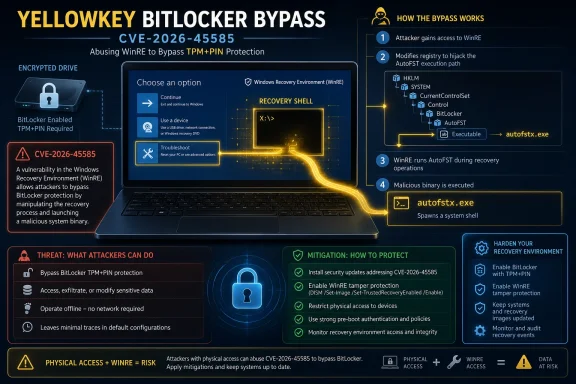
The exploit centers on the FsTx Auto Recovery Utility,
That deletion is the pivot. Instead of a constrained recovery workflow, the system can drop into an unrestricted command shell while the BitLocker-protected volume is already accessible. The attacker does not need to brute-force a recovery key. The attacker does not need to extract TPM secrets. The attacker needs the right files, physical access, and a reboot path into the vulnerable recovery flow.
This is why the phrase “BitLocker bypass” is both accurate and easy to misunderstand. YellowKey is not a general-purpose cryptographic break. It is an abuse of the chain of trust around a recovery environment that, under common configurations, can arrive at a moment where the disk is already unlocked.
That convenience has always involved a bargain. TPM-only protection is strong against many offline attacks, but it is not the same thing as requiring the user to prove knowledge of a secret before the drive unlocks. If an attacker can make the platform boot into a trusted-enough state that releases the key, the user may never enter the story.
YellowKey attacks that bargain. It does not say BitLocker is useless; it says BitLocker without pre-boot authentication can become too trusting when recovery code is manipulated. The TPM does what it was asked to do in a boot-and-recovery design that Microsoft deemed acceptable. The failure is in how much power the recovery path was allowed to have once that trust was granted.
That is why Microsoft’s TPM+PIN recommendation is not a cosmetic hardening step. Requiring a startup PIN changes the unlock condition. The TPM no longer releases what is needed merely because the platform looks right; the user must also provide the correct input before the operating system volume becomes available.
That is not the kind of change most organizations want to perform under pressure. It is image surgery, not endpoint hygiene. It also has to be done carefully, because WinRE is not just another directory full of utilities; it is part of Windows’ recovery and servicing story.
The trust relationship matters. If an attacker simply replaces or tampers with WinRE, BitLocker should detect that the recovery environment has changed and refuse to automatically unlock the protected volume. That is the intended protection boundary. Microsoft’s mitigation tries to preserve a trusted WinRE while removing the automatic behavior that makes this particular exploit path viable.
In a small environment, this is annoying. In a large fleet, it is a deployment project. Administrators need to identify affected machines, validate WinRE status, apply the modification, confirm BitLocker recovery material is escrowed, and test that recovery still works. The risk is not just missing a machine; it is breaking the recovery path on the machine someone desperately needs during an outage.
But disclosure drama can become a convenient fog machine. The engineering question remains: why could a recovery-only component and Transactional NTFS replay interaction open a shell with access to a protected volume under a default-ish BitLocker posture? That is not answered by condemning the researcher.
Windows has accumulated decades of recovery mechanisms, backward-compatible utilities, alternate boot paths, servicing assumptions, and enterprise manageability hooks. Each one has a reason to exist. Together, they form a sprawling pre-OS and recovery ecosystem that must be trusted enough to repair Windows but constrained enough not to become a skeleton key.
YellowKey is a case study in that tension. The exploit is not impressive because it uses a glamorous memory corruption chain or a speculative execution trick. It is impressive because it appears to abuse legitimate recovery plumbing to arrive at an illegitimate outcome.
But the phrase “requires physical access” should not soothe anyone responsible for laptops, field devices, executive machines, legal systems, journalists’ computers, developer workstations, or servers in less-than-perfectly-controlled spaces. Devices are stolen from cars, hotel rooms, airports, repair shops, conference tables, and homes. In those cases, full-disk encryption is supposed to turn possession of hardware into possession of a brick.
For regulated industries, the stakes are even clearer. Encryption is often part of the argument that a lost device is not a reportable data exposure. If an attacker can plausibly bypass the default protection on a fully patched system with a USB stick and a recovery boot path, legal and compliance teams will not care that the CVSS score stayed below the panic line.
This is also why administrators should resist binary thinking. YellowKey does not mean every BitLocker deployment has failed. It means organizations need to revisit which BitLocker mode they are actually using and whether that mode matches the threats they claim to be addressing.
Still, the case for TPM+PIN is stronger after YellowKey. A startup PIN forces an attacker with a stolen laptop to cross a knowledge barrier before the volume unlocks. It also reduces the blast radius of recovery-environment weirdness, because the protected data is not automatically made available just because the machine entered a trusted boot path.
Enterprises have tools to manage this transition. Group Policy and Intune can enforce additional authentication at startup, and administrators can configure TPM startup PIN requirements for operating system drives. Existing TPM-only deployments can be changed through PowerShell, command-line tooling, or the BitLocker control panel, though fleet-scale changes should be piloted before broad enforcement.
The practical concern is user experience. A four- or six-digit pre-boot PIN may be easier to deploy but weaker against guessing than a longer enhanced PIN, depending on policy and TPM anti-hammering behavior. A long alphanumeric PIN is better security but harder to type on varied keyboards before Windows loads. The right answer depends on the organization, but “we left it TPM-only because that was easiest” is now a weaker answer than it was a week ago.
But “server” no longer always means “locked rack in a professionally managed facility.” Branch offices, labs, retail locations, industrial environments, and small businesses run Windows Server in places where physical controls are uneven. Server Core is not magically immune because it lacks a desktop shell. If the vulnerable recovery environment and BitLocker configuration are present, the architectural issue remains.
There is also an operational paradox. Servers are often harder to move to TPM+PIN because unattended reboot is a feature, not a convenience. Patch windows, remote restarts, power events, and disaster recovery processes all assume machines can come back without a human standing at the console.
That makes the WinRE mitigation especially important on servers where TPM+PIN is impractical. It also means administrators should review whether recovery environments are enabled, trusted, and properly monitored on machines where physical access is not as theoretical as the asset inventory suggests.
A durable fix should tighten the boundary between recovery automation and unlocked protected volumes. It should also give administrators clearer visibility into WinRE trust state, image modification, and BitLocker unlock behavior during recovery. Today, much of this machinery is understood by specialists but opaque to the people expected to operate it across thousands of endpoints.
Microsoft also has a documentation challenge. The company has long described TPM+PIN as a stronger posture, but default Windows behavior and enterprise convenience have normalized TPM-only deployments. YellowKey makes the gap between “supported and common” and “appropriate for serious physical-access threat models” impossible to ignore.
If Microsoft wants administrators to change BitLocker posture, it needs to make that change less painful. That means better Intune reporting, safer staged rollout controls, clearer user messaging, and reliable recovery-key escrow checks before enforcement. Security advice that generates lockouts will be delayed, bypassed, or quietly abandoned.
That distinction is now the line between “encrypted against casual offline access” and “hardened against this class of physical bypass.” Inventory systems need to expose it. Compliance reports need to stop treating all BitLocker states as equivalent. Security teams need to know not just whether BitLocker is on, but how the key is protected and whether WinRE remains in a trusted, mitigated condition.
The response should start with visibility, not panic. Organizations should identify affected Windows versions, enumerate BitLocker protectors, verify recovery-key escrow, determine WinRE status, and decide where TPM+PIN is warranted. Only then should they push broad changes.
There is a temptation to disable WinRE outright as a quick defensive move. That may be appropriate in some tightly managed environments, but it has trade-offs. WinRE is part of repair, reset, and recovery workflows, and removing it can turn routine support situations into more expensive incidents. The better approach is to mitigate the vulnerable behavior while preserving recovery where it is genuinely needed.
The most concrete lessons are operational rather than philosophical:
 Microsoft’s Mitigation Arrives After the Exploit, Not Before It
YellowKey became public before Microsoft had a patch ready, after a researcher associated with the Chaotic Eclipse or Nightmare-Eclipse name released working exploit details. Microsoft’s advisory frames that publication as a violation of coordinated disclosure norms, and the company is not wrong to be unhappy about live exploit code landing before a vendor fix. But the operational reality for administrators is simpler and harsher: the clock started when the proof of concept became reproducible, not when the advisory became official.The vulnerability is classified as a BitLocker security feature bypass with a CVSS score of 6.8. That score reflects the need for physical access, which sharply narrows the attack surface compared with a network-exploitable bug. It also risks making the flaw sound less consequential than it is, because physical access is precisely the scenario full-disk encryption is meant to survive.
Microsoft says the affected platforms include Windows 11 versions 24H2, 25H2, and 26H1 on x64 systems, along with Windows Server 2025, including Server Core installations. That is a modern Windows footprint, not an antique compatibility corner. For organizations that standardize on current Windows builds and TPM-backed BitLocker, the advisory lands squarely in the middle of their endpoint security model.
The company’s immediate guidance is not “install this update.” It is “change how WinRE behaves” and “stop relying on TPM-only BitLocker where the threat model includes physical access.” That is an important distinction. A patch fixes code. A mitigation changes assumptions.
The Weak Link Is the Recovery Environment Everyone Forgot to Fear
YellowKey’s path runs through the Windows Recovery Environment, better known as WinRE. WinRE is supposed to be a trusted repair context: the place Windows goes when boot fails, recovery is requested, or system repair tools are needed. The problem is that recovery environments sit in a privileged twilight zone, close enough to the boot process to be trusted and powerful enough to affect encrypted systems.The exploit centers on the FsTx Auto Recovery Utility,
autofstx.exe, which exists inside the WinRE image. When WinRE launches, that utility can be started automatically through the image’s registry configuration. In the YellowKey scenario, specially crafted FsTx files trigger Transactional NTFS replay behavior that reportedly deletes winpeshl.ini, a configuration file that helps control what shell or recovery process starts inside WinRE.That deletion is the pivot. Instead of a constrained recovery workflow, the system can drop into an unrestricted command shell while the BitLocker-protected volume is already accessible. The attacker does not need to brute-force a recovery key. The attacker does not need to extract TPM secrets. The attacker needs the right files, physical access, and a reboot path into the vulnerable recovery flow.
This is why the phrase “BitLocker bypass” is both accurate and easy to misunderstand. YellowKey is not a general-purpose cryptographic break. It is an abuse of the chain of trust around a recovery environment that, under common configurations, can arrive at a moment where the disk is already unlocked.
TPM-Only BitLocker Was Always a Trade-Off
The uncomfortable part for many Windows shops is that TPM-only BitLocker is not some exotic misconfiguration. It is the default posture that made widespread disk encryption tolerable. Users turn on a laptop, Windows boots, and the TPM releases the key if the measured boot state looks acceptable. There is no pre-boot password prompt, no PIN to forget, and no help desk spike every time someone mistypes a code before coffee.That convenience has always involved a bargain. TPM-only protection is strong against many offline attacks, but it is not the same thing as requiring the user to prove knowledge of a secret before the drive unlocks. If an attacker can make the platform boot into a trusted-enough state that releases the key, the user may never enter the story.
YellowKey attacks that bargain. It does not say BitLocker is useless; it says BitLocker without pre-boot authentication can become too trusting when recovery code is manipulated. The TPM does what it was asked to do in a boot-and-recovery design that Microsoft deemed acceptable. The failure is in how much power the recovery path was allowed to have once that trust was granted.
That is why Microsoft’s TPM+PIN recommendation is not a cosmetic hardening step. Requiring a startup PIN changes the unlock condition. The TPM no longer releases what is needed merely because the platform looks right; the user must also provide the correct input before the operating system volume becomes available.
The Manual Fix Is a Reminder That WinRE Is Part of the Attack Surface
Microsoft’s primary mitigation asks administrators to preventautofstx.exe from automatically starting when the WinRE image launches. The process involves mounting the WinRE image, loading the system registry hive from that mounted image, editing the Session Manager BootExecute value to remove the autofstx.exe entry, then saving, unloading, committing, and reestablishing BitLocker trust for WinRE.That is not the kind of change most organizations want to perform under pressure. It is image surgery, not endpoint hygiene. It also has to be done carefully, because WinRE is not just another directory full of utilities; it is part of Windows’ recovery and servicing story.
The trust relationship matters. If an attacker simply replaces or tampers with WinRE, BitLocker should detect that the recovery environment has changed and refuse to automatically unlock the protected volume. That is the intended protection boundary. Microsoft’s mitigation tries to preserve a trusted WinRE while removing the automatic behavior that makes this particular exploit path viable.
In a small environment, this is annoying. In a large fleet, it is a deployment project. Administrators need to identify affected machines, validate WinRE status, apply the modification, confirm BitLocker recovery material is escrowed, and test that recovery still works. The risk is not just missing a machine; it is breaking the recovery path on the machine someone desperately needs during an outage.
The Disclosure Fight Should Not Distract From the Engineering Lesson
Microsoft is right to criticize public exploit release without coordinated disclosure. Publishing working exploit code before a patch puts defenders in a miserable position and gives opportunistic attackers a recipe. It also compresses vendor response time in ways that can produce rushed, incomplete, or operationally painful mitigations.But disclosure drama can become a convenient fog machine. The engineering question remains: why could a recovery-only component and Transactional NTFS replay interaction open a shell with access to a protected volume under a default-ish BitLocker posture? That is not answered by condemning the researcher.
Windows has accumulated decades of recovery mechanisms, backward-compatible utilities, alternate boot paths, servicing assumptions, and enterprise manageability hooks. Each one has a reason to exist. Together, they form a sprawling pre-OS and recovery ecosystem that must be trusted enough to repair Windows but constrained enough not to become a skeleton key.
YellowKey is a case study in that tension. The exploit is not impressive because it uses a glamorous memory corruption chain or a speculative execution trick. It is impressive because it appears to abuse legitimate recovery plumbing to arrive at an illegitimate outcome.
Physical Access Is Not a Footnote for Laptop Security
The inevitable minimizing argument is that YellowKey requires physical access. That is true, and it matters. A remote attacker cannot spray this across the internet, and most enterprise compromises still begin with phishing, credential theft, exposed services, or vulnerable edge devices.But the phrase “requires physical access” should not soothe anyone responsible for laptops, field devices, executive machines, legal systems, journalists’ computers, developer workstations, or servers in less-than-perfectly-controlled spaces. Devices are stolen from cars, hotel rooms, airports, repair shops, conference tables, and homes. In those cases, full-disk encryption is supposed to turn possession of hardware into possession of a brick.
For regulated industries, the stakes are even clearer. Encryption is often part of the argument that a lost device is not a reportable data exposure. If an attacker can plausibly bypass the default protection on a fully patched system with a USB stick and a recovery boot path, legal and compliance teams will not care that the CVSS score stayed below the panic line.
This is also why administrators should resist binary thinking. YellowKey does not mean every BitLocker deployment has failed. It means organizations need to revisit which BitLocker mode they are actually using and whether that mode matches the threats they claim to be addressing.
TPM+PIN Is Better Security With Predictable Friction
Moving from TPM-only to TPM+PIN is the cleanest strategic answer, but it is not free. Pre-boot PINs create user training requirements, support tickets, accessibility concerns, and operational wrinkles around reboots, remote maintenance, and patch cycles. Security teams that pretend otherwise will lose credibility with endpoint teams.Still, the case for TPM+PIN is stronger after YellowKey. A startup PIN forces an attacker with a stolen laptop to cross a knowledge barrier before the volume unlocks. It also reduces the blast radius of recovery-environment weirdness, because the protected data is not automatically made available just because the machine entered a trusted boot path.
Enterprises have tools to manage this transition. Group Policy and Intune can enforce additional authentication at startup, and administrators can configure TPM startup PIN requirements for operating system drives. Existing TPM-only deployments can be changed through PowerShell, command-line tooling, or the BitLocker control panel, though fleet-scale changes should be piloted before broad enforcement.
The practical concern is user experience. A four- or six-digit pre-boot PIN may be easier to deploy but weaker against guessing than a longer enhanced PIN, depending on policy and TPM anti-hammering behavior. A long alphanumeric PIN is better security but harder to type on varied keyboards before Windows loads. The right answer depends on the organization, but “we left it TPM-only because that was easiest” is now a weaker answer than it was a week ago.
Servers Are Different, but Not Exempt
Windows Server 2025 appearing in the affected list changes the conversation slightly. Many servers are in data centers where physical access is controlled, logged, and restricted. For those systems, YellowKey may be less urgent than for mobile endpoints.But “server” no longer always means “locked rack in a professionally managed facility.” Branch offices, labs, retail locations, industrial environments, and small businesses run Windows Server in places where physical controls are uneven. Server Core is not magically immune because it lacks a desktop shell. If the vulnerable recovery environment and BitLocker configuration are present, the architectural issue remains.
There is also an operational paradox. Servers are often harder to move to TPM+PIN because unattended reboot is a feature, not a convenience. Patch windows, remote restarts, power events, and disaster recovery processes all assume machines can come back without a human standing at the console.
That makes the WinRE mitigation especially important on servers where TPM+PIN is impractical. It also means administrators should review whether recovery environments are enabled, trusted, and properly monitored on machines where physical access is not as theoretical as the asset inventory suggests.
Microsoft’s Patch Will Need to Do More Than Remove One Autostart
The eventual patch will be judged by more than whether it blocks the published proof of concept. Microsoft needs to address the specificautofstx.exe behavior, but it also needs to show that WinRE cannot be steered into equivalent shell-spawning outcomes through neighboring recovery components. If the fix is too narrow, the next named-color exploit will write itself.A durable fix should tighten the boundary between recovery automation and unlocked protected volumes. It should also give administrators clearer visibility into WinRE trust state, image modification, and BitLocker unlock behavior during recovery. Today, much of this machinery is understood by specialists but opaque to the people expected to operate it across thousands of endpoints.
Microsoft also has a documentation challenge. The company has long described TPM+PIN as a stronger posture, but default Windows behavior and enterprise convenience have normalized TPM-only deployments. YellowKey makes the gap between “supported and common” and “appropriate for serious physical-access threat models” impossible to ignore.
If Microsoft wants administrators to change BitLocker posture, it needs to make that change less painful. That means better Intune reporting, safer staged rollout controls, clearer user messaging, and reliable recovery-key escrow checks before enforcement. Security advice that generates lockouts will be delayed, bypassed, or quietly abandoned.
The Real Risk Is the Fleet Nobody Audited
The most dangerous machines after YellowKey are not necessarily the ones everyone knows are high value. They are the ordinary laptops with default encryption, stale assumptions, and no recent audit of protectors. They are the devices listed as “encrypted” in a dashboard without any distinction between TPM-only and TPM+PIN.That distinction is now the line between “encrypted against casual offline access” and “hardened against this class of physical bypass.” Inventory systems need to expose it. Compliance reports need to stop treating all BitLocker states as equivalent. Security teams need to know not just whether BitLocker is on, but how the key is protected and whether WinRE remains in a trusted, mitigated condition.
The response should start with visibility, not panic. Organizations should identify affected Windows versions, enumerate BitLocker protectors, verify recovery-key escrow, determine WinRE status, and decide where TPM+PIN is warranted. Only then should they push broad changes.
There is a temptation to disable WinRE outright as a quick defensive move. That may be appropriate in some tightly managed environments, but it has trade-offs. WinRE is part of repair, reset, and recovery workflows, and removing it can turn routine support situations into more expensive incidents. The better approach is to mitigate the vulnerable behavior while preserving recovery where it is genuinely needed.
YellowKey Turns a Checkbox Into a Security Decision
For years, “BitLocker enabled” has been a comforting checkbox. YellowKey makes that checkbox look incomplete. The question is no longer whether the disk is encrypted, but whether the boot and recovery path can be trusted not to hand an attacker the decrypted result.The most concrete lessons are operational rather than philosophical:
- Organizations should treat CVE-2026-45585 as a real endpoint data-protection issue even though it requires physical access.
- Administrators should identify systems running affected Windows 11 and Windows Server 2025 builds and determine whether they rely on TPM-only BitLocker.
- Microsoft’s WinRE mitigation should be tested and deployed deliberately, because it modifies the recovery image rather than installing a conventional patch.
- TPM+PIN materially improves protection against this attack path, but it requires planning for user support, reboot workflows, and recovery-key escrow.
- Compliance teams should distinguish between BitLocker being enabled and BitLocker being configured with pre-boot authentication appropriate to the device’s risk.
- A future Microsoft patch should be validated against the broader recovery-environment trust model, not merely against the public YellowKey proof of concept.
References
- Primary source: Security Affairs
Published: 2026-05-20T15:40:06.252790
Microsoft issues YellowKey mitigation, no patch yet
Microsoft acknowledged the YellowKey BitLocker bypass flaw and released mitigations, urging admins to disable autofstx.exe and enable TPM+PINsecurityaffairs.com
- Related coverage: windowscentral.com
Microsoft fixes annoying BitLocker lockout — but only for Windows 11, leaving Windows 10 stuck | Windows Central
Windows 11 25H2 users get a BitLocker bug fix, while Windows 10 remains stuck with recovery headaches until Microsoft rolls out a broader solution.www.windowscentral.com - Related coverage: helpnetsecurity.com
Microsoft provides mitigation for "YellowKey" BitLocker bypass flaw (CVE-2026-45585) - Help Net Security
Microsoft is working on a fix for CVE-2026-45585 (aka "Yellowkey"), a vulnerability that can be used to bypass Windows' BitLocker protection.www.helpnetsecurity.com - Official source: learn.microsoft.com
BitLocker countermeasures | Microsoft Learn
Learn about technologies and features to protect against attacks on the BitLocker encryption key.learn.microsoft.com - Related coverage: blackfort-tec.de
YellowKey: Technical Analysis of a Potential BitLocker Recovery Attack | Blackfort Technology
A security researcher has published research describing a potential BitLocker bypass in Windows 11 and Server 2022/2025, requiring physical access and leveraging the Windows Recovery Environment (WinRE) as an attack vector.blackfort-tec.de - Related coverage: arstechnica.com
Zero-day exploit completely defeats default Windows 11 BitLocker protections - Ars Technica
It's not entirely clear how the exploit works. Microsoft says it's investigating.arstechnica.com
- Related coverage: techradar.com
This worrying Microsoft BitLocker backdoor can grant full access to a locked drive — and all you need is a USB stick | TechRadar
Chaotic Eclipse is wreaking havoc across the Windows landscapewww.techradar.com - Official source: techcommunity.microsoft.com
YellowKey BitLocker Exploit | Microsoft Community Hub
Hi AllI hope you are well.Anyway, the YellowKey BitLocker Exploit has came to my attention.We already have automatic  / silent BitLocker encryption... techcommunity.microsoft.com
- Related coverage: tomshardware.com
Microsoft BitLocker-protected drives can now be opened with just some files on a USB stick — YellowKey zero-day exploit demonstrates an apparent backdoor | Tom's Hardware
Also, it's a twofer with the GreenPlasma zero-day local privilege escalation.www.tomshardware.com - Related coverage: windowsreport.com
Microsoft Rushes to Mitigate Dangerous New “YellowKey” Windows Exploit
Microsoft rushes to mitigate the new “YellowKey” flaw that may bypass BitLocker protections and expose encrypted Windows drives to attackers. windowsreport.com
- Related coverage: matricedigitale.it
Microsoft pubblica mitigazioni per YellowKey che bypassa BitLocker su Windows 11 - Matrice Digitale
Microsoft pubblica mitigazioni urgenti per YellowKey, zero-day che aggira BitLocker su Windows 11 e Server 2025.www.matricedigitale.it - Related coverage: pcffm.de
YellowKey-BitLocker-Bypass (05/2026): Wie WinRE, FsTx und FailRelock Windows-11-Geräte gefährden
Im Mai 2026 hat der Sicherheitsforscher Chaotic Eclipse unter dem Namen YellowKey einen öffentlich nachvollziehbaren Proof of Concept für einen BitLocker-Bypass veröffentlicht. Der Angriff betrifft nach Angaben des Forschers Windows 11 sowie Windows Server 2022 und 2025, nicht jedoch Windows 10...www.pcffm.de - Related coverage: tempmail.ninja
YellowKey BitLocker Bypass: The Chaotic Eclipse Zero-Day Exploit | TempMail Ninja
The disclosure of the YellowKey BitLocker bypass by researcher Chaotic Eclipse reveals a critical zero-day vulnerability in the Windows Recovery Environment. Continue reading →tempmail.ninja - Related coverage: hackyourmom.com
- Official source: download.microsoft.com
- Official source: csrc.nist.gov

