

YouTube appears to be stepping up a quiet, technical pressure campaign against people who run ad‑blocking software: users and researchers now report that the platform is selectively hiding video descriptions and comment threads for viewers whose browsers report ad‑blockers, and the blockers that ordinarily patch around YouTube’s anti‑ad tooling are finding it harder and slower than ever to respond.
There has been a slow, escalating tug‑of‑war between browser extension ad‑blockers and major publishers for years. For platforms like YouTube, ads are the principal monetization layer; for many users, ad blockers are the practical tool that restores an annoy‑free experience. That conflict has been technical, legal, and productized: websites have increasingly deployed ad‑block detection and mitigation, while ad‑block projects have adapted by updating filter lists and rewriting blocking strategies.
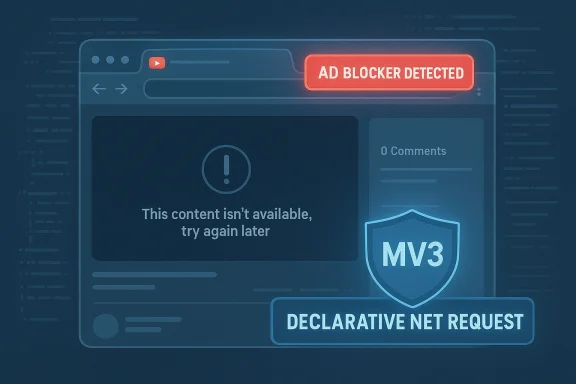
In early 2026 a wave of new complaints surfaced: viewers saw a YouTube UI that looked deliberately degraded — missing descriptions, empty comment areas, and intermittent playback errors that read “This content isn’t available, try again later.” Those messages often went away when users disabled their ad‑blocker or switched browsers. Multiple community threads and coverage picked this up as a coordinated push from YouTube to nudge users toward payment (YouTube Premium) or to stop using ad‑blocking tools.
AdGuard — a company that both makes consumer ad‑blocking software and maintains filter lists used by many blockers — publicly analyzed the phenomenon and concluded YouTube had begun to strip non‑essential page content (comments and descriptions) for certain ad‑block‑detected sessions, effectively making the platform less usable unless you either turn off your blocker or pay for Premium. AdGuard also flagged a structural reason why fixes are taking longer to reach Chrome users: the extension platform Google now requires, Manifest V3 (MV3), makes the kinds of fast, flexible rule updates ad‑blockers relied on much harder to deliver.
At the heart of the problem is the replacement of the legacy webRequest API — which allowed extensions to intercept and modify network requests in real time — with the new declarativeNetRequest (DNR) API in Manifest V3. DNR works by shipping a pre‑compiled set of blocking rules that the browser evaluates efficiently at the network layer, rather than letting an extension programmatically examine and modify every request as it happens. That tradeoff improves some security and privacy aspects of extensions, but it introduces real limits for ad‑blockers:
Uploaded community forums and thread dumps we reviewed show long‑running user conversations about YouTube increasingly resisting third‑party blockers — threads asking for new blockers, sharing workarounds, and noting how some browsers still escape the problem. Those community traces underline that the issue spans many user segments and is not strictly isolated to one build or country.
There are three systemic things to watch:
For users, the options are straightforward but unsatisfying: stop using blockers and accept targeted ads (or pay), move to browsers or tools that remain able to block at scale, or install system‑level filtering. For the ecosystem, the stakes are about much more than a few missing comment threads: they are about control, choice, and the balance of power between platforms, developers, and end users. The engineering justifications for MV3 are real, but so are the usability and privacy consequences. Expect more friction as the platform and its critics test the boundaries, and expect the timetable for fixes to be dictated as much by review policies and quotas as by engineering skill.
The debate is therefore both technical and political: the browser APIs Google chooses, and the review paths it allows, will shape what software can do on millions of desktops. Users, browser vendors, extension developers, and regulators all have a role to play in deciding whether those rules steer the web toward a more secure but more controlled future — or whether new norms will preserve third‑party tooling and user choice.
Source: Windows Central AdGuard says YouTube is punishing ad‑block users by hiding comments
 Background
There has been a slow, escalating tug‑of‑war between browser extension ad‑blockers and major publishers for years. For platforms like YouTube, ads are the principal monetization layer; for many users, ad blockers are the practical tool that restores an annoy‑free experience. That conflict has been technical, legal, and productized: websites have increasingly deployed ad‑block detection and mitigation, while ad‑block projects have adapted by updating filter lists and rewriting blocking strategies.In early 2026 a wave of new complaints surfaced: viewers saw a YouTube UI that looked deliberately degraded — missing descriptions, empty comment areas, and intermittent playback errors that read “This content isn’t available, try again later.” Those messages often went away when users disabled their ad‑blocker or switched browsers. Multiple community threads and coverage picked this up as a coordinated push from YouTube to nudge users toward payment (YouTube Premium) or to stop using ad‑blocking tools.
AdGuard — a company that both makes consumer ad‑blocking software and maintains filter lists used by many blockers — publicly analyzed the phenomenon and concluded YouTube had begun to strip non‑essential page content (comments and descriptions) for certain ad‑block‑detected sessions, effectively making the platform less usable unless you either turn off your blocker or pay for Premium. AdGuard also flagged a structural reason why fixes are taking longer to reach Chrome users: the extension platform Google now requires, Manifest V3 (MV3), makes the kinds of fast, flexible rule updates ad‑blockers relied on much harder to deliver.
Why this matters right now
This is more than an annoyance. The approach is layered and consequential:- It affects the user experience for millions of free viewers, who may lose the social and contextual features that make YouTube useful: comments, timestamps, creator notes, and links in descriptions.
- It forces a choice between disabling privacy tools, paying for a subscription, or switching browsers and ecosystems.
- It tests the technical limits of today’s extension APIs: MV3’s restrictions on dynamic, real‑time request handling mean ad‑blockers can no longer adapt as rapidly to platform countermeasures as they once did.
What AdGuard found — and why they say it's worse under MV3
AdGuard published a technical write‑up saying YouTube is intentionally removing comments and descriptions for some users who run ad blockers. Their analysis is rooted in two observations: first, the behavior is selective (it’s not happening to all users); second, when ad‑block filters are updated on desktop, the problem often disappears — but those fixes are arriving more slowly on Chromium‑based browsers because of MV3 constraints.At the heart of the problem is the replacement of the legacy webRequest API — which allowed extensions to intercept and modify network requests in real time — with the new declarativeNetRequest (DNR) API in Manifest V3. DNR works by shipping a pre‑compiled set of blocking rules that the browser evaluates efficiently at the network layer, rather than letting an extension programmatically examine and modify every request as it happens. That tradeoff improves some security and privacy aspects of extensions, but it introduces real limits for ad‑blockers:
- Rulesets are static and count‑limited by the browser. Extensions declare static rules in their package and can also use a dynamic rules API, but quotas and size limits constrain how much can be done at runtime. The Chrome docs now guarantee a minimum static ruleset of 30,000 entries for enabled rulesets, and newer versions expose dynamic rule windows of up to 30,000 safe dynamic rules, but limits remain on regex rules and rule complexity. Regular expression rules are capped at 1,000 per type and each rule has a compiled size limit.
- Fast fixes — the incremental, small updates to filter lists that once rolled out quickly to users — are now gated by the Chrome Web Store review process. Google offers an expedited/skip review path for updates that only change DNR rule files and meet strict “safe rule” criteria, but many of the YouTube fixes ad‑blockers need are not eligible for skip review. That means fixes need full reviews that can take days. AdGuard says the gap between an identified break and a rule delivered to users has grown.
Evidence from users and coverage
This is not just an academic debate. Multiple Reddit threads describe the same symptoms — playback errors tied to ad placements, and empty comments/descriptions — with workarounds that include disabling add‑ons or switching to non‑Chromium browsers. News outlets and tech sites covered the surge in error messages and the selective content stripping, citing examples and user reports. Windows Central, which first reported a surge in the playback error messages and linked them to ad‑block detection, also documented user workarounds and the suspicion that Google was intentionally making life difficult for ad‑block users.Uploaded community forums and thread dumps we reviewed show long‑running user conversations about YouTube increasingly resisting third‑party blockers — threads asking for new blockers, sharing workarounds, and noting how some browsers still escape the problem. Those community traces underline that the issue spans many user segments and is not strictly isolated to one build or country.
The technical detail: declarativeNetRequest, safe rules, and review pathways
For a technical audience, here’s how the pieces fit together:- DeclarativeNetRequest (DNR) replaces webRequest blocking in MV3. Instead of arbitrary JavaScript intercepting traffic, DNR relies on a rules engine that sits higher in the network stack and matches predeclared rules efficiently. This reduces extension‑level attack surface but reduces flexibility.
- There are two broad rule types: static rules embedded in the extension package, and dynamic/session rules that extensions can add at runtime. Static rules are limited by a ruleset count and can be updated via extension package updates. Dynamic rules support changes but are quota‑limited, and “unsafe” dynamic rules have a lower cap than “safe” ones. Regex complexity and per‑rule size limits constrain what can be expressed in DNR.
- The Chrome Web Store supports a skip review/expedited channel for updates that only modify DNR static rule files and meet safe rule criteria; eligible changes can go live in minutes. However, many of the sophisticated pattern matches or non‑safe transformations needed to counter a platform like YouTube are not eligible. Those require a full review. That’s the procedural choke point blocking fast rollouts of fixes.
Why Google made these changes — and where they’re defensible
It’s fair to separate intent from impact. Google’s public rationale for MV3 centers on three themes: security, performance, and privacy.- Security: shrinking the attack surface for extensions (less arbitrary network interception) reduces a whole class of extension‑level exploits.
- Performance: DNR runs at a lower level inside the browser, which can reduce CPU and memory overhead compared with many JS‑driven blocking strategies.
- Privacy: Google argues MV3 makes malicious or privacy‑invading extensions harder to implement and more visible in their capabilities.
Risks, tradeoffs, and unintended consequences
The policy and technical shifts create a number of concrete risks:- Privacy erosion by degree: if ad‑blocking extensions are less effective, more users may be nudged into either paying for ad‑free experiences or accepting more trackers and ad‑targeted content. That’s a distributional privacy cost: people without the means or desire to pay are left with diminished privacy tools.
- Monoculture risk: Chrome’s market share gives Google leverage over the extension ecosystem. If the dominant browser constrains extension capabilities, users on that browser lose options compared with users on alternative engines (notably, Firefox still supports capabilities that make rapid ad‑block updates possible). That fosters lock‑in and reduces competition between browser vendors on user protection features.
- Creator economics and perverse incentives: targeting ad‑block users by degrading the social features of a platform will change user habits — and may ultimately shift watch time or engagement metrics in ways that are hard to predict. Creators who rely on description links and comments to drive engagement could be collateral damage.
- Arms race escalation: engineering full‑time countermeasures invites more obfuscation on both sides. That increases complexity and fragility across the web ecosystem.
Workarounds, mitigations, and practical advice for readers
If you are affected and want practical, current options, here’s a prioritized list that balances effectiveness, safety, and legibility.- Try a non‑Chromium browser for YouTube viewing.
- Firefox and other Gecko‑based browsers are not beholden to Chromium’s MV3 enforcement and currently support extension behaviors that allow ad‑blockers to update and react faster. Many users report fewer problems on Firefox.
- Use a system‑level network filter.
- Tools like AdGuard for Windows or Mac run outside the browser and intercept traffic at the OS level, so they’re not limited by the browser’s extension API. AdGuard explicitly recommends their standalone apps as a robust option for users who want system‑wide filtering. AdGuard’s own engineering team appreciates that approach because it sidesteps MV3 entirely.
- Consider network DNS or router‑level blockers.
- Pi‑hole or DNS‑level filtering can block ad backends across devices, including mobile and smart TVs. This is a lower‑maintenance option for households or power users comfortable configuring networking gear.
- Subscribe to YouTube Premium if you value an ad‑free, fully featured experience.
- In the US the full YouTube Premium plan is listed at $13.99/month for individuals (Premium Lite tiers and regional variants exist at lower prices), and Premium removes ads site‑wide while also enabling background play and offline downloads. This is the vendor‑supported path to an ad‑free experience. Verify pricing for your country before subscribing.
- If you rely on extension filters, keep them updated and consider running a secondary browser profile without extensions for interactions requiring comments or logged‑in features.
- Some users run two browsers or two profiles: one with blockers for passive watching and another extension‑free session for commenting and interacting.
- System‑level tools and DNS blockers shift the attack surface. They require careful configuration; misconfiguration can break benign functionality.
- Some workarounds (like VPN‑based country price arbitraging or unofficial front‑ends) may violate terms of service or local regulations; proceed with caution and informed consent.
For extension developers and filter maintainers: strategies to speed recovery
Ad‑block teams are living in a more constrained world, but there are actionable steps to reduce lag when platforms change:- Prioritize safe DNR rule changes that qualify for expedited review: if a fix can be expressed strictly as a blocking rule with allowed actions, mark it as eligible and submit for skip‑review. Documentation exists to help structure updates for the skip review path.
- Invest in cross‑engine parity: maintain rulesets for Gecko (Firefox) independently so users on alternative browsers keep receiving quick updates while Chromium channels go through review.
- Communicate transparently with users about expected timelines and manual workarounds, including detailed instructions for temporary disabling or whitelisting and for installing system‑level apps where appropriate.
- Collaborate with browser vendors where possible. Some teams have had success shaping APIs and quota changes by engaging upstream — but this is a long game and depends on the browser vendor’s incentives.
The broader picture: product incentives, trust, and the future of the web
This episode is another data point in a larger industry trend: the platforms that control access to audiences also control the plumbing of how that access happens. When the plumbing changes — extension APIs, ad networks, anti‑adblock detection — the rules of engagement for users and third‑party developers change, too.There are three systemic things to watch:
- Regulatory pressure: antitrust, consumer protection, and platform transparency investigations around dominant ecosystems may intensify if platforms are seen to be using technical rules to foreclose competition or to degrade third‑party privacy tools.
- Technical fragmentation: users may increasingly vote with their browsers. If Firefox or other engines become the haven for privacy tooling, there will be a split in the web experience and possible performance and interoperability tradeoffs.
- Productization of enforcement: platforms will continue to experiment with subtle gradations of user experience — from playback throttles to UI removal — in order to nudge behavior. That experimentation will create a patchwork of regional and account‑level outcomes unless there is more standardized transparency.
Conclusion
The recent reports that YouTube is hiding comments and descriptions for sessions where ad‑blockers are detected are not an isolated quirk; they are the visible tip of an unfolding technical and policy shift. Manifest V3 and its declarativeNetRequest model have closed the door on a number of quick, surgical fixes that ad‑blockers used to deploy. That makes the arms race between platforms and blockers slower, more centralized, and — depending on your perspective — more enforceable or more restrictive.For users, the options are straightforward but unsatisfying: stop using blockers and accept targeted ads (or pay), move to browsers or tools that remain able to block at scale, or install system‑level filtering. For the ecosystem, the stakes are about much more than a few missing comment threads: they are about control, choice, and the balance of power between platforms, developers, and end users. The engineering justifications for MV3 are real, but so are the usability and privacy consequences. Expect more friction as the platform and its critics test the boundaries, and expect the timetable for fixes to be dictated as much by review policies and quotas as by engineering skill.
The debate is therefore both technical and political: the browser APIs Google chooses, and the review paths it allows, will shape what software can do on millions of desktops. Users, browser vendors, extension developers, and regulators all have a role to play in deciding whether those rules steer the web toward a more secure but more controlled future — or whether new norms will preserve third‑party tooling and user choice.
Source: Windows Central AdGuard says YouTube is punishing ad‑block users by hiding comments
