

ZainTECH’s new listing of Microsoft Azure ExpressRoute on the Azure Marketplace for Kuwaiti customers marks a practical turning point in how public‑sector and enterprise buyers in Kuwait can procure private, low‑latency cloud connectivity — a capability the partners say will accelerate cloud migrations, support regulated workloads, and underpin the country’s AI and digital modernization ambitions.
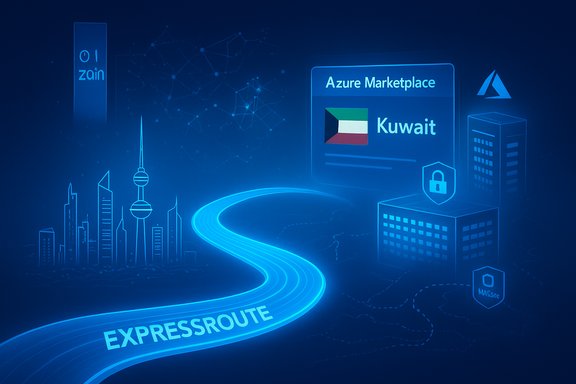
On October 8, 2025, ZainTECH — the integrated digital‑solutions arm of Zain Group — announced that Microsoft Azure ExpressRoute is now available to customers in Kuwait via the Azure Marketplace. The offering is delivered in collaboration with Zain Kuwait and Zain Omantel International (ZOI), and is presented as a first‑of‑its‑kind multi‑entity marketplace listing across Zain Group’s commercial and wholesale arms. The announcement was framed as an operational enabler for government and large enterprises, promising a simplified procurement path to private Azure connectivity, peering into nearby Azure datacenters (notably in the UAE and selected European regions), and, in some cases, the ability to apply existing Azure consumption credits when buying ExpressRoute through the Marketplace.
This move arrives against a broader strategic backdrop: Microsoft publicly signalled its intent on March 6, 2025 to expand Azure capacity and AI capabilities in Kuwait, with plans for an AI‑capable local Azure region and associated skilling and governance programs. The Marketplace listing for ExpressRoute is an immediate, practical building block that complements the longer‑term regional cloud ambitions.
What it changes:
The move accelerates procurement velocity and supports predictable, low‑latency connectivity to nearby Azure regions — an important enabler for real‑time services and AI adoption. Yet the convenience of Marketplace ordering must be paired with rigorous procurement checks, careful architecture for redundancy and security, and explicit written confirmations about billing and credit applicability.
When treated as one element in a broader modernization program — combining staged migrations, multi‑provider resilience, and a clear path to local region residency — the ZainTECH ExpressRoute listing can materially lower friction for Kuwait’s cloud and AI ambitions while preserving the guardrails required by regulated, mission‑critical systems.
Source: ITP.net https://www.itp.net/edge/zaintech-launches-azure-expressroute-in-kuwait/
 Background / Overview
On October 8, 2025, ZainTECH — the integrated digital‑solutions arm of Zain Group — announced that Microsoft Azure ExpressRoute is now available to customers in Kuwait via the Azure Marketplace. The offering is delivered in collaboration with Zain Kuwait and Zain Omantel International (ZOI), and is presented as a first‑of‑its‑kind multi‑entity marketplace listing across Zain Group’s commercial and wholesale arms. The announcement was framed as an operational enabler for government and large enterprises, promising a simplified procurement path to private Azure connectivity, peering into nearby Azure datacenters (notably in the UAE and selected European regions), and, in some cases, the ability to apply existing Azure consumption credits when buying ExpressRoute through the Marketplace.This move arrives against a broader strategic backdrop: Microsoft publicly signalled its intent on March 6, 2025 to expand Azure capacity and AI capabilities in Kuwait, with plans for an AI‑capable local Azure region and associated skilling and governance programs. The Marketplace listing for ExpressRoute is an immediate, practical building block that complements the longer‑term regional cloud ambitions.
Why this matters now
Kuwait’s national digital agenda — commonly referenced as Vision 2035 or New Kuwait — prioritizes modern infrastructure, digital public services, and economic diversification. For government ministries, utilities, and regulated enterprises, five constraints often slow cloud adoption:- Procurement friction: separate contracts for carrier circuits and cloud services, lengthy vendor coordination, and invoicing complexity.
- Data residency and compliance: requirements about where citizen and regulated data may be stored and processed.
- Predictable performance: mission‑critical workloads (real‑time analytics, OT/SCADA telemetry, AI inference) need consistent, low‑latency connectivity.
- Operational visibility and vendor accountability: governments prefer local partners for escalation, audits, and compliance support.
- AI readiness: large models and datasets require high throughput and reliable network paths when training or running inference.
What Azure ExpressRoute actually provides
Azure ExpressRoute is Microsoft’s private connectivity service that establishes a dedicated Layer‑3 circuit between a customer’s network and Microsoft’s global backbone. The core technical benefits are:- Private, non‑internet transport that bypasses the public internet for Azure traffic, reducing exposure to internet variability and peering unpredictability.
- Predictable latency and consistent throughput, which matter for transactional systems, telepresence, and latency‑sensitive AI workloads.
- High capacity options, including service‑provider delivered circuits and ExpressRoute Direct ports with 10 Gbps and 100 Gbps physical capacity where supported.
- Redundancy and SLAs, with circuits designed for dual connections to Microsoft Enterprise Edge and financial uptime commitments in Microsoft’s published SLA for ExpressRoute.
- Advanced features such as ExpressRoute Global Reach for private inter‑site connectivity over Microsoft’s backbone and MACsec link encryption on supported configurations.
What the ZainTECH listing changes — and what it does not
The Azure Marketplace placement brings immediate practical benefits, but it’s important to separate procurement and portal convenience from the physical realities of network delivery.What it changes:
- Single‑pane discovery and ordering inside the Azure portal for connectivity products.
- Potential consolidation of billing so ExpressRoute charges appear alongside other Azure invoices for customers whose commercial contracts support that flow.
- A vendor stack that combines local operator relationships (Zain Kuwait), regional wholesale backbone reach (ZOI), and Microsoft platform support — simplifying vendor management for government procurement teams.
- Faster initiation of procurement cycles by eliminating separate carrier tender steps for many buyers.
- Marketplace listing is not a substitute for physical provisioning: circuit build, fiber cross‑connects, colocation handoffs, and local acceptance testing still take calendar time.
- Billing and applicability of Azure consumption credits are account‑specific. Whether credits can be applied when a customer purchases ExpressRoute via Marketplace depends on the customer’s Microsoft agreement model (e.g., Enterprise Agreement, Microsoft Customer Agreement, CSP model) and the publisher configuration. Claims that credits are applicable should be validated in writing with both Microsoft account teams and ZainTECH sales.
- Data residency is controlled by Azure region selection, not by ExpressRoute. A private circuit reduces transport over the public internet but does not change where compute or data storage are located.
The players and roles
- ZainTECH — systems integrator and managed‑services arm that packages cloud, cybersecurity, and integration services for enterprise and government customers.
- Zain Kuwait — the local operator providing last‑mile delivery, in‑country escalation, and enterprise customer relationships.
- Zain Omantel International (ZOI) — the wholesale joint venture offering subsea and terrestrial backbone reach, which brings international routing diversity and lower‑latency paths to regional Azure hubs.
- Microsoft — provides the Azure backbone, ExpressRoute technology, and the Marketplace channel for distribution; also advancing plans for an onshore Azure region and AI programs.
Technical deployment considerations for IT teams
Implementing ExpressRoute via a Marketplace offer requires pragmatic architecture and operations planning. Key technical considerations:- Peering model selection
- Use Private Peering to connect to Azure Virtual Networks (VNet) for application traffic.
- Use Microsoft Peering for platform services and certain Azure PaaS endpoints where required.
- Carefully design route filters and BGP advertisements to prevent accidental route leakage.
- Bandwidth and port choices
- Choose a logical circuit and port arrangement that matches expected traffic. For hyperscale needs, consider ExpressRoute Direct ports (10 Gbps / 100 Gbps) if available in the termination region.
- Account for burst capacity and plan for growth; migrating large datasets for AI training requires sustained high throughput and predictable egress costs.
- Redundancy and diversity
- Deploy dual ExpressRoute circuits in separate peering locations or diverse providers to avoid single‑point failures.
- Combine ExpressRoute with encrypted internet VPN failover (site‑to‑site VPN) for emergency continuity scenarios.
- Security and encryption
- While ExpressRoute avoids the public internet, sensitive workloads should still apply application‑level encryption.
- Where available, enable link‑layer encryption (MACsec) on physical ports for additional protection.
- Implement robust identity, access management, and network segmentation on the Azure side.
- Performance testing and acceptance
- Run proof‑of‑concepts that measure real‑world latency, jitter, and throughput across representative workloads before full cutovers.
- Validate failover behavior and route convergence under simulated outage conditions.
- Cost and egress planning
- Model egress charges and SKU choices (Local vs. Standard vs. Premium) and assess whether the Marketplace purchase uses metered or unmetered billing models. These choices materially affect total cost of ownership for data‑intensive workloads.
Commercial and procurement caveats
The convenience of Marketplace procurement can be powerful — but it introduces new commercial diligence requirements:- Verify billing flows in writing. Confirm how ExpressRoute charges will appear on invoices and whether Azure consumption credits will be accepted against the Marketplace SKU for the customer’s specific agreement type.
- Clarify SLA ownership. Ensure the contract delineates Microsoft’s network SLA, the carrier’s delivery and availability commitments, and the managed‑services responsibilities of ZainTECH for provisioning, escalation, and remediation.
- Define acceptance criteria. Insist on technical acceptance testing and documented handover milestones before moving production services over the ExpressRoute circuit.
- Audit compliance responsibilities. Determine which party will provide audit logs, routing records, and evidence required for regulatory compliance reviews.
- Plan for multi‑vendor continuity. Avoid single‑vendor dependency for critical national services by designing multi‑carrier or multi‑region failover strategies.
Security, compliance and data residency
ExpressRoute reduces exposure to the public internet but does not, by itself, satisfy data residency or sovereignty requirements. For regulated workloads:- Data residency is a function of Azure region selection and contractual commitments about where data at rest and in‑flight are processed. A local Kuwait Azure region — if and when Microsoft brings one online — will be the definitive path to on‑shore compute and residency.
- Transport controls provided by ExpressRoute strengthen evidence for audits and controls; however, agencies should couple private transport with robust encryption, strict access control, and detailed logging.
- Operational security requires joint runbooks between the telco, ZainTECH, and Microsoft for incident response, route‑change notification, and forensic data collection.
Risks and potential downsides
The initiative offers strong value but is not without risk:- Execution risk. Marketplace listing compresses the procurement conversation but does not shorten physical provisioning timelines. Misaligned expectations about delivery windows can derail migration schedules.
- Billing surprises. If Azure consumption credits or contracted discounts are not accepted for Marketplace SKUs due to account model mismatches, expected cost savings may evaporate.
- Vendor lock‑in concerns. A single‑provider, deeply integrated delivery path eases operations but can create switching friction for future multi‑cloud strategies.
- False sense of sovereignty. Private connectivity should not be conflated with on‑shore data residency. Only a local Azure region fully addresses in‑country compute residency.
- Operational dependencies. Critical national services should not rely on a single backbone path or single peering location. Design diversity is essential.
Strategic implications for Kuwait’s digital ambitions
The ZainTECH ExpressRoute Marketplace listing is more than a product launch: it is a strategic accelerator for Kuwait’s push to modernize government IT and prepare for AI‑driven services. Immediate effects include:- Shorter procurement cycles for ministries and regulated enterprises, enabling faster migration of pilot workloads to production.
- Improved performance for latency‑sensitive services by enabling private peering into nearby Azure regions (UAE and Europe).
- A local vendor ecosystem that understands regulatory expectations and can orchestrate compliance, skilling, and integration work.
- A building block for larger projects: secure private connectivity is a precondition for national AI deployments, Copilot integrations, and zone‑redundant availability architectures.
Practical next steps for CIOs and procurement leads
For organizations evaluating ExpressRoute via the Marketplace, recommended actions are:- Request a formal billing and offer review from ZainTECH and Microsoft that clearly demonstrates how ExpressRoute charges will appear on your enterprise invoice and whether any Azure consumption credits apply.
- Run a proof‑of‑concept over ExpressRoute for a representative, production‑like workload to measure latency, throughput, and failover behavior under load.
- Audit data classification and map sensitive assets to the appropriate Azure regions and contractual terms before any migration begins.
- Define a multi‑provider contingency plan and require diverse physical paths and dual circuits for mission‑critical services.
- Insist on written SLAs that cover both network availability and managed‑services response times, and specify escalation paths across ZainTECH, Zain Kuwait, ZOI, and Microsoft.
- Build a phased migration plan that starts with lower‑risk services and moves progressively to higher‑risk, regulated data workloads once proofs and compliance checks pass.
How this fits into the regional competitive landscape
Many carriers and wholesale providers across the Middle East have previously created ExpressRoute or private connectivity offers that integrate with the Azure Marketplace. What makes the ZainTECH arrangement notable is:- The multi‑entity alignment inside one group (ZainTECH + Zain Kuwait + ZOI) combining local operator presence, systems integration, and subsea/transit reach.
- Timing relative to Microsoft’s broader commitments to Kuwait’s cloud and AI strategy, which together create a near‑term path for procurement and a longer‑term path for regionally sovereign compute.
- The political and procurement context in Kuwait — public agencies often prefer an end‑to‑end local partner for compliance, procurement, and escalation.
Conclusion
ZainTECH’s launch of Azure ExpressRoute on the Azure Marketplace for Kuwait is a pragmatic, tactical step with strategic resonance. For the first time, many Kuwaiti government agencies and large enterprises can discover and order private Azure connectivity from inside the Azure portal while relying on a locally anchored delivery team with international backbone reach.The move accelerates procurement velocity and supports predictable, low‑latency connectivity to nearby Azure regions — an important enabler for real‑time services and AI adoption. Yet the convenience of Marketplace ordering must be paired with rigorous procurement checks, careful architecture for redundancy and security, and explicit written confirmations about billing and credit applicability.
When treated as one element in a broader modernization program — combining staged migrations, multi‑provider resilience, and a clear path to local region residency — the ZainTECH ExpressRoute listing can materially lower friction for Kuwait’s cloud and AI ambitions while preserving the guardrails required by regulated, mission‑critical systems.
Source: ITP.net https://www.itp.net/edge/zaintech-launches-azure-expressroute-in-kuwait/
