

Zawa, an AI branding platform promoted by 9to5Google on July 4, 2026, offers small businesses a browser-based suite for generating logos, brand kits, product images, social assets, and video content from a single workspace. The pitch is simple: replace the messy first mile of brand creation with one subscription and a pile of AI-assisted tools. The more interesting story is not that another startup can generate a logo, but that branding software is being rebuilt around continuity rather than isolated creative tricks. For Windows users, freelancers, and small IT shops, Zawa is another sign that the design stack is moving from heavyweight desktop suites to cloud agents that promise speed, consistency, and fewer handoffs.
The 9to5Google piece frames Zawa around the familiar small-business problem: a company needs a name, a logo, some product imagery, and a visual style long before it has the budget for a designer or agency. That is a real pain point, and Zawa’s logo workflow appears built for the non-designer who knows what a business does but not how to translate that into marks, typography, palettes, and layouts.
According to Zawa’s own product pages, the platform can generate logo designs from a business identity and then carry that visual system into mockups, posters, menus, packaging, social posts, and brand guides. That matters because the cheapest logo is often the most expensive part of a brand if it cannot be reused cleanly. A logo file without usage rules, colors, font pairings, and layout variants is not a brand system; it is clip art with ambition.
Zawa is not alone here. Canva, Adobe Express, Wix, Looka, Tailor Brands, and a long tail of AI logo tools have been attacking the same market for years. What Zawa is trying to sell is not just generation, but an integrated brand memory: build once, reuse everywhere, and let AI agents remix assets without losing the visual thread.
That is the useful distinction. The logo is the entry point, but the business model is the workspace.
A local service business, Etsy seller, restaurant, repair shop, newsletter publisher, or indie software studio often needs twenty design outputs before it can afford one professional design engagement. It needs a logo for a site header, a square icon for social media, a flyer, a background for product shots, a banner ad, a product mockup, and perhaps a short video. None of those assets can look as if they came from five unrelated templates.
That is where AI design platforms have found their market. They reduce the cost of the first draft, which is often the most psychologically expensive part of creative work. Instead of staring at a blank canvas in Photoshop or Illustrator, the user starts with a system-generated direction and then edits toward acceptability.
The danger is that speed can masquerade as strategy. A small business still needs to know who it is selling to, what promises it can make, and what it should avoid looking like. Zawa can generate a polished restaurant poster, but it cannot know whether the restaurant should feel premium, family-friendly, nostalgic, local, experimental, or aggressively cheap unless the operator supplies that judgment.
That breadth is the strategy. The modern small-business design problem is fragmented across too many apps. One tool removes a background, another improves resolution, another creates mockups, another schedules posts, another generates copy, and another exports videos. Zawa’s bet is that users would rather accept one platform’s opinionated workflow than stitch together half a dozen specialist services.
This is the same force that made Microsoft 365 attractive to businesses that did not necessarily love every individual app. Integration often beats best-of-breed quality when the buyer is time-poor. The small business owner does not wake up wanting the industry’s best background remover; they want the product photo to stop looking like it was taken under fluorescent light on a cluttered counter.
For WindowsForum readers, the comparison to traditional desktop software is obvious. Photoshop, Illustrator, Premiere Pro, Affinity Photo, CorelDRAW, and GIMP all remain powerful tools in the hands of people who know what they are doing. Zawa is aimed at the user who does not want a tool; they want an outcome.
That changes the implied user interface. Older creative software asks the user to manipulate objects directly. Template software asks the user to choose a layout and swap in text and images. Agentic software asks the user to describe an objective: make this product look premium, turn this logo into social assets, remove distractions from these product photos, or create a video from this footage.
That can be liberating, but it also hides complexity. When a tool makes more decisions on the user’s behalf, the user must become better at reviewing results. The bottleneck shifts from manual execution to editorial judgment.
This is where businesses should be careful. AI agents can produce plausible brand assets quickly, but plausible is not the same as legally safe, distinctive, accessible, or on-message. A logo that resembles another company’s mark, a generated model that misrepresents a product, or a social image that implies a false capability can create problems that are not solved by prettier pixels.
That is a practical feature because small businesses rarely have perfect source material. Product photos come from phones, old websites, vendor catalogs, trade show shots, screenshots, and customer-submitted images. Before a business can generate polished collateral, it often needs to rescue the messy assets it already has.
The same goes for background removal and object removal. These tools used to require either careful manual masking or a dedicated designer. Now they are table stakes in AI design suites, and their value is less about novelty than volume. If a seller needs to clean up 80 product shots before updating an online storefront, bulk processing is more important than a spectacular demo.
Still, image enhancement has limits. Upscaling can invent detail. Cleanup tools can erase useful context. Background generators can make products look better than they are. The responsible workflow is to treat AI image processing as presentation cleanup, not factual alteration.
9to5Google says Zawa can enhance low-resolution video clips, remove captions or social media watermarks from old footage, and generate product videos using user footage and AI. Zawa’s pricing page lists video editing, video generation, video background removal, video enhancer, and video watermark remover tools, with limits varying by plan.
That is powerful, but video raises the stakes. A still image can mislead; a video can mislead faster and more convincingly. Removing captions or watermarks from “old footage” may be legitimate when the business owns the material, but it can also cross into rights problems if the footage came from another creator, platform, or campaign.
Businesses should treat video tools as production accelerators, not permission machines. If you did not have the right to reuse footage before AI cleaned it up, you probably do not have the right after. The software can remove a watermark; it cannot remove a license obligation.
That means users should not evaluate the service like a traditional boxed app. The relevant question is not just “How much per month?” It is “How many usable outputs can I create before I hit a limit, downgrade in quality, or need more credits?”
This is now common across AI services because generation has a real compute cost. Lightweight edits may be effectively high-volume on paid plans, while generative video, advanced image models, and agentic tasks consume more credits. For a casual user, that may be fine. For a business trying to produce hundreds of product images or regular video campaigns, usage math matters.
The practical advice is boring but necessary: test the free plan with real business assets before subscribing annually. A demo logo is not enough. Users should try a full workflow: create a logo, generate a brand kit, clean product images, export social posts, and produce at least one video asset. The value of an all-in-one suite only appears when the pieces actually work together.
That is good news for small teams that live on inexpensive laptops, Copilot+ PCs, or mixed-device environments. A browser-based design suite lowers setup friction. It also makes collaboration easier, because assets and brand kits live in the cloud instead of on one employee’s desktop.
But the cloud model also creates dependencies. If the platform changes pricing, reduces free limits, removes a model, suffers downtime, or alters export rights, users have less control than they would with local software and locally stored project files. The more a business centralizes its brand workflow inside one AI platform, the more important export options and asset ownership become.
For IT pros advising small organizations, the questions are familiar: Where is the data stored? Who can access the workspace? Can assets be exported in standard formats? What happens if the subscription lapses? Does the platform provide team controls, auditability, or enterprise support? The design tool may look like a marketing purchase, but it can become an operational dependency.
That does not mean professional designers become irrelevant. If anything, strong designers become more valuable when every business can generate something that looks vaguely professional. Differentiation moves upstream: positioning, taste, originality, typography discipline, campaign thinking, art direction, and the ability to say no.
The market likely splits. At the bottom, businesses use AI suites directly. In the middle, marketers and freelancers use AI tools to increase throughput. At the top, agencies use AI as production infrastructure while selling strategy and polish.
Zawa’s audience sits mostly in the first two groups. It is for people who cannot justify a traditional design engagement, or for operators who need assets faster than a human production queue can deliver. That is a real market, and it is expanding.
A logo can be clean and still forgettable. A product background can be beautiful and still wrong for the customer. A social post can be balanced, legible, and polished while saying nothing worth remembering. The more businesses rely on the same models, templates, and aesthetic defaults, the more they risk converging on the same sanitized look.
This is not unique to Zawa. It is the broader pattern of AI creative tools. They make the median output better and may make the market more visually homogeneous at the same time.
The antidote is not to reject the tools. It is to bring sharper inputs. Businesses that use AI design platforms well will feed them with real constraints: local references, customer language, product truths, competitive differences, and brand rules that are not interchangeable. The weaker the brief, the more generic the output.
Logo generation deserves special caution. A mark can be visually pleasing and still be too close to another brand’s identity. AI tools can generate forms that echo common training patterns, industry clichés, or existing marks without the user realizing it.
The same applies to generated product imagery. If AI backgrounds, models, or video scenes create a materially misleading impression of a product, the business owns the consequences. A tool can help a small shop look bigger, but it should not help it look fake.
There is also a privacy dimension. Uploading product prototypes, unpublished campaigns, customer images, or internal brand documents to any cloud AI platform should trigger basic review. That is not paranoia; it is normal vendor management.
An integrated AI suite has a fair chance against that. Even if its best outputs are not award-winning, consistency alone can be valuable. A small business with a stable logo, coherent colors, cleaned-up product photos, and repeatable social templates is already ahead of many competitors.
But the platform has to prove that its “one-stop shop” claim survives daily use. The first session may impress. The fifth project is the test. Does the brand kit stay consistent? Are exports clean? Can a user revise without starting over? Do generated images remain usable after close inspection? Do credits disappear faster than expected?
Those mundane details determine whether Zawa becomes a real business tool or another AI toy with a polished landing page.
That promise is credible in design because so much small-business branding is repetitive. Menus, flyers, product shots, launch posts, holiday promos, packaging mockups, banner ads, and short videos all follow patterns. AI is good at patterns.
The limitation is that brands are built through choices, not just outputs. A business still has to decide what it stands for, what it refuses to imitate, and how it wants customers to feel. Zawa can accelerate the production of those choices, but it cannot make them meaningful on its own.
That is not inherently bad. Every serious creative system has some kind of lock-in, from Adobe libraries to Canva brand kits to Microsoft 365 templates. The key is whether the lock-in is earned by convenience or imposed by poor export paths.
Users should ask whether they can download logos in vector formats, export brand guidelines, save transparent PNGs, retrieve high-resolution originals, and preserve edited assets outside the platform. If the answer is yes, the service is a useful accelerator. If the answer is no, the brand lives at the mercy of a subscription.
This is especially important for businesses that start with Zawa and later hire a designer. A professional designer should be able to inherit the files, clean them up, refine the system, and build from there. AI-generated branding should be a bridge, not a cul-de-sac.
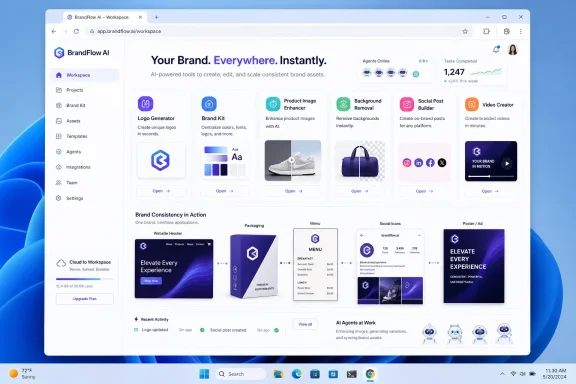 The Logo Generator Is the Hook, Not the Product
The 9to5Google piece frames Zawa around the familiar small-business problem: a company needs a name, a logo, some product imagery, and a visual style long before it has the budget for a designer or agency. That is a real pain point, and Zawa’s logo workflow appears built for the non-designer who knows what a business does but not how to translate that into marks, typography, palettes, and layouts.According to Zawa’s own product pages, the platform can generate logo designs from a business identity and then carry that visual system into mockups, posters, menus, packaging, social posts, and brand guides. That matters because the cheapest logo is often the most expensive part of a brand if it cannot be reused cleanly. A logo file without usage rules, colors, font pairings, and layout variants is not a brand system; it is clip art with ambition.
Zawa is not alone here. Canva, Adobe Express, Wix, Looka, Tailor Brands, and a long tail of AI logo tools have been attacking the same market for years. What Zawa is trying to sell is not just generation, but an integrated brand memory: build once, reuse everywhere, and let AI agents remix assets without losing the visual thread.
That is the useful distinction. The logo is the entry point, but the business model is the workspace.
Small Businesses Are Buying Time Before They Buy Taste
The most persuasive part of Zawa’s pitch is not that it will create the perfect identity. It almost certainly will not, at least not without human judgment. The persuasive part is that many businesses do not need perfection on day one; they need something coherent enough to launch, test, and sell.A local service business, Etsy seller, restaurant, repair shop, newsletter publisher, or indie software studio often needs twenty design outputs before it can afford one professional design engagement. It needs a logo for a site header, a square icon for social media, a flyer, a background for product shots, a banner ad, a product mockup, and perhaps a short video. None of those assets can look as if they came from five unrelated templates.
That is where AI design platforms have found their market. They reduce the cost of the first draft, which is often the most psychologically expensive part of creative work. Instead of staring at a blank canvas in Photoshop or Illustrator, the user starts with a system-generated direction and then edits toward acceptability.
The danger is that speed can masquerade as strategy. A small business still needs to know who it is selling to, what promises it can make, and what it should avoid looking like. Zawa can generate a polished restaurant poster, but it cannot know whether the restaurant should feel premium, family-friendly, nostalgic, local, experimental, or aggressively cheap unless the operator supplies that judgment.
The All-in-One Claim Is Where the Stakes Get Bigger
9to5Google describes Zawa as a one-stop shop for design work, and Zawa’s own site leans heavily into that same idea. The platform lists tools for image enhancement, upscaling, object removal, background removal, background generation, photo editing, logo generation, image remixing, social posts, bulk photo editing, and video workflows. Its pricing page also describes AI agents, AI image generation, AI editing, video generation, video enhancement, watermark removal, and e-commerce-focused tools.That breadth is the strategy. The modern small-business design problem is fragmented across too many apps. One tool removes a background, another improves resolution, another creates mockups, another schedules posts, another generates copy, and another exports videos. Zawa’s bet is that users would rather accept one platform’s opinionated workflow than stitch together half a dozen specialist services.
This is the same force that made Microsoft 365 attractive to businesses that did not necessarily love every individual app. Integration often beats best-of-breed quality when the buyer is time-poor. The small business owner does not wake up wanting the industry’s best background remover; they want the product photo to stop looking like it was taken under fluorescent light on a cluttered counter.
For WindowsForum readers, the comparison to traditional desktop software is obvious. Photoshop, Illustrator, Premiere Pro, Affinity Photo, CorelDRAW, and GIMP all remain powerful tools in the hands of people who know what they are doing. Zawa is aimed at the user who does not want a tool; they want an outcome.
AI Agents Turn Design From Editing Into Delegation
The most 2026 part of Zawa’s pitch is not the logo generator or the image enhancer. It is the agentic workflow. Zawa says users can prompt AI agents to work through design tasks in the background and return usable outputs.That changes the implied user interface. Older creative software asks the user to manipulate objects directly. Template software asks the user to choose a layout and swap in text and images. Agentic software asks the user to describe an objective: make this product look premium, turn this logo into social assets, remove distractions from these product photos, or create a video from this footage.
That can be liberating, but it also hides complexity. When a tool makes more decisions on the user’s behalf, the user must become better at reviewing results. The bottleneck shifts from manual execution to editorial judgment.
This is where businesses should be careful. AI agents can produce plausible brand assets quickly, but plausible is not the same as legally safe, distinctive, accessible, or on-message. A logo that resembles another company’s mark, a generated model that misrepresents a product, or a social image that implies a false capability can create problems that are not solved by prettier pixels.
Image Enhancement Is the Quiet Workhorse
Zawa’s image enhancer may be less glamorous than the AI logo generator, but it is probably more useful for many businesses. 9to5Google notes that the tool can improve blurry or low-resolution images, support 4K output, enlarge images up to 8x, and handle bulk edits. Zawa’s pricing page similarly lists image enhancement and upscaling among its basic AI tools, with higher tiers unlocking higher limits and HD or UHD output.That is a practical feature because small businesses rarely have perfect source material. Product photos come from phones, old websites, vendor catalogs, trade show shots, screenshots, and customer-submitted images. Before a business can generate polished collateral, it often needs to rescue the messy assets it already has.
The same goes for background removal and object removal. These tools used to require either careful manual masking or a dedicated designer. Now they are table stakes in AI design suites, and their value is less about novelty than volume. If a seller needs to clean up 80 product shots before updating an online storefront, bulk processing is more important than a spectacular demo.
Still, image enhancement has limits. Upscaling can invent detail. Cleanup tools can erase useful context. Background generators can make products look better than they are. The responsible workflow is to treat AI image processing as presentation cleanup, not factual alteration.
Video Makes the Platform Ambitious and Riskier
Zawa’s move into video is predictable. Static brand kits are useful, but social platforms increasingly reward motion. A business that once needed a logo and a website header now needs short-form product clips, vertical ads, animated promos, and repurposed footage for multiple channels.9to5Google says Zawa can enhance low-resolution video clips, remove captions or social media watermarks from old footage, and generate product videos using user footage and AI. Zawa’s pricing page lists video editing, video generation, video background removal, video enhancer, and video watermark remover tools, with limits varying by plan.
That is powerful, but video raises the stakes. A still image can mislead; a video can mislead faster and more convincingly. Removing captions or watermarks from “old footage” may be legitimate when the business owns the material, but it can also cross into rights problems if the footage came from another creator, platform, or campaign.
Businesses should treat video tools as production accelerators, not permission machines. If you did not have the right to reuse footage before AI cleaned it up, you probably do not have the right after. The software can remove a watermark; it cannot remove a license obligation.
Pricing Is Really a Compute Budget
The 9to5Google article says Zawa is free to start and that subscriptions begin at just under $6 per month when purchased annually. Zawa’s pricing page, as currently presented, shows a free tier alongside Plus, Pro, Max, and Enterprise options, with access governed by credits, tool categories, and usage limits. It describes credits as the platform’s universal in-app currency for AI-powered features.That means users should not evaluate the service like a traditional boxed app. The relevant question is not just “How much per month?” It is “How many usable outputs can I create before I hit a limit, downgrade in quality, or need more credits?”
This is now common across AI services because generation has a real compute cost. Lightweight edits may be effectively high-volume on paid plans, while generative video, advanced image models, and agentic tasks consume more credits. For a casual user, that may be fine. For a business trying to produce hundreds of product images or regular video campaigns, usage math matters.
The practical advice is boring but necessary: test the free plan with real business assets before subscribing annually. A demo logo is not enough. Users should try a full workflow: create a logo, generate a brand kit, clean product images, export social posts, and produce at least one video asset. The value of an all-in-one suite only appears when the pieces actually work together.
The Windows Angle Is the Browser Eating the Creative Desktop
Zawa is not a Windows product in the traditional sense, but Windows users are part of the core audience for this shift. For decades, serious creative work on PCs meant installing heavyweight desktop applications, managing fonts, learning file formats, and understanding export settings. The new model is browser-first, subscription-funded, and increasingly indifferent to the operating system underneath.That is good news for small teams that live on inexpensive laptops, Copilot+ PCs, or mixed-device environments. A browser-based design suite lowers setup friction. It also makes collaboration easier, because assets and brand kits live in the cloud instead of on one employee’s desktop.
But the cloud model also creates dependencies. If the platform changes pricing, reduces free limits, removes a model, suffers downtime, or alters export rights, users have less control than they would with local software and locally stored project files. The more a business centralizes its brand workflow inside one AI platform, the more important export options and asset ownership become.
For IT pros advising small organizations, the questions are familiar: Where is the data stored? Who can access the workspace? Can assets be exported in standard formats? What happens if the subscription lapses? Does the platform provide team controls, auditability, or enterprise support? The design tool may look like a marketing purchase, but it can become an operational dependency.
AI Branding Compresses the Middle of the Market
The uncomfortable truth for the creative industry is that tools like Zawa do not need to replace great designers to change the market. They only need to replace the low-budget, low-brief, fast-turnaround work that many designers already find frustrating. A $50 logo, a batch of product backgrounds, or a week of templated social posts is exactly the work AI suites are built to absorb.That does not mean professional designers become irrelevant. If anything, strong designers become more valuable when every business can generate something that looks vaguely professional. Differentiation moves upstream: positioning, taste, originality, typography discipline, campaign thinking, art direction, and the ability to say no.
The market likely splits. At the bottom, businesses use AI suites directly. In the middle, marketers and freelancers use AI tools to increase throughput. At the top, agencies use AI as production infrastructure while selling strategy and polish.
Zawa’s audience sits mostly in the first two groups. It is for people who cannot justify a traditional design engagement, or for operators who need assets faster than a human production queue can deliver. That is a real market, and it is expanding.
The Risk Is Generic Professionalism
AI design tools are very good at making things look finished. They are less reliable at making things feel specific. That distinction matters because branding is not merely decoration; it is memory.A logo can be clean and still forgettable. A product background can be beautiful and still wrong for the customer. A social post can be balanced, legible, and polished while saying nothing worth remembering. The more businesses rely on the same models, templates, and aesthetic defaults, the more they risk converging on the same sanitized look.
This is not unique to Zawa. It is the broader pattern of AI creative tools. They make the median output better and may make the market more visually homogeneous at the same time.
The antidote is not to reject the tools. It is to bring sharper inputs. Businesses that use AI design platforms well will feed them with real constraints: local references, customer language, product truths, competitive differences, and brand rules that are not interchangeable. The weaker the brief, the more generic the output.
The Legal and Ethical Fine Print Is Part of the Product
Any platform that generates logos, images, and videos touches rights questions. Users should understand what Zawa’s terms say about commercial use, generated assets, uploaded materials, and retained data before building a business identity around the service. The marketing promise may be “no experience required,” but commercial use still requires due diligence.Logo generation deserves special caution. A mark can be visually pleasing and still be too close to another brand’s identity. AI tools can generate forms that echo common training patterns, industry clichés, or existing marks without the user realizing it.
The same applies to generated product imagery. If AI backgrounds, models, or video scenes create a materially misleading impression of a product, the business owns the consequences. A tool can help a small shop look bigger, but it should not help it look fake.
There is also a privacy dimension. Uploading product prototypes, unpublished campaigns, customer images, or internal brand documents to any cloud AI platform should trigger basic review. That is not paranoia; it is normal vendor management.
Zawa’s Real Competition Is the Workflow You Already Have
The question is not whether Zawa beats Photoshop, Canva, Adobe Express, or a human designer feature by feature. The question is whether it beats the messy workflow small businesses already use. That workflow often includes phone photos, Google Docs, old logos in random folders, screenshots, cheap freelancers, template sites, and a heroic amount of last-minute improvisation.An integrated AI suite has a fair chance against that. Even if its best outputs are not award-winning, consistency alone can be valuable. A small business with a stable logo, coherent colors, cleaned-up product photos, and repeatable social templates is already ahead of many competitors.
But the platform has to prove that its “one-stop shop” claim survives daily use. The first session may impress. The fifth project is the test. Does the brand kit stay consistent? Are exports clean? Can a user revise without starting over? Do generated images remain usable after close inspection? Do credits disappear faster than expected?
Those mundane details determine whether Zawa becomes a real business tool or another AI toy with a polished landing page.
The Useful Reading of Zawa Is Practical, Not Magical
Zawa should be understood as part of a larger migration in small-business software. Accounting, customer support, website building, marketing automation, and now brand production are all being packaged as guided, AI-assisted workflows. The promise is not that every owner becomes an expert. The promise is that fewer tasks require starting from zero.That promise is credible in design because so much small-business branding is repetitive. Menus, flyers, product shots, launch posts, holiday promos, packaging mockups, banner ads, and short videos all follow patterns. AI is good at patterns.
The limitation is that brands are built through choices, not just outputs. A business still has to decide what it stands for, what it refuses to imitate, and how it wants customers to feel. Zawa can accelerate the production of those choices, but it cannot make them meaningful on its own.
The Brand Kit Becomes the New Lock-In
The old lock-in was file format. The new lock-in is memory. If Zawa stores a company’s logo, palettes, typography, image styles, and reusable brand assets, the platform becomes more valuable the longer it is used—and harder to leave.That is not inherently bad. Every serious creative system has some kind of lock-in, from Adobe libraries to Canva brand kits to Microsoft 365 templates. The key is whether the lock-in is earned by convenience or imposed by poor export paths.
Users should ask whether they can download logos in vector formats, export brand guidelines, save transparent PNGs, retrieve high-resolution originals, and preserve edited assets outside the platform. If the answer is yes, the service is a useful accelerator. If the answer is no, the brand lives at the mercy of a subscription.
This is especially important for businesses that start with Zawa and later hire a designer. A professional designer should be able to inherit the files, clean them up, refine the system, and build from there. AI-generated branding should be a bridge, not a cul-de-sac.
The Zawa Pitch Leaves Buyers With a Short Checklist
Zawa’s appeal is easy to understand: it offers a faster path from business idea to usable visual identity. The smarter buyer will treat that promise as a workflow trial rather than a miracle claim.- A free plan is useful only if it lets you test a complete branding workflow with real assets, not just sample prompts.
- Logo generation should be followed by a basic trademark and similarity check before the mark becomes central to the business.
- Image enhancement, background removal, and bulk editing are likely to deliver the most immediate practical value for sellers and service businesses.
- Video tools should be used only with footage and assets the business has the right to reuse.
- Subscription value depends on credits, export quality, usage limits, and whether the brand kit can be moved outside Zawa.
- AI-generated branding still needs human taste, customer knowledge, and a clear business position to avoid looking generic.
References
- Primary source: 9to5Google
Published: 2026-07-04T16:00:33.437149
Zawa is your one-stop shop for building your brand with logo & image tools, more
Building a business in 2026 means creating a brand. You need a logo, cohesive designs, and high quality images to...9to5google.com - Related coverage: zawa.ai
Compare Free and Paid Plans | Zawa (formerly X-Design )
Explore Zawa's pricing plans including Free, Plus, Pro, and Enterprise options. Compare features, AI tools, and credits to find the best plan for your needs.zawa.ai
- Related coverage: fstoppers.com
ZAWA AI Branding Tool Tested: Fresh Logo Design | Fstoppers
ZAWA AI branding tool tested for logo redesign and brand kit creation. See how this web-based platform analyzes existing assets and generates modern visual identities for creative professionals.fstoppers.com - Related coverage: digitalcitizen.life
Zawa AI Agent: Transforming How Businesses Build Their Brands
A lot has been said about building a brand: how it’s the best approach to grow a business or an audience. Yet, brand building is neither easy nor cheap. You have to design a logo, business card, posters, and other branding paraphernalia. These things take time and effort, which most...www.digitalcitizen.life
- Related coverage: nasadigitech.com
- Related coverage: uploads.strikinglycdn.com
How much to charge for a graphic design logo
How much to charge for a graphic design logo. Graphic designs make websites, products, and other visual presentations stand out, and because graphuploads.strikinglycdn.com
