

ZoomInfo said on June 5, 2026, that its verified go-to-market intelligence is now available inside Anthropic’s Claude through a native connector powered by GTM.AI, giving eligible ZoomInfo customers access to company, contact, and buying-signal data from Claude.ai and Claude Code. The announcement is not just another SaaS integration badge; it is a sign that enterprise AI is moving from “chat with your documents” toward “act against your systems of record.” For WindowsForum readers, the interesting part is not the sales jargon but the infrastructure pattern: MCP connectors, permissioned data planes, and AI assistants becoming front ends for business databases. That pattern is coming for every Microsoft 365 tenant, CRM estate, developer workstation, and governance committee sooner than most organizations are ready to admit.
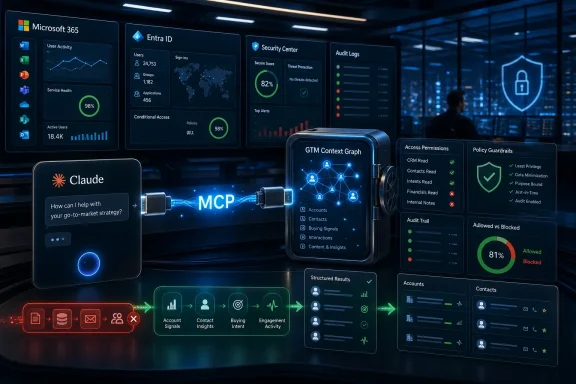
ZoomInfo’s pitch is straightforward: customers who already pay for its B2B data can connect that entitlement to Claude and ask for account research, stakeholder mapping, contact enrichment, or buying-signal analysis in plain English. Instead of copying records into a prompt or exporting CSVs into yet another sales workflow, Claude can query ZoomInfo’s GTM Context Graph through a native connector.
That sounds like a productivity feature, and for a sales team it probably is. A rep can ask for decision makers at a target account, a revenue operations manager can build a list of accounts matching a specific profile, and a GTM engineer can use Claude Code to orchestrate enrichment and scoring steps. The claimed data backbone is large: more than 100 million companies, 500 million contacts, and billions of signals.
But the strategic move is more interesting than the individual use case. ZoomInfo is trying to make its data layer portable across AI surfaces before those surfaces become the new operating environment for work. Claude, ChatGPT, Microsoft Copilot, Salesforce Agentforce, HubSpot Breeze, Gong, LeanData, Glean, and Google integrations all point to the same thesis: the winning business database is no longer the one with the nicest web app, but the one that agents can call safely, repeatedly, and with enough context to be useful.
This is the practical meaning of headless in enterprise AI. ZoomInfo does not need every user to live inside ZoomInfo’s interface if it can ensure that ZoomInfo’s records are what agents retrieve when users ask commercially valuable questions elsewhere. In that world, the data vendor becomes infrastructure, the assistant becomes the interface, and the application layer starts to look less like a destination and more like a permission boundary.
The analogy is imperfect, but useful: MCP is trying to do for AI tools what USB-C did for peripherals. It does not make every device safe, high-quality, or well-governed. It does, however, lower the friction of connecting things that previously required custom glue.
That matters because the enterprise AI story has been stuck between two unsatisfying extremes. On one side are chatbots that know only what a user pastes into a window. On the other are bespoke automation projects that require weeks of integration work and become brittle as soon as a workflow changes. MCP aims for a middle path: a standardized way for an assistant to discover tools, request context, call functions, and return structured results.
ZoomInfo’s adoption of MCP is therefore not merely a technical implementation detail. It is a bet that the assistant ecosystem will not consolidate around one dominant front end. If customers use Claude for analysis, Copilot for Office work, ChatGPT for general tasks, and Salesforce Agentforce for CRM operations, ZoomInfo wants its data to be callable from all of them.
That is good news for interoperability, at least in theory. It also raises a harder question: once every assistant can call every business system, who is responsible when the agent does exactly what it was allowed to do but not what the business intended?
AI connectors weaken that boundary. When a user can ask Claude to “find likely buyers in mid-market fintech using a competing platform and enrich the top contacts,” the interface is no longer a form. It is a negotiation between natural language, model interpretation, connector permissions, vendor policy, and the data provider’s API.
That can be powerful. It can also be unnerving. Natural language has a way of making complex data access feel casual, and casual access is where governance mistakes tend to hide.
ZoomInfo says the Claude integration inherits access control, permissioning, data lineage, AI policy, and audit logging through GTM.AI. That is exactly the right vocabulary, and it is the vocabulary every enterprise AI vendor is now using. The question for IT leaders is how much of that governance is actually inspectable, enforceable, and aligned with existing identity and compliance systems.
For a Windows-heavy enterprise, that usually means Microsoft Entra ID, conditional access, Purview, Defender, endpoint controls, DLP rules, SIEM ingestion, and a thicket of CRM permissions built up over years. The connector is only one piece of the chain. The assistant account, the user identity, the data entitlement, the tool permission, the generated output, and the downstream action all matter.
For ZoomInfo, that opens the door to GTM workflows that look less like sales enablement and more like software pipelines. A user might ask Claude Code to read a target account list, enrich company and contact records, check buying signals, score accounts against an ideal customer profile, write the output to a CRM-ready format, and generate follow-up messaging. If connected tools allow it, some of those steps can become executable rather than advisory.
That is where the promise and risk converge. Revenue teams have always used spreadsheet macros, browser extensions, workflow builders, and duct-taped scripts to move data around. Claude Code gives that improvisational tradition a much more capable interface. It also gives non-engineers a way to build automations that may touch regulated data, consume paid enrichment credits, or trigger downstream sales activity.
The old shadow IT problem was that employees adopted unsanctioned SaaS tools. The new version is subtler: employees may use sanctioned AI clients with sanctioned connectors to create unsanctioned workflows. From a governance standpoint, that is harder to detect because every individual component may be approved.
This is why audit logging and policy controls cannot be decorative. If an agent enriches 5,000 contacts, attributes intent signals, and pushes scores into a campaign workflow, administrators need to know who initiated it, what data was queried, what tool calls were made, what outputs were generated, and whether those outputs left the approved environment. “The AI did it” is not an audit trail.
ZoomInfo’s announcement highlights a different model. Rather than assuming one assistant will own the enterprise, it assumes that specialized assistants will coexist and that the data layer must follow the user. Claude may be better suited for certain reasoning, writing, coding, or agentic tasks; Copilot may be better positioned inside Microsoft 365 and Windows workflows. The vendor that exposes clean connectors to both does not have to choose.
This creates pressure on Microsoft in two directions. First, Copilot must become a better consumer of third-party context, not merely a summarizer of Microsoft Graph data. Second, Microsoft’s governance stack must account for users who work across non-Microsoft AI surfaces while still touching corporate data.
Microsoft’s connector ecosystem is already moving in that direction, and ZoomInfo’s presence in Microsoft connector contexts suggests the company wants to be available wherever enterprise agents operate. The practical result is a multi-assistant workplace. Users will not ask whether a task is “for Copilot” or “for Claude” in the abstract. They will use whichever assistant has the right context, tool access, model behavior, and organizational blessing.
That is uncomfortable for vendors that want to own the whole interface. It is more realistic for IT departments, which have spent decades managing heterogeneous estates despite every platform owner’s dream of monoculture.
Sales is simply one of the first business functions where the economics of agentic data access are obvious. The data is valuable, the workflows are repetitive, the appetite for automation is high, and the tolerance for imperfect but useful output is often greater than in finance, legal, or security. If AI connectors can prove themselves in go-to-market workflows, they will spread elsewhere.
The same architectural pattern applies to HR systems, procurement databases, ticketing platforms, vulnerability scanners, data warehouses, and internal knowledge bases. An assistant that can retrieve verified contact records today can retrieve asset inventories tomorrow. An agent that enriches accounts today can triage support cases, draft change requests, correlate alerts, or update documentation tomorrow.
That is why the ZoomInfo-Claude integration belongs in a broader enterprise IT conversation. It is another example of AI moving from content generation to contextual action. The former was annoying when wrong. The latter can be operationally consequential when wrong.
The distinction matters. A hallucinated paragraph in a sales email is embarrassing. A hallucinated database update, permission change, compliance classification, or customer segmentation rule can become a business incident.
But verified inputs do not guarantee sound outputs. A contact record may be accurate, a company profile may be current, and a buying signal may be real, while the model’s synthesis remains flawed. It might overstate intent, misread relevance, infer an organizational structure that is not actually present, or recommend outreach that violates internal policy.
This is the trap in many enterprise AI deployments. Vendors talk about grounding as if the hard problem is solved once the model has access to reliable data. Grounding is necessary, but it is not judgment. The model still has to decide what matters, how to combine signals, when to ask for clarification, and how to express uncertainty.
In sales workflows, that uncertainty may show up as wasted time, awkward outreach, or misprioritized accounts. In other domains, the consequences can be more severe. A security analyst asking an AI agent to prioritize vulnerabilities, for example, needs more than accurate CVE data; they need defensible reasoning about exploitability, asset exposure, compensating controls, and business impact.
The same principle applies here. ZoomInfo can provide better commercial context to Claude. It cannot, by itself, make every Claude-generated GTM recommendation correct.
Traditional data platforms require users to search, filter, export, and interpret. AI assistants make activation feel conversational. A user can ask for a list of prospects matching a nuanced profile, request email addresses or phone numbers where permitted, and fold those results into messaging or workflow automation without leaving the assistant.
That compression of steps is precisely the productivity gain. It is also what makes privacy and compliance scrutiny more important. When friction drops, volume tends to rise. When volume rises, small policy misunderstandings scale quickly.
Organizations using this connector should care about more than whether the data vendor has a compliance page. They should examine who can access which records, what enrichment actions cost or expose, how consent and opt-out rules are represented, and whether outputs can be copied into unapproved systems. They should also ask how AI-generated segmentation interacts with regional privacy rules and internal acceptable-use policies.
This is especially important for multinational companies. A sales workflow that feels routine in one jurisdiction may require tighter controls in another. If an AI assistant is allowed to blur those boundaries in the name of convenience, the organization owns the resulting risk.
What is genuinely new is the way the model sits between the user and the system. In older automation, a workflow designer encoded the steps. In agentic systems, the user states an outcome and the model may decide which tools to call, in what order, and with what intermediate reasoning. That makes policy design much more important.
ZoomInfo’s GTM.AI framing acknowledges this by emphasizing a common governance plane. The company wants customers to see it not as a connector one-off, but as a controlled context layer across many AI clients. That is the right enterprise story because customers do not want to rebuild policy for every assistant.
Still, implementation will determine whether the story holds. A common governance plane must handle identity mapping, role-based permissions, tool-specific controls, data lineage, audit trails, rate limits, credit consumption, and revocation. It must also be understandable to administrators who are already buried under dashboards.
The risk is that every vendor builds its own mini-governance universe and calls it unified. Enterprises have seen this movie before. The cloud era produced overlapping control planes for identity, logging, policy, and cost management. The AI era could repeat the same mistake at higher speed unless vendors integrate cleanly with the systems administrators already use.
The agent boundary is the new perimeter. It sits between a user’s intent and the systems that can fulfill it. In a connector-rich environment, that boundary may matter as much as the browser session, VPN tunnel, or endpoint agent.
For administrators, the practical questions are becoming clearer. Which AI clients are approved? Which connectors are allowed? Which users can enable them? Are connector permissions centrally managed or left to individual users? Do logs flow into the organization’s SIEM? Can DLP inspect AI outputs? Are generated files labeled, retained, and discoverable? Can administrators distinguish a user reading a record from an agent bulk-enriching thousands of them?
Those questions are not theoretical. Claude connectors, Copilot connectors, ChatGPT connectors, and custom MCP servers all move the enterprise toward a world where access is mediated by tools that can reason, summarize, and act. That is useful, but it also means old access models may be too coarse.
If a user has permission to view a record, should their AI assistant have permission to retrieve hundreds of similar records, infer a pattern, and generate an outbound campaign? Technically, those may be adjacent actions. Operationally, they are different.
A malicious browser extension can steal data. A poorly designed OAuth app can overreach. A rogue SaaS integration can quietly sync sensitive information. AI connectors inherit all of those risks and add model-mediated ambiguity on top. Users may not always understand which system an assistant is querying, what data is being returned, or where the output is going next.
ZoomInfo’s connector is from a known vendor and appears in Claude’s connector directory, which is very different from a random GitHub MCP server. But the broader pattern still matters. Once users get accustomed to enabling connectors, the enterprise must decide whether the marketplace is open by default, curated by administrators, or locked down to approved integrations.
The answer should probably vary by organization and data class. A small startup may accept broad experimentation. A regulated enterprise should not. What matters is that the policy is deliberate rather than accidental.
This is where Microsoft’s long experience with tenant administration, app consent policies, Defender for Cloud Apps, and Entra governance becomes relevant even when the assistant is not Microsoft’s. Enterprises will need equivalent controls across AI ecosystems, and they will need them before connector sprawl becomes unmanageable.
That is why the phrase “verified” appears so heavily in the company’s positioning. In an agent workflow, stale or inaccurate data is not just an annoyance. It can propagate through sequences, scoring models, CRM fields, sales forecasts, and executive dashboards. Bad data has always been expensive; agents can make it expensive faster.
The GTM Context Graph is ZoomInfo’s answer to that problem. It packages identity resolution, company data, contact data, technographics, firmographics, and buying signals as a queryable context layer. The term “graph” is doing important work here because it suggests relationships rather than flat records: people to companies, companies to technologies, signals to likely intent, and accounts to possible buying committees.
Whether that graph performs as advertised will depend on data freshness, coverage, accuracy, and customer-specific fit. A global enterprise selling infrastructure software has different needs from a regional services firm. A contact record that is “verified” for one purpose may still be insufficient for another.
The move into Claude does not settle those questions. It makes them more visible because users will now encounter ZoomInfo’s claims inside the flow of AI-assisted work rather than inside a dedicated data product.
ZoomInfo understands this. Microsoft understands it. Salesforce understands it. So do Google, OpenAI, Anthropic, ServiceNow, Atlassian, and nearly every enterprise software vendor trying to reposition itself for the agent era.
The company that owns the context can shape the answer. If Claude is asked which accounts to prioritize and ZoomInfo supplies the commercial signals, ZoomInfo becomes part of the decision. If Copilot is asked which customer issue needs escalation and Microsoft Graph plus Dynamics supply the context, Microsoft becomes part of the decision. If a security agent prioritizes alerts using endpoint telemetry, vulnerability data, and identity risk, the vendors feeding that context influence operational reality.
This is why connectors are not neutral plumbing. They encode vendor assumptions about what data matters, what actions are available, and what counts as a useful result. The assistant may provide the conversational interface, but the connected systems shape the world it sees.
That should make enterprises cautious about over-reliance on any single context provider. It should also make them more serious about data quality inside their own systems. AI agents will not magically fix a messy CRM, contradictory account ownership rules, or stale enrichment fields. They may simply make the mess easier to query.
The direction of travel is clear. Enterprise users will increasingly expect assistants to reach into approved systems, retrieve live context, perform multi-step work, and explain the result. Vendors will increasingly compete to be the trusted context layer for those assistants. IT departments will increasingly be asked to govern workflows that are neither traditional apps nor simple chat sessions.
That creates a familiar tension. Business units will see speed. Security teams will see access paths. Compliance teams will see data movement. Finance teams will see consumption-based cost. Administrators will see another control plane to integrate.
The organizations that handle this well will not be the ones that ban everything or approve everything. They will be the ones that classify data, define agent permissions, centralize logs, test connector behavior, and teach users that an AI assistant with tool access is closer to a junior operator than a search box.
 Claude Gets a Sales Database, but the Bigger Story Is the Connector War
ZoomInfo’s pitch is straightforward: customers who already pay for its B2B data can connect that entitlement to Claude and ask for account research, stakeholder mapping, contact enrichment, or buying-signal analysis in plain English. Instead of copying records into a prompt or exporting CSVs into yet another sales workflow, Claude can query ZoomInfo’s GTM Context Graph through a native connector.That sounds like a productivity feature, and for a sales team it probably is. A rep can ask for decision makers at a target account, a revenue operations manager can build a list of accounts matching a specific profile, and a GTM engineer can use Claude Code to orchestrate enrichment and scoring steps. The claimed data backbone is large: more than 100 million companies, 500 million contacts, and billions of signals.
But the strategic move is more interesting than the individual use case. ZoomInfo is trying to make its data layer portable across AI surfaces before those surfaces become the new operating environment for work. Claude, ChatGPT, Microsoft Copilot, Salesforce Agentforce, HubSpot Breeze, Gong, LeanData, Glean, and Google integrations all point to the same thesis: the winning business database is no longer the one with the nicest web app, but the one that agents can call safely, repeatedly, and with enough context to be useful.
This is the practical meaning of headless in enterprise AI. ZoomInfo does not need every user to live inside ZoomInfo’s interface if it can ensure that ZoomInfo’s records are what agents retrieve when users ask commercially valuable questions elsewhere. In that world, the data vendor becomes infrastructure, the assistant becomes the interface, and the application layer starts to look less like a destination and more like a permission boundary.
MCP Is Quietly Becoming the USB-C Port for Enterprise AI
ZoomInfo’s connector leans on Model Context Protocol, the open standard Anthropic introduced to let AI systems connect to external tools and data sources in a consistent way. MCP has quickly become one of the most important technical ideas in the agent boom because it gives vendors a lingua franca for exposing tools to AI clients without building bespoke integrations for every assistant.The analogy is imperfect, but useful: MCP is trying to do for AI tools what USB-C did for peripherals. It does not make every device safe, high-quality, or well-governed. It does, however, lower the friction of connecting things that previously required custom glue.
That matters because the enterprise AI story has been stuck between two unsatisfying extremes. On one side are chatbots that know only what a user pastes into a window. On the other are bespoke automation projects that require weeks of integration work and become brittle as soon as a workflow changes. MCP aims for a middle path: a standardized way for an assistant to discover tools, request context, call functions, and return structured results.
ZoomInfo’s adoption of MCP is therefore not merely a technical implementation detail. It is a bet that the assistant ecosystem will not consolidate around one dominant front end. If customers use Claude for analysis, Copilot for Office work, ChatGPT for general tasks, and Salesforce Agentforce for CRM operations, ZoomInfo wants its data to be callable from all of them.
That is good news for interoperability, at least in theory. It also raises a harder question: once every assistant can call every business system, who is responsible when the agent does exactly what it was allowed to do but not what the business intended?
The Database Is No Longer Behind the Glass
For decades, enterprise software protected business data through interfaces that constrained behavior. A CRM screen showed certain fields, a search form exposed certain filters, and a report builder required users to understand enough of the data model to ask structured questions. Those interfaces were annoying, but they also functioned as guardrails.AI connectors weaken that boundary. When a user can ask Claude to “find likely buyers in mid-market fintech using a competing platform and enrich the top contacts,” the interface is no longer a form. It is a negotiation between natural language, model interpretation, connector permissions, vendor policy, and the data provider’s API.
That can be powerful. It can also be unnerving. Natural language has a way of making complex data access feel casual, and casual access is where governance mistakes tend to hide.
ZoomInfo says the Claude integration inherits access control, permissioning, data lineage, AI policy, and audit logging through GTM.AI. That is exactly the right vocabulary, and it is the vocabulary every enterprise AI vendor is now using. The question for IT leaders is how much of that governance is actually inspectable, enforceable, and aligned with existing identity and compliance systems.
For a Windows-heavy enterprise, that usually means Microsoft Entra ID, conditional access, Purview, Defender, endpoint controls, DLP rules, SIEM ingestion, and a thicket of CRM permissions built up over years. The connector is only one piece of the chain. The assistant account, the user identity, the data entitlement, the tool permission, the generated output, and the downstream action all matter.
Claude Code Turns Sales Ops Into a Developer Workflow
The inclusion of Claude Code is the detail that should make technical readers sit up. Claude.ai is the obvious surface for conversational research. Claude Code is something different: an agentic development environment where tool calls, scripts, files, APIs, and workflows can be composed into repeatable operations.For ZoomInfo, that opens the door to GTM workflows that look less like sales enablement and more like software pipelines. A user might ask Claude Code to read a target account list, enrich company and contact records, check buying signals, score accounts against an ideal customer profile, write the output to a CRM-ready format, and generate follow-up messaging. If connected tools allow it, some of those steps can become executable rather than advisory.
That is where the promise and risk converge. Revenue teams have always used spreadsheet macros, browser extensions, workflow builders, and duct-taped scripts to move data around. Claude Code gives that improvisational tradition a much more capable interface. It also gives non-engineers a way to build automations that may touch regulated data, consume paid enrichment credits, or trigger downstream sales activity.
The old shadow IT problem was that employees adopted unsanctioned SaaS tools. The new version is subtler: employees may use sanctioned AI clients with sanctioned connectors to create unsanctioned workflows. From a governance standpoint, that is harder to detect because every individual component may be approved.
This is why audit logging and policy controls cannot be decorative. If an agent enriches 5,000 contacts, attributes intent signals, and pushes scores into a campaign workflow, administrators need to know who initiated it, what data was queried, what tool calls were made, what outputs were generated, and whether those outputs left the approved environment. “The AI did it” is not an audit trail.
Microsoft Copilot Is the Unavoidable Comparison
For a WindowsForum audience, Claude’s new ZoomInfo connector inevitably invites comparison with Microsoft Copilot. Microsoft has spent the last several years positioning Copilot as the AI layer across Windows, Microsoft 365, GitHub, Dynamics, Power Platform, Security, and Azure. Its advantage is proximity: identity, documents, email, Teams chats, calendars, endpoints, and administrative controls already live in Microsoft’s orbit.ZoomInfo’s announcement highlights a different model. Rather than assuming one assistant will own the enterprise, it assumes that specialized assistants will coexist and that the data layer must follow the user. Claude may be better suited for certain reasoning, writing, coding, or agentic tasks; Copilot may be better positioned inside Microsoft 365 and Windows workflows. The vendor that exposes clean connectors to both does not have to choose.
This creates pressure on Microsoft in two directions. First, Copilot must become a better consumer of third-party context, not merely a summarizer of Microsoft Graph data. Second, Microsoft’s governance stack must account for users who work across non-Microsoft AI surfaces while still touching corporate data.
Microsoft’s connector ecosystem is already moving in that direction, and ZoomInfo’s presence in Microsoft connector contexts suggests the company wants to be available wherever enterprise agents operate. The practical result is a multi-assistant workplace. Users will not ask whether a task is “for Copilot” or “for Claude” in the abstract. They will use whichever assistant has the right context, tool access, model behavior, and organizational blessing.
That is uncomfortable for vendors that want to own the whole interface. It is more realistic for IT departments, which have spent decades managing heterogeneous estates despite every platform owner’s dream of monoculture.
The Sales Use Case Is Narrow, the Governance Lesson Is Broad
It would be easy for sysadmins to dismiss this as sales technology noise. ZoomInfo, GTM.AI, contact enrichment, account scoring, buying signals — these sound far removed from patch management, endpoint security, Windows deployments, or identity governance. That would be a mistake.Sales is simply one of the first business functions where the economics of agentic data access are obvious. The data is valuable, the workflows are repetitive, the appetite for automation is high, and the tolerance for imperfect but useful output is often greater than in finance, legal, or security. If AI connectors can prove themselves in go-to-market workflows, they will spread elsewhere.
The same architectural pattern applies to HR systems, procurement databases, ticketing platforms, vulnerability scanners, data warehouses, and internal knowledge bases. An assistant that can retrieve verified contact records today can retrieve asset inventories tomorrow. An agent that enriches accounts today can triage support cases, draft change requests, correlate alerts, or update documentation tomorrow.
That is why the ZoomInfo-Claude integration belongs in a broader enterprise IT conversation. It is another example of AI moving from content generation to contextual action. The former was annoying when wrong. The latter can be operationally consequential when wrong.
The distinction matters. A hallucinated paragraph in a sales email is embarrassing. A hallucinated database update, permission change, compliance classification, or customer segmentation rule can become a business incident.
Verified Data Does Not Mean Verified Judgment
ZoomInfo’s central claim is that Claude will read from verified GTM data rather than whatever a user pastes into a prompt. That is a real improvement over ad hoc prompting. Grounding a model in a maintained data source reduces one class of error: the assistant is less likely to invent basic facts when it can call a system designed to provide them.But verified inputs do not guarantee sound outputs. A contact record may be accurate, a company profile may be current, and a buying signal may be real, while the model’s synthesis remains flawed. It might overstate intent, misread relevance, infer an organizational structure that is not actually present, or recommend outreach that violates internal policy.
This is the trap in many enterprise AI deployments. Vendors talk about grounding as if the hard problem is solved once the model has access to reliable data. Grounding is necessary, but it is not judgment. The model still has to decide what matters, how to combine signals, when to ask for clarification, and how to express uncertainty.
In sales workflows, that uncertainty may show up as wasted time, awkward outreach, or misprioritized accounts. In other domains, the consequences can be more severe. A security analyst asking an AI agent to prioritize vulnerabilities, for example, needs more than accurate CVE data; they need defensible reasoning about exploitability, asset exposure, compensating controls, and business impact.
The same principle applies here. ZoomInfo can provide better commercial context to Claude. It cannot, by itself, make every Claude-generated GTM recommendation correct.
The Privacy Debate Moves From Collection to Activation
ZoomInfo has long operated in the sensitive world of business contact data, where the line between useful professional intelligence and uncomfortable surveillance is regularly debated. The Claude integration does not create that debate, but it changes the interface through which users experience it.Traditional data platforms require users to search, filter, export, and interpret. AI assistants make activation feel conversational. A user can ask for a list of prospects matching a nuanced profile, request email addresses or phone numbers where permitted, and fold those results into messaging or workflow automation without leaving the assistant.
That compression of steps is precisely the productivity gain. It is also what makes privacy and compliance scrutiny more important. When friction drops, volume tends to rise. When volume rises, small policy misunderstandings scale quickly.
Organizations using this connector should care about more than whether the data vendor has a compliance page. They should examine who can access which records, what enrichment actions cost or expose, how consent and opt-out rules are represented, and whether outputs can be copied into unapproved systems. They should also ask how AI-generated segmentation interacts with regional privacy rules and internal acceptable-use policies.
This is especially important for multinational companies. A sales workflow that feels routine in one jurisdiction may require tighter controls in another. If an AI assistant is allowed to blur those boundaries in the name of convenience, the organization owns the resulting risk.
The New Stack Is Data, Policy, and Agents
The software industry has a habit of renaming old ideas when a new interface arrives. Data integration becomes context engineering. Workflow automation becomes agentic orchestration. API access becomes tool use. Some of that is marketing, but not all of it.What is genuinely new is the way the model sits between the user and the system. In older automation, a workflow designer encoded the steps. In agentic systems, the user states an outcome and the model may decide which tools to call, in what order, and with what intermediate reasoning. That makes policy design much more important.
ZoomInfo’s GTM.AI framing acknowledges this by emphasizing a common governance plane. The company wants customers to see it not as a connector one-off, but as a controlled context layer across many AI clients. That is the right enterprise story because customers do not want to rebuild policy for every assistant.
Still, implementation will determine whether the story holds. A common governance plane must handle identity mapping, role-based permissions, tool-specific controls, data lineage, audit trails, rate limits, credit consumption, and revocation. It must also be understandable to administrators who are already buried under dashboards.
The risk is that every vendor builds its own mini-governance universe and calls it unified. Enterprises have seen this movie before. The cloud era produced overlapping control planes for identity, logging, policy, and cost management. The AI era could repeat the same mistake at higher speed unless vendors integrate cleanly with the systems administrators already use.
Windows Admins Should Watch the Agent Boundary
This announcement is not about Windows, but Windows administrators should still pay attention. Most enterprise AI work ultimately lands on endpoints, browsers, identity providers, office suites, developer machines, and SaaS applications. Windows remains the place where much of that work is initiated, copied, cached, scripted, and exfiltrated if controls fail.The agent boundary is the new perimeter. It sits between a user’s intent and the systems that can fulfill it. In a connector-rich environment, that boundary may matter as much as the browser session, VPN tunnel, or endpoint agent.
For administrators, the practical questions are becoming clearer. Which AI clients are approved? Which connectors are allowed? Which users can enable them? Are connector permissions centrally managed or left to individual users? Do logs flow into the organization’s SIEM? Can DLP inspect AI outputs? Are generated files labeled, retained, and discoverable? Can administrators distinguish a user reading a record from an agent bulk-enriching thousands of them?
Those questions are not theoretical. Claude connectors, Copilot connectors, ChatGPT connectors, and custom MCP servers all move the enterprise toward a world where access is mediated by tools that can reason, summarize, and act. That is useful, but it also means old access models may be too coarse.
If a user has permission to view a record, should their AI assistant have permission to retrieve hundreds of similar records, infer a pattern, and generate an outbound campaign? Technically, those may be adjacent actions. Operationally, they are different.
The Marketplace Becomes the New Attack Surface
Connector directories are becoming the app stores of enterprise AI. They promise discoverability, easy setup, and user-friendly integration. They also create a new supply chain problem.A malicious browser extension can steal data. A poorly designed OAuth app can overreach. A rogue SaaS integration can quietly sync sensitive information. AI connectors inherit all of those risks and add model-mediated ambiguity on top. Users may not always understand which system an assistant is querying, what data is being returned, or where the output is going next.
ZoomInfo’s connector is from a known vendor and appears in Claude’s connector directory, which is very different from a random GitHub MCP server. But the broader pattern still matters. Once users get accustomed to enabling connectors, the enterprise must decide whether the marketplace is open by default, curated by administrators, or locked down to approved integrations.
The answer should probably vary by organization and data class. A small startup may accept broad experimentation. A regulated enterprise should not. What matters is that the policy is deliberate rather than accidental.
This is where Microsoft’s long experience with tenant administration, app consent policies, Defender for Cloud Apps, and Entra governance becomes relevant even when the assistant is not Microsoft’s. Enterprises will need equivalent controls across AI ecosystems, and they will need them before connector sprawl becomes unmanageable.
ZoomInfo Is Selling Trust as Much as Data
ZoomInfo’s competitive challenge is not merely to have a large database. Many vendors claim large datasets, intent signals, enrichment APIs, and AI-ready records. The strategic challenge is to persuade customers that its data can be trusted enough for agents to use autonomously or semi-autonomously.That is why the phrase “verified” appears so heavily in the company’s positioning. In an agent workflow, stale or inaccurate data is not just an annoyance. It can propagate through sequences, scoring models, CRM fields, sales forecasts, and executive dashboards. Bad data has always been expensive; agents can make it expensive faster.
The GTM Context Graph is ZoomInfo’s answer to that problem. It packages identity resolution, company data, contact data, technographics, firmographics, and buying signals as a queryable context layer. The term “graph” is doing important work here because it suggests relationships rather than flat records: people to companies, companies to technologies, signals to likely intent, and accounts to possible buying committees.
Whether that graph performs as advertised will depend on data freshness, coverage, accuracy, and customer-specific fit. A global enterprise selling infrastructure software has different needs from a regional services firm. A contact record that is “verified” for one purpose may still be insufficient for another.
The move into Claude does not settle those questions. It makes them more visible because users will now encounter ZoomInfo’s claims inside the flow of AI-assisted work rather than inside a dedicated data product.
The Assistant Interface Rewards Whoever Owns Context
The deeper platform battle is about context ownership. Large language models are increasingly commoditized at the interface layer, at least from the perspective of business users who simply want useful results. What differentiates an AI workflow is the context it can reach, the tools it can use, and the policies that govern it.ZoomInfo understands this. Microsoft understands it. Salesforce understands it. So do Google, OpenAI, Anthropic, ServiceNow, Atlassian, and nearly every enterprise software vendor trying to reposition itself for the agent era.
The company that owns the context can shape the answer. If Claude is asked which accounts to prioritize and ZoomInfo supplies the commercial signals, ZoomInfo becomes part of the decision. If Copilot is asked which customer issue needs escalation and Microsoft Graph plus Dynamics supply the context, Microsoft becomes part of the decision. If a security agent prioritizes alerts using endpoint telemetry, vulnerability data, and identity risk, the vendors feeding that context influence operational reality.
This is why connectors are not neutral plumbing. They encode vendor assumptions about what data matters, what actions are available, and what counts as a useful result. The assistant may provide the conversational interface, but the connected systems shape the world it sees.
That should make enterprises cautious about over-reliance on any single context provider. It should also make them more serious about data quality inside their own systems. AI agents will not magically fix a messy CRM, contradictory account ownership rules, or stale enrichment fields. They may simply make the mess easier to query.
A Small Connector Announcement Points to a Much Larger Operating Model
The ZoomInfo-Claude integration is easy to summarize but harder to categorize. It is a connector announcement, a data-platform play, an MCP proof point, a Claude ecosystem expansion, and a signal that GTM teams are becoming early adopters of agentic business workflows. Its importance depends less on how many users enable it this month than on how normal this pattern becomes.The direction of travel is clear. Enterprise users will increasingly expect assistants to reach into approved systems, retrieve live context, perform multi-step work, and explain the result. Vendors will increasingly compete to be the trusted context layer for those assistants. IT departments will increasingly be asked to govern workflows that are neither traditional apps nor simple chat sessions.
That creates a familiar tension. Business units will see speed. Security teams will see access paths. Compliance teams will see data movement. Finance teams will see consumption-based cost. Administrators will see another control plane to integrate.
The organizations that handle this well will not be the ones that ban everything or approve everything. They will be the ones that classify data, define agent permissions, centralize logs, test connector behavior, and teach users that an AI assistant with tool access is closer to a junior operator than a search box.
The Claude Connector Is a Test Case for the Agentic Back Office
ZoomInfo’s announcement leaves enterprise buyers with a practical checklist, even if the company’s own messaging naturally emphasizes the upside. The connector may be useful, but its real value depends on how well it fits into an organization’s identity, governance, compliance, and workflow architecture.- ZoomInfo customers can now use a native Claude connector to bring company, contact, and buying-signal data into Claude.ai and Claude Code.
- The integration is powered by GTM.AI and exposed through Model Context Protocol, reinforcing MCP’s role as a common connection layer for AI tools.
- Claude Code support makes the connector more than a research feature because it can become part of repeatable, agentic GTM workflows.
- The governance claims around access control, permissioning, lineage, policy, and audit logging are central to whether enterprises should trust the integration at scale.
- Windows and Microsoft 365 administrators should treat AI connectors as a new access boundary, not as harmless chatbot add-ons.
- Verified data can reduce hallucination risk, but it does not eliminate the need to validate model reasoning, downstream actions, and compliance obligations.
References
- Primary source: 01net
Published: 2026-06-05T18:50:29.965097
Loading…
www.01net.it - Related coverage: venturebeat.com
Loading…
venturebeat.com - Official source: claude.com
Loading…
claude.com - Related coverage: gtm.ai
Loading…
gtm.ai - Related coverage: kpmg.com
- Related coverage: barchart.com
Loading…
www.barchart.com
