

Mark Zuckerberg’s attempt to keep a small, Montessori-style learning pod tucked inside his sprawling Palo Alto compound has become a high-profile example of how local zoning rules can bring even Silicon Valley’s most powerful residents to heel.
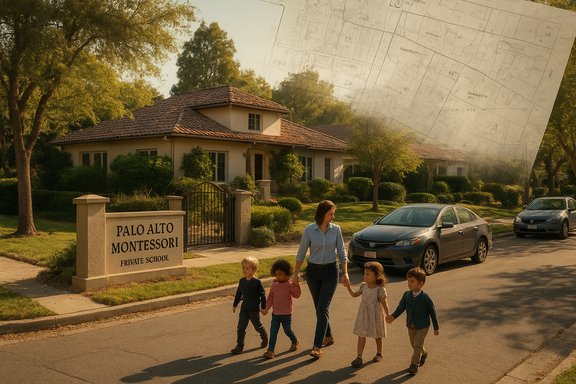
For several years a private educational operation—widely reported under the name Bicken Ben School (often abbreviated BBS)—was run from a residential property within the Crescent Park neighborhood of Palo Alto. Neighbors first began noticing a steady morning rhythm of vehicles and children arriving at the compound in 2021; over time that observation hardened into scrutiny and formal complaints as residents questioned whether what began as a pandemic-era homeschooling pod had morphed into an unpermitted private school. The resulting dispute escalated into multi-year correspondence between neighbors, city planners, and the school’s representatives, ultimately culminating in a formal order to cease operations on the compound. What matters in this story is not only the presence of the school itself, but the pattern it exposes: concentrated wealth, extensive property consolidation, and private security interacting with land-use rules designed to preserve residential character. Those frictions turned routine zoning enforcement into a politically charged neighborhood campaign, drawing national attention and raising questions about consistency of municipal enforcement.
For planners and policymakers, the core takeaway is operational: create clearer rules and faster procedures to handle the proliferation of non-traditional educational formats. For neighbors, the lesson is organizational: sustained, well-documented civic action works. And for wealthy property owners, the practical reality is unavoidable: building a private campus inside a residential zone invites scrutiny, and the law will eventually demand alignment between intent and local regulation.
This episode will likely prompt other Bay Area and national communities to reassess how small private schools and education pods fit into residential landscapes—and to codify a more transparent, equitable approach to resolving those tensions.
Source: Storyboard18 Mark Zuckerberg started school in his house for 30 students, neighbour complaints lead to a shut down order
 Background
For several years a private educational operation—widely reported under the name Bicken Ben School (often abbreviated BBS)—was run from a residential property within the Crescent Park neighborhood of Palo Alto. Neighbors first began noticing a steady morning rhythm of vehicles and children arriving at the compound in 2021; over time that observation hardened into scrutiny and formal complaints as residents questioned whether what began as a pandemic-era homeschooling pod had morphed into an unpermitted private school. The resulting dispute escalated into multi-year correspondence between neighbors, city planners, and the school’s representatives, ultimately culminating in a formal order to cease operations on the compound. What matters in this story is not only the presence of the school itself, but the pattern it exposes: concentrated wealth, extensive property consolidation, and private security interacting with land-use rules designed to preserve residential character. Those frictions turned routine zoning enforcement into a politically charged neighborhood campaign, drawing national attention and raising questions about consistency of municipal enforcement. Overview of the Bicken Ben School saga
What BBS reportedly was
- A small, Montessori-style program centered around elementary grades, described in public reporting as serving roughly 15–40 children at various points depending on the source—neighbourhood estimates skewed higher than the numbers recorded in state filings.
- Staffed by several educators and administrators; job postings and LinkedIn citations connected to the operation reference roles such as "head of school" and suggested ambitions for expansion, including references to multiple campuses or affiliated sites in some listings.
- Identified in California state directories and filings under names and abbreviations tied to the family’s in-house program (BBS/Bicken Ben School) with recorded opening dates that differ slightly from neighbour recollections.
Why neighbors complained
- Increased traffic and parking disruption: residents described daily drop-offs and pickups, plus staff vehicles and security presence that altered the rhythm of the residential street.
- Construction, noise, and prolonged property conversions tied to the expansion of the compound had been an ongoing friction point for years prior to the school dispute, amplifying sensitivity around any additional change of use.
- Perception of preferential treatment: when enforcement moved slowly or when city staff engaged in discussions about conditional approvals, some neighbors publicly accused officials of bending rules for a high-profile property owner. That accusation became a central theme in correspondence to the city.
City enforcement and resolution
- Palo Alto planning officials ultimately determined that a conditional use permit was required for the operation of a private school from a residence in that zoning district. City staff told the family’s legal counsel they needed to cease operations on-site by June 30, 2025, and threatened legal action if the school continued to operate in violation of local code. Reports indicate the on-site operation ceased around mid-2025, though the family’s spokesperson has said the program relocated rather than shut down outright.
Timeline: key milestones
- 2021 — Neighbors begin observing regular drop-offs and a pattern of activity at the compound that suggested a group-learning environment beyond informal home-schooling. Public reporting traces the program’s informal beginnings to around this year.
- 2022 — State filings and job postings for the operation begin to surface, listing small student cohorts and advertising school staff roles; public records later cited growth in enrollment in state directories.
- 2022–2024 — Escalating neighborhood complaints around traffic, security escorts for city inspectors, and prolonged redevelopment work on multiple adjacent properties owned by the family feed into a larger conflict with the neighborhood association and city staff.
- March 2025 — City staff communicated to the family’s legal representatives that the in-house program must stop operating on the compound by June 30, 2025, unless appropriately permitted.
- June–August 2025 — Reports and state records suggest the Bicken Ben listing was removed from state directories in August; neighbors reported cessation of visible drop-offs by late summer, while a family spokesperson said the school had relocated.
Why zoning rules matter here
The legal threshold: residential use versus institutional use
Residential zones typically allow limited home-based activities but restrict operations that generate new traffic, outside staff, or repeated non-resident presence. Running a private school—defined by persistent enrollment, employees, and daily drop-off traffic—usually triggers land-use review and requires a conditional use permit (or to be located in a zone where private schools are allowed by right). That review exists to protect neighborhood character, traffic patterns, and public safety. Palo Alto’s application of these standards in this case followed those conventional principles.The enforcement challenge
Enforcement of land-use code depends on detection, documentation, and political will. Complaints from neighbours triggered an extended process of investigation and correspondence, highlighting how resource and reputational asymmetries (fueled by wealth and high-profile residents) can complicate straightforward code enforcement. The case shows that municipal staff often prefer negotiated compliance but retain the authority to issue cease-and-desist directives when negotiations fail.Analysis: what this episode reveals about power, policy, and process
Strengths and positive signals
- Rule of law reasserted: the city’s eventual shutdown order demonstrates that zoning codes are enforceable even when the party in question is highly influential. When neighbors escalated complaints and documentation reached city staff, the municipal apparatus acted to require compliance with land-use rules.
- Community oversight matters: neighbor-organized complaints, correspondence, and public pressure moved the issue into the municipal domain. Local engagement remains one of the most effective checks on unauthorized land use.
- Municipal transparency through records: the disclosure of planning files, emails, and public records (the primary material used by investigative reporting) gave the community and journalists the documentation needed to verify timelines and decisions. This kind of transparency underpins democratic accountability.
Weaknesses and risks
- Inconsistent enforcement perceptions: neighbors repeatedly alleged preferential treatment. Regardless of whether that perception is factually accurate, it corrodes trust in local government. Municipal staff must balance sensitive negotiations with high-profile residents against the need to be seen as impartial. The longer the enforcement is delayed, the greater the erosion of public confidence.
- Regulatory gaps for new schooling models: pandemic-era homeschooling pods, microschools, and hybrid private pods have proliferated, and local codes were rarely written with these models in mind. Municipalities face a practical challenge: adapt rules to new educational formats or enforce legacy zoning strictly. Both approaches carry trade-offs.
- Relocation vs. closure ambiguity: family spokespersons said the school relocated after enforcement, but public records and neighbor observation indicate a halt to doorstep activity. That ambiguity poses oversight risks: if the program simply moved to another jurisdiction or private address not visible to neighbors, regulators and the public lose effective oversight. The relocation claim is difficult to verify without further public records. This is a key area to treat with caution.
Public-policy implications and broader trends
Wealth, land consolidation, and neighborhood governance
The episode sits at the intersection of two broader dynamics: the concentration of wealth allowing individuals to assemble compound-style properties that look and operate like small private campuses, and the limited capacity of municipal zoning to regulate those uses efficiently. When private estates begin to operate like small institutions (with staff, service vehicles, and security), they challenge the assumptions embedded in single-family residential zoning. Policymakers and planners must decide whether to tighten rules, craft special overlay zones, or create clearer paths for mixed residential/institutional uses.The rise of alternative schooling formats
Pandemic-era experimentation produced multiple educational modalities—micro-schools, pods, and homeschooling collectives. Many parents and educators prefer small, flexible programs, but those models can create friction with neighbors when they operate at scale or recruit professional staff. The law needs to be nimble enough to recognize high-quality, low-impact alternatives without creating loopholes that enable unregulated institutional activity in residential areas. This case is a cautionary example for cities nationwide that will face similar questions.Transparency and municipal responsiveness
Public trust in local government requires not only impartial decision-making but also clear communication channels and timelines. When neighbors feel blindsided by quiet changes, suspicion rises. Cities should consider procedural reforms: more proactive public notice for substantial in-home operations, standard checklists for what differentiates a hobby or pod from an institution, and faster timelines for investigating and resolving complaints. These administrative fixes could reduce friction and the likelihood of protracted disputes.What actually happened to the students and the program?
Available reporting shows two plausible outcomes, both of which have been asserted by different parties:- The city’s order halted operations at the Palo Alto compound by the deadline; state directory listings suggest the Bicken Ben entry was removed by mid-August 2025, and neighbors reported no visible weekday arrivals thereafter.
- Family representatives maintain the program did not shut down but relocated to a site in a different jurisdiction where private schools are permitted by right, or were reclassified under a different regulatory category; however, the new location and regulatory status have not been publicly verified. This claim is therefore plausible but currently unverified. Treat relocation claims as provisional until corroborated by public records or regulatory filings.
Lessons for planners, neighbors, and families
- For neighbors: document disturbances early and systematically. Photographs, traffic logs, and dated communications with city offices create the evidentiary record municipal staff need to act. Collective, sustained reporting to planning departments is often more effective than ad-hoc complaints.
- For municipalities: update zoning guidance to specify thresholds for when home-based learning pods cross into regulated schools. Clear, short-rule thresholds (e.g., number of non-resident staff, daily non-resident visits, parking impacts) reduce ambiguity and speed enforcement.
- For families and operators: consult planning departments before expanding a home-based educational program. Proactively seeking a conditional use permit or locating a program in a zone that permits private schools will avoid later enforcement headaches and neighborhood conflict.
Caveats and unverifiable claims
- Reported enrollment numbers vary significantly across sources: neighbour estimates suggested as many as 30–40 children, while state filings and internal job posts described smaller cohorts (9–14 students at certain times). The most reliable evidence about enrollment is official state filings and the school’s own employment listings; anecdotal neighborhood counts are useful signals but not definitive. Readers should treat the larger estimates as observational rather than documentary.
- The family’s claim that the program relocated is currently unconfirmed by public filing in the original jurisdiction; absent a searchable new site or registration, the relocation claim cannot be independently verified. It remains a plausible explanation, but it is not yet substantiated by public records.
Final assessment
The Bicken Ben episode is a practical reminder that zoning and land-use rules are not abstract rituals—they are community safeguards meant to balance private property rights against neighborhood character and public services. In this instance, the enforcement process demonstrates that local government can assert those safeguards even when the property owner is among the most powerful figures in the region. Yet the dispute also highlights systemic frictions: incomplete rules for novel schooling models, the political optics of enforcing regulations against wealthy residents, and the administrative burdens municipalities face when neighbors demand swift action.For planners and policymakers, the core takeaway is operational: create clearer rules and faster procedures to handle the proliferation of non-traditional educational formats. For neighbors, the lesson is organizational: sustained, well-documented civic action works. And for wealthy property owners, the practical reality is unavoidable: building a private campus inside a residential zone invites scrutiny, and the law will eventually demand alignment between intent and local regulation.
This episode will likely prompt other Bay Area and national communities to reassess how small private schools and education pods fit into residential landscapes—and to codify a more transparent, equitable approach to resolving those tensions.
Quick reference: concrete facts supported by public records and reporting
- A named program associated with the family—commonly referred to as Bicken Ben School (BBS)—operated in or near the Crescent Park neighborhood in Palo Alto beginning in the early 2020s, at least informally.
- City staff told the family’s counsel in March 2025 the on-site program must cease operations by June 30, 2025, unless properly permitted; by late summer 2025 on-site drop-offs reportedly stopped.
- Discrepancies exist between neighbor-observed enrollment (higher) and state-directory/student counts (lower); job postings and school listings at times indicated ambitions for larger enrollment and multiple locations, complicating verification.
Source: Storyboard18 Mark Zuckerberg started school in his house for 30 students, neighbour complaints lead to a shut down order
