
10ZiG has expanded the language coverage of its endpoint stack to English, German, French, Spanish, Italian, Portuguese, and Dutch, bringing the same seven-language set to 10ZiG Manager v6 and 10ZiG Linux OS 16.5 or later. For organizations that run 10ZiG thin or zero clients across European offices, the practical gain is a more consistent administrative experience from the device’s local interface to the management console.
ChannelLife first reported the language expansion on August 5, describing it as a portfolio-wide localization move aimed at customers and channel partners in Europe and other international markets. 10ZiG’s own current Manager v6 materials corroborate an important part of that account: the platform’s release notes list translated scheduled-task text and fixes for a missing translation key in the web console, while the manager’s compatibility notes specify support for 10ZiG Linux NOS, PeakOS, and RepurpOS from version 16.5 onward.
The detail that deserves attention is what the announcement does not promise. This is an interface-localization release, not a regional management service. There is no stated change to support hours, local-language technical support, documentation completeness, training, regulatory hosting, or the availability of every product feature in every language. IT teams should treat it as a usability improvement with operational value—not as proof that a multinational deployment can retire its existing language-specific support processes.
10ZiG’s stated goal is consistency: an administrator in Germany, Spain, France, Italy, Portugal, the Netherlands, or an English-speaking office should be able to work with the same vendor-supported language choices in both the endpoint OS and the central management layer. That removes an avoidable split common in distributed endpoint projects, where the device user interface may be localized but the platform used for provisioning, firmware maintenance, policy work, and troubleshooting remains English-only.
For a thin-client fleet, this distinction reaches beyond convenience. Local support staff often need to interpret device screens during desk-side triage, walk users through connection recovery, verify certificate or network settings, and escalate incidents with screenshots. When the screen seen at the endpoint and the terminology in the management console diverge by language, documentation and troubleshooting scripts become harder to maintain.
The 10ZiG Linux OS baseline is also specific. The company says the matching language support applies to version 16.5 and later, covering NOS, PeakOS, and RepurpOS deployments in the Manager v6 compatibility range. That matters to administrators holding older firmware on long-lived thin clients: multilingual management does not remove the need to validate firmware compatibility, test endpoint upgrades, and stage rollout waves before switching production devices.
10ZiG’s existing Linux OS documentation already shows why device language cannot be treated as a cosmetic setting. The endpoint configuration surface includes keyboard layouts, certificates, networking, display configuration, smart-card functions, USB redirection, connection settings, and other controls that may be touched by regional support teams. The value of localization rises when it reduces mistakes in those settings—not when it merely translates menu labels.
There is also a limit to the published evidence. ChannelLife lists the seven languages explicitly, but 10ZiG’s currently available Manager 6.1.0 release notes do not independently enumerate the full set or identify which screens were translated in this update. The notes do confirm translation-related work in the web console, including scheduled-task information and a corrected missing translation key. Organizations with strict language requirements should therefore test the exact workflows they depend on—especially device recovery, policy editing, reporting, role administration, error dialogs, and audit exports—rather than assume complete translation from the announcement alone.
This distinction changes the upgrade conversation for existing customers. 10ZiG Manager v5 remains available as a Windows installer, with its current listed version at 5.5.1.1. Manager 6.1.0 arrives as a Linux virtual appliance, using an OVA deployment model, so this is a change in architecture as well as interface and feature set.
10ZiG describes the appliance as a way to avoid Windows Server infrastructure and related licensing overhead. That is true in the narrow sense that the new Manager v6 deployment is built around a preconfigured Linux appliance rather than a conventional Windows Server installation. But “no Windows Server required” should not be read as “no infrastructure planning required.”
The installation guide calls for four virtual CPUs, 8 GB of RAM, a thin-provisioned virtual disk with roughly 58.6 GB of capacity, an initial DHCP assignment, and planning around DNS, hostnames, and persistent IP addressing. The appliance is officially supported on VMware x86 hypervisors, including VMware Workstation, VMware Player, and ESXi 7 or later. 10ZiG says it may operate on other platforms, but support outside the stated VMware scope is conditional on a case-by-case basis.
For Windows administrators, that means the management plane may be leaving Windows Server while landing more squarely in the virtualization team’s remit. The ownership model can improve—fewer Windows patching and licensing tasks—but it can also introduce dependencies on VMware capacity, VM backup policy, OVA lifecycle management, network configuration, and Linux appliance credential handling.
That omission turns this from a simple “turn on a new language” story into a deployment-planning story for existing customers. A team already operating Manager v5 should not infer that it can import its production database, move to the appliance, and inherit its current organization hierarchy, client groups, schedules, templates, records, and management history in one supported step.
10ZiG does document database import and export capabilities in the v6 settings tool, but those are not the same thing as a supported v5-to-v6 migration. The distinction matters. Import and export tools can help with backup, recovery, and movement within the v6 platform; they do not prove that legacy data structures and configurations will translate cleanly from the Windows-based v5 product.
The same release notes list other early-release constraints. ImageStore was not functional in 6.1.0, and Windows endpoint support was described as preview-only, requiring a separate TZ Secure Agent available on request. Those limitations do not directly undermine localization for 10ZiG Linux clients, but they make clear that the v6 appliance remains an evolving product line rather than a drop-in replacement for every existing Manager deployment.
The sensible sequence for a production estate is therefore straightforward:
Language support supplies a practical layer to that strategy. A distributor or reseller can sell hardware and software into a local market without asking every implementation team to conduct provisioning and support entirely in English. It also gives 10ZiG a more coherent message when it argues that it provides both the endpoint OS and management tool rather than a collection of separately administered components.
Still, language parity does not erase the harder problems in multinational endpoint management. A Madrid office, a Rotterdam service desk, and a German central IT team may each use a familiar interface, but they still need agreed ownership boundaries, device naming conventions, certificate processes, maintenance windows, firmware rings, escalation paths, and role-based access policies. Manager v6 includes multi-tenancy, role-based access control, cloud connectivity, and Entra integration, but the announcement provides no new detail on how those controls are localized or how they are licensed, deployed, and supported by region.
For existing 10ZiG customers, the immediate action is modest: assess whether localized UI coverage solves a real support or adoption problem, then test it against the exact Manager 6.1.0 workflows used in production. For Manager v5 customers, the more pressing fact is that the appliance transition and the language update should be planned as separate projects until the promised migration capability is actually delivered.
The detail that deserves attention is what the announcement does not promise. This is an interface-localization release, not a regional management service. There is no stated change to support hours, local-language technical support, documentation completeness, training, regulatory hosting, or the availability of every product feature in every language. IT teams should treat it as a usability improvement with operational value—not as proof that a multinational deployment can retire its existing language-specific support processes.
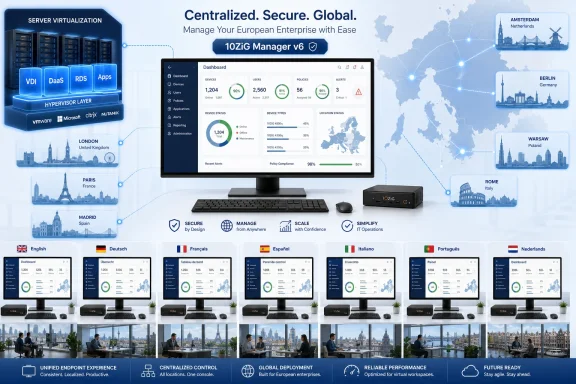 Seven Languages Across the Console and Endpoint
10ZiG’s stated goal is consistency: an administrator in Germany, Spain, France, Italy, Portugal, the Netherlands, or an English-speaking office should be able to work with the same vendor-supported language choices in both the endpoint OS and the central management layer. That removes an avoidable split common in distributed endpoint projects, where the device user interface may be localized but the platform used for provisioning, firmware maintenance, policy work, and troubleshooting remains English-only.For a thin-client fleet, this distinction reaches beyond convenience. Local support staff often need to interpret device screens during desk-side triage, walk users through connection recovery, verify certificate or network settings, and escalate incidents with screenshots. When the screen seen at the endpoint and the terminology in the management console diverge by language, documentation and troubleshooting scripts become harder to maintain.
The 10ZiG Linux OS baseline is also specific. The company says the matching language support applies to version 16.5 and later, covering NOS, PeakOS, and RepurpOS deployments in the Manager v6 compatibility range. That matters to administrators holding older firmware on long-lived thin clients: multilingual management does not remove the need to validate firmware compatibility, test endpoint upgrades, and stage rollout waves before switching production devices.
10ZiG’s existing Linux OS documentation already shows why device language cannot be treated as a cosmetic setting. The endpoint configuration surface includes keyboard layouts, certificates, networking, display configuration, smart-card functions, USB redirection, connection settings, and other controls that may be touched by regional support teams. The value of localization rises when it reduces mistakes in those settings—not when it merely translates menu labels.
There is also a limit to the published evidence. ChannelLife lists the seven languages explicitly, but 10ZiG’s currently available Manager 6.1.0 release notes do not independently enumerate the full set or identify which screens were translated in this update. The notes do confirm translation-related work in the web console, including scheduled-task information and a corrected missing translation key. Organizations with strict language requirements should therefore test the exact workflows they depend on—especially device recovery, policy editing, reporting, role administration, error dialogs, and audit exports—rather than assume complete translation from the announcement alone.
The Important Version Number Is 6.1.0, Not Just “v6”
The current shipping Manager v6 package is version 6.1.0, according to 10ZiG’s download page and June 25 release documentation. That is the first general-availability release of the Linux-based virtual appliance, rather than merely a later build of an established v6 deployment path.This distinction changes the upgrade conversation for existing customers. 10ZiG Manager v5 remains available as a Windows installer, with its current listed version at 5.5.1.1. Manager 6.1.0 arrives as a Linux virtual appliance, using an OVA deployment model, so this is a change in architecture as well as interface and feature set.
10ZiG describes the appliance as a way to avoid Windows Server infrastructure and related licensing overhead. That is true in the narrow sense that the new Manager v6 deployment is built around a preconfigured Linux appliance rather than a conventional Windows Server installation. But “no Windows Server required” should not be read as “no infrastructure planning required.”
The installation guide calls for four virtual CPUs, 8 GB of RAM, a thin-provisioned virtual disk with roughly 58.6 GB of capacity, an initial DHCP assignment, and planning around DNS, hostnames, and persistent IP addressing. The appliance is officially supported on VMware x86 hypervisors, including VMware Workstation, VMware Player, and ESXi 7 or later. 10ZiG says it may operate on other platforms, but support outside the stated VMware scope is conditional on a case-by-case basis.
For Windows administrators, that means the management plane may be leaving Windows Server while landing more squarely in the virtualization team’s remit. The ownership model can improve—fewer Windows patching and licensing tasks—but it can also introduce dependencies on VMware capacity, VM backup policy, OVA lifecycle management, network configuration, and Linux appliance credential handling.
Existing Manager v5 Customers Still Face a Migration Gap
The most consequential caveat is buried in the Manager 6.1.0 release notes: a Manager v5-to-v6 database migration was not yet available and was listed as planned for version 6.1.1. The materials available on August 5 do not establish that 6.1.1 has shipped, and 10ZiG’s download page still identifies 6.1.0 as the current Manager v6 version.That omission turns this from a simple “turn on a new language” story into a deployment-planning story for existing customers. A team already operating Manager v5 should not infer that it can import its production database, move to the appliance, and inherit its current organization hierarchy, client groups, schedules, templates, records, and management history in one supported step.
10ZiG does document database import and export capabilities in the v6 settings tool, but those are not the same thing as a supported v5-to-v6 migration. The distinction matters. Import and export tools can help with backup, recovery, and movement within the v6 platform; they do not prove that legacy data structures and configurations will translate cleanly from the Windows-based v5 product.
The same release notes list other early-release constraints. ImageStore was not functional in 6.1.0, and Windows endpoint support was described as preview-only, requiring a separate TZ Secure Agent available on request. Those limitations do not directly undermine localization for 10ZiG Linux clients, but they make clear that the v6 appliance remains an evolving product line rather than a drop-in replacement for every existing Manager deployment.
The sensible sequence for a production estate is therefore straightforward:
- Validate the seven-language experience on a non-production Manager v6.1.0 appliance and representative 10ZiG Linux OS 16.5-or-later endpoints.
- Confirm which administrative screens, error messages, task flows, and reports must be understandable to each regional support group.
- Keep Manager v5 migration planning separate from language enablement until 10ZiG publishes a supported migration path and the target release is available.
- Verify hypervisor support and appliance resource requirements before treating the Linux appliance as a substitute for existing Windows Server infrastructure.
Localization Fits 10ZiG’s European Channel Expansion
The timing is consistent with 10ZiG’s wider EMEA push. The company has established a German presence, expanded partner activity, and named Dakel as its distribution partner in Spain. 10ZiG’s own February announcement about Dakel positioned the arrangement around centrally managed endpoints for Spanish industrial and professional deployments, while Dakel’s corporate materials also list the addition of 10ZiG to its endpoint offerings.Language support supplies a practical layer to that strategy. A distributor or reseller can sell hardware and software into a local market without asking every implementation team to conduct provisioning and support entirely in English. It also gives 10ZiG a more coherent message when it argues that it provides both the endpoint OS and management tool rather than a collection of separately administered components.
Still, language parity does not erase the harder problems in multinational endpoint management. A Madrid office, a Rotterdam service desk, and a German central IT team may each use a familiar interface, but they still need agreed ownership boundaries, device naming conventions, certificate processes, maintenance windows, firmware rings, escalation paths, and role-based access policies. Manager v6 includes multi-tenancy, role-based access control, cloud connectivity, and Entra integration, but the announcement provides no new detail on how those controls are localized or how they are licensed, deployed, and supported by region.
For existing 10ZiG customers, the immediate action is modest: assess whether localized UI coverage solves a real support or adoption problem, then test it against the exact Manager 6.1.0 workflows used in production. For Manager v5 customers, the more pressing fact is that the appliance transition and the language update should be planned as separate projects until the promised migration capability is actually delivered.
References
- Primary source: ChannelLife UK
Published: 2026-08-05T07:00:00+00:00
10ZiG adds multilingual support across endpoint software
The move could ease deployment and support for IT teams managing dispersed fleets across Europe, where local language tools are increasingly important. channellife.co.uk
- Related coverage: 10zig.com
10ZiG Appoints Dakel as New Distribution Partner for Spain; 10ZiG RepurpOS Powers New DKL D800 Thin Client | 10ZiG
10ZiG Appoints Dakel as New Distribution Partner for Spain 10ZiG Appoints Dakel as New Distribution Partner for Spain; 10ZiG RepurpOS Powers New DKL D800 Thin Client Partnership expands 10ZiG’s European footprint and introduces a ruggedized thin client optimized for industrial environments...www.10zig.com - Related coverage: 10zig.com
Archivos Globales | 10ZiG
 www.10zig.com
- Related coverage: dakel.com
Thin Client 10ZiG en España · Partner autorizado · DAKEL
Partner 10ZiG en España. Thin y zero clients para Citrix, VMware y Microsoft, con 10ZiG Manager gratuito y garantía de 3 años. Asesoramiento experto.dakel.com - Related coverage: 10zigbucket.s3-us-west-2.amazonaws.com
- Related coverage: linkedin.com
10ZiG Technology | LinkedIn
10ZiG Technology | 4,682 followers on LinkedIn. Thin & Zero Client Endpoint Solutions for Cloud Workspaces & Virtual Desktops (Hardware & Software) | 10ZiG Technology is a world market leader in the field of endpoints for Desktop Virtualization. Focused solely on the development of Thin and Zero...www.linkedin.com
- Related coverage: muycanal.com
10ZiG refuerza la gama Thin client de Dakel
El mayorista Dakel Informática firma acuerdo de distribución con 10ZiG Technology, especializado en soluciones endpoint par entornos industriales. Así,www.muycanal.com - Related coverage: manuals.plus
- Related coverage: onlinemediacafe.com
10ZiG Announces General Availability of 10ZiG Manager v6 and Linux Virtual Appliance
New Linux-based management platform delivers enhanced scalability, security, and simplified deployment at no additional cost ...onlinemediacafe.com - Related coverage: windowsforum.com
10ZiG Manager v6: Linux Virtual Appliance for Easier VDI and Zero Client Management | Windows Forum
On July 1, 2026, 10ZiG Technology made 10ZiG Manager v6 and its new Linux Virtual Appliance generally available, moving its endpoint management stack away...windowsforum.com - Related coverage: es.linkedin.com
10ZiG Technology | LinkedIn
10ZiG Technology | 4682 seguidores en LinkedIn. Thin & Zero Client Endpoint Solutions for Cloud Workspaces & Virtual Desktops (Hardware & Software) | 10ZiG Technology is a world market leader in the field of endpoints for Desktop Virtualization. Focused solely on the development of Thin and Zero... - Related coverage: at.linkedin.com
10ZiG Technology | LinkedIn
10ZiG Technology | 4.682 Follower:innen auf LinkedIn. Thin & Zero Client Endpoint Solutions for Cloud Workspaces & Virtual Desktops (Hardware & Software) | 10ZiG Technology is a world market leader in the field of endpoints for Desktop Virtualization. Focused solely on the development of Thin... - Related coverage: itbrief.ca
10ZiG launches Linux-based Manager v6 for endpoints
Customers will avoid Windows Server licensing costs as 10ZiG shifts endpoint management to a Linux appliance with tighter controls and lower overhead. itbrief.ca

