
Amazon’s own public material supports the broad connection. It identifies Nanivadekar as a principal engineer in Amazon Ads’ Creative X organization and shows him presenting Creative Agent at an Amazon Ads event in India. What Amazon has not publicly documented is the individual ownership of each product feature or the internal “two-pager” process described by MediaPost. The profile is valuable as a view into Amazon’s invention culture, but advertisers should not read it as a product roadmap or as proof that a new customer-facing tool is imminent.
The concrete product is already here. Creative Agent, first introduced as an unnamed agentic AI tool in Creative Studio in September 2025 and formally branded at unBoxed in November 2025, is Amazon Ads’ attempt to turn ad creation into a guided, multi-stage system rather than a series of disconnected tools.
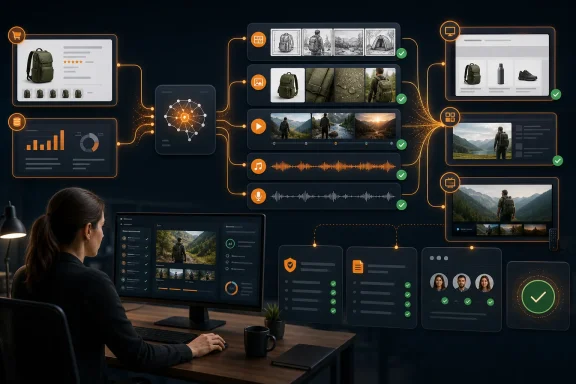 Creative Agent Is a Workflow, Not a Single Image Model
Amazon Ads says Creative Agent can research a brand and its products, propose concepts and taglines, build editable storyboards, generate images, create multi-scene video, and add animation, music and voiceovers. The resulting assets can be saved to the Creative Asset library for use across Sponsored Brands, Sponsored Display, Amazon DSP and Brand Stores. At its November 2025 launch, Amazon also said the tool could create streaming TV ads.
That scope is more consequential than the usual “AI ad generator” label suggests. Most generative creative tools begin with a prompt and produce an isolated image, script or clip. Amazon’s design begins with commercial context: product pages, Brand Stores, an advertiser’s website and Amazon’s own retail signals. The system then uses that context to recommend a creative direction and assemble an ad asset intended for Amazon’s media inventory.
For advertisers, that can remove a genuine operational bottleneck. A seller that has product imagery but no internal video team can move from a product page to a usable video concept without exporting data, commissioning an agency, moving files among design tools and manually rebuilding assets in an advertising console. Amazon’s stated objective is to lower both turnaround time and production cost, particularly for businesses without specialist creative staff.
But it also means the tool has access to more sensitive and commercially consequential inputs than a standalone image generator. It is working from brand positioning, product claims, campaign intent and Amazon’s shopper data. A generated ad that looks polished can still be wrong, off-brand, noncompliant in a particular market or poorly matched to a product’s real capabilities. The human reviewer has not been eliminated; the review step has simply moved later in the process, after an AI system has created a plausible-looking campaign package.
Amazon says the service is designed to expose its reasoning and allow feedback at each stage. That is useful, but it is not the same as an audit trail that proves why an asset made a claim, selected a visual or used a particular audience insight. Amazon’s launch material does not spell out how long prompt and asset data are retained, which roles can approve generated creative, or what campaign-level controls an enterprise administrator receives. Those are practical questions for agencies and large advertisers before allowing employees to treat Creative Agent as a production channel.
Video Generator Shows How Fast Amazon Is Replacing the First Version of Its Own Tools
MediaPost describes Video Generator as a project associated with Nanivadekar’s team. The public timeline confirms that Amazon has iterated on it unusually quickly. Amazon Ads launched Video Generator in beta in September 2024, initially allowing advertisers to create an eight-second, low-motion video from a single product image. In June 2025, after roughly nine months of beta testing, Amazon made an enhanced version broadly available to U.S. advertisers.
The upgrade was material. Amazon said the new version could generate higher-motion product shots, transform still images into motion, create multi-scene video with text animations and background music, and return six variations for selection. That is a shift from animated catalog imagery toward something closer to short-form commercial production.
It also demonstrates why Nanivadekar’s observation about “disposable” software deserves attention. In this category, a tool’s first release may be obsolete before procurement, training and governance processes catch up. Video Generator’s September 2024 version and its June 2025 version were not just successive patches; they represented very different levels of output quality and creative flexibility.
For IT administrators, that accelerates a familiar SaaS problem. The security review cannot be a one-time decision made when a tool is first enabled. Inputs, supported media formats, underlying models, geographic availability and downstream publishing pathways can all change while the product retains the same name. Amazon later expanded Video Generator beyond the United States, but availability has varied by market and campaign type. Teams operating globally should verify the current account-level entitlement instead of assuming feature parity from a U.S. launch announcement.
The short version is that Amazon is using its own ad platform as a delivery mechanism for rapidly changing generative media capabilities. That will favor organizations that can establish simple approval rules—approved product facts, brand-safe asset libraries, named final approvers and routine checks of output claims—without creating a months-long review queue for every experiment.
The $220 Billion CapEx Figure Is Not an Amazon Ads Budget
The MediaPost profile places Amazon’s generative-advertising work alongside Andy Jassy’s announcement that Amazon now expects to spend about $220 billion in cash capital expenditures in 2026. The two developments are connected at the level of corporate strategy, but they should not be conflated.
Amazon’s second-quarter earnings release said its trailing-12-month free cash flow had moved to a $7.6 billion outflow, driven largely by higher property and equipment purchases tied primarily to AI investment. The company also reported 26% year-over-year advertising growth for the quarter. Separately, Jassy told investors that AI and chips had each passed a $25 billion annualized revenue run rate.
Yet the extra spending is not a dedicated war chest for Creative Agent, Video Generator or Amazon Ads. The Associated Press reported that the $220 billion total includes robots, semiconductors and satellites, as well as AI-related infrastructure, and that higher memory-chip costs were the stated reason the 2026 estimate rose from $200 billion. Amazon’s infrastructure build-out is principally about serving demand across AWS and the company’s broader technology operations.
That distinction changes how the profile should be read. The ads team benefits from Amazon’s models, cloud capacity and internal AI investment, but it is not driving the entire capital-expenditure cycle. Creative Agent is better understood as a high-visibility application of Amazon’s AI stack: a way to turn the company’s cloud, foundation-model and retail-data investments into a service that can create more advertising inventory and reduce the friction of buying it.
There is a business logic in that arrangement. AWS sells the infrastructure and model services. Amazon Ads owns a vast commerce data set and a marketplace where generated assets can be deployed. The advertiser supplies product information and ad spend. A tool that makes campaign production easier can increase the number of advertisers able to test video, display and streaming placements, even if those advertisers never become AWS customers.
Amazon’s Advantage Is the Closed Loop From Product Page to Media Buy
Amazon’s strongest differentiator is not that it can generate an image or video. Competitors can do that. Its advantage is that the creation system is connected to a commerce platform that knows what is being sold, how it is described, where it can be advertised and—at least within Amazon’s own measurement environment—whether shoppers respond.
Creative Agent’s use of retail signals is therefore both its selling point and its governance challenge. Amazon says those signals help it develop ads aligned to a brand’s products and customer interests, while the company also claims the system can maintain brand safety and compliance across Amazon Ads. Those are vendor claims, not independent measurements of output quality, campaign performance or legal compliance.
The company has also given advertisers no public, apples-to-apples data showing whether Creative Agent-generated ads outperform conventionally produced creative across categories, budgets and placements. Testimonials from early users establish that some testers found the workflow useful; they do not establish a universal performance gain. An advertiser should measure generated variants against its existing creative rather than accept the premise that automation will improve return on ad spend.
The more immediate operational value may be experimentation. Generating six video alternatives or several storyboard directions in minutes makes it cheaper to test product angles, visual treatments and calls to action. But low production cost can encourage teams to create too many near-duplicate assets, weakening campaign discipline and making results harder to interpret. The answer is not to forbid the tool; it is to set a test plan before the content flood begins.
For Windows-based marketing and IT environments, there is no new client software deployment hidden in this announcement. These are cloud-based Amazon Ads capabilities accessed through Amazon’s advertising workflow. The work falls instead on identity management, browser-access policy, approved asset storage, data-handling rules and the people authorized to publish ads. That is less dramatic than a new desktop application, but it is where the real control over an agentic creative system will live.
Amazon has already moved from a basic product-image-to-video beta to a broader creative agent that can assemble assets for multiple ad formats. The next practical consequence is clear: advertisers that use Amazon Ads will increasingly be asked to govern AI-generated creative as routine campaign output, not as a lab experiment.