

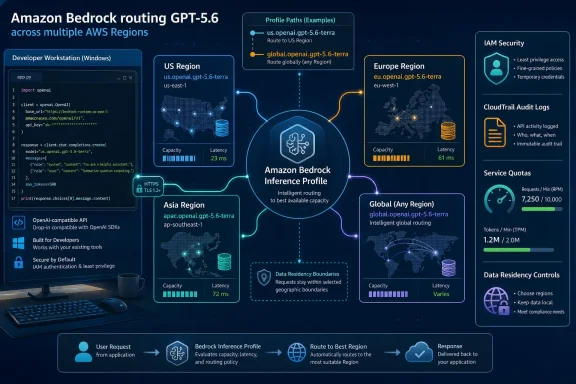
bedrock-runtime path, applications must call an inference profile ID such as us.openai.gpt-5.6-terra or global.openai.gpt-5.6-terra, rather than the underlying model ID.AWS detailed the rollout in its August 20 launch post, following a shorter August 17 AWS announcement. Its Bedrock documentation confirms that the new route supports OpenAI’s Responses and Chat Completions APIs alongside Bedrock’s Converse API. For Windows developers and enterprise IT teams already standardizing on AWS identity, logging, and cost controls, the launch makes Bedrock a more practical high-throughput endpoint for OpenAI-compatible applications—but it also changes the data-location, IAM, quota, and audit assumptions those applications need to enforce.
bedrock-runtime changes the integration contract
GPT-5.6 Sol, Terra, and Luna had already reached Bedrock through AWS’s bedrock-mantle endpoint, which provides in-Region access with an OpenAI-compatible interface. The cross-Region launch adds the same OpenAI-style API surface on bedrock-runtime, but the two endpoint families are not interchangeable.
On the older bedrock-mantle path, an application can name a direct model identifier such as openai.gpt-5.6-luna and receive in-Region processing in a supported AWS Region. The new runtime endpoint does not offer that direct in-Region option for these GPT-5.6 models. AWS’s current Luna model card explicitly says runtime callers must use either the US geographic profile or the global profile.
That is a migration trap for teams treating this as a base-URL change. Repointing an existing OpenAI SDK client from bedrock-mantle to bedrock-runtime while retaining openai.gpt-5.6-terra as the model value will not select the new capacity pool. The model parameter has to change too.
The profile is more than a friendly alias. It is the authorization and routing object that tells Bedrock where a request is permitted to run. A US profile keeps inference inside AWS’s defined US geography; a global profile permits Bedrock to select from its supported commercial Regions based on capacity. AWS says requests, account billing, quotas, CloudTrail events, and invocation logs remain associated with the source Region even when processing occurs elsewhere.
That centralizes administration, but it can also conceal a significant fact from dashboards that only report the calling Region: the work may have been executed in another AWS Region. AWS exposes the selected processing location in CloudTrail through the additionalEventData.inferenceRegion field. Teams with residency, incident-response, or customer-audit obligations should collect and retain that field rather than assuming source Region equals processing Region.
Global capacity is also a data-location decision
AWS describes cross-Region inference primarily as a capacity feature. That is accurate: requests can draw from a multi-Region compute pool instead of waiting behind demand in a single Region. The US geographic profiles can route among US East (N. Virginia), US East (Ohio), US West (Oregon), and—when invoked from eligible locations—US West (N. California) and Canadian Regions under the profile’s defined routing rules.
The global profiles are broader. AWS’s regional-availability documentation lists destinations across North America, Europe, Asia Pacific, the Middle East, and South America for GPT-5.6. A request submitted through global.openai.gpt-5.6-sol, global.openai.gpt-5.6-terra, or global.openai.gpt-5.6-luna may be processed in any supported commercial Region.
For a consumer-facing Windows application generating summaries, support replies, or classification labels, that may be the sensible setting during demand spikes. For an enterprise Copilot-like assistant handling legal files, device telemetry, internal source code, or regulated customer records, it must be an explicit policy decision. “Global” does not mean globally replicated storage by default; it means the prompt and completion can be processed in a Region outside the caller’s geography.
The safer rule is straightforward:
- Use
us.openai.gpt-5.6-*when policy permits US-wide processing but prohibits global processing. - Keep using the direct in-Region
bedrock-mantleendpoint when the workload requires processing in one named Region. - Use
global.openai.gpt-5.6-*only after privacy, contract, and data-residency owners approve worldwide commercial-Region processing.
AWS also says content flagged by its automated abuse-detection classifiers for GPT-5.6 can be retained for up to 30 days for offline abuse detection. That condition applies regardless of whether a team chooses geographic or global routing. Enterprises should therefore distinguish the data-residency question from the separate retention question; a US-only profile does not eliminate the latter.
IAM policies need to cover the profile and the destination model
The documentation’s most consequential implementation detail is that permission to invoke the inference profile is not enough. AWS requires access to the GPT-5.6 foundation model in every potential destination Region for geographic routing, or access to the global model ARN for global routing. Runtime users also need permission on their account’s default Bedrock project.
This differs from a simple regional allowlist in a way that may surprise central cloud-governance teams. A restrictive AWS Organizations service control policy can deny a global inference request because global routing evaluates aws:RequestedRegion as unspecified. Geographic routing is evaluated against its eligible destination Regions. An SCP that permits only us-east-1 can therefore block a request launched from Virginia if Bedrock needs Ohio or Oregon capacity.
AWS recommends exempting approved inference profiles through the bedrock:InferenceProfileArn condition key rather than broadly allowing every potential destination Region or allowing unspecified across AWS services. That is the right design: it preserves a tight Region perimeter while authorizing only the Bedrock routing behavior the organization chose.
Administrators should also account for API differences. The OpenAI-compatible Responses and Chat Completions APIs can authenticate with AWS credentials or Bedrock bearer tokens, which require bedrock:CallWithBearerToken. Streaming through the Converse API additionally requires bedrock:InvokeModelWithResponseStream. A policy that works in a quick non-streaming console proof of concept can still fail after a Windows service or containerized production application enables streamed output.
The profile determines quota behavior as well as routing
Cross-Region inference is often presented as a way to avoid throttling, but it does not create an unlimited shared budget. AWS assigns separate tokens-per-minute quota pools to the geographic and global profiles. Switching from us.openai.gpt-5.6-terra to global.openai.gpt-5.6-terra can change both the available capacity pool and the quota allocation being consumed.
The billing math deserves particular attention for agentic coding and security-analysis workloads, where long outputs can dominate. AWS says GPT-5.6 output tokens have a 10x burndown rate against tokens-per-minute quota. A request with 2,000 input tokens and 1,000 output tokens consumes 12,000 tokens of the quota calculation before considering cache writes. Raw input-plus-output counts alone will badly understate load for verbose agents.
Prompt caching partially changes that equation. AWS says cache-read tokens do not count toward the token-per-minute quota, and the GPT-5.6 models support both implicit caching and explicit cache breakpoints. That favors workloads with stable policy prompts, large tool definitions, coding standards, retrieval instructions, or persistent context that is reused across many requests.
The catch is that caching needs routing stability. AWS instructs developers to supply a prompt_cache_key so requests sharing the same prefix reach the same cache. Teams load-testing global routing without that key can conclude that caching is ineffective when they have simply allowed related requests to land on different capacity.
AWS’s model cards also show global inference can be priced below geographic routing. For GPT-5.6 Luna, the listed global rate is lower than the US geographic rate for both short- and long-context requests. That makes global routing financially attractive, but it should not cause a compliance team to inherit a worldwide processing footprint by accident. Cost savings here come with a genuine governance tradeoff.
Documentation exposes a tool-use inconsistency
AWS’s August 20 launch post says all three GPT-5.6 variants support “server-side tool calling.” Yet AWS’s currently published GPT-5.6 Luna model card marks server-side tool use as unsupported. The broader Bedrock server-side tool-use documentation says the capability is presently available for the OpenAI GPT-OSS models, with support for other models coming later.
The records do agree that GPT-5.6 can be used with client-side tool calling: an application supplies tool definitions, receives a tool-call request from the model, executes the tool itself, and returns the result. That works through the supported APIs and remains the dependable integration model for GPT-5.6 today.
The discrepancy matters because server-side tool execution is a very different deployment model. It would let Bedrock invoke a registered Lambda function or AgentCore Gateway on an application’s behalf under a managed authorization design. A team that assumes GPT-5.6 can do that based on the launch post could design an agent architecture that the model card says is unavailable.
Until AWS reconciles those pages, developers should treat client-side tool orchestration as the supported GPT-5.6 path and validate any server-side tool configuration in a non-production account before committing to it.
The immediate benefit of the launch is clear: a Bedrock-hosted GPT-5.6 application can scale through a profile without its operators manually selecting a fallback Region or maintaining separate regional endpoint logic. The immediate responsibility is equally clear: update model IDs, IAM roles, SCP exceptions, CloudTrail parsing, quota alarms, and data-processing documentation before enabling global routing.
References
- Introducing cross-Region inference for OpenAI GPT-5.6 models on Amazon Bedrock - Amazon Web Services (AWS) Amazon Web Services (AWS) · 2026-08-20T21:46:03+00:00