
The useful question for anyone with an aging AMD system is not whether a processor is “old.” It is whether the game, resolution, target frame rate, graphics card, storage, memory configuration, and CPU architecture create a CPU-limited result. The consequences are visible in 1% low frame rates and frame-time spikes—hitches that make a 60 fps average feel worse than the number suggests.
The distinction matters when deciding whether to replace a GPU, update an AM4 system, or retire an AM3+ machine. A high-end graphics card does not repair an overloaded simulation thread, a four-thread processor running out of scheduling room, or a slow storage setup struggling with asset streaming.
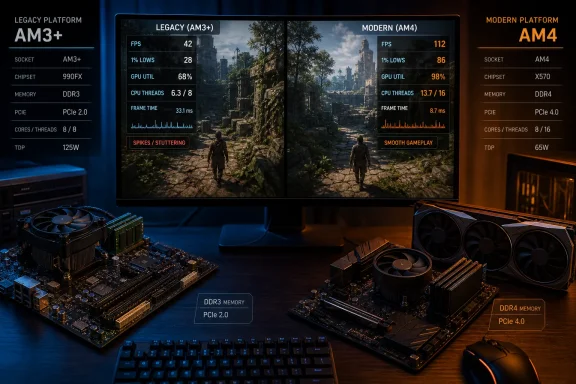 The real dividing line is threads, per-core speed, and frame pacing
A CPU bottleneck happens when the processor cannot finish the game logic and draw-call work for the next frame soon enough. The GPU then waits, its utilization falls, and lowering graphical settings may raise the frame rate only slightly—or not at all. In a heavily CPU-bound title, reducing resolution can even expose the CPU limit more clearly because the graphics card completes its part faster.
Older AMD chips land in different categories here. The FX-6300 and FX-8350 are products of AMD’s Piledriver era: they advertise six and eight integer cores respectively, but their shared-module design and weak per-thread performance have aged badly in games that need fast response from a handful of busy threads. Their power use is also hard to justify beside later Ryzen parts; the FX-8350 carries a 125 W thermal design power before accounting for platform age and overclocking.
The Athlon 3000G is a more straightforward case. Its two cores and four threads can still handle ordinary desktop use and lighter esports games, but dual-core CPUs have crossed from budget compromise to routine constraint in demanding PC releases. Adding a fast discrete GPU does not change the fact that the CPU has to run the game world, audio, input, background tasks, and graphics submission.
Four-core, four-thread Zen processors deserve similar caution. The Ryzen 3 1200 and Ryzen 3 2200G have far stronger per-core performance than FX chips, but four threads leave little room once Windows, a browser tab, Discord, game launchers, capture software, anti-cheat, and the game itself compete for CPU time. TechSpot’s testing of Battlefield 2042 found four-core/four-thread processors could suffer constant stuttering in its 128-player workload. That does not make every four-thread Ryzen unusable in every game; it does make high, stable frame rates in current CPU-heavy releases an unrealistic purchase target.
The Ryzen 5 1400’s four cores and eight threads provide more breathing room, but it still carries first-generation Zen’s lower IPC—instructions per clock, a shorthand for how much useful work a core completes at a given frequency—and relatively high memory latency. It remains capable for older games, indie titles, and esports. It is no longer a sensible CPU to pair deliberately with a premium graphics card for a high-refresh-rate AAA build.
The Ryzen 5 1600 needs a version check before it is written off
The original Ryzen 5 1600 is the outlier in Analytics Insight’s list because it has six cores and 12 threads, rather than four cores or fewer. It is slower than newer Ryzen generations, especially at high frame rates, but it is not in the same emergency-upgrade category as an Athlon 3000G or a Ryzen 3 1200.
More importantly, “Ryzen 5 1600” identifies two materially different desktop parts. The original 14 nm model, commonly called the 1600 AE after its product code, uses first-generation Zen cores. The later 12 nm Ryzen 5 1600 AF is effectively a slightly downclocked Ryzen 5 2600 built on Zen+, with higher sustained clocks and improved memory behavior.
TechSpot’s direct comparison found the 1600 AF roughly matched the Ryzen 5 2600 and outperformed the original 1600 in both single-core work and several games, including stronger 1% lows. A system owner should check the full processor part number or use a tool such as CPU-Z before treating every “1600” result online as applicable to their machine.
That does not mean the original 1600 is a modern performance champion. CD Projekt Red’s official Cyberpunk 2077 requirements list the Ryzen 5 1600 as the CPU for a 1080p, Low, 30 fps baseline, while its 1080p, High, 60 fps tier names the Ryzen 7 7800X3D. The same chart is a reminder that a published “minimum” means the developer considers the configuration sufficient to run the game at a defined low target—not that it will deliver the experience enthusiasts usually mean by smooth modern PC gaming.
Game requirements show why one blanket verdict fails
The supplied report cites Cyberpunk 2077, Starfield, and Black Myth: Wukong as examples of games that expose older CPUs. The official requirements support the broader point, but they also demonstrate why processor advice must be tied to a title and performance target.
Bethesda lists the Ryzen 5 2600X as Starfield’s minimum AMD CPU and the Ryzen 5 3600X as its recommended part, alongside 16 GB of RAM and an SSD. That places a first-generation Ryzen 5 1600 below the official minimum, even though it has six cores and 12 threads. The issue is not simply core count; Zen+ and Zen 2 deliver architectural, clock, and memory-latency improvements that matter in a game known for a demanding CPU workload.
Steam’s listed minimum for Black Myth: Wukong is a Ryzen 5 5500, while the recommended CPU is a Ryzen 5 5600X. That is a considerably newer baseline than the first-generation Ryzen chips in the report. A Ryzen 5 1400 or 1600 may still launch many modern games, but support tables increasingly identify newer parts because developers need a predictable floor for performance and testing.
There is a second missing variable: storage. CD Projekt Red changed Cyberpunk 2077’s published baseline to require an SSD and explicitly said it was discontinuing active testing on the previous HDD-based minimum configuration, while noting that the game might still work there. Bethesda also specifies an SSD for Starfield. A slow hard drive, insufficient RAM, shader compilation, or a full VRAM buffer can produce stutter that looks like a CPU bottleneck from the couch.
Before spending on a processor, verify the actual failure mode. Watch GPU utilization during repeatable gameplay rather than a menu or built-in cinematic benchmark. If GPU utilization repeatedly drops while one or several CPU threads are saturated and frame times spike, the processor is implicated. If the GPU remains near full load, lowering GPU-heavy settings, enabling an upscaler, or changing the graphics card may be more productive.
AM4 owners have a meaningful upgrade path, but it is not automatic
For a Ryzen 3 1200, Ryzen 5 1400, Ryzen 5 1600, or Ryzen 3 2200G system on AM4, the Ryzen 5 5600 is the sensible baseline upgrade. It brings Zen 3 cores, six cores and 12 threads, higher IPC, and 35 MB of combined cache while retaining a 65 W rating. It is the kind of replacement that can materially improve both average frame rates and the lows that determine whether motion feels steady.
The Ryzen 7 5700X3D is the stronger AM4 gaming option for owners who already have a capable graphics card and want to extend the platform rather than rebuild. AMD specifies eight cores, 16 threads, and 100 MB of total cache for the 105 W chip. TechSpot’s multi-game testing found it remained competitive with far newer processors, showing why the extra cache can be more valuable in games than a modest clock-speed advantage alone.
But AM4 compatibility requires verification rather than optimism. AMD’s chipset matrix says Ryzen 5000 support differs by motherboard chipset and can require a BIOS update; X370, B350, and A320 boards may rely on selective beta BIOS releases, while some prebuilt systems impose their own restrictions. Update the firmware with the old working processor installed, confirm the exact CPU is on the board vendor’s support list, and check cooler capacity before buying a 5700X3D.
Ryzen APUs add another wrinkle. AMD notes that socket AM4 Ryzen processors with Radeon graphics are limited to eight PCIe 3.0 lanes for the graphics card. The Ryzen 3 2200G falls into that class. A discrete GPU will work, but an eight-lane PCIe 3.0 link can become another limitation with certain newer cards and workloads. That is not “incompatibility”; it is a platform constraint worth considering before installing an expensive GPU into an entry-level 2018 APU system.
AM3+ systems should be treated as platform replacements
The upgrade calculation changes for FX-6300 and FX-8350 owners. Those CPUs use socket AM3+, which cannot accept Ryzen processors. Moving from an FX chip to a Ryzen 5 5600 or Ryzen 7 5700X3D means replacing the motherboard and DDR3 memory as well as the CPU; an AM5 move also means DDR5.
That expense makes targeted troubleshooting especially important. An FX-8350 paired with a modest GPU at 1440p may be limited primarily by the graphics card in some games. An FX-8350 paired with a recent high-performance GPU at 1080p or a 144 Hz target is much more likely to waste GPU potential, particularly in large multiplayer matches, simulation-heavy worlds, and scenes packed with AI.
The practical conclusion is narrower than “old AMD CPUs cannot run modern games.” FX processors, Athlon 3000Gs, and four-thread first-generation Ryzen chips are now clear performance liabilities for modern AAA gaming. The original Ryzen 5 1600 is aging but remains a functional six-core baseline in games with modest targets, while the 1600 AF deserves separate treatment altogether. For AM4 owners, a verified Ryzen 5 5600 or Ryzen 7 5700X3D upgrade can change the character of a system without replacing every component; for AM3+ owners, the same result requires planning for a new platform, not another graphics-card purchase alone.
References
- Primary source: Analytics Insight
Published: August 7, 2026 at 5:00 PM UTC
Outdated AMD CPUs That Bottleneck Modern Games in 2026
Older AMD CPUs can limit modern gaming performance despite powerful GPUs. Find out which processors are showing their age and whether it's time to upgrade.www.analyticsinsight.net - Related coverage: ea.com
Battlefield™ 6 System Requirements for PC - Electronic Arts
Find out the minimum and recommended system requirements for Battlefield™ 6www.ea.com
- Related coverage: tomshardware.com
AMD relaunches $40 dual-core Athlon 3000G CPU with new packaging and cooler — Zen refuses to retire even in 2025 | Tom's Hardware
Despite being an AM4 CPU, stores have warned that the chip is not compatible with B550 and A520 chipset AM4 motherboards.www.tomshardware.com - Related coverage: tomshardware.com
AMD keeps AM4 platform on life support with 2020-era Zen 3 CPU — Ryzen 3 5100 surfaces, nine years after AM4 launch | Tom's Hardware
Long live AM4!www.tomshardware.com