
VideoCardz first highlighted the firmware upload, while Phoronix traced it to the linux-firmware repository and identified the specific components. The immediate conclusion is straightforward: AMD’s open-source graphics stack is now close to having the software pieces required to boot and run GFX11.7 hardware. The more speculative conclusion in the original framing—that this confirms a “Ryzen 500 Medusa Point” launch—does not follow from the firmware commit.
AMD has not announced a Ryzen 500 product family, a Medusa Point processor, GFX11.7 specifications, or a launch date. The public code points to upcoming APU-class graphics hardware, but it does not attach those GPU IDs to a retail processor name. That distinction matters for buyers and administrators planning deployments: firmware readiness is a sign of product preparation, not a launch schedule.
 Firmware is the final gate Linux systems often miss
Modern AMD GPUs depend on several firmware images before the kernel driver can fully initialize graphics, media, display and security-related blocks. The AMDGPU driver may recognize a device, and Mesa may know how to compile shaders for it, but the machine can still lack working acceleration or display output if the matching binary firmware has not reached the installed distribution.
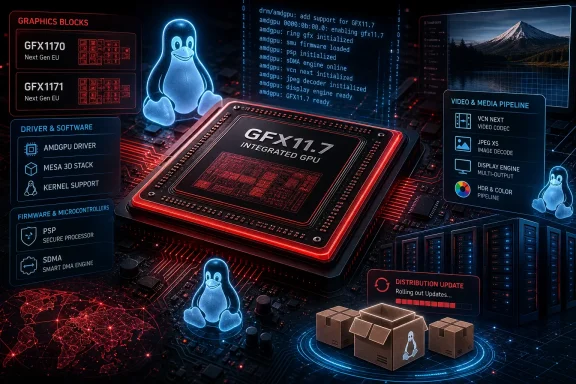
That is why the GFX11.7 upload matters. Phoronix reports that the update includes firmware for GFX11.7.0 and GFX11.7.1, plus the Platform Security Processor versions 15.0.0 and 15.0.9, SDMA 6.1.4, and the VPE 2.0 video-processing engine. It also points to DCN 4.2, AMD’s Display Core Next block, arriving as part of the same new hardware generation.
The important operational change is timing. AMD historically delivered some GPU firmware at launch or after hardware reached the market, leaving early Linux adopters to install newer firmware packages manually, run development kernels, or wait for their distribution to catch up. By placing these images in linux-firmware before launch, AMD gives Fedora, Ubuntu, openSUSE, Arch and enterprise Linux vendors an opportunity to include them in regular updates ahead of retail availability.
That does not guarantee every new laptop will work flawlessly on day one. OEM-specific components, panel behavior, audio controllers, suspend/resume quirks and power tuning frequently arrive on separate timelines. But it removes one of the most basic and disruptive failure modes: a new GPU reaching customers before the firmware package that lets the driver start it.
GFX11.7 is not desktop RDNA 4
The “RDNA 4m” label invites an easy but misleading comparison with AMD’s desktop RDNA 4 Radeon GPUs. Public LLVM and Mesa work places GFX1170, GFX1171 and GFX1172 in the GFX11 family, not the GFX12 family used for full RDNA 4. In practical terms, this appears to be a new integrated-graphics branch that builds on the RDNA 3.5 lineage while adding selected newer instruction-set features.
Phoronix has followed the development since GFX1170 appeared in LLVM in February. The compiler and driver changes show additions such as FP8 and BF8 conversion support and newer matrix-oriented instructions, while Mesa’s RadeonSI OpenGL driver and RADV Vulkan driver have gained the new target IDs. The LLVM project’s own merged work also separates GFX1171 and GFX1172 from GFX12 targets, reinforcing that this is not merely a renumbered desktop Radeon architecture.
That technical split matters because architecture labels can imply features that the public code does not establish. GFX11.7 may inherit useful RDNA 4-style instructions, particularly for machine-learning-adjacent operations, without matching the complete rendering, ray-tracing, cache or compute design of a GFX12 RDNA 4 discrete GPU. There is no basis yet for treating an eventual GFX11.7 iGPU as equivalent to a Radeon RX 9000-series GPU.
Nor does the firmware upload reveal compute-unit counts, clocks, memory bandwidth, NPU specifications, media formats, display-output counts or power targets. Firmware filenames identify support requirements; they are not a specification sheet.
The Medusa Point connection remains a rumor
The most persistent theory is that GFX11.7 will appear in Zen 6-based “Medusa Point” APUs. It is a plausible theory, but it remains a theory. VideoCardz links the firmware to that family, and earlier reporting has connected the GFX11.7 targets to future mobile AMD silicon, yet the firmware commit itself contains no processor codename or commercial branding.
Igor’sLAB reached the same caution after inspecting AMD-related LLVM work: the compiler records GFX1170, GFX1171 and GFX1172 as related APU targets, but does not identify the final products. The site specifically noted that the Medusa Point association comes from the broader reporting and rumor trail rather than an AMD statement embedded in the public source code.
There is also a nomenclature problem with calling this a “Ryzen 500” launch. AMD’s current public mobile branding has already used the Ryzen AI 300 and Ryzen AI 400 series, while the company has not published a Ryzen 500 naming scheme for these unannounced Zen 6 parts. A future branding change is possible, but treating it as settled now would turn an unconfirmed marketing label into a product announcement AMD has not made.
For Windows users, the firmware event offers no direct promise of a Radeon Software driver, a Windows Update package, or a launch date. AMD’s Windows driver stack is separate from Linux’s upstream kernel-and-Mesa process. The useful signal is broader: AMD is far enough along in platform enablement to publish initialization blobs for two GFX11.7 variants, suggesting hardware validation is moving from internal software work toward the distribution and OEM stage.
Linux 7.3 and Mesa 26.2–26.3 are the likely starting point
Phoronix identifies Linux 7.3 and Mesa 26.2 through 26.3 as the likely software baseline for GFX11.7 support. That should be read as a planning guide, not a compatibility guarantee. The kernel supplies the AMDGPU driver and display support; Mesa supplies the user-space OpenGL and Vulkan drivers; linux-firmware provides the binary images required by the GPU and related IP blocks.
The three components must line up. A current Mesa build cannot make up for an older kernel that lacks the needed PCI IDs or display code, and a new kernel cannot fully initialize the hardware without updated firmware. For early adopters, the practical requirement will be a recent kernel, a recent Mesa release, and a current linux-firmware package—not merely one updated component.
Distribution timing will determine the experience on launch day. Rolling distributions can absorb all three pieces quickly, while fixed-release distributions may backport the support or require hardware-enable stacks. Corporate Linux deployments should expect the usual validation cycle before approving a new AMD notebook platform, especially where external displays, USB4 docks, remote-management images or GPU-accelerated workloads are involved.
The absence of GFX1172 firmware is the clearest remaining gap in the public record. It could mean that variant is later in AMD’s validation schedule, belongs to a different product tier, or simply has not been uploaded yet. The code alone does not tell us which explanation is correct.
What is now established is narrower and more useful: AMD has supplied Linux with firmware for GFX1170 and GFX1171 before the hardware’s public debut, and the upstream driver stack has largely caught up. The next concrete milestone is not another codename rumor—it is AMD naming the processors and OEMs shipping machines whose support can finally be tested outside the source tree.