
AMD Instinct MI300X remains a formidable accelerator for memory-bound AI inference, but a July 30, 2026 explainer from NASSCOM Community presents it as though it were AMD’s forward-looking flagship rather than a 2023-generation part that has since been overtaken by the MI325X and CDNA 4-based MI350 series. The distinction changes the buying advice: the MI300X’s 192GB of HBM3 can still solve real deployment problems, yet a new buyer should treat it as an installed-base, availability, or price-performance decision—not as the default foundation for a new “future-ready” AI cluster.
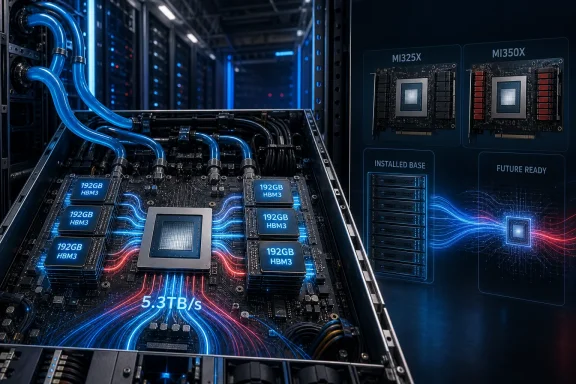
NASSCOM’s overview correctly identifies the core appeal: a single MI300X combines 192GB of HBM3, 5.3TB/s of peak memory bandwidth, 304 compute units, and AMD’s CDNA 3 architecture. AMD launched the OAM-form-factor accelerator on December 6, 2023, with a 750W peak board-power rating. Its raw specifications remain substantial for serving models that otherwise require aggressive sharding across several smaller-memory GPUs.
But the article leaves out the most consequential date. AMD launched the MI350X on June 12, 2025, more than a year before the NASSCOM piece was published. The newer CDNA 4 accelerator carries 288GB of HBM3E per GPU, delivers up to 8TB/s of memory bandwidth, adds lower-precision MXFP4 and MXFP6 support, and carries a 1,000W typical board-power rating. AMD’s MI325X also moved the same CDNA 3 family to 256GB of HBM3E and 6TB/s.
The MI300X is therefore still relevant, but its role has narrowed. For an organization with qualified MI300X servers, an existing ROCm deployment, or a favorable cloud contract, its large memory pool can make it a practical inference engine. For a greenfield purchase, comparing it only with “traditional AI GPUs,” as the NASSCOM article does, obscures AMD’s own newer options and makes the hardware sound newer than it is.
The strongest claim in the NASSCOM article is also the most defensible: 192GB of local HBM3 can reduce model sharding. Model weights, attention state, temporary tensors, and the KV cache used to retain conversational context must all fit somewhere. More local memory can reduce cross-GPU traffic and simplify serving designs, particularly for large models, long context windows, or workloads where several models must reside in memory simultaneously.
That does not mean a 192GB MI300X makes every large model a single-GPU workload. The usable model size depends on precision, quantization, context length, batch size, framework overhead, and the amount of KV-cache capacity reserved for concurrent users. A quantized model can fit while its high-throughput serving configuration does not. Conversely, a model that fits in one GPU may still need several accelerators to meet latency, concurrency, or high-availability requirements.
This is where the article’s repeated suggestion that more memory means “fewer GPUs” needs qualification. It can mean fewer GPUs for capacity, but not necessarily fewer GPUs for production throughput. A customer-facing inference service is often constrained by tokens per second, time to first token, redundancy targets, or the size of the active request queue—not only whether weights fit on a device.
MLCommons’ MLPerf Inference results show that MI300X systems remain active in standardized testing, including an eight-GPU Supermicro system using 192GB MI300X accelerators. That is evidence of a usable ecosystem and ongoing optimization work, but it is not a universal performance verdict. MLPerf scores depend on the specific model, scenario, precision, server configuration, software release, and optimization path submitted. They should be used to shortlist platforms, then validated against the exact model and serving stack an organization intends to run.
That means the accelerator cannot simultaneously offer every tenant a 192GB memory pool. An operator that chooses eight-way CPX partitioning gains isolation and finer-grained scheduling, but each partition has access to 24GB of HBM. That is useful for smaller inference services, test environments, or mixed workloads, but it is incompatible with the headline use case of hosting a large model in one unified memory space.
AMD says these partitions are spatial: they are built from physically grouped compute dies, called XCDs, rather than being an abstract scheduler quota. The driver and hardware configure the partitioning, and AMD’s platform supports SR-IOV virtualization for sharing the accelerator among virtual machines. Those capabilities matter to cloud operators and internal GPU-as-a-service teams, but they are not a substitute for capacity planning.
A practical consequence follows: organizations need to decide whether the MI300X will be a large-model appliance or a multi-tenant pool before setting expectations for users. A 24GB partition is familiar territory for smaller LLMs and conventional ML workloads. It is not the same resource as a 192GB accelerator, even though both may originate from the same physical module.
The NASSCOM article also suggests that partitioning automatically improves utilization. It can, but only when the workloads are small enough to fit the partitions and steady enough to keep them busy. Fragmenting a GPU can create stranded capacity when one tenant needs more memory than its assigned slice while neighboring partitions are lightly loaded.
AMD rates each MI300X at up to 750W peak board power. Eight of them represent 6kW of accelerator power alone, before host CPUs, memory, storage, network adapters, fans, power-conversion losses, and cooling equipment are counted. Liquid cooling may indeed be appropriate for dense deployments, but “liquid-cooled AI data center” is not a performance feature that follows automatically from choosing MI300X. It is an engineering and facilities commitment with implications for rack design, maintenance, leak detection, service procedures, and site power delivery.
The article’s networking recommendations are directionally sensible but incomplete. High-speed Ethernet, InfiniBand, and RDMA do not automatically improve a single-GPU workload. They become important when model parallelism, distributed training, storage access, or multi-node serving generates enough traffic to make interconnect latency and bandwidth material. An eight-GPU MI300X baseboard has fast internal connectivity; moving beyond that box is where fabric design becomes decisive.
Storage also needs workload-specific planning. NVMe can accelerate checkpoint loading and data pipelines, but it does not cure a compute-bound transformer workload. A high-throughput parallel file system can be worthwhile for large-scale training, while a latency-sensitive inference cluster may instead need disciplined model-image distribution, local caching, and rapid recovery after node replacement.
AMD’s ROCm stack has matured substantially since MI300X launched, and the current compatibility documentation includes supported builds for PyTorch, vLLM, and ONNX Runtime on the accelerator. Still, framework names in a marketing list should not be mistaken for identical feature coverage or equal performance across models. ROCm versions, operating systems, container images, kernel versions, attention back ends, quantization schemes, and distributed-communications libraries must be qualified as a complete stack.
Memory capacity can reduce costs if it eliminates nodes, accelerators, networking tiers, or operational complexity that a particular model would otherwise require. It can also raise costs if the deployment leaves expensive 192GB devices underutilized, demands specialized power and cooling, or requires engineering effort to port and tune CUDA-oriented software for ROCm.
The right comparison is not “MI300X versus a traditional AI GPU.” It is a measured comparison between candidate platforms running the same model, precision, context window, request mix, availability target, and software version. Teams should record throughput, tail latency, startup time, memory headroom, power draw, failure recovery, and engineering time—not just theoretical FP8 numbers.
AMD lists 2.61 PFLOPS of dense FP8 matrix performance for the MI300X, rising to 5.22 PFLOPS with structured sparsity. Those are peak theoretical figures, useful for understanding the chip’s ceiling but insufficient for predicting a production chatbot, document-analysis service, or scientific pipeline. The vendor’s figures do not account for a model’s kernel mix, memory behavior, or whether its sparsity assumptions are actually met.
The MI300X’s lasting value is concrete: it puts 192GB of high-bandwidth memory behind one logical GPU and offers credible partitioning and virtualization options for operators who can use them. By August 2026, though, it should be evaluated as a mature CDNA 3 platform with a large installed base—not as AMD’s latest answer to enterprise AI.
But the article leaves out the most consequential date. AMD launched the MI350X on June 12, 2025, more than a year before the NASSCOM piece was published. The newer CDNA 4 accelerator carries 288GB of HBM3E per GPU, delivers up to 8TB/s of memory bandwidth, adds lower-precision MXFP4 and MXFP6 support, and carries a 1,000W typical board-power rating. AMD’s MI325X also moved the same CDNA 3 family to 256GB of HBM3E and 6TB/s.
The MI300X is therefore still relevant, but its role has narrowed. For an organization with qualified MI300X servers, an existing ROCm deployment, or a favorable cloud contract, its large memory pool can make it a practical inference engine. For a greenfield purchase, comparing it only with “traditional AI GPUs,” as the NASSCOM article does, obscures AMD’s own newer options and makes the hardware sound newer than it is.
 192GB solves a placement problem, not every AI problem
The strongest claim in the NASSCOM article is also the most defensible: 192GB of local HBM3 can reduce model sharding. Model weights, attention state, temporary tensors, and the KV cache used to retain conversational context must all fit somewhere. More local memory can reduce cross-GPU traffic and simplify serving designs, particularly for large models, long context windows, or workloads where several models must reside in memory simultaneously.That does not mean a 192GB MI300X makes every large model a single-GPU workload. The usable model size depends on precision, quantization, context length, batch size, framework overhead, and the amount of KV-cache capacity reserved for concurrent users. A quantized model can fit while its high-throughput serving configuration does not. Conversely, a model that fits in one GPU may still need several accelerators to meet latency, concurrency, or high-availability requirements.
This is where the article’s repeated suggestion that more memory means “fewer GPUs” needs qualification. It can mean fewer GPUs for capacity, but not necessarily fewer GPUs for production throughput. A customer-facing inference service is often constrained by tokens per second, time to first token, redundancy targets, or the size of the active request queue—not only whether weights fit on a device.
MLCommons’ MLPerf Inference results show that MI300X systems remain active in standardized testing, including an eight-GPU Supermicro system using 192GB MI300X accelerators. That is evidence of a usable ecosystem and ongoing optimization work, but it is not a universal performance verdict. MLPerf scores depend on the specific model, scenario, precision, server configuration, software release, and optimization path submitted. They should be used to shortlist platforms, then validated against the exact model and serving stack an organization intends to run.
GPU partitioning trades away the 192GB headline capacity
NASSCOM correctly says the MI300X supports partitioning, but it treats that feature as an unqualified utilization gain. AMD’s current documentation makes the trade-off much clearer: the MI300X can operate as one 192GB logical GPU in SPX mode, as two 96GB devices in DPX mode, or as eight 24GB devices in CPX mode.That means the accelerator cannot simultaneously offer every tenant a 192GB memory pool. An operator that chooses eight-way CPX partitioning gains isolation and finer-grained scheduling, but each partition has access to 24GB of HBM. That is useful for smaller inference services, test environments, or mixed workloads, but it is incompatible with the headline use case of hosting a large model in one unified memory space.
AMD says these partitions are spatial: they are built from physically grouped compute dies, called XCDs, rather than being an abstract scheduler quota. The driver and hardware configure the partitioning, and AMD’s platform supports SR-IOV virtualization for sharing the accelerator among virtual machines. Those capabilities matter to cloud operators and internal GPU-as-a-service teams, but they are not a substitute for capacity planning.
A practical consequence follows: organizations need to decide whether the MI300X will be a large-model appliance or a multi-tenant pool before setting expectations for users. A 24GB partition is familiar territory for smaller LLMs and conventional ML workloads. It is not the same resource as a 192GB accelerator, even though both may originate from the same physical module.
The NASSCOM article also suggests that partitioning automatically improves utilization. It can, but only when the workloads are small enough to fit the partitions and steady enough to keep them busy. Fragmenting a GPU can create stranded capacity when one tenant needs more memory than its assigned slice while neighboring partitions are lightly loaded.
The real infrastructure is an eight-GPU server, not a card for a workstation
For Windows enthusiasts and IT teams accustomed to add-in GPUs, the MI300X’s form factor deserves more attention than it gets in the submitted article. This is a passive OAM accelerator module designed for supported data-center systems, not a retail PCIe graphics card intended for a desktop chassis. AMD’s reference MI300X platform uses eight accelerators on a Universal Baseboard, creating a system-wide total of 1.5TB of HBM3 connected through Infinity Fabric.AMD rates each MI300X at up to 750W peak board power. Eight of them represent 6kW of accelerator power alone, before host CPUs, memory, storage, network adapters, fans, power-conversion losses, and cooling equipment are counted. Liquid cooling may indeed be appropriate for dense deployments, but “liquid-cooled AI data center” is not a performance feature that follows automatically from choosing MI300X. It is an engineering and facilities commitment with implications for rack design, maintenance, leak detection, service procedures, and site power delivery.
The article’s networking recommendations are directionally sensible but incomplete. High-speed Ethernet, InfiniBand, and RDMA do not automatically improve a single-GPU workload. They become important when model parallelism, distributed training, storage access, or multi-node serving generates enough traffic to make interconnect latency and bandwidth material. An eight-GPU MI300X baseboard has fast internal connectivity; moving beyond that box is where fabric design becomes decisive.
Storage also needs workload-specific planning. NVMe can accelerate checkpoint loading and data pipelines, but it does not cure a compute-bound transformer workload. A high-throughput parallel file system can be worthwhile for large-scale training, while a latency-sensitive inference cluster may instead need disciplined model-image distribution, local caching, and rapid recovery after node replacement.
AMD’s ROCm stack has matured substantially since MI300X launched, and the current compatibility documentation includes supported builds for PyTorch, vLLM, and ONNX Runtime on the accelerator. Still, framework names in a marketing list should not be mistaken for identical feature coverage or equal performance across models. ROCm versions, operating systems, container images, kernel versions, attention back ends, quantization schemes, and distributed-communications libraries must be qualified as a complete stack.
“Cost optimization” cannot be assumed from memory capacity
The NASSCOM article repeatedly points to lower costs but provides neither a hardware price nor a workload-based comparison. AMD does not publish a standard public price for the MI300X module, and cloud providers package the hardware into different instance shapes, network configurations, commitments, and egress terms. Without those inputs, no article can establish that MI300X lowers total cost of ownership for a particular buyer.Memory capacity can reduce costs if it eliminates nodes, accelerators, networking tiers, or operational complexity that a particular model would otherwise require. It can also raise costs if the deployment leaves expensive 192GB devices underutilized, demands specialized power and cooling, or requires engineering effort to port and tune CUDA-oriented software for ROCm.
The right comparison is not “MI300X versus a traditional AI GPU.” It is a measured comparison between candidate platforms running the same model, precision, context window, request mix, availability target, and software version. Teams should record throughput, tail latency, startup time, memory headroom, power draw, failure recovery, and engineering time—not just theoretical FP8 numbers.
AMD lists 2.61 PFLOPS of dense FP8 matrix performance for the MI300X, rising to 5.22 PFLOPS with structured sparsity. Those are peak theoretical figures, useful for understanding the chip’s ceiling but insufficient for predicting a production chatbot, document-analysis service, or scientific pipeline. The vendor’s figures do not account for a model’s kernel mix, memory behavior, or whether its sparsity assumptions are actually met.
The MI300X’s lasting value is concrete: it puts 192GB of high-bandwidth memory behind one logical GPU and offers credible partitioning and virtualization options for operators who can use them. By August 2026, though, it should be evaluated as a mature CDNA 3 platform with a large installed base—not as AMD’s latest answer to enterprise AI.
References
- Primary source: Nasscom
Published: 2026-07-30T05:45:28+00:00
Loading…
community.nasscom.in - Related coverage: instinct.docs.amd.com
Loading…
instinct.docs.amd.com - Related coverage: instinct.docs.amd.com
Loading…
instinct.docs.amd.com - Related coverage: amd.com
Loading…
www.amd.com - Related coverage: amd.com
Loading…
www.amd.com - Related coverage: rocm.docs.amd.com
Loading…
rocm.docs.amd.com - Related coverage: rocm.docs.amd.com
Loading…
rocm.docs.amd.com