
AMD’s Instinct MI400 announcement is a data-center infrastructure launch, not a GPU release Windows users or ordinary server buyers will be able to deploy as a card. The MI455X is designed around AMD’s 72-GPU Helios rack-scale system, while the scientific-computing MI430X remains planned for 2027. The crucial correction to the Daily Tribune report is timing: AMD formally launched the MI400 family at its Advancing AI event on July 23, 2026, not August 4.
AMD’s own product page identifies July 23 as the MI455X launch date, and Data Center Dynamics and Tom’s Hardware independently covered the event that day. Reuters reported that AMD said Helios was in full production and would begin shipping “in the coming months.” That means the announcement marks the start of a systems rollout, rather than broad, immediately available accelerator hardware.
For IT teams watching AMD as an alternative to Nvidia’s AI infrastructure, the meaningful development is that AMD now has a defined rack-scale answer to Nvidia’s 72-GPU NVL systems. The less glamorous reality is that the biggest numbers AMD is advertising depend on buying into that tightly integrated Helios platform—and its availability, final system configurations, pricing, and cloud access schedule remain largely undisclosed.
The MI455X is AMD’s frontier AI part, intended for high-volume inference, large-model training, and fine-tuning. It uses AMD’s fifth-generation CDNA architecture and carries 432GB of HBM4 memory with up to 23.3TB/s of bandwidth per GPU. AMD rates it at 40.3 petaflops for MXFP4 operations, a low-precision format meant for AI work rather than conventional scientific double-precision computing.
Those figures are material because AI clusters increasingly run into memory capacity and data-movement limits before they exhaust nominal compute throughput. A single MI455X has 50% more memory than the 288GB MI355X, and AMD lists nearly three times the peak memory bandwidth. Tom’s Hardware’s technical breakdown confirms the 432GB capacity is delivered through 12 HBM4 stacks, while Data Center Dynamics reports the 23.3TB/s figure and the chip’s 3.6TB/s scale-up connectivity.
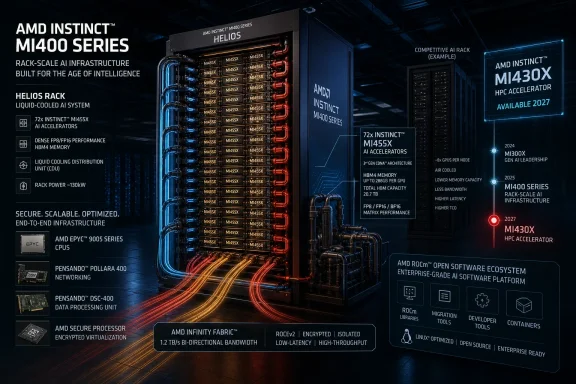
But AMD has packaged the MI455X around Helios rather than treating it as a flexible PCIe accelerator for a conventional enterprise GPU server. The Helios design combines 72 MI455X accelerators, 18 sixth-generation EPYC “Venice” CPUs, Pensando networking, liquid cooling, ROCm software, and AMD’s UALink-over-Ethernet fabric in a double-width Open Rack design.
AMD says a complete Helios rack provides 31TB of HBM4 and up to 2.9 exaflops of peak FP4 performance. Those are rack-level statistics. They describe an installation that requires specialized power, cooling, networking, service procedures, and supply-chain coordination—not a capacity upgrade for an existing Windows Server cluster.
The design does close an important product gap. Nvidia’s recent AI hardware strategy has centered on delivering the GPU, high-speed interconnect, CPU, networking, and rack as one integrated deployment unit. AMD had powerful individual Instinct accelerators before, but Helios is the company’s clearest attempt to sell an equivalent system-level building block. That is the competitive shift behind the MI400 announcement.
AMD claims the MI430X will provide up to 288 TFLOPS of hardware-based FP64 vector performance. That specification is substantially more relevant to simulation, computational fluid dynamics, weather modeling, engineering analysis, and other codes that cannot simply trade precision for higher low-bit AI throughput. Data Center Dynamics independently reported the same 288-TFLOPS figure.
The catch is simple: AMD’s current MI400 family page says the MI430X is expected to be available in 2027. Its CDNA 5 architecture page repeats that it is planned for a 2027 release and warns that MI430X products may enable a different set of CDNA 5 features than the MI455X.
That leaves AMD’s July launch carrying two very different commercial timelines. MI455X and Helios are the near-term AI-factory offering; MI430X is a forward-looking HPC roadmap commitment. Research institutions evaluating GPU refresh cycles should not read the MI430X performance claim as a product they can procure this year, and should expect final specifications and platform details to remain subject to change until AMD takes it to market.
That is strategically important, especially for organizations trying to avoid making a long-lived AI platform decision solely around CUDA. Yet open software should not be mistaken for universal operating-system support. AMD’s published MI455X specifications currently list Linux x86 64-bit as the supported operating system.
For the WindowsForum audience, that is the operational detail that cuts through the broader platform messaging: MI400 is not a Windows GPU deployment story. ROCm’s openness may matter to developers, research organizations, and cloud providers building Linux-based AI infrastructure, but AMD has not published Windows support for the MI455X. There is no indication that a Windows Server administrator will be installing these accelerators into an existing Hyper-V or Windows AI stack.
This does not diminish ROCm’s relevance. It means the software claim needs to be measured correctly. Portability between supported Linux deployments, frameworks, compilers, libraries, and standards-based fabrics is useful; it is not the same as workload portability to every operating environment a prospective customer happens to run.
AMD also has work to do beyond the hardware. The company’s performance figures are peak theoretical values and its Helios comparisons refer to an unnamed “leading competitive solution.” Independent technical coverage sees MI455X as AMD’s strongest AI accelerator and rack-scale design yet, but real purchasing decisions will turn on production performance across common frameworks, distributed-training reliability, model support, power efficiency, and the maturity of ROCm tooling under customer workloads.
Still, the announcement is a security feature list, not a deployment guide. AMD has not publicly detailed in this announcement which encryption protocols and algorithms apply to the GPU links, how keys are provisioned and rotated, what attestation interfaces customers receive, whether the protections extend beyond rack-scale traffic, or how the components integrate with a customer’s existing identity, key-management, and monitoring systems.
Those omissions are not evidence that the protections are inadequate. They are, however, gaps procurement and security teams need closed before treating “encrypted GPU-to-GPU communication” as a fulfilled control. A secure boot chain protects against one category of firmware tampering; it does not replace tenant isolation, host hardening, supply-chain controls, vulnerability response, or a documented attestation workflow.
The security positioning has a second implication. By putting these functions into a standardized rack-scale platform, AMD is trying to make Helios more palatable for sovereign AI and large institutional deployments where operational control matters alongside performance. But the company’s current public framing still splits the actual products: MI455X and Helios are the frontline commercial offer, while the MI430X’s sovereign AI and HPC role is scheduled for 2027.
The immediate limitation is availability and scope. AMD has not announced public MI455X pricing, a broad OEM availability list, or a detailed calendar for customer deliveries. Reuters’ report that Helios systems will ship in the coming months is more concrete than AMD’s launch language, but it still does not tell enterprises when they can receive, deploy, and validate a production rack. The MI430X, meanwhile, is a 2027 product.
For Windows administrators and PC enthusiasts, there is no upgrade path here: no retail card, no Windows support, and no local workstation use case. For cloud, AI, and HPC operators, MI400 is consequential precisely because AMD is now offering a rack-scale platform with credible memory and interconnect specifications. The first practical milestone will be Helios deliveries and independently reproducible ROCm performance—not the July 23 launch date AMD and subsequent coverage have already placed in the rear-view mirror.
For IT teams watching AMD as an alternative to Nvidia’s AI infrastructure, the meaningful development is that AMD now has a defined rack-scale answer to Nvidia’s 72-GPU NVL systems. The less glamorous reality is that the biggest numbers AMD is advertising depend on buying into that tightly integrated Helios platform—and its availability, final system configurations, pricing, and cloud access schedule remain largely undisclosed.
 MI455X is a Helios component first
The MI455X is AMD’s frontier AI part, intended for high-volume inference, large-model training, and fine-tuning. It uses AMD’s fifth-generation CDNA architecture and carries 432GB of HBM4 memory with up to 23.3TB/s of bandwidth per GPU. AMD rates it at 40.3 petaflops for MXFP4 operations, a low-precision format meant for AI work rather than conventional scientific double-precision computing.Those figures are material because AI clusters increasingly run into memory capacity and data-movement limits before they exhaust nominal compute throughput. A single MI455X has 50% more memory than the 288GB MI355X, and AMD lists nearly three times the peak memory bandwidth. Tom’s Hardware’s technical breakdown confirms the 432GB capacity is delivered through 12 HBM4 stacks, while Data Center Dynamics reports the 23.3TB/s figure and the chip’s 3.6TB/s scale-up connectivity.
But AMD has packaged the MI455X around Helios rather than treating it as a flexible PCIe accelerator for a conventional enterprise GPU server. The Helios design combines 72 MI455X accelerators, 18 sixth-generation EPYC “Venice” CPUs, Pensando networking, liquid cooling, ROCm software, and AMD’s UALink-over-Ethernet fabric in a double-width Open Rack design.
AMD says a complete Helios rack provides 31TB of HBM4 and up to 2.9 exaflops of peak FP4 performance. Those are rack-level statistics. They describe an installation that requires specialized power, cooling, networking, service procedures, and supply-chain coordination—not a capacity upgrade for an existing Windows Server cluster.
The design does close an important product gap. Nvidia’s recent AI hardware strategy has centered on delivering the GPU, high-speed interconnect, CPU, networking, and rack as one integrated deployment unit. AMD had powerful individual Instinct accelerators before, but Helios is the company’s clearest attempt to sell an equivalent system-level building block. That is the competitive shift behind the MI400 announcement.
The MI430X is the HPC story—but it is not available yet
AMD is dividing the MI400 series into two distinct roles. The MI455X focuses on frontier AI in Helios, while the MI430X targets sovereign AI, national research facilities, and high-performance computing workloads where hardware FP64 performance matters.AMD claims the MI430X will provide up to 288 TFLOPS of hardware-based FP64 vector performance. That specification is substantially more relevant to simulation, computational fluid dynamics, weather modeling, engineering analysis, and other codes that cannot simply trade precision for higher low-bit AI throughput. Data Center Dynamics independently reported the same 288-TFLOPS figure.
The catch is simple: AMD’s current MI400 family page says the MI430X is expected to be available in 2027. Its CDNA 5 architecture page repeats that it is planned for a 2027 release and warns that MI430X products may enable a different set of CDNA 5 features than the MI455X.
That leaves AMD’s July launch carrying two very different commercial timelines. MI455X and Helios are the near-term AI-factory offering; MI430X is a forward-looking HPC roadmap commitment. Research institutions evaluating GPU refresh cycles should not read the MI430X performance claim as a product they can procure this year, and should expect final specifications and platform details to remain subject to change until AMD takes it to market.
“Open ROCm” does not mean Windows support
AMD’s pitch centers on ROCm, its open software stack comprising programming models, compilers, runtimes, libraries, and deployment tools. AMD argues that an open foundation offers customers portability across systems, network choices, and software environments, reducing dependence on a single vendor’s proprietary stack.That is strategically important, especially for organizations trying to avoid making a long-lived AI platform decision solely around CUDA. Yet open software should not be mistaken for universal operating-system support. AMD’s published MI455X specifications currently list Linux x86 64-bit as the supported operating system.
For the WindowsForum audience, that is the operational detail that cuts through the broader platform messaging: MI400 is not a Windows GPU deployment story. ROCm’s openness may matter to developers, research organizations, and cloud providers building Linux-based AI infrastructure, but AMD has not published Windows support for the MI455X. There is no indication that a Windows Server administrator will be installing these accelerators into an existing Hyper-V or Windows AI stack.
This does not diminish ROCm’s relevance. It means the software claim needs to be measured correctly. Portability between supported Linux deployments, frameworks, compilers, libraries, and standards-based fabrics is useful; it is not the same as workload portability to every operating environment a prospective customer happens to run.
AMD also has work to do beyond the hardware. The company’s performance figures are peak theoretical values and its Helios comparisons refer to an unnamed “leading competitive solution.” Independent technical coverage sees MI455X as AMD’s strongest AI accelerator and rack-scale design yet, but real purchasing decisions will turn on production performance across common frameworks, distributed-training reliability, model support, power efficiency, and the maturity of ROCm tooling under customer workloads.
Security claims need implementation details before they become procurement requirements
AMD says MI400 supports secure boot, encrypted GPU-to-GPU links, and hardware-based protections. For AI clusters processing proprietary models, regulated data, government workloads, or research datasets, encrypted fabric traffic and authenticated firmware are meaningful capabilities. GPU-to-GPU traffic carries inputs, weights, activations, checkpoints, and collective-operation data that operators may not want exposed within a rack or cluster.Still, the announcement is a security feature list, not a deployment guide. AMD has not publicly detailed in this announcement which encryption protocols and algorithms apply to the GPU links, how keys are provisioned and rotated, what attestation interfaces customers receive, whether the protections extend beyond rack-scale traffic, or how the components integrate with a customer’s existing identity, key-management, and monitoring systems.
Those omissions are not evidence that the protections are inadequate. They are, however, gaps procurement and security teams need closed before treating “encrypted GPU-to-GPU communication” as a fulfilled control. A secure boot chain protects against one category of firmware tampering; it does not replace tenant isolation, host hardening, supply-chain controls, vulnerability response, or a documented attestation workflow.
The security positioning has a second implication. By putting these functions into a standardized rack-scale platform, AMD is trying to make Helios more palatable for sovereign AI and large institutional deployments where operational control matters alongside performance. But the company’s current public framing still splits the actual products: MI455X and Helios are the frontline commercial offer, while the MI430X’s sovereign AI and HPC role is scheduled for 2027.
What AMD has actually put on the market
The MI400 family should be read as AMD moving from selling accelerators to selling an integrated AI rack. Helios offers a 72-GPU coherent domain, HBM4 capacity measured in tens of terabytes per rack, and a fabric strategy based on UALink over Ethernet and standards-based Ethernet for scale-out. AMD is betting that customers want an Nvidia-class deployment unit without surrendering software and networking choices to a proprietary stack.The immediate limitation is availability and scope. AMD has not announced public MI455X pricing, a broad OEM availability list, or a detailed calendar for customer deliveries. Reuters’ report that Helios systems will ship in the coming months is more concrete than AMD’s launch language, but it still does not tell enterprises when they can receive, deploy, and validate a production rack. The MI430X, meanwhile, is a 2027 product.
For Windows administrators and PC enthusiasts, there is no upgrade path here: no retail card, no Windows support, and no local workstation use case. For cloud, AI, and HPC operators, MI400 is consequential precisely because AMD is now offering a rack-scale platform with credible memory and interconnect specifications. The first practical milestone will be Helios deliveries and independently reproducible ROCm performance—not the July 23 launch date AMD and subsequent coverage have already placed in the rear-view mirror.
References
- Primary source: Daily Tribune
Published: 2026-08-04T17:58:16.670000+00:00
AMD unveils MI400 GPUs | Daily Tribune
AMD introduced its Instinct MI400 Series GPUs, delivering next-generation AI and high-performance computing capabilities with HBM4 memory, advanced security features, and the open ROCm platform for scalable data center deployments.tribune.net.ph - Related coverage: amd.com
AMD Instinct™ MI400 Series GPUs
AMD Instinct™ MI400 Series GPUs, built on AMD CDNA™ 5 architecture, are designed to accelerate frontier AI, data center, Sovereign AI and HPC workloads.www.amd.com - Related coverage: amd.com
AMD Instinct™ MI455X GPUs
Built on 5th Gen AMD CDNA™ architecture, the AMD Instinct™ MI455X GPU is designed specifically for the AMD Helios rackscale solution offering leadership performance and modern capability for inference, training, and fine-tuning.www.amd.com - Related coverage: datacenterdynamics.com
AMD launches Instinct MI400 Series GPUs for AI workloads - DCD
Targets both frontier AI and supercomputingwww.datacenterdynamics.com - Related coverage: tomshardware.com
AMD takes the wraps off its Instinct MI455X AI accelerator — CDNA 5 and Helios rack-scale architecture combine to take the fight to Nvidia in the data center | Tom's Hardware
Massive performance gains, higher memory capacity, and a large scale-up domain make for AMD’s strongest AI chip yetwww.tomshardware.com - Related coverage: itpro.com
AMD Advancing AI 2026: Helios on the rise, with launch of new Instinct GPUs | IT Pro
The rack-scale architecture announced in 2025 is finally rolling off the production linewww.itpro.com - Related coverage: datacenterdynamics.com
AMD officially launches Helios rackscale system, with MI455X GPUs, Venice Epyc CPUs, and Pensando - DCD
Following ZT acquisition, company looks to compete with Nvidia's system-level approachwww.datacenterdynamics.com - Related coverage: daily.semidoped.com