
AMD’s Ryzen AI Halo is now a $3,999.99, Micro Center–exclusive mini PC built around the Ryzen AI Max+ 395 and 128GB of soldered unified memory, and its significance lies less in new silicon than in AMD taking ownership of the developer experience. Camera Jabber correctly identifies it as a compelling local-AI machine for creators, but AMD’s own material makes the sharper point: Halo is a reference platform with a curated software image, support path, rollback mechanism, and a direct line into AMD’s ROCm stack.
That distinction is essential for Windows users weighing the box against a Framework Desktop or another Ryzen AI Max+ 395 system. The CPU, Radeon 8060S integrated GPU, memory capacity and 120W power envelope are familiar Strix Halo ingredients. What AMD is selling at a premium is a controlled deployment target for local models and agent software, with Windows 11 Pro or Linux available from Micro Center as two separate SKUs.
AMD first announced Ryzen AI Halo at CES on January 5, 2026, projected a second-quarter introduction, and said Micro Center would be the first global launch partner. AMD confirmed availability on July 6. Micro Center’s current listing puts both the Linux and Windows 11 Pro editions at $3,999.99 and limits purchase to in-store pickup, which means this is neither a broadly distributed consumer mini PC nor a normal component platform.
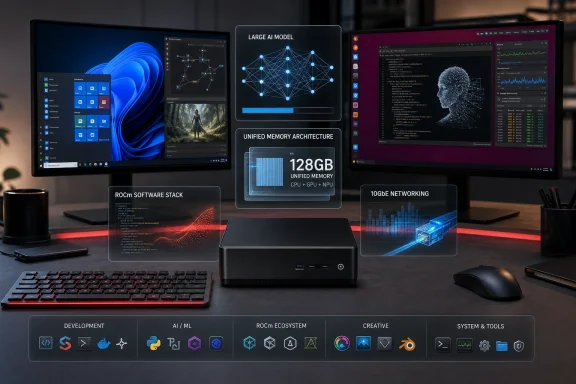
The Halo specification is substantial: 16 Zen 5 CPU cores and 32 threads, 40 RDNA 3.5 compute units in the Radeon 8060S, a 50-TOPS XDNA 2 NPU, 128GB of LPDDR5X-8000 unified memory, 2TB of M.2 storage, 10GbE, Wi-Fi 7, Bluetooth 5.4 and a 150mm-square chassis that is 45.4mm tall. AMD rates the system at 120W TDP and lists three USB-C ports plus a fourth USB-C power input and HDMI 2.1b.
The 128GB memory pool is the real purchase criterion. AMD’s Developer Center permits a user to allocate a large share of system memory to the integrated GPU; AMD’s own example shows approximately 94GB available to graphics from 125.5GB usable memory. That is why the platform can load quantized models that will not fit into the 16GB or 24GB VRAM of many conventional workstation graphics cards.
AMD says the system can run models with up to 200 billion parameters locally. Treat that as a capacity claim rather than a performance promise. Whether a model is useful on the machine depends on quantization, context length, inference framework, model architecture and the acceptable tokens-per-second rate. A model that fits in memory may still be too slow for interactive use, particularly once context windows grow.
Independent testing context supports the need for that caution. Tom’s Hardware, comparing local-AI platforms in 2026, found that memory bandwidth and software stack choices can matter as much as raw memory capacity. The Radeon 8060S has 256GB/s of memory bandwidth; that is enough to make 128GB unified-memory systems valuable for model fitting, but it is a different class of machine from a discrete accelerator with much wider high-bandwidth memory.
But AMD’s own July 6 developer-platform post calls the curated Ryzen AI developer platform a “Linux based solution.” The out-of-box environment AMD describes is a modified Debian-based system with preloaded models and software, playbooks, ROCm, PyTorch, ComfyUI, vLLM, Lemonade and Visual Studio Code. The Register, which tested a Linux review unit, likewise reported a Debian-derived installation with ROCm 7.13 and preinstalled AI applications and frameworks.
AMD’s ROCm 7.14 announcement is even more specific: the complete ROCm developer toolchain has production Linux support on the Ryzen AI Halo developer workstation, while Windows support is available for Radeon and Ryzen AI Max hardware. That wording does not mean Windows is unsuitable. It means the most curated, validated and recoverable Halo experience is centered on Linux.
For IT departments and Windows-first creative shops, this produces a practical split:
ServeTheHome characterized the $3,999 Halo as a local-AI developer system in a DGX Spark-like form factor, with 128GB of memory and AMD’s pledge of a top-tier developer experience. That is the honest framing. It includes an unusually compact one-liter-ish chassis, 10GbE networking, a 2TB self-encrypting M.2 SSD, both operating-system choices and a vendor-owned image. It does not include socketed memory, a discrete GPU upgrade path, PCIe expansion, or hardware that fundamentally outruns other fully configured Max+ 395 systems.
The memory is soldered, a limitation Camera Jabber notes but does not fully reckon with. Buyers get a fixed 128GB ceiling for the life of the unit. The M.2 SSD can be serviced or replaced; the component that makes the box valuable for local AI cannot. This is an appliance-style workstation, not a modular workstation.
The 10GbE port is useful for moving datasets, checkpoints and media assets across a fast NAS, particularly for studios already using shared storage. It should not be mistaken for a cluster fabric. Nvidia’s DGX Spark has been marketed with much faster networking options for scale-out work, while Halo provides a single 10GbE interface. Halo is positioned for one capable local node, not a turnkey multi-node training rig.
Photopea runs in a browser and is not evidence of Ryzen AI Halo-specific acceleration. Affinity Photo can use GPU acceleration, but Camera Jabber provides no benchmark showing the Radeon 8060S surpassing competing systems in a defined retouching workflow. Adobe Premiere Pro includes AI-assisted functions such as Enhance Speech and scene edit detection, but the publication does not establish which portions of those workflows run locally on Halo’s NPU, which use the GPU, which depend on Adobe services, or how they perform under Windows 11 Pro on this device.
For a creator who needs an editing workstation first and an AI lab second, those unanswered questions are costly. AMD’s 8060S can provide strong integrated graphics performance and the 16-core CPU has enough general-purpose compute for serious media work. Yet the Halo’s economic case rests on running local AI models that need unusually large shared memory—not on browser editing or the existence of a Premiere feature list.
AMD has also announced that the Ryzen AI Max+ PRO 495, expected in the third quarter of 2026, will raise memory support to 192GB. That makes Halo’s fixed 128GB configuration harder to treat as a long-lived maximum-memory investment. AMD has not announced a Halo refresh using that processor, a price, or whether existing Halo customers will have an upgrade path. Given the soldered memory, they should assume they will not.
It is a poor fit for buyers who simply want the cheapest way to obtain a Ryzen AI Max+ 395 with 128GB, who expect a conventional workstation upgrade path, or who need predictable best-in-class performance for Adobe and Affinity workloads. Those users should compare actual current prices, storage, networking, support terms and independent application benchmarks across existing Max+ 395 machines before accepting Halo’s premium.
AMD has delivered something more credible than a speculative “AI PC”: a real, shipping small-form-factor system with a defined local-AI purpose and official software maintenance mechanisms. But its value is the reference platform and its validated stack, not a breakthrough in the Max+ 395 hardware. Buyers choosing Windows should make that decision with clear eyes: the Windows SKU is supported, while the fullest Halo developer experience AMD has described and independently demonstrated remains rooted in Linux.
AMD first announced Ryzen AI Halo at CES on January 5, 2026, projected a second-quarter introduction, and said Micro Center would be the first global launch partner. AMD confirmed availability on July 6. Micro Center’s current listing puts both the Linux and Windows 11 Pro editions at $3,999.99 and limits purchase to in-store pickup, which means this is neither a broadly distributed consumer mini PC nor a normal component platform.
 The Hardware Is Proven; the Reference Image Is the Product
The Halo specification is substantial: 16 Zen 5 CPU cores and 32 threads, 40 RDNA 3.5 compute units in the Radeon 8060S, a 50-TOPS XDNA 2 NPU, 128GB of LPDDR5X-8000 unified memory, 2TB of M.2 storage, 10GbE, Wi-Fi 7, Bluetooth 5.4 and a 150mm-square chassis that is 45.4mm tall. AMD rates the system at 120W TDP and lists three USB-C ports plus a fourth USB-C power input and HDMI 2.1b.The 128GB memory pool is the real purchase criterion. AMD’s Developer Center permits a user to allocate a large share of system memory to the integrated GPU; AMD’s own example shows approximately 94GB available to graphics from 125.5GB usable memory. That is why the platform can load quantized models that will not fit into the 16GB or 24GB VRAM of many conventional workstation graphics cards.
AMD says the system can run models with up to 200 billion parameters locally. Treat that as a capacity claim rather than a performance promise. Whether a model is useful on the machine depends on quantization, context length, inference framework, model architecture and the acceptable tokens-per-second rate. A model that fits in memory may still be too slow for interactive use, particularly once context windows grow.
Independent testing context supports the need for that caution. Tom’s Hardware, comparing local-AI platforms in 2026, found that memory bandwidth and software stack choices can matter as much as raw memory capacity. The Radeon 8060S has 256GB/s of memory bandwidth; that is enough to make 128GB unified-memory systems valuable for model fitting, but it is a different class of machine from a discrete accelerator with much wider high-bandwidth memory.
Windows Is Supported, but Linux Gets the First-Class Developer Story
Camera Jabber’s description of “full ROCm support on both Windows and Linux” needs a more precise reading. AMD sells a Windows 11 Pro Halo, and AMD’s ROCm documentation now supports Ryzen AI Max hardware on Windows, including PyTorch paths and WSL support for Strix and Strix Halo. That makes Windows a legitimate operating-system choice for deploying, experimenting with and integrating local AI workloads.But AMD’s own July 6 developer-platform post calls the curated Ryzen AI developer platform a “Linux based solution.” The out-of-box environment AMD describes is a modified Debian-based system with preloaded models and software, playbooks, ROCm, PyTorch, ComfyUI, vLLM, Lemonade and Visual Studio Code. The Register, which tested a Linux review unit, likewise reported a Debian-derived installation with ROCm 7.13 and preinstalled AI applications and frameworks.
AMD’s ROCm 7.14 announcement is even more specific: the complete ROCm developer toolchain has production Linux support on the Ryzen AI Halo developer workstation, while Windows support is available for Radeon and Ryzen AI Max hardware. That wording does not mean Windows is unsuitable. It means the most curated, validated and recoverable Halo experience is centered on Linux.
For IT departments and Windows-first creative shops, this produces a practical split:
- The Windows 11 Pro edition makes sense where local inference must connect to Windows-native applications, Windows management, Windows-based automation or existing desktop workflows.
- The Linux edition makes more sense for teams buying Halo specifically to develop ROCm workloads, test open-source model servers, use AMD’s supplied playbooks, and depend on the machine’s factory-image rollback path.
- A Windows buyer should budget time for framework validation rather than assume the Linux preloaded experience transfers feature-for-feature to Windows.
The $4,000 Question Is Software Support, Not Performance per Dollar
The Halo’s price is difficult to defend as a pure hardware purchase. AMD itself used a $2,566 Framework Desktop configuration with the same Ryzen AI Max+ 395, 128GB of memory and equivalent storage in its December 2025 tokens-per-second-per-dollar comparison against Nvidia’s DGX Spark. Since then, LPDDR5X pricing and supply conditions have moved, and current equivalent system prices are less stable, but the comparison still exposes the issue: AMD’s own platform uses the same underlying APU and fixed unified-memory architecture that OEM systems had already brought to market.ServeTheHome characterized the $3,999 Halo as a local-AI developer system in a DGX Spark-like form factor, with 128GB of memory and AMD’s pledge of a top-tier developer experience. That is the honest framing. It includes an unusually compact one-liter-ish chassis, 10GbE networking, a 2TB self-encrypting M.2 SSD, both operating-system choices and a vendor-owned image. It does not include socketed memory, a discrete GPU upgrade path, PCIe expansion, or hardware that fundamentally outruns other fully configured Max+ 395 systems.
The memory is soldered, a limitation Camera Jabber notes but does not fully reckon with. Buyers get a fixed 128GB ceiling for the life of the unit. The M.2 SSD can be serviced or replaced; the component that makes the box valuable for local AI cannot. This is an appliance-style workstation, not a modular workstation.
The 10GbE port is useful for moving datasets, checkpoints and media assets across a fast NAS, particularly for studios already using shared storage. It should not be mistaken for a cluster fabric. Nvidia’s DGX Spark has been marketed with much faster networking options for scale-out work, while Halo provides a single 10GbE interface. Halo is positioned for one capable local node, not a turnkey multi-node training rig.
Creative-App Claims Need More Evidence Than the Spec Sheet Provides
Camera Jabber’s practical suggestions—Photopea for browser-based edits, Affinity Photo for Vulkan acceleration and Premiere Pro’s AI features—are reasonable examples of software a creative may use around the device. They do not demonstrate that Halo is uniquely effective for those applications.Photopea runs in a browser and is not evidence of Ryzen AI Halo-specific acceleration. Affinity Photo can use GPU acceleration, but Camera Jabber provides no benchmark showing the Radeon 8060S surpassing competing systems in a defined retouching workflow. Adobe Premiere Pro includes AI-assisted functions such as Enhance Speech and scene edit detection, but the publication does not establish which portions of those workflows run locally on Halo’s NPU, which use the GPU, which depend on Adobe services, or how they perform under Windows 11 Pro on this device.
For a creator who needs an editing workstation first and an AI lab second, those unanswered questions are costly. AMD’s 8060S can provide strong integrated graphics performance and the 16-core CPU has enough general-purpose compute for serious media work. Yet the Halo’s economic case rests on running local AI models that need unusually large shared memory—not on browser editing or the existence of a Premiere feature list.
AMD has also announced that the Ryzen AI Max+ PRO 495, expected in the third quarter of 2026, will raise memory support to 192GB. That makes Halo’s fixed 128GB configuration harder to treat as a long-lived maximum-memory investment. AMD has not announced a Halo refresh using that processor, a price, or whether existing Halo customers will have an upgrade path. Given the soldered memory, they should assume they will not.
Who Should Actually Buy Ryzen AI Halo
The Ryzen AI Halo is a sensible purchase for a developer who needs a compact, vendor-supported AMD target with 128GB of unified memory, wants 10GbE, and values a known-good software image more than expansion or lowest cost. It also suits a Windows organization that needs a physical Windows 11 Pro endpoint for deployment validation while preserving the option to run AMD’s Linux-oriented development environment on a separate unit or partitioned workflow.It is a poor fit for buyers who simply want the cheapest way to obtain a Ryzen AI Max+ 395 with 128GB, who expect a conventional workstation upgrade path, or who need predictable best-in-class performance for Adobe and Affinity workloads. Those users should compare actual current prices, storage, networking, support terms and independent application benchmarks across existing Max+ 395 machines before accepting Halo’s premium.
AMD has delivered something more credible than a speculative “AI PC”: a real, shipping small-form-factor system with a defined local-AI purpose and official software maintenance mechanisms. But its value is the reference platform and its validated stack, not a breakthrough in the Max+ 395 hardware. Buyers choosing Windows should make that decision with clear eyes: the Windows SKU is supported, while the fullest Halo developer experience AMD has described and independently demonstrated remains rooted in Linux.
References
- Primary source: Camera Jabber
Published: 2026-08-04T19:00:00+00:00
Loading…
camerajabber.com - Related coverage: tomshardware.com
Exploring Apple Silicon’s local AI performance with the Mac Studio and M4 Max — M4 Max beats GB10 and Strix Halo in decode throughput, but memory bandwidth isn't everything | Tom's Hardware
Does higher memory bandwidth make for the best local AI platform?www.tomshardware.com - Related coverage: amd.com
AMD Ryzen™ AI Halo Developer Platform with Ryzen™ AI Max+ 395 processor
Build the AI You Want. Your Stack. Your Rules.www.amd.com - Related coverage: amd.com
AMD Ryzen™ AI Halo Now Available at Micro Center
Ryzen AI Halo launches at Micro Center, powering agentic PCs for developers building larger, next-generation local AI applications.www.amd.com - Related coverage: servethehome.com
AMD Ryzen AI Halo Developer System Review AMD Goes for Local AI - ServeTheHome
We test the AMD Ryzen AI Halo developer system and see how AMD is putting its spin on a 128GB local AI dev boxwww.servethehome.com
- Related coverage: rocm.docs.amd.com
Loading…
rocm.docs.amd.com - Related coverage: theregister.com
Loading…
www.theregister.com - Related coverage: techradar.com
AMD’s Ryzen AI Halo enters 2026, taking on Nvidia DGX Spark mini PC with massive local AI performance ambitions | TechRadar
The computer will handle multiple displays and local AI jobs simultaneously with speedwww.techradar.com - Related coverage: tomshardware.com
AMD challenges Nvidia's DGX Spark with $3,999 Ryzen AI Halo with Windows 11 support — Strix Halo desktop undercuts Nvidia by $700, packs 128GB of unified memory | Tom's Hardware
The AI mini PC supports both Linux and Windows 11.www.tomshardware.com